
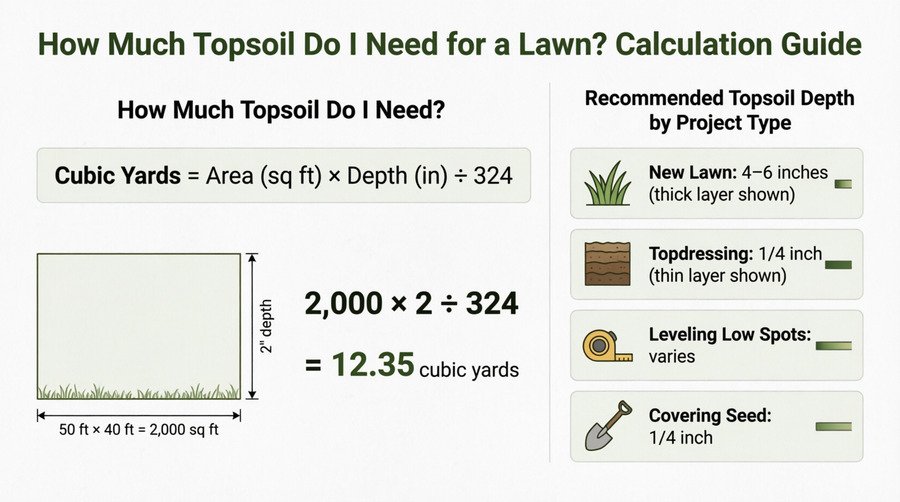
How much topsoil do I need for a lawn? This is one of the most common questions homeowners ask before starting a landscaping project. The exact answer comes down to two main numbers: the total square footage of your yard and the specific depth of soil you plan to add. The basic formula is straightforward: multiply your square footage by the depth in inches, then divide that number by 324 to get your total in cubic yards.
Cubic yards of topsoil = Lawn area (sq ft) × Depth (in) ÷ 324
For instance, if you have a 1,000 sq ft lawn and want to add a 1-inch layer, the math looks like this:
1,000 × 1 ÷ 324 = 3.09 cubic yards.
However, the depth you choose changes drastically based on your actual goal. A brand-new lawn, routine topdressing on established grass, and filling in a sunken low spot all require completely different depths. Picking the wrong depth is the single biggest mistake homeowners make when ordering soil.
Depth Guidelines Based on Your Project
| Project Type | Recommended Depth |
|---|---|
| New lawn (seed or sod on bare/graded earth) | 4 to 6 inches |
| Topdressing an established lawn | ~1/4 inch (1/2 inch absolute max) |
| Leveling low spots | Varies; use the average depth of the depression |
| Covering grass seed (after overseeding) | ~1/4 inch |
Most online calculators skip this crucial step, yet it’s the deciding factor in whether your final order is actually useful.
New Lawns Need a Real Root Zone
A new lawn requires a substantial foundation, not just a cosmetic dusting. University agricultural extensions consistently recommend a minimum of 4 to 6 inches of quality topsoil for new lawns. Crucially, take this measurement after the soil has firmed and settled, not while it’s still loose and fluffy. This isn’t an arbitrary rule; healthy grass roots naturally extend several inches downward. A shallow layer over hard, compacted subsoil traps roots, leading to a lawn that quickly scorches and struggles during summer heat.
That being said, you don’t automatically need to buy 4 to 6 inches of new topsoil for every project. If your native soil is already well-draining, reasonably fertile, and hasn’t been heavily compacted by construction equipment, improving what you have might be enough. A simple soil test is the most reliable way to determine your starting point.
Established Lawns Require a Light Touch
Topdressing is purely a maintenance task, not a way to build a new soil profile. Applying soil at “new lawn” depths over existing grass will smother it. Turf experts generally recommend applying no more than 1/4 inch of topdressing, with 1/2 inch being the absolute upper limit. Anything thicker buries the grass crowns, blocking essential sunlight and air circulation.
Leveling Low Spots is a Custom Calculation
Don’t assume the entire yard needs the same treatment. Measure the specific depressed areas. Use the average depth of the dip rather than its deepest point, since most depressions gradually slope up toward the edges.
How Much Topsoil Do I Need for a Lawn? (Step-by-Step Calculation)
Step 1: Measure your lawn.
For a standard rectangle, just multiply length by width.
Example: 50 ft × 40 ft = 2,000 sq ft.
Step 2: Select your project depth using the guidelines above.
Step 3: Run the cubic yards formula.
Cubic yards = Square feet × Depth (in inches) ÷ 324
Example: For 2,000 sq ft at a 2-inch depth:
2,000 × 2 ÷ 324 = 12.35 cubic yards.
Step 4: Decide on your final order quantity.
The calculated number is a theoretical volume, not necessarily your final purchase order. Whether you round up depends on your measurement confidence and whether your target depth is “loose” or “firmed.” Avoid the bad habit of blindly adding 10% or 15% to every order. Instead, ask your supplier if their quoted volume is based on loose or compacted material, as this dictates how much settling will occur. Once you have your final volume figured out, you can easily estimate your total budget by checking current market rates for how much a yard of dirt costs in your specific area.
Where Does the “324” Come From?
It’s simple geometry. One cubic yard equals 27 cubic feet. Since there are 12 inches in a foot, you multiply those together:
27 × 12 = 324.
Dividing by 324 is just a shortcut to convert square feet and inches directly into cubic yards. If you prefer, you can do it in three steps: convert your depth to feet (inches ÷ 12), multiply by the area to get cubic feet, and then divide by 27. Both methods yield the same result. If you are trying to figure out your coverage area instead of volume, our guide on how many square feet a cubic yard covers breaks down the math for different depths.
Topsoil Volume Reference Chart
Note: These are calculated volumes. Always verify with your supplier before ordering, as delivery conditions and selling increments can cause slight adjustments.
| Lawn Area | 1/4″ Depth | 1/2″ Depth | 1″ Depth | 2″ Depth | 4″ Depth | 6″ Depth |
|---|---|---|---|---|---|---|
| 500 sq ft | 0.39 yd³ | 0.77 yd³ | 1.54 yd³ | 3.09 yd³ | 6.17 yd³ | 9.26 yd³ |
| 1,000 sq ft | 0.77 yd³ | 1.54 yd³ | 3.09 yd³ | 6.17 yd³ | 12.35 yd³ | 18.52 yd³ |
| 1,500 sq ft | 1.16 yd³ | 2.31 yd³ | 4.63 yd³ | 9.26 yd³ | 18.52 yd³ | 27.78 yd³ |
| 2,000 sq ft | 1.54 yd³ | 3.09 yd³ | 6.17 yd³ | 12.35 yd³ | 24.69 yd³ | 37.04 yd³ |
| 5,000 sq ft | 3.86 yd³ | 7.72 yd³ | 15.43 yd³ | 30.86 yd³ | 61.73 yd³ | 92.59 yd³ |
Notice the massive difference: a typical quarter-acre new lawn (~2,000 sq ft) at a 4-inch depth requires about 24.69 cubic yards. Topdressing that same lawn at 1/4 inch requires less than 2 cubic yards. This gap perfectly illustrates why identifying your project type is more important than the math itself.
Measuring Irregularly Shaped Lawns
Very few yards are perfect rectangles. Break your yard into manageable geometric shapes:
- Rectangle/Square: Length × Width
- Triangle: (Length × Width) ÷ 2
- Circle: π × radius² (use half the diameter for the radius)
Calculate the area of each section individually, then add them together. For large or highly irregular properties, a measuring wheel or digital mapping tool will provide far better accuracy than pacing it out.
How Many Bags of Topsoil Do You Need?
Bagged soil volumes vary by manufacturer. Always check the label instead of guessing (common sizes are 0.75, 1, or 1.5 cubic feet).
Formula: Number of bags = (Cubic yards needed × 27) ÷ Bag volume in cubic feet.
Example: If you need 1 cubic yard and your bags hold 1 cubic foot each, you need 27 bags. Always round up to the next full bag.
For anything larger than a minor patch job, bulk delivery is almost always more practical and cheaper per cubic yard. Bags are really only convenient for small topdressing jobs or filling isolated holes.
Cubic Yards vs. Tons
Volume and weight are entirely different metrics. You cannot automatically convert a supplier’s cubic yard price to tons without knowing the material’s specific density. Topsoil weight fluctuates based on moisture content, organic matter, texture, and compaction. To understand delivery limits or trailer capacities, it helps to know exactly how much a yard of dirt weighs under different conditions. If a supplier states their product weighs, for example, 1.2 tons per cubic yard, multiply your total cubic yards by that number. Never rely on a generic internet average.
Should You Remove the Grass First?
It entirely depends on the volume of soil you are adding:
- Thin topdressing (~1/4 inch): Leave the grass. Work the material gently into the surface.
- Minor leveling: Usually doesn’t require turf removal, provided the layer remains thin enough to avoid smothering.
- Major grade changes: Burying grass under several inches of soil won’t fix underlying drainage issues and will likely suffocate the old lawn, creating a messy, uneven surface later.
- Full renovation: Yes, remove existing grass and weeds. You are building a new root zone from scratch.
The core question isn’t “should I remove grass?” It’s “how much soil am I adding, and what does the final grade need to achieve?”
Should You Mix Topsoil With Existing Soil?
When preparing a new lawn, tilling some of the new topsoil into the native layer beneath it prevents a sharp, restrictive boundary between two different soil types—a leading cause of long-term drainage failure. For topdressing established lawns, the thin layer is usually worked into the surface via light raking or core aeration, rather than left sitting as a distinct crust. In both scenarios, a soil test is your best tool to determine if you actually need better drainage, pH adjustment, or more organic matter.
Topsoil vs. Garden Soil
“Topsoil” is not a strictly regulated term. Its texture, organic content, and screening quality (removal of rocks/debris) can vary wildly between suppliers. Garden soil, conversely, is formulated for in-ground planting beds and is often heavier and more nutrient-dense than what a lawn requires. For turf projects, focus on the material’s actual composition, drainage profile, and whether it has been screened, rather than just the label on the pile.
Accounting for Settling
Freshly spread soil will settle once it is watered and walked on. The depth you see immediately after delivery is not the depth you will have a month later. The rate of settling depends on moisture, compaction, and the soil blend. This is why blanket rules like “always add 15% extra” are flawed. What truly matters is clarifying with your supplier whether the depth recommendation you are following (like the 4-to-6-inch rule) refers to loose soil or settled soil.
Pre-Order Checklist
- Measure the lawn area accurately, breaking odd shapes into simpler geometric sections.
- Choose the depth that matches your specific project (new lawn, topdressing, or leveling), not a generic guess.
- Calculate using the formula: Area × Depth ÷ 324.
- Ask the supplier about the soil’s composition, screening status, and whether their volume quote is for loose or settled material.
- Verify delivery access. Truck sizes and dump locations vary, and not every driveway can handle a heavy delivery truck.
Frequently Asked Questions
How much topsoil do I need for grass seed?
It depends on the context. If you are building a new root zone from scratch, plan for 4 to 6 inches. If you are just covering seed after overseeding an existing lawn, a light 1/4-inch layer is all you need.
How thick should topsoil be for a lawn?
For a brand-new lawn, 4 to 6 inches of firmed, settled topsoil is the standard recommendation. For topdressing existing grass, stick to about 1/4 inch to avoid smothering the turf.
Can grass grow through a layer of topsoil?
Thin layers (like a 1/4-inch topdressing) are perfectly fine for established grass. However, a thick layer intended for new lawn establishment is designed for bare soil, not for spreading over living grass.
Is it cheaper to buy topsoil in bulk or in bags?
For larger areas, bulk topsoil sold by the cubic yard is almost always more cost-effective than buying dozens of bags. Bags only make financial sense for small patch jobs or very minor topdressing.
Does 1 cubic yard of topsoil weigh 1 ton?
Not necessarily. Soil weight fluctuates based on moisture, texture, and compaction. There is no universal weight. Always ask your supplier for the specific tons-per-cubic-yard figure for their exact product.
How much topsoil do I need to level my lawn?
Measure the low areas independently. Use the average depth required to bring each depression level with the surrounding grade, rather than applying the deepest point’s measurement across the whole yard. Keep in mind that topsoil alone may not fix severe underlying drainage problems.
Should I mix topsoil with grass seed before spreading?
No. For overseeding, it is best to spread the seed first, then lightly cover it with a thin layer of soil. Even seed-to-soil contact is far more critical than physically blending the two.
The Bottom Line
The math itself—area times depth divided by 324—is the easy part. The real challenge, and the factor that determines whether your order is successful, is choosing the correct depth for your specific goal: several inches for a new foundation, a light dusting for maintenance, or a measured average for spot leveling. Get the depth right first, and the math will naturally follow. If you prefer to skip the manual calculations, you can plug your exact measurements into TheCalcYard’s topsoil calculator to get your cubic yard total instantly and accurately.
3 thoughts on “How Much Topsoil Do I Need for a Lawn? (Complete Calculation Guide by Project)”