
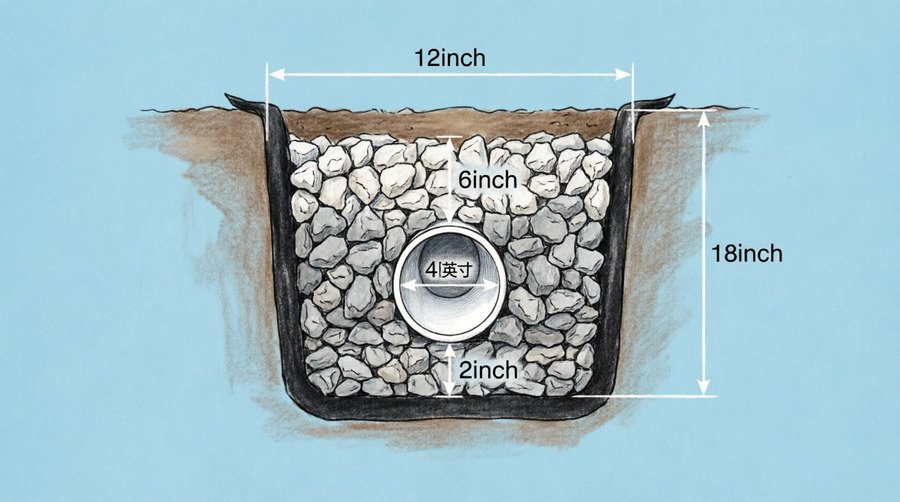
How much gravel for french drain projects require depends on your specific trench dimensions, but a standard 12-inch-wide, 18-inch-deep residential installation typically needs roughly 1 cubic yard for every 20 linear feet. That puts a 50-foot run at about 2.75 cubic yards and a 100-foot run at about 5.5 cubic yards, before you add anything for waste.
Those numbers only work for that one trench size, though. Your trench is almost certainly different, and the only way to get a number you can actually order against is to run your own measurements through this formula:
Cubic yards of gravel = Length (ft) × Width (ft) × Gravel depth (in) ÷ 324
What follows is where that 324 comes from, how to measure the trench without fooling yourself, worked examples for 50-foot and 100-foot drains, which gravel size actually drains, and the mistakes that make homeowners order twice.
How Much Gravel for French Drain: Key Variables
There’s no single number that fits every French drain. Five variables drive the total, and they’re all project-specific:
- Trench length — the full run, turns included.
- Trench width — how wide you actually dig, not the pipe’s outside diameter.
- Gravel-filled depth — which isn’t always the full trench depth. Plenty of installs cap the gravel a few inches below grade and finish with topsoil or sod.
- Pipe diameter — the pipe eats space the gravel would otherwise fill.
- Pipe position — how much gravel sits below, beside, and above the pipe. This doesn’t change the total volume much, but it changes how you think about the install.
Volume comes first. Cubic feet, then cubic yards. Tons are a secondary conversion that depends on the specific stone’s density, so do yourself a favor and resist the urge to jump straight to “how many tons” before you know your trench dimensions.
The French Drain Gravel Calculator Formula
Gravel (cubic yards) = Length × Width × Gravel depth (in) ÷ 324
Length and width in feet. Gravel depth in inches. The 324 is just two conversions glued together: 12 inches per foot, 27 cubic feet per cubic yard. Multiply them and you get 324.
If you’d rather keep everything in feet, the equivalent is:
Cubic yards = Length (ft) × Width (ft) × Depth (ft) ÷ 27
Same answer either way. Use whichever units are easier to measure with, then plug the numbers into TheCalcYard’s gravel calculator and skip the manual math.
Should you subtract the pipe?
For a rough purchase estimate, a lot of contractors just use the full rectangular trench volume and round up. If you want a tighter number, subtract what the pipe displaces:
Net gravel volume = Trench volume − Pipe volume
Pipe volume = π × radius² × length
A standard 4-inch perforated pipe (radius 2 inches, or 1⁄6 foot) displaces about 0.087 cubic feet per linear foot. Over 100 feet, that’s roughly 0.32 cubic yards. In a typical 12-inch-wide trench, it’s a small correction, but a real one. Worth including when you’re ordering bulk stone by the yard from a quarry. Safe to skip if you’re buying bagged stone and rounding up anyway.
How to Calculate Gravel for a French Drain, Step by Step
Step 1 — Measure the trench length. Run a tape along the entire planned path, corners and all, and write it down in feet.
Step 2 — Measure the trench width. The actual excavated width, not the pipe’s outside diameter. Feet.
Step 3 — Determine the gravel-filled depth. Don’t assume the whole trench depth is gravel. Some installs set the pipe near the top and finish the upper several inches with topsoil or sod. Measure only the portion that will actually hold stone, and record it in inches.
Step 4 — Calculate cubic feet. Length × Width × Depth. If your depth is in inches, convert it to feet first (divide by 12).
Step 5 — Convert to cubic yards. Cubic feet ÷ 27. Or just use the combined formula: Length × Width × Depth (in) ÷ 324.
Step 6 — Subtract the pipe volume, if you want precision. For a 4-inch pipe, that’s roughly 0.32 cubic yards per 100 feet. You can skip this on shorter runs or bagged-stone jobs where you’re already rounding up.
Step 7 — Add a purchase allowance. Real trenches aren’t perfect rectangles. Walls settle unevenly. The bottom isn’t flat. Stone gets lost in handling. A 5 to 10 percent buffer is common practice, treat it as insurance, not a rule.
How Much Gravel for a 50-Foot French Drain?
Here’s a fully worked example. Change any of the assumptions and the answer moves with it.
Example assumptions:
- Length: 50 ft
- Trench width: 12 in (1 ft)
- Gravel-filled depth: 18 in (1.5 ft)
- Pipe: 4-inch perforated pipe, centered
Trench volume: 50 × 1 × 1.5 = 75 cubic feet = 2.78 cubic yards
Pipe displacement (50 ft): 50 × 0.087 ≈ 4.36 cubic feet ≈ 0.16 cubic yards
Net gravel volume: 75 − 4.36 = 70.6 cubic feet ≈ 2.62 cubic yards
With a 5 percent purchase allowance: roughly 2.75 cubic yards of clean drainage stone.
At a typical density of 1.35 to 1.5 tons per cubic yard for clean 3⁄4-inch stone, that’s approximately 3.7 to 4.1 tons.
How Much Gravel for a 100-Foot French Drain?
Same trench dimensions, double the length:
Trench volume: 100 × 1 × 1.5 = 150 cubic feet = 5.56 cubic yards
Pipe displacement (100 ft): 100 × 0.087 ≈ 8.73 cubic feet ≈ 0.32 cubic yards
Net gravel volume: 150 − 8.73 = 141.3 cubic feet ≈ 5.23 cubic yards
With a 5 percent allowance: plan for about 5.5 cubic yards, or roughly 7.4 to 8.3 tons at 1.35 to 1.5 tons per cubic yard.
Double the length, roughly double the gravel, as long as width and depth stay put. That linear relationship is what makes the formula useful for runs of any length.
What if the trench is deeper?
Take that same 100-foot trench and dig it 24 inches deep instead of 18: 100 × 1 × 2 = 200 cubic feet = 7.41 cubic yards gross, before the pipe comes out. That’s nearly 2 cubic yards more than the 18-inch example. Gravel depth is the variable that moves the total fastest.
French Drain Gravel Quantity Reference Chart
Approximate gross trench volume (pipe not subtracted) for a trench 12 inches wide and 18 inches deep. Use it as a starting reference. Your actual trench will almost certainly differ, and TheCalcYard’s calculator will give you an exact figure for your own measurements.
| French Drain Length | Trench Width | Trench Depth | Approx. Volume | Approx. Cubic Yards |
|---|---|---|---|---|
| 25 ft | 12 in | 18 in | 37.5 cu ft | 1.39 |
| 50 ft | 12 in | 18 in | 75.0 cu ft | 2.78 |
| 75 ft | 12 in | 18 in | 112.5 cu ft | 4.17 |
| 100 ft | 12 in | 18 in | 150.0 cu ft | 5.56 |
Pipe displacement not subtracted. For a 4-inch pipe, subtract roughly 0.087 cubic feet per linear foot, or about 0.16 cubic yards per 50 feet. To adapt the table to a different trench size, multiply the cubic-yard column by the ratio of your actual width × depth to 216 square inches (the 12 × 18 example).
How Much Gravel Goes Under, Around, and Above the Pipe?
Under the pipe
The bedding layer beneath a perforated pipe does three jobs: it supports the pipe, it gives water a path, and it helps you hold a consistent slope along the run. There’s no single universal depth, but 2 to 3 inches of clean gravel is a common residential bedding thickness.
For foundation drains specifically, the 2024 International Residential Code (Section R405.1) calls for drainage tile or perforated pipe to sit on a minimum of 2 inches of washed gravel or crushed rock, and to be covered with at least 6 inches of the same material. That code section applies to drains around concrete or masonry foundations enclosing below-grade living space, not every yard drain, but it’s a benchmark a lot of installers follow even outside foundation work. The exact depth you need also depends on pipe diameter, trench-bottom conditions, and the slope you’re holding (a minimum of about 1 percent, or roughly 1⁄8 inch per foot, is standard).
Around the pipe
This is the gravel filling the space on each side of the pipe, tying the bedding below to the cover above. A practical minimum that a lot of installers use is at least 2 inches of gravel on each side of the pipe. The real number depends on your trench width, pipe diameter, and how centered the pipe sits.
Above the pipe
The layer above the pipe is usually the biggest single chunk of the total gravel volume, because it typically runs from the top of the pipe up to grade — or up to the point where you switch to soil backfill. For a 100-foot drain with a 12-inch-wide trench and a 4-inch pipe:
- 2 inches of gravel above the pipe: roughly 0.93 cubic yards
- 6 inches of gravel above the pipe: roughly 2.78 cubic yards
- 12 inches of gravel above the pipe: roughly 5.56 cubic yards
Triple that depth and you roughly triple that layer’s contribution to the total. If you’re trying to shave material cost, the depth of gravel above the pipe is the dimension to adjust first, as long as the design still performs.
What Size Gravel Is Best for a French Drain?
The most commonly recommended material for a perforated-pipe French drain is 3⁄4-inch clean, washed drainage stone, sometimes sold as #57 stone. What actually matters:
- Particle size. 3⁄4 inch nominal is big enough to hold open voids for water flow, small enough to bed around a 4-inch pipe without bridging.
- Cleanliness. The stone should be washed, with minimal fines, dust, sand, crusher dust. Fines migrate into the voids over time and kill permeability.
- Shape. Rounded river gravel and angular crushed stone both work when they’re clean. Angular stone locks in place. Rounded stone shovels easier.
- Fabric compatibility. If the trench is wrapped in geotextile, size the stone so it doesn’t puncture or work through the fabric over time.
What to avoid:
- Gravel with heavy fines — crusher run, quarry process, “3⁄4 minus.” Great under pavers and driveways, terrible inside a French drain.
- Very large stone (2 inches and up). Harder to bed around the pipe, and it can create channels that reduce contact with the surrounding soil.
- Very small stone. Reduces void space, slows drainage.
Confirm with the supplier before you order that the material is washed, screened, and intended for drainage use.
Can You Use Pea Gravel for a French Drain?
Pea gravel, typically 1⁄4 to 3⁄8 inch, smooth and rounded, is popular for decorative paths and top dressing. It isn’t the best choice for a perforated-pipe French drain. Smaller particles mean smaller voids, which slow water down. The rounded shape packs tighter than angular crushed stone, which cuts permeability further. And it’s usually sold in small bags at a much higher price per cubic yard than bulk drainage stone.
Pea gravel can work in a gravel-only trench drain with no pipe, over a short run where flow rates are low. For a conventional French drain meant to move meaningful water away from a foundation or across a yard, 3⁄4-inch clean washed stone is the more reliable call.
What Does “3⁄4 Minus” Gravel Mean?
“3⁄4 minus” means the material contains particles ranging from dust up to 3⁄4 inch. The “minus” says everything smaller than the top size is included — which is the opposite of what a drainage layer needs.
| Material | Fines Content | Drainage Suitability |
|---|---|---|
| 3⁄4-inch clean washed stone | Very low | Good for French drains |
| 3⁄4-inch minus (crusher run) | High | Good for bases, poor for drains |
| Pea gravel (1⁄4 to 3⁄8 in) | Low | Decorative; marginal for drains |
If a supplier offers you 3⁄4 minus for a French drain, ask for 3⁄4-inch clean washed stone instead. The two products aren’t interchangeable here.
How Many Bags of Gravel for a French Drain?
Bag quantity depends on the bag’s labeled volume, not its weight. A 50-pound bag of one product can hold a different volume than a 50-pound bag of another, densities vary by material.
Number of bags = Total gravel volume ÷ Volume per bag, rounded up to the next whole bag.
Example: your calculated volume is 2.78 cubic yards (75 cubic feet), and your bag is labeled 0.5 cubic feet per 50-pound bag.
75 ÷ 0.5 = 150 bags
Check the volume printed on the bag itself. Don’t assume a standard coverage per 50-pound bag, it varies by product, moisture content, and aggregate type. For any run longer than about 25 to 30 feet, bulk delivery by the yard or ton is almost always cheaper than buying bagged stone.
How Many Yards or Tons of Gravel Do I Need?
Cubic yards measure space. Tons measure weight. Start with cubic yards. Convert to tons only if your supplier prices by the ton.
- 1 cubic yard = 27 cubic feet
- Clean washed drainage stone (3⁄4-inch, like #57 stone) typically weighs about 1.35 to 1.5 tons per cubic yard, depending on rock type, moisture, and grading.
So a 5.5-cubic-yard order of 3⁄4-inch washed stone would weigh roughly 7.4 to 8.3 tons, but confirm with your supplier’s stated bulk density for the material you’re actually buying. It can vary noticeably by quarry.
The correct sequence is always: dimensions → cubic feet → cubic yards → optional tons conversion. Never start with tons.
Do You Need Gravel for a French Drain?
In a conventional French drain, yes. Gravel is the drainage medium, it creates the void space that lets water move toward the perforated pipe and on to the outlet. Alternatives exist (proprietary drainage composites, chamber systems, sock-wrapped pipe set in narrow slots), but they’re different products with different calculation methods entirely.
Can a French drain use just gravel, with no pipe?
Yes. A trench filled entirely with clean gravel, sometimes called a gravel drain or rubble drain, does move water. That’s how a lot of early French drains were built. Whether it’s the right choice depends on expected water volume, trench length and slope, soil type, and outlet conditions. A perforated pipe gives the system a defined conduit that moves water faster and resists long-term clogging from fine sediment better than gravel alone, which is why most modern residential installs use a gravel-and-pipe combination.
How Wide and Deep Should a French Drain Trench Be?
No single universal dimension. Typical residential French drains run 12 to 24 inches wide and 18 to 24 inches deep, but the right size for a given project depends on pipe diameter, required bedding and cover depth, expected water volume, soil type and site slope, frost depth in cold climates, and nearby utility locations.
A common minimum is a trench wide enough to allow at least 2 inches of gravel on each side of the pipe, plus the pipe itself. For a 4-inch pipe, that suggests a minimum width of about 8 inches — in practice, most installers dig 12 inches or wider for easier work and better long-term performance. Depth is driven mainly by where the water problem originates (footing level, slab edge, yard low spot) and by frost-line considerations in freezing climates. Before you dig, call 811 to have underground utilities marked, regardless of trench depth.
How Much Does a 50-Foot French Drain Cost?
Gravel is only one line item. Professional exterior French drain installation typically runs about $10 to $65 per linear foot depending on region, soil conditions, and trench depth, which puts a 50-foot exterior drain in roughly the $500 to $3,250 range for materials and labor combined. Interior basement French drains cost considerably more, often $40 to $100 per linear foot, because the work involves breaking and repairing a concrete floor.
Gravel itself is usually a modest share of that total. Trenching labor, pipe, and geotextile fabric typically account for more of the cost. Get quotes from local contractors for an exact number, soil type and site access can move the price significantly in either direction.
Common French Drain Gravel Mistakes
- Calculating from the house footprint instead of the trench. Measure the actual trench, not the area you’re trying to drain.
- Ignoring trench width or depth. Small changes in either dimension move the total fast.
- Confusing cubic yards with tons. They aren’t interchangeable, and mixing them up leads to under-ordering or over-ordering.
- Assuming all gravel weighs the same. Density varies by material and moisture.
- Using gravel with fines — 3⁄4 minus, crusher run. It clogs the drainage voids over time.
- Forgetting to subtract pipe volume when ordering bulk stone for a precise order.
- Ordering too little with no buffer. A 5 to 10 percent allowance is cheap insurance against a return trip.
- Assuming the entire trench must be gravel. Some designs backfill the upper portion with soil.
- Ignoring pipe slope. A drain with no slope won’t drain, no matter how much gravel surrounds it.
- Treating one online example as a universal standard. Your trench dimensions are your trench dimensions.
Frequently Asked Questions
Do you need to put gravel under a French drain pipe? Yes. A gravel bedding layer beneath the pipe supports it, holds the slope, and aids drainage. Common bedding depths are 2 to 3 inches, though the design you’re following should drive the exact figure.
Can you use 3⁄4-inch gravel for a French drain? Yes, 3⁄4-inch clean washed stone is one of the most commonly recommended sizes. Avoid 3⁄4-inch minus or crusher run, which contain fines that hurt drainage.
How deep should I dig a trench for a French drain? Depth depends on the water problem and the local frost line. Residential trenches are commonly 18 to 24 inches deep, with the pipe positioned so there’s gravel both below and above it.
Do you put dirt on top of a French drain? Often, yes. A lot of installs place gravel to within a few inches of the surface, then finish with topsoil and sod, or with decorative stone. Not every French drain is gravel all the way to grade.
Can I put gravel straight onto soil? In a French drain, gravel goes inside a trench that’s typically lined with geotextile fabric to keep surrounding soil from migrating into the aggregate. Placing drainage gravel directly on unlined soil shortens the system’s useful life as fines work their way into the stone.
What’s the lifespan of a French drain? A properly installed French drain, lined with geotextile fabric and filled with washed stone, commonly lasts several decades with minimal maintenance. Skip the fabric or use gravel with fines and the system will silt up and lose effectiveness much sooner.
Bottom Line
For a standard 12-inch-wide, 18-inch-deep trench, a 50-foot French drain needs about 2.75 cubic yards (roughly 3.7 to 4.1 tons) of gravel, and a 100-foot drain needs about 5.5 cubic yards (roughly 7.4 to 8.3 tons), after subtracting pipe volume and adding a 5 percent buffer. Those figures only hold for that specific trench size. Measure your own length, width, and gravel-filled depth, run them through Length × Width × Depth (in) ÷ 324, and use 3⁄4-inch clean washed stone rather than pea gravel or crusher run. Getting the gravel size right matters as much as getting the quantity right, the wrong stone clogs regardless of how much you buy.