
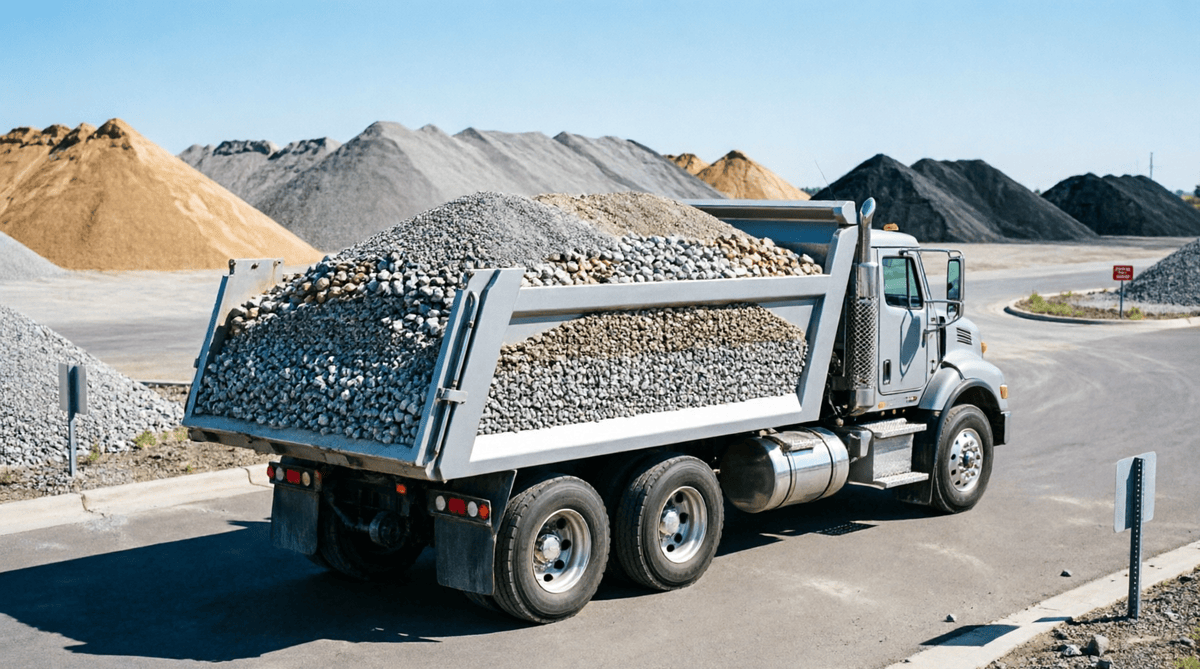
A dump truck load of gravel typically costs somewhere between $400 and $1,200 delivered as a rough planning range for a standard residential load, but the actual price depends heavily on your location, the type of gravel, delivery distance, and whether you order a full or partial load.
Most homeowners ordering a standard residential load, somewhere in the 10-to-16-ton range, delivered locally, land in the $600 to $1,200 range. That’s the number worth anchoring on for driveway and landscaping projects. But before you call a supplier, it helps to understand what’s actually driving that price and how to avoid paying for more gravel than you need.
How Much Does a Dump Truck Load of Gravel Cost?
Here’s a breakdown by truck size, using estimated 2026 planning ranges based on typical supplier pricing. Your actual quote will vary:
| Truck Type | Typical Payload | Delivered Price Range (2026 estimates) |
|---|---|---|
| Single-axle dump truck | 5–8 tons | $200–$650 |
| Tandem-axle dump truck | 10–16 tons | $400–$1,200 |
| Tri-axle dump truck | 18–25 tons | $600–$1,800 |
These figures already include delivery, but they assume a fairly typical situation: driveway-grade material like crushed stone or crusher run, delivery within the supplier’s normal service area (often 10 to 20 miles), and easy site access. Push any one of those variables – decorative stone, a 40-mile haul, or a driveway a truck can’t turn around in – and the price moves accordingly.
Two things matter more than the sticker price on the low end of that table. First, a full truckload almost always beats a partial one on a per-ton basis, because the driver’s time and the truck’s fuel cost roughly the same whether the bed is half-full or topped off. Second, the number you actually get quoted has very little to do with a national average and everything to do with your local supplier, so treat every figure here as a planning range, not a promise.
How Many Cubic Yards Are in a Dump Truck?
This is where a lot of online answers oversimplify. You’ll often see “a dump truck holds 14 to 16 cubic yards” presented as gospel, but that number describes one specific truck configuration, not dump trucks in general. And with a dense material like gravel, volume usually isn’t even the limiting factor. Weight is.
Dump trucks come in a few standard configurations, and each one carries a different combination of volume capacity and legal payload:
- Single-axle dump truck. Typically holds 5 to 7 cubic yards and is legally limited to roughly 5 to 8 tons, depending on the truck’s GVWR (gross vehicle weight rating) and state axle-weight limits. This is the size most often used for smaller residential deliveries.
- Tandem-axle dump truck (sometimes called a “10-wheeler”). Bed capacity generally runs 10 to 14 cubic yards, with a legal payload around 10 to 16 tons. This is the closest thing to a “standard” dump truck for residential and light commercial gravel delivery.
- Tri-axle dump truck. Bed capacity is often 12 to 18 cubic yards, but the third axle allows a much higher legal payload, typically 18 to 25 tons.
Here’s the part that trips people up: a truck’s bed might physically hold 14 cubic yards, but gravel weighs roughly 2,400 to 3,000 pounds per cubic yard (about 1.4 tons as a planning figure). Multiply that out, and 14 cubic yards of gravel could weigh close to 19 tons, which may exceed what that particular truck is legally rated to carry. That’s why a tandem-axle truck hauling gravel often gets loaded to somewhere between 10 and 12 cubic yards, not its full 14-yard bed. The driver stops adding material once the scale says the truck is at its legal weight limit, even though there’s visibly more room in the box.
The practical takeaway: don’t assume every “dump truck load” is the same size. Ask your supplier directly what their truck carries, in tons, not just cubic yards, for the specific material you’re ordering.
How Much Does Gravel Cost Per Ton or Cubic Yard?
Gravel is priced by the ton at most quarries and by the cubic yard at most landscape supply yards, and neither unit is inherently cheaper; you’re just paying for the same rock measured two different ways. What actually moves the price is the type of stone.
| Gravel Type | Typical Price Per Ton | Typical Price Per Cubic Yard |
|---|---|---|
| Crushed concrete (recycled aggregate) | $10–$40 | $15–$55 |
| Crusher run / road base | $20–$35 | $25–$45 |
| Crushed stone (¾” and similar) | $25–$40 | $30–$50 |
| Pea gravel | $30–$50 | $35–$60 |
| River rock / decorative stone | $50–$100 | $60–$120 |
If you’re asking what the cheapest way to get gravel is, the answer is usually a combination of two things: choosing crushed concrete or crusher run instead of decorative stone, and ordering a full truckload rather than a partial one. Crushed concrete tends to be the single cheapest option because it’s recycled material rather than freshly quarried rock. It can work well for base layers and driveways in many situations, though its performance depends on the quality of the recycled material and your specific project requirements.
For a quick answer to how much 1 ton of crushed stone costs: figure roughly $25 to $40 for standard ¾-inch crushed stone before delivery, or $10 to $40 for crushed concrete or basic crusher run. Add delivery on top, and a single ton delivered locally often runs $50 to $150 all-in once minimum-order fees are factored in, which is exactly why ordering by the truckload, rather than by the single ton, tends to be the better value once your project needs more than 3 or 4 tons.
How much does a cubic yard of gravel actually weigh?
There’s no single fixed answer, because gravel density depends on the stone type, moisture content, and how compacted it is. What’s reliable is the range: a cubic yard of typical gravel weighs between 2,400 and 3,000 pounds. For rough estimating purposes, 1.4 tons per cubic yard is a useful planning figure, but actual weight varies by stone type, moisture content, and compaction. Wetter material or fines-heavy mixes can run closer to 3,000 pounds per yard, while some looser or drier stone can come in lighter. Always confirm with your supplier.
What Affects the Cost of a Gravel Delivery?
The material price is only part of the invoice. What actually determines your total tends to come down to a handful of variables:
- Distance from the supplier. Most quarries and landscape yards include free delivery within a set radius, often 10 to 20 miles, then charge $2 to $5 per mile beyond that. A delivery 40 miles out can easily cost double what the same load costs 10 miles away. Diesel prices and state fuel taxes also play a role, with the U.S. average on-highway diesel price at $5.643 per gallon as of April 2026.
- Load size. Bigger loads cost less per ton because the delivery fee is largely fixed regardless of how full the truck is. A 5-ton order can end up costing two to three times more per ton, delivered, than a 20-ton order going to the same address.
- Gravel type. Crushed concrete and crusher run sit at the low end; polished decorative stone and specialty colors sit at the high end.
- Minimum order requirements. Many suppliers set a minimum of 3 to 10 tons for delivery. Order below that and you may be charged a small-load or short-load surcharge that can add $25 to $100.
- Site access. Narrow driveways, steep grades, low-hanging branches, or soft ground that a heavy truck can’t safely enter may force the supplier to use a smaller truck (raising the per-ton cost) or charge for extra time.
- Season and demand. Spring and summer are peak season for landscaping and construction, when demand can affect availability and pricing. Ordering in late fall or winter may offer better rates.
Full Load vs. Half Load Gravel
This is the question that actually determines what you’ll pay: should you order exactly what your project needs, or round up to a full truckload?
A full load means the truck is loaded to its practical maximum, either its bed capacity or its legal weight limit, whichever comes first. A half load (or any partial load) means the supplier sends the same truck and driver but only fills it partway.
Here’s the part that surprises a lot of first-time buyers: half-load pricing is rarely exactly half of full-load pricing. The reason is straightforward: a truck, driver, and fuel cost the supplier almost the same amount whether the bed is full or half-full. The material itself is usually the cheap part of the equation; the trip is the expensive part. So a partial load often costs more than half the price of a full load, and some suppliers add a flat short-load fee of $50 to $100 on top of that for any delivery below their stated minimum.
That has a practical consequence: if your project calculation comes out to, say, 90 percent of a truck’s capacity, it’s frequently cheaper, or at least no more expensive, to round up to the full load than to order the smaller amount and pay a partial-load premium. The leftover material isn’t wasted, either; a little extra gravel for later top-dressing beats paying for a second delivery.
Before you order, it’s worth asking your supplier a short list of questions:
- How many cubic yards, and how many tons, does your truck carry for this specific material?
- Is the quoted price for material only, or does it include delivery?
- Is there a minimum order size, and what’s the short-load fee if I come in under it?
- What’s the delivery charge for my address, and does it change with load size?
- Does the price per ton change based on which gravel type I choose?
That handful of questions usually surfaces the real cost difference between ordering exactly what you calculated and rounding up to a full load, and it’s a five-minute phone call that can save a second delivery fee down the line.
How Much Gravel Do You Need?
Before you can decide between a full load and a half load, you need a real number for your project, and that starts with one formula:
Length × Width × Depth = Volume
Measure your project area in feet. If your depth is in inches, convert it to feet first by dividing by 12. Multiply the three numbers together to get cubic feet, then divide by 27 (since one cubic yard equals 27 cubic feet) to get cubic yards.
Cubic Yards = (Length × Width × Depth) ÷ 27
Once you have cubic yards, multiply by roughly 1.4 to get an estimated weight in tons, useful if your supplier prices by the ton rather than by the yard.
How much area does gravel cover, by depth?
| Depth | Coverage Per Cubic Yard | Coverage Per Ton (approx.) |
|---|---|---|
| 1 inch | 324 sq ft | ~230 sq ft |
| 2 inches | 162 sq ft | ~115 sq ft |
| 3 inches | 108 sq ft | ~77 sq ft |
| 4 inches | 81 sq ft | ~58 sq ft |
| 6 inches | 54 sq ft | ~39 sq ft |
These are theoretical figures based on the mathematical volume; real projects usually need a small allowance on top for compaction, settling, and uneven ground, so treat this table as your starting point, not your final order quantity.
That table also answers a handful of common sizing questions directly. How much gravel do you need for a 10×10 area (100 sq ft)? Using a hypothetical 3-inch decorative depth, that’s about 0.93 cubic yards; call it 1 cubic yard, or roughly 1.4 tons. A 10×12 area at the same depth comes out to about 1.11 cubic yards (roughly 1.6 tons), and a 10×20 area at 4 inches deep, a common walkway or small driveway spec, works out to about 2.47 cubic yards, or roughly 3.5 tons.
Sizing things up: what does a given tonnage actually look like?
Numbers on a page don’t always translate to a sense of scale, so here’s what a few common order sizes mean in practice, using the 1.4-ton-per-yard planning figure:
- 1 ton of gravel is about 0.7 cubic yards, roughly 19 cubic feet, or enough to cover about 75 to 110 square feet at a 2-to-3-inch depth. It’s a modest pile, well within what a single heaped wheelbarrow trip (many times over) or a small truck bed could move.
- 2 tons of gravel is about 1.4 cubic yards and covers roughly 150 to 230 square feet at 2 to 3 inches. By volume, that fits inside most pickup beds. By weight, it often doesn’t fit safely; 2 tons is 4,000 pounds, well above the payload capacity of many pickup trucks. Always check your vehicle’s actual payload rating (found on the driver’s door jamb) before loading heavy materials.
- 3 tons of gravel is roughly 2.1 cubic yards, covering around 230 square feet at 3 inches, enough for a decent-sized garden path or a small patio base.
- 5 tons of gravel is about 3.6 cubic yards, covering roughly 385 square feet at 3 inches deep. Picture a pile a bit taller and wider than a standard pickup bed, heaped, or slightly more material than one full heaped pickup load.
Is 2 inches of gravel enough?
It depends entirely on what you’re covering. Two inches works fine for decorative top-dressing or light ground cover. For load-bearing applications like a driveway, parking pad, or paver base, a typical recommendation is 4 inches or more, often built in multiple compacted layers. However, the exact depth depends on your soil, traffic, drainage, and material choice.
Can you put gravel over dirt?
You can, but it’s not the recommended approach for anything beyond a very casual, low-traffic area. Bare soil lets gravel sink and mix into the ground over time, and weeds work their way up through it. A geotextile fabric barrier laid between the soil and the gravel keeps the layers separated and stops most weed growth. It’s often recommended for driveways and high-traffic gravel surfaces, though its use depends on your soil conditions, drainage, and project design.
How many bags of gravel are in a ton?
Bagged gravel is typically sold in 0.5-cubic-foot bags weighing around 40 to 50 pounds. That works out to about 40 to 50 bags per ton (2,000 pounds ÷ 40-50 pounds per bag), or about 54 bags per cubic yard. Bags make sense for very small jobs, well under a cubic yard, but bulk delivery is dramatically cheaper per pound once a project needs more than a ton or two. Bagged gravel from home centers can cost $200–$300 per ton or more, while bulk delivery runs $25–$55 per ton.
Example: Calculating Gravel and Cost for a Driveway
As a hypothetical example, say you’re resurfacing a 24-foot by 12-foot gravel driveway with a 4-inch crusher run base and a 2-inch crushed stone top layer. This represents one common approach, but your project may require different depths depending on soil, drainage, and use.
Base layer (4 inches):
- Area: 24 × 12 = 288 sq ft
- Depth in feet: 4 ÷ 12 = 0.333 ft
- Volume: 288 × 0.333 = 95.9 cubic feet ÷ 27 = 3.55 cubic yards
- Weight: 3.55 × 1.4 ≈ 4.97 tons
Top layer (2 inches):
- Depth in feet: 2 ÷ 12 = 0.167 ft
- Volume: 288 × 0.167 = 48.1 cubic feet ÷ 27 = 1.78 cubic yards
- Weight: 1.78 × 1.4 ≈ 2.49 tons
Total: about 5.3 cubic yards, or roughly 7.5 tons combined. As a rough estimating practice, you might add 5–10% for compaction and spillage, but the exact allowance depends on your specific material and installation method. Confirm the recommended quantity with your supplier before ordering.
That number matters for the load-size decision covered earlier. Eight tons is more than a single-axle truck’s typical 5-to-8-ton capacity, but well under half of a tandem-axle truck’s 10-to-16-ton range. Depending on the supplier, this project might arrive as one single-axle load close to its max, or as a partial tandem-axle load, and it’s worth asking which option costs less delivered, since the answer isn’t automatic.
As a purely hypothetical illustration of how the pieces add up (not a quoted or average price): if crusher run runs $30 per ton and crushed stone runs $40 per ton, the material alone would be roughly 5 × $30 + 2.5 × $40 = $150 + $100 = $250. Add a delivery fee, anywhere from $50 for a nearby single trip to $150 or more if a partial-load surcharge applies, and the hypothetical delivered total lands somewhere in the **$300 to $450** range. Your actual quote will depend entirely on your local supplier’s pricing, so treat this as a worked example of the math, not a number to expect on your invoice.
For your own project’s exact numbers, including a compaction buffer and a weight estimate for your specific gravel type, the Gravel Calculator runs this same math automatically. Enter your dimensions and gravel type, and it hands you both the cubic yardage and the estimated tonnage in one pass, so you’re calling suppliers with a real number instead of a guess.
Not sure if you need a half-load or a full truck? Enter your project dimensions into our free Cubic Yard Calculator to get the exact volume, then compare it to standard dump truck sizes.
How to Get the Best Gravel Delivery Price Near You
Nobody can tell you the exact delivered price for your address; it depends on your distance from the nearest quarry, which suppliers serve your area, current fuel costs, and how competitive your local market is. What you can do is shop it the right way:
- Calculate your cubic yards and tons first, using the formula above or the Gravel Calculator, so you’re asking for a specific quantity rather than a vague “how much for a driveway.”
- Decide on a gravel type, crusher run for a base layer, crushed stone or pea gravel for a finish layer, and so on.
- Contact 2 to 3 local suppliers rather than accepting the first quote. Prices for the same material can vary meaningfully between yards just a few miles apart.
- Ask for the delivered price, not just the material price. A low per-ton quote can turn into the most expensive option once delivery and minimum-order fees are added.
- Confirm the truck’s capacity and the delivery charge for your specific address before committing, since driveway access sometimes forces a smaller (and pricier per ton) truck.
- Compare total delivered cost across suppliers, not just the sticker price per ton; the cheapest material isn’t always the cheapest driveway.
Common Questions About Dump Truck Loads of Gravel
How much weight is a dump truck load of gravel? It depends entirely on the truck. A single-axle load typically runs 5 to 8 tons, a standard tandem-axle load runs 10 to 16 tons, and a tri-axle load can reach 18 to 25 tons. Always confirm the specific weight with your supplier rather than assuming a standard figure.
How far will 20 tons of gravel cover? At the 1.4-ton-per-yard planning figure, 20 tons is about 14.3 cubic yards. That covers roughly 1,160 square feet at a 4-inch depth, or about 2,300 square feet spread just 2 inches deep. Depth changes the coverage dramatically, so always calculate for your specific project depth rather than relying on a single “tons per area” rule of thumb.
How many tons of gravel cover 1,000 square feet? At 2 inches deep, roughly 8.5 to 9 tons. At 4 inches deep, roughly 17 tons. At 6 inches deep, roughly 26 tons. The depth you need drives the tonnage far more than the square footage alone.
What area will 2 tons of gravel cover? About 150 to 230 square feet at a 2-to-3-inch depth, or roughly 100 square feet at 4 inches. Exact coverage shifts with the specific gravel’s density, so use your supplier’s stated weight per cubic yard for a precise figure.
How far will 1 ton of gravel spread? Roughly 75 to 115 square feet at a 2-to-3-inch depth, enough for a small garden path or a modest decorative bed, but not much more.
What does 1 ton of gravel look like, roughly? About 19 cubic feet; picture a cube a little over 2.5 feet on each side, or a pile that would only partially fill a standard heaped pickup bed.
The Bottom Line
There’s no single answer to what a dump truck of gravel costs; your price depends on truck size, gravel type, delivery distance, and local market. Calculate your volume first, call 2–3 local suppliers, and compare delivered totals, not per-ton prices. Use the Gravel Calculator to get your numbers before you pick up the phone.