
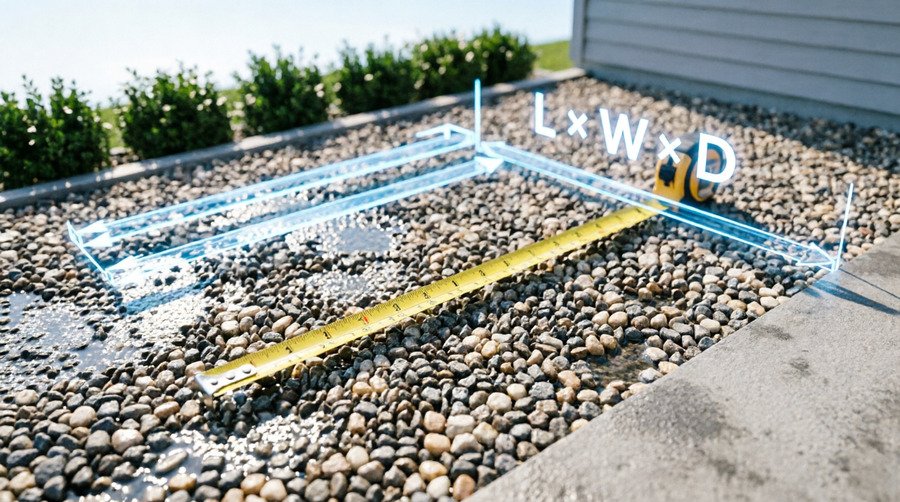
Figuring gravel might seem like a headache, but it actually boils down to one simple step: converting your length, width, and depth measurements into a total volume, and then translating that into the unit your supplier actually uses.
Need the quick version? If you’re measuring depth in inches, just use this formula:
Cubic yards = length (ft) × width (ft) × depth (in) ÷ 324
Let’s say you have a 20 ft by 20 ft area and you want it 4 inches deep. The math is 20 × 20 × 4 ÷ 324, which gives you 4.94 cubic yards. If your supplier prices things by weight instead of volume, just multiply those cubic yards by the material’s weight (pounds per cubic yard) and divide by 2,000 to get your tonnage.
That’s the basic math most people need. But if you want to know exactly where those numbers come from, how driveway layers affect your order, or how to avoid the calculation mistakes that lead to ordering too much (or too little), keep reading.
(Pro tip: You can also plug your numbers into TheCalcYard’s Gravel Calculator to skip the manual math and instantly get volume, weight, and an estimated cost.)
The Core Gravel Formulas
Keep these handy. Everything else in this guide is just a variation of these basics.
| What you’re finding | Formula |
|---|---|
| Volume in cubic feet | Length (ft) × width (ft) × depth (ft) |
| Volume in cubic yards | Cubic feet ÷ 27 |
| Volume in cubic yards (depth in inches) | Length (ft) × width (ft) × depth (in) ÷ 324 |
| Coverage area from a known volume | Cubic yards × 324 ÷ depth (in) |
| Weight in tons | Cubic yards × pounds per cubic yard ÷ 2,000 |
| Volume from a known weight | Tons × 2,000 ÷ pounds per cubic yard |
Where do those numbers come from? Well, 27 is simply the math behind a cubic yard (a cube measuring 3 ft on each side: 3 × 3 × 3 = 27 cubic feet). The 324 is just that same conversion applied when you measure depth in inches instead of feet (12 inches × 27 = 324). It saves you from having to convert inches to feet as a separate step.
Step-by-Step: How Much Gravel Do You Actually Need?
Follow this sequence for any project, whether it’s a driveway, a walkway, or a fill area.
- Measure the length in feet.
- Measure the width in feet.
- Decide on your depth. (Most driveways need 4 to 6 inches; paths and decorative beds usually only need 2 to 3 inches).
- Multiply length × width × depth (in inches) and divide by 324. (If your depth is already in feet, multiply length × width × depth and divide by 27).
- If buying by weight, multiply your cubic yards by the pounds per cubic yard, then divide by 2,000 for tons.
- Add a 5% to 10% buffer for waste and settling.
- Double-check the final number with your supplier, as they might round up or down to fit their truck sizes.
Two Ways to Calculate Cubic Yards
Both methods give you the exact same answer, so just pick the one you prefer.
- Method 1 (Convert first): For a 30 ft long, 12 ft wide, 4-inch deep area, convert the depth to feet first (4 ÷ 12 = 0.333 ft). Then calculate 30 × 12 × 0.333 = ~120 cubic feet. Divide by 27 to get ~4.44 cubic yards.
- Method 2 (The 324 shortcut): Just use 30 × 12 × 4 ÷ 324 = 4.44 cubic yards. No extra conversion steps required.
Figuring Gravel for a Driveway
Measuring a driveway is a bit trickier than a simple box shape. Why? Because most gravel driveways aren’t just one flat, uniform layer of material.
- Measure the length along the actual driving surface, from the street to the garage or parking pad.
- Measure the width. If it’s a straight path, one measurement is fine. But if it curves, widens, or has a parking pad, break it down into separate rectangular or triangular sections and calculate them individually.
- Determine the depth. There’s no universal “correct” thickness. It depends on your soil, drainage, climate, and traffic. A lightly used driveway on solid, well-drained dirt needs less material than one handling heavy trucks over soft mud.
- Calculate cubic yards using the 324 formula.
- Account for layers. Many driveways use a 4-inch compacted base of larger rock, topped with a 2-inch layer of smaller surface rock. If you’re doing this, calculate the base and surface volumes separately, then add them together. (Treating a thin 2-inch top layer as the entire depth of the driveway is a very common ordering mistake).
- Convert to tons if needed, using the specific weight your supplier provides.
How Much Gravel for a Driveway? (Depth Matters)
The total amount scales directly with your depth. Even a small change in thickness makes a huge difference. Here’s what a 20 ft by 100 ft driveway looks like at three common depths:
| Driveway (20 × 100 ft) | Depth | Cubic Yards |
|---|---|---|
| Surface layer only | 2 in | 12.35 cu yd |
| Standard | 4 in | 24.69 cu yd |
| Heavy traffic | 6 in | 37.04 cu yd |
Bumping the depth from 4 to 6 inches increases your volume by 50%. Keep in mind, these numbers only cover the stated footprint. They don’t factor in compaction loss, uneven edges, or excavation, which will all push your final order a bit higher.
Is 2 Inches of Gravel Enough for a Driveway?
That depends entirely on what those 2 inches represent. If it’s a top layer sitting on top of a properly compacted base, 2 inches is perfectly fine for a lightly used driveway on firm ground. But if you’re trying to build the entire driveway with just 2 inches of gravel over soft, poorly drained soil or in a freeze-thaw climate? It won’t hold up.
This also answers the common debate: “Should driveways be 4 or 6 inches thick?” There is no single national standard. The real question you need to ask is whether that 4 or 6 inches refers only to the top layer, or the entire structural base.
How to Calculate Tons of Gravel
Once you have your cubic yards, converting to tons is easy:
Tons = cubic yards × pounds per cubic yard ÷ 2,000
Example: You need 10 cubic yards of a material that weighs 2,400 lbs per cubic yard. 10 × 2,400 ÷ 2,000 = 12 tons. (Note: 2,400 lbs is just an example assumption. Your specific gravel might weigh more or less).
Why Tons and Cubic Yards Aren’t the Same Thing
This is the #1 reason people order the wrong amount. A cubic yard measures volume (space), while a ton measures weight. You can only convert between them if you know the exact density of your material, and gravel density varies wildly.
Loose gravel usually weighs between 95 and 120 lbs per cubic foot, depending on the rock type, moisture, and particle size. For instance, a standard 50 lb bag of Quikrete all-purpose gravel yields 0.5 cubic feet, which equals about 100 lbs per cubic foot. Using 100 lbs as a baseline: 100 × 27 = 2,700 lbs per cubic yard. Divide by 2,000, and you get 1.35 tons per cubic yard. But a washed river rock or a heavy road base will weigh significantly more.
Because of this, treat “1 ton = 1 cubic yard” as a very rough guess at best. For a real order, always ask your supplier for the exact weight per cubic yard of the specific material you’re buying.
Gravel Coverage: How Far Will It Go?
Coverage is entirely dependent on depth:
Coverage (sq ft) = cubic yards × 324 ÷ depth (in)
| Volume | 2 in depth | 4 in depth | 6 in depth |
|---|---|---|---|
| 1 cu yd | 162 sq ft | 81 sq ft | 54 sq ft |
| 2 cu yd | 324 sq ft | 162 sq ft | 108 sq ft |
| 5 cu yd | 810 sq ft | 405 sq ft | 270 sq ft |
| 10 cu yd | 1,620 sq ft | 810 sq ft | 540 sq ft |
| 20 cu yd | 3,240 sq ft | 1,620 sq ft | 1,080 sq ft |
For example, 2 cubic yards spread at 4 inches deep covers 162 sq ft. But if you spread that same 2 cubic yards at just 2 inches deep, it covers 324 sq ft. You’re just spreading the same volume thinner.
How Much Driveway Will 20 Tons Cover?
You can’t answer this without converting tons back to cubic yards first. Let’s assume a density of 2,700 lbs per cubic yard. 20 tons × 2,000 = 40,000 lbs. 40,000 ÷ 2,700 = ~14.8 cubic yards. At a 4-inch depth, that covers roughly 1,200 sq ft (14.8 × 324 ÷ 4). Change your density assumption, and that coverage number changes, so always get the actual weight from your supplier before finalizing a tonnage order.
Visualizing the Math
What Does 1 Cubic Yard of Gravel Look Like?
It’s exactly 27 cubic feet. Picture a perfect cube measuring 3 ft by 3 ft by 3 ft. When it gets dumped in your yard, it won’t look like a neat box—it’ll form a sloped mound—but that 3-foot cube is a great mental reference.
Will a Yard of Gravel Fit in My Pickup Truck?
Space-wise? Yes, 27 cubic feet will fit in most truck beds. But the real issue is weight, not space. At roughly 2,700 lbs per cubic yard, a full yard might exceed your light-duty pickup’s legal payload limit once you add passengers and tools. Before hauling it yourself, check the payload sticker on your driver’s side door jamb. The right question isn’t “will it fit?” it’s “can my truck safely carry this weight?”
How Much Does a 50 lb Bag Cover?
A 50 lb weight doesn’t tell you coverage on its own. You need to check the bag’s cubic foot yield. Formula: Coverage (sq ft) = bag volume (cu ft) × 12 ÷ depth (in) A standard 50 lb bag of Quikrete yields 0.5 cubic feet. At 2 inches deep, that covers 3 sq ft. At 4 inches deep, it covers 1.5 sq ft. Always check the exact volume printed on the bag you’re buying.
Dump Truck Loads and Costs
There is no single “standard” dump truck load. Capacity depends on the truck’s physical size, legal weight limits, and the gravel’s density.
- Coverage: A 15 cubic yard load at 4 inches deep covers 1,215 sq ft (15 × 324 ÷ 4).
- Cost: Total cost = quantity × unit price, plus delivery/minimum fees. A cheap per-ton price can quickly become expensive once delivery and minimum load fees are added. Always ask if delivery is included in the quote.
As of 2026, bulk gravel material alone typically runs $15 to $75 per ton (crushed stone and decorative rocks cost more), with delivery adding $50 to $200. These are just planning estimates—always get a local quote.
Gravel Driveway Cost Examples
- Small pad (20×20 ft at 4 in): 4.94 cubic yards. At $50/cu yd, that’s ~$247 for material only (before delivery, grading, or compaction).
- Standard driveway (100×12 ft at 4 in): ~14.81 cubic yards. At $50/cu yd, that’s roughly $740 for material alone. A finished project will cost more due to labor and base prep. Always compare quotes using the same unit (yards, tons, or truckloads).
Calculating for Irregular Shapes
Not every yard is a perfect rectangle. For curved driveways or odd-shaped paths, break the area down into smaller, manageable shapes:
- Rectangle/Square: area = length × width
- Triangle: area = ½ × base × height
- Circle: area = π × radius²
Calculate the volume for each section, convert them to cubic yards, and add them together. This is much more accurate than just guessing an “average” length and width.
Choosing the Right Gravel & Prepping the Base
Crushed Stone vs. Natural Gravel
Crushed stone is mechanically broken into angular pieces that lock together and compact tightly, making it ideal for driveways. Natural gravel has rounded pieces, which feel nice underfoot for paths but shift around under vehicle tires.
Base vs. Surface Material
Use larger, angular rock for the bottom base layer for stability, and smaller rock on top for a smooth driving surface.
Driveway Base and Preparation FAQs
- Can I just lay gravel on dirt? Sometimes, but if your soil is wet or weak, the gravel will sink into the mud and create ruts. The ground underneath matters just as much as the rock on top.
- Do I need a sub-base or fabric? A heavily used driveway on soft soil needs a proper aggregate base and often a geotextile fabric to keep the gravel from sinking into the dirt. Don’t confuse engineered geotextile fabric with thin garden landscape fabric—they do different jobs.
Downsides of a Gravel Driveway
Gravel driveways require periodic regrading, can develop ruts or potholes, produce dust, and make snow removal a bit of a headache compared to paved surfaces. Good drainage and proper base prep minimize these issues.
Gravel vs. Crushed Stone vs. Concrete or Paving
Suppliers often use the terms “gravel” and “crushed stone” loosely, so don’t rely on labels alone. Instead, compare the actual characteristics: particle shape, size, gradation, fines content, drainage, and price.
How does gravel compare to concrete or asphalt?
- Gravel wins on: Lower upfront cost, simpler installation, easy spot repairs, and no curing time.
- Concrete/paving wins on: Less routine maintenance, a smoother surface, and longer lifespan with minimal upkeep.
- The trade-off: Gravel needs periodic grading, weed control, and topping off. Concrete costs more initially but demands less day-to-day work.
Is gravel actually cheaper over the long run? That depends on your site prep, local labor and material costs, and how many years you expect the surface to last. There’s no one-size-fits-all answer.
Do I Need a Permit for a Gravel Driveway?
There’s no universal answer — it all depends on your local rules. Permit requirements vary based on:
- Your city or county regulations.
- Whether you’re building a new driveway access or just resurfacing an existing one.
- Whether the driveway connects to a public road.
- Local drainage rules or right-of-way restrictions.
Always check with your local building or public works department before breaking ground, especially if you’re changing how the driveway connects to the street. Skipping this step can lead to fines or being forced to redo the work.
Common Calculation Mistakes to Avoid
- Mixing up inches and feet: If your depth is 4 inches, don’t plug ‘4’ into a feet-based formula. Use the 324 shortcut.
- Using the wrong divisor: Cubic feet to yards is ÷ 27. Feet + inches is ÷ 324. Mixing them up will ruin your math.
- Thinking tons = yards: They are only connected by density. Always ask your supplier for the weight per yard.
- Ignoring the width: An 8 ft wide driveway needs less than half the material of a 20 ft wide one.
- Forgetting the layers: If your design calls for a 4-inch base and a 2-inch top layer, calculate both. Don’t just calculate the top 2 inches and call it a day.
- Skipping the buffer: Always add 5-10% for compaction and spillage so you don’t have to pay for a second delivery.
Frequently Asked Questions
How do I figure out how much gravel I need?
Measure length and width in feet, pick your depth, and use: cubic yards = length × width × depth (in inches) ÷ 324. Convert to tons later if needed.
How do I figure yards of gravel?
Multiply length × width × depth (in inches) and divide by 324. For a 20 ft by 20 ft area at 4 inches deep: 20 × 20 × 4 ÷ 324 = 4.94 cubic yards.
How do I figure tons of gravel?
Calculate cubic yards first, then multiply by the material’s pounds per cubic yard and divide by 2,000. Your supplier can give you the correct weight for the specific gravel you’re buying.
Is 1 ton of gravel equal to 1 cubic yard?
Not exactly. Depending on the rock, a cubic yard usually weighs between 1.2 and 1.4 tons. Always confirm with your supplier.
How much gravel do I need for a 20 ft driveway?
You need a length too! If you mean 20 ft wide by 100 ft long at 4 inches deep, that’s 20 × 100 × 4 ÷ 324 = 24.69 cubic yards.
Will a yard of gravel fit in a pickup?
It will fit in the bed, but it might be too heavy. Check your truck’s payload rating on the door jamb sticker before loading up.
What is the best gravel size for a driveway?
There’s no single “best” size, but here’s the general rule:
- Base layer: Use a larger, angular aggregate (like 3/4″ crushed stone) for stability.
- Surface layer: Use a smaller material (like ¼” to ½” gravel) for a smoother driving surface. The right choice depends on your traffic, drainage needs, and what’s locally available.
Final Takeaway
Calculating gravel is easy once you realize you’re solving two separate puzzles: volume and weight.
Start with the 324 formula to find your cubic yards. Convert to tons only once you know your specific material’s weight. For driveways, don’t forget to factor in your base layers and soil conditions. Once you have your numbers, give your supplier the volume, material type, and address, and have them confirm the final load before it ships.