
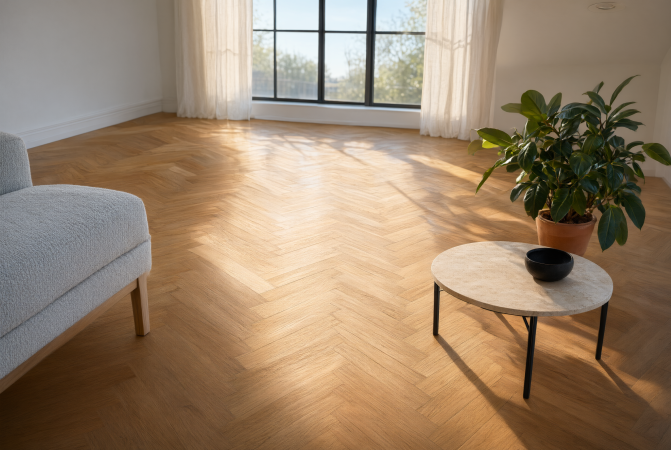
Walk into a room with parquet flooring and you’ll notice something immediately — the floor itself becomes part of the design. Instead of long boards running in one direction, parquet arranges small wood pieces into repeating geometric patterns. Herringbone, chevron, basket weave, and Versailles top the list of recognizable layouts. You can buy it as solid wood, engineered wood, or even laminate that mimics the look, and that construction choice determines everything from sandability to moisture resistance to your final bill.
This guide walks through what parquet actually is, how it’s built, which patterns and wood species dominate the market, what you’ll realistically spend, how installation works, and the day-to-day care it needs — including scratch repair.
What Is Parquet Flooring?
Think of a parquet floor as a mosaic made from wood. Dozens — sometimes hundreds — of small blocks, slats, or tiles fit together to create a decorative design across the entire room. A conventional plank floor has one dominant grain direction. A parquet floor has a pattern your eye follows.
The individual pieces are typically cut from hardwood and joined tightly. Older installations used solid wood blocks glued one at a time to a subfloor. Today’s market offers prefinished blocks, engineered planks milled specifically for herringbone or chevron layouts, and preassembled panels or tiles that speed up installation considerably.
You’ll find parquet in historic homes and apartments, of course, but also in modern offices, boutique hotels, museums, restaurants, and new residential builds where the owner wants more visual interest than straight planks deliver. The appeal is straightforward: natural wood paired with a deliberate pattern gives a room character without requiring extra décor on the walls.
One important clarification — parquet describes a flooring style, not a single product. Whether any given parquet floor qualifies as “real wood” depends entirely on how it’s constructed, which we’ll break down below.
Parquet Meaning, Pronunciation, and History
Let’s clear up the pronunciation first. Parquet is said “par-KAY” — the final “t” stays silent. The word comes from French.
As for what it means: in French, “parquet” originally referred to a small enclosed compartment, a diminutive form of the word for a park or enclosure. When applied to floors, it describes a surface built from many small wood compartments. In English, the term covers both the flooring style and, somewhat separately, the main floor seating area in a theater.
Why is it called parquet flooring? The name reflects the technique’s French roots. Parquet developed in France beginning around the 1600s as an alternative to cold stone or tile in large rooms, and it became closely associated with grand French interiors. The Versailles pattern takes its name directly from the palace, where panel-style parquet became famous. Exact dates vary across historical sources, so take any single “first use” year with a grain of salt. For formal terminology, the flooring-industry vocabulary standard ISO 5323:2019 defines the official terms used for wood flooring and parquet.
Is Parquet Flooring Real Wood?
The short answer: often yes, but not always. Because parquet describes a pattern and format rather than a specific material, the construction underneath varies considerably.
- Solid wood parquet is made entirely from wood, top to bottom.
- Engineered wood parquet features a real hardwood surface layer bonded to a layered core beneath.
- Laminate parquet carries a printed photographic surface — it’s not wood on top at all.
The National Wood Flooring Association (NWFA) classifies solid and engineered wood as real wood flooring and puts laminate in a separate category entirely. If a product label says “parquet-style,” “parquet look,” or “herringbone design” without specifying what the wear surface is made of, ask directly before you buy.
Types of Parquet Flooring
Solid wood parquet
Solid parquet gets cut from single pieces of hardwood. This is the traditional format, and when the pieces are thick enough, you can sand and refinish them multiple times over the floor’s life. The tradeoff: solid wood expands and contracts as indoor humidity shifts, so it needs a stable environment and careful installation. Basements and other damp spaces are generally a poor fit.
Engineered wood parquet
Engineered parquet bonds a hardwood top layer (called the wear layer) to a core of layered wood or similar material. That cross-layered core makes the floor more dimensionally stable than solid wood, which is exactly why it’s often chosen for installation over concrete or in areas with moderate humidity swings. Refinishing potential depends on how thick the wear layer is — a thin layer might handle one light sanding at most, while a thicker one allows multiple refinishes.
Laminate parquet flooring
Laminate parquet uses a high-density fiberboard core topped with a printed image of wood and a protective clear coat. It handles scratches and fading well and typically costs less than real wood options. The downside: you can’t sand it back to fresh wood. When damage happens, you’re replacing planks or tiles. Laminate also lacks the tactile feel and natural variation that real wood provides.
Table 1: Types of parquet flooring
| Type | Construction | Main characteristics | Refinishing potential | Best suited for |
|---|---|---|---|---|
| Solid wood parquet | Single pieces of hardwood | Natural variation; reacts to humidity changes | High if thick enough; can often be sanded multiple times | Stable-climate interiors, historic restoration |
| Engineered wood parquet | Hardwood wear layer over layered core | More stable than solid; real wood surface | Depends on wear layer; limited to moderate | Homes with humidity swings, concrete subfloors (per manufacturer) |
| Laminate parquet | Photographic layer over fiberboard core | Scratch resistant; lower cost; not real wood | None; damaged pieces are replaced | Budget projects, rentals, high-wear rooms |
Popular Parquet Patterns and Designs
Herringbone
Herringbone uses rectangular pieces with square-cut ends, laid at right angles so each piece’s end meets the side of its neighbor. The result is a zigzag where the ends form a staggered edge. It works in both traditional and contemporary settings. Installation is trickier than straight planks because the layout has to be exact. Remember: herringbone is a pattern, not a separate material — you can find it in solid wood, engineered wood, or laminate.
Chevron
Chevron planks have ends cut at an angle (typically around 45 to 60 degrees) so they meet to form continuous V shapes with a clean, straight spine. At a quick glance, herringbone and chevron look similar, but they’re not the same thing. Herringbone pieces meet at right angles with square ends. Chevron pieces have angled ends that join in continuous V lines. Chevron demands precisely cut pieces and a perfectly aligned centerline, making it usually the more challenging of the two patterns.
Basket weave
Basket weave groups two or more slats side by side, then turns the next group 90 degrees to create a woven appearance. It reads as classic and slightly rustic, works beautifully in smaller rooms and entry areas, and is simpler to lay out than herringbone thanks to its square grid structure.
Versailles
The Versailles pattern uses decorative panels — often square — made of crossing slats, set on the diagonal or in a grid. It ranks among the most formal parquet designs and carries strong associations with period interiors. It’s also usually the most expensive pattern because the panels are intricate to manufacture and demand careful installation.
Brick and square-on-square
The brick pattern lays short rectangular pieces in offset rows, mimicking actual brickwork. It’s simple and subtle. Square-on-square (sometimes called mosaic) parquet arranges small squares made of slats, often sold as tiles. Both patterns are comparatively easy to install and suit casual or mid-century interiors well.
Table 2: Parquet flooring patterns
| Pattern | Arrangement | Visual appearance | Design suitability |
|---|---|---|---|
| Herringbone | Rectangular, square-cut pieces at right angles | Zigzag with staggered edges | Traditional to contemporary |
| Chevron | Angled-end pieces joined in continuous V lines | Sharp, directional V pattern | Modern and formal rooms |
| Basket weave | Groups of slats alternating 90 degrees | Woven, grid-like | Classic, cottage, small rooms |
| Versailles | Decorative square panels of crossed slats | Ornate lattice | Formal, period, luxury |
| Brick | Offset rows of short blocks | Understated, brickwork | Casual and transitional |
| Square-on-square | Small slat squares in a grid | Geometric checkerboard feel | Mid-century, retro, retail |
Choosing a pattern for your room
Pattern direction changes how a room feels in ways people often underestimate. Running herringbone along the longest wall emphasizes length; running it on the diagonal makes a small room feel more dynamic. Narrow pieces create a busier, finer texture, while wider pieces read as calmer. In small rooms, a pale wood with a low-contrast pattern keeps the floor from competing with your furniture. In larger rooms, a bolder pattern can anchor the whole space. Test samples at different times of day — natural and artificial light change how wood color reads, sometimes dramatically.
What Type of Wood Is Used for Parquet Flooring?
Parquet gets made from many species. No single wood is best for every home. Your right choice depends on traffic levels, finish type, maintenance willingness, and whether you’re going solid or engineered. The hardness figures below are approximate Janka ratings (the force needed to embed a steel ball in the wood) — higher numbers mean greater resistance to denting.
Oak (red oak about 1,290; white oak about 1,360) dominates parquet installations. It has clear grain, takes stain and oil well, and offers solid durability.
Maple (hard maple about 1,450) is pale and fine-grained with a clean look that suits modern spaces. It dents less readily but can show uneven staining.
Walnut (American black walnut about 1,010) brings rich brown tones. It’s softer than oak, so it dents more easily, but the color keeps it in high demand.
Beech (about 1,300) is light and uniform. Hard, but it reacts noticeably to humidity changes.
Ash (white ash about 1,320) has a bold open grain similar to oak and works as a pale option.
Cherry (black cherry about 950) is soft compared with the others and darkens with light exposure over time.
Table 3: Wood species used in parquet flooring
| Wood species | Appearance | Characteristics | Common applications |
|---|---|---|---|
| Oak | Light to medium; distinct grain | Durable; accepts many finishes | Living areas, general residential |
| Maple | Pale, fine, even grain | Hard; clean, modern look | Contemporary interiors |
| Walnut | Rich dark brown | Softer; dramatic color | Formal rooms, feature areas |
| Beech | Pale pink to light brown | Hard; sensitive to moisture changes | Modern interiors |
| Ash | Light with strong grain | Hard; bold grain | Contemporary and rustic spaces |
| Cherry | Reddish brown, darkens with age | Softer; changes color over time | Low to moderate traffic rooms |
Here’s something worth noting: hardness matters less than many buyers assume. The finish, the subfloor condition, and household habits — pets, high heels, dragging furniture — often cause more visible wear than the wood species itself.
Parquet Flooring Styles: Traditional to Modern
Traditional parquet leans toward dark or mid-tone wood, intricate patterns like Versailles, and glossy or satin finishes. Modern parquet often goes the other direction — wider herringbone or chevron in light oak with a matte or oil finish for a calmer overall look. Light colors reflect more light and make small rooms feel larger; darker woods add warmth but show dust and scratches differently. Minimalist interiors usually suit simple patterns in a single species, while classic or luxury interiors can support more elaborate designs.
Advantages and Disadvantages of Parquet Flooring
Are parquet floors good? They can be — when the product matches the room and installation is done right. They offer strong visual character and, in solid or thick engineered forms, genuine longevity. The tradeoffs involve cost, installation complexity, and moisture sensitivity.
Table 4: Advantages and disadvantages
| Advantages | Disadvantages |
|---|---|
| Distinctive decorative appearance | Intricate patterns need skilled installation |
| Wide range of patterns and species | Labor costs can be higher than straight planks |
| Real wood options | Wood reacts to moisture and humidity |
| Can often be refinished (solid and thicker engineered) | Scratches and wear show on the surface |
| Long service life when installed and maintained well | Maintenance requirements depend on the finish |
| Works with many interior styles | Repairing individual damaged blocks can be difficult |
Parquet isn’t automatically more durable than other floor types, and it isn’t automatically more expensive than every alternative. The outcome depends on the specific products you’re comparing.
Is Parquet Flooring Still in Style?
Absolutely. Parquet remains widely used in both restored historic homes and new construction. Herringbone and chevron in natural oak or warm wood tones show up constantly in contemporary interiors, and traditional patterns stay standard for period restoration work. The style has shifted from ornate, high-gloss looks toward simpler, matte, natural-toned versions. This article won’t claim any single pattern is the current “trend” — trend claims change fast and are hard to verify. If resale appeal matters to you, a classic pattern in natural wood tones tends to age more gracefully than an unusual color or pattern choice.
What Is Parquet Flooring Used For?
Parquet serves as finished flooring in living rooms, dining rooms, hallways, entryways, bedrooms, offices, and commercial spaces like hotels and restaurants. It also works as an accent — a parquet border around a room or a pattern inset in an entry, for example. Because wood reacts poorly to water, it’s less suited to full bathrooms, laundry rooms, or any area where standing water is frequent.
How Much Does Parquet Flooring Cost?
Parquet costs more than many standard flooring options, mostly because of labor, pattern complexity, and material choices — not because wood parquet is inherently luxurious. Prices swing widely depending on region, species, product type, and project specifics.
Country and currency: United States, USD. Price research date: November 9, 2026. These figures come from secondary cost guides and contractor-pricing pages, not from manufacturer price lists or government data, so treat them as rough planning ranges rather than firm quotes.
- Several 2026 US guides describe professionally installed parquet as roughly $10 to $25 per square foot, with elaborate patterns like Versailles reaching toward $30 or $40 per square foot. (internationaltrucks)
- Another 2026 guide gives a wider span, from about $9 per square foot installed for budget engineered herringbone up to about $45 per square foot for solid French oak Versailles. (dgfloors)
- A separate 2026 guide places typical hardwood and engineered wood installation at $8 to $18 per square foot, useful as a baseline for straight-plank flooring. (pages)
The sources don’t agree on exact numbers, and some of the lowest and highest figures come from pages that don’t show their methodology. The pattern is more reliable than any specific dollar figure: parquet generally costs more than straight-plank installation of the same material because patterns take more cutting and layout time. Get at least three local written quotes before committing.
What affects parquet flooring prices
- Wood species and grade. Clear, select grades cost more than rustic grades with knots and color variation.
- Solid versus engineered versus laminate. Laminate is typically the lowest cost; solid hardwood in intricate patterns is typically the highest.
- Pattern complexity. Herringbone and chevron require more cutting and alignment than a straight lay. Versailles panels are often the most expensive.
- Thickness and wear layer. More usable wood generally costs more.
- Installation labor. Pattern layout is slow, and skilled installers charge accordingly.
- Subfloor preparation. Leveling, moisture mitigation, and repairs can add meaningfully to the budget.
- Adhesive and finishing. Glue-down installation requires flooring adhesive, and site-finished floors need sanding, stain, and finish coats.
- Waste. Diagonal and herringbone layouts produce more offcuts than straight planks.
Material versus installation cost
Budget material and labor separately because they move independently. One guide estimates that for most flooring, labor runs roughly 30 to 50 percent of the total bill, and complex patterns can push that share higher. (pages)
Example: budgeting a 12 by 15 foot room (illustrative only)
Assumptions: engineered oak herringbone, 12% waste allowance, material at $9 per square foot, labor at $8 per square foot, boxes covering 20 square feet each. These are example inputs, not market averages.
- Room area: 12 × 15 = 180 sq ft
- Material to order with waste: 180 × 1.12 = 201.6 sq ft
- Boxes: 201.6 ÷ 20 = 10.08, so order 11 boxes
- Material cost: 201.6 × $9 = $1,814.40
- Labor (charged on installed area): 180 × $8 = $1,440.00
- Estimated total before subfloor prep, removal, trim, and finishing: $3,254.40
Check the waste figure against your specific product and layout. [Insert link to TheCalcYard flooring calculator here] can help you convert room dimensions into square footage and boxes, but confirm its waste setting suits a pattern layout — pattern floors usually need more waste allowance than straight planks.
Why is parquet so expensive?
The short answer: labor and complexity. Parquet pieces must be cut, sorted, and aligned precisely, so installation takes longer. Intricate patterns need more skilled labor. High-quality solid wood adds to the material cost on top of that.
Is parquet more expensive than tiles?
It depends. Ceramic and porcelain tile prices range from budget to premium, and tile installation requires its own preparation and labor. A basic tile floor can cost less than parquet, while designer porcelain or natural stone can cost as much or more. Compare installed prices for the specific products, pattern, installation method, and local labor rates you’re actually considering.
Parquet Flooring Compared With Other Options
Table 5: Parquet flooring vs. other flooring
| Flooring type | Appearance | Construction | Maintenance | Main considerations |
|---|---|---|---|---|
| Parquet (wood) | Geometric pattern in real wood | Solid or engineered blocks, planks, or panels | Regular dry cleaning; refinishing for solid or thick engineered | Moisture sensitivity; higher labor for patterns |
| Straight-plank hardwood | Linear wood grain | Solid or engineered planks | Similar to wood parquet | Simpler to install; less decorative |
| Laminate | Printed wood look, including parquet patterns | Fiberboard core with photographic layer | Easy to clean; cannot be sanded | Lower cost; moisture can swell edges |
| Ceramic or porcelain tile | Tile finish, varied designs | Fired clay tile with grout | Grout cleaning; very low maintenance | Colder and harder underfoot; cost varies |
| Vinyl (including luxury vinyl) | Wood and stone looks | Layered synthetic planks or tiles | Easy to clean | Many products are water resistant; not real wood |
Parquet vs. herringbone
This comparison trips up a lot of readers because herringbone is a kind of parquet. Parquet is the broad category of patterned wood flooring; herringbone is one specific pattern within that category. A herringbone floor is, by definition, a parquet floor.
Parquet vs. laminate
Wood parquet offers real wood on the surface and, in many cases, the option to refinish down the road. Laminate parquet costs less and resists scratches well, but it cannot be sanded and the surface is a printed image. Choose wood if long-term refinishing matters to you. Choose laminate if budget and durability under light use come first.
Parquet vs. tile
Tile handles moisture far better and is the usual choice for bathrooms, entries, and kitchens with frequent spills. Wood parquet feels warmer and softer underfoot but needs more careful moisture control.
Parquet vs. straight-plank hardwood
Both are wood. Parquet gives you a decorative pattern and typically costs more to install. Straight planks are faster to lay and can be simpler to repair when damage occurs.
How Thick Is Parquet Flooring?
There’s no single thickness — it varies with the product type and manufacturer.
- Solid parquet may come as thin tiles or blocks (often in the range of roughly 5/16 inch to 3/4 inch) or as thicker strips designed for nail-down use. Always check the manufacturer’s specifications.
- Engineered parquet has a total thickness that often falls between about 3/8 inch and 3/4 inch, depending on the product.
- Wear layer thickness is the usable hardwood on top, and it’s not the same as total thickness. It can range from under 1 millimeter on thin products to several millimeters on thicker ones. The wear layer — not the total thickness — determines how much sanding is possible.
Always read the product data sheet for both numbers. For refinishing questions, ask directly how many sandings the wear layer can handle.
How Is Parquet Flooring Made?
Manufacturing varies by product, but the general sequence runs like this:
- Selecting and preparing the wood. Logs are sawn into boards and graded.
- Drying and conditioning. The wood is dried to a controlled moisture content so it stays stable after installation.
- Cutting. Boards are cut into blocks, slats, or strips of the required size. Chevron planks have their ends cut at an angle during this step.
- Machining. Edges may be milled with tongue-and-groove profiles or other joint types.
- Forming pattern components. Slats can be assembled into tiles or decorative panels, sometimes on a backing mesh or paper.
- Engineered construction. For engineered products, a hardwood wear layer is bonded to a layered core.
- Finishing. Many products ship prefinished with lacquer, oil, or other factory finishes. Others arrive unfinished for site finishing.
Traditional solid parquet is made from individual wood pieces, while modern engineered and panelized products add core layers and often factory-applied finishes.
How to Install Parquet Flooring
Installation methods differ by product, so the manufacturer’s written instructions always take priority. That said, the professional approach generally follows these steps:
- Inspect and prepare the subfloor. It should be clean, dry, structurally sound, and flat within the tolerance the manufacturer specifies. Patch low spots and grind high spots.
- Check moisture. Test both the subfloor and the wood. For concrete, manufacturers usually require specific moisture test results and may require a moisture barrier. NWFA guidance also addresses moisture content differences between wood flooring and wood subfloors. Indoor relative humidity is commonly recommended in the range of about 30 to 50 percent.
- Acclimate the flooring if the manufacturer requires it, in the room where it will be installed, with the HVAC system running as it normally would.
- Plan the layout. Find the center of the room and snap layout lines. For herringbone and chevron, a misaligned starting line spreads errors across the whole floor.
- Choose the installation method. Glue-down is common for parquet, and some products allow nail-down, staple-down, or floating installation. Use only a method the manufacturer approves.
- Apply adhesive where required. Use the trowel size and open time specified.
- Set and align pieces. Work from the layout lines and keep joints tight. Leave expansion gaps at walls as directed.
- Cure and finish. Allow adhesive to cure as specified. Site-finished floors are then sanded and sealed or oiled; prefinished floors are cleaned and protected.
Because of the layout skill involved, many homeowners hire a professional for herringbone, chevron, and Versailles installations.
A safety note for old parquet
If you’re removing or sanding old parquet from a house built before about the 1980s, the black mastic adhesive underneath may contain asbestos. U.S. EPA guidance recommends not disturbing suspect flooring materials and testing before removal. Do not dry-sand or scrape suspect adhesive.
What Type of Glue Is Used for Parquet Flooring?
No single adhesive is correct for every parquet floor. The right choice depends on the flooring product, the subfloor, and moisture conditions. Common categories of wood flooring adhesive include urethane, silane-modified polymer (often called MS polymer), epoxy, and some water-based or solvent-based products. Each has different bond characteristics, flexibility, moisture tolerance, and working time.
What matters more than the category is compatibility:
- The flooring manufacturer’s instructions list approved adhesives.
- The adhesive manufacturer’s data sheet specifies approved subfloors, trowel size, and moisture limits.
- Concrete, plywood, and existing underlayments may need different products or primers.
- Using an unapproved adhesive can void the flooring warranty.
When in doubt, call the flooring manufacturer’s technical support before purchasing adhesive.
How to Clean Parquet Floors
Cleaning depends on the finish, so check the manufacturer’s care guide first.
Routine care for most finished parquet:
- Remove dust and grit often with a soft broom or a vacuum with a hard-floor setting. Grit scratches finishes.
- Wipe with a slightly damp microfiber mop, not a wet one.
- Use a cleaner made for wood floors and compatible with your finish.
- Wipe spills immediately.
- Dry the surface; never leave standing water.
Finish matters:
- Lacquered or sealed parquet tolerates a damp mop and wood-floor cleaner, but water can still seep through joints and gaps.
- Oiled parquet needs care products made for oiled floors, and periodic re-oiling restores protection.
- Unfinished or specially treated wood is highly sensitive to moisture and stains and needs the manufacturer’s specific guidance.
Avoid:
Soaking the floor, steam cleaners (unless the manufacturer explicitly approves them), abrasive pads, strong chemicals, wax on products not meant for it, and homemade vinegar-and-water mixes, which some manufacturers advise against. Put felt pads under furniture and use mats at entries.
How to Repair Parquet Flooring Scratches
The correct repair depends on how deep the scratch is and what finish the floor has.
- Minor surface scratches affect only the finish. Clean the area, then use a manufacturer-approved maintenance or touch-up product. Fine scratches on oiled floors can often be spot-treated with the matching care oil.
- Deeper scratches cut into the wood. Clean the area, then fill with a wood filler or repair stick close to the floor’s color, and seal or finish to match. Test on a hidden spot first — colors shift once finished.
- Severe damage may need professional refinishing or replacing individual blocks. Because parquet pieces are small and interlocked, replacing one block carefully is possible but can be fiddly, and a pattern mismatch will show.
Refinishing limits: Solid and thick engineered parquet can often be sanded. Laminate parquet cannot, and aggressive sanding can cut through a thin engineered wear layer or damage neighboring blocks. If you’re unsure of the floor’s construction, check with the manufacturer or a flooring professional before sanding.
Can parquet flooring be refinished? Often yes for solid and thick-wear-layer engineered parquet; no for laminate.
Frequently Asked Questions
What is parquet flooring? A floor made of small wood pieces arranged in decorative geometric patterns, such as herringbone, chevron, basket weave, or Versailles.
Is parquet a wooden floor? Usually, but not always. Parquet may be solid wood, engineered wood with a real hardwood surface, or laminate that only imitates wood.
Do people still use parquet flooring? Yes. It’s common in restorations and in new homes, especially herringbone and chevron in natural wood tones.
What type of wood is parquet made from? Oak is the most common, followed by maple, walnut, beech, ash, and cherry. The best choice depends on traffic, finish, and the specific product.
Why is parquet flooring so expensive? Mainly because the installation is labor-intensive and precise. Species, grade, and pattern complexity also add cost.
How thick is parquet flooring? It varies. Check the manufacturer’s data for both total thickness and wear layer thickness, since the wear layer determines how much sanding is possible.
What type of glue is used for parquet flooring? Use the adhesive approved by the flooring manufacturer for your subfloor and moisture conditions. Common categories include urethane and silane-modified polymer products.
Can parquet flooring be refinished? Solid and thick engineered parquet often can. Laminate cannot.
Conclusion
Parquet flooring is a flexible, long-lasting design choice when you match the product to the room. Confirm whether the floor is solid, engineered, or laminate — that decision drives refinishing options, moisture tolerance, and price. Budget for pattern-related labor and subfloor preparation, and follow the manufacturer’s instructions for adhesive, cleaning, and repair. Before you order, measure the room, add a realistic waste allowance for your pattern, and collect several written installation quotes.