
A board foot is a volume of wood equal to 144 cubic inches, a piece 12 inches long, 12 inches wide, and 1 inch thick. It’s the unit hardwood and rough lumber are bought and sold in, so knowing how to calculate board feet is how you check a lumber quote, price a project, or estimate what a log will yield.
The formula takes one line:
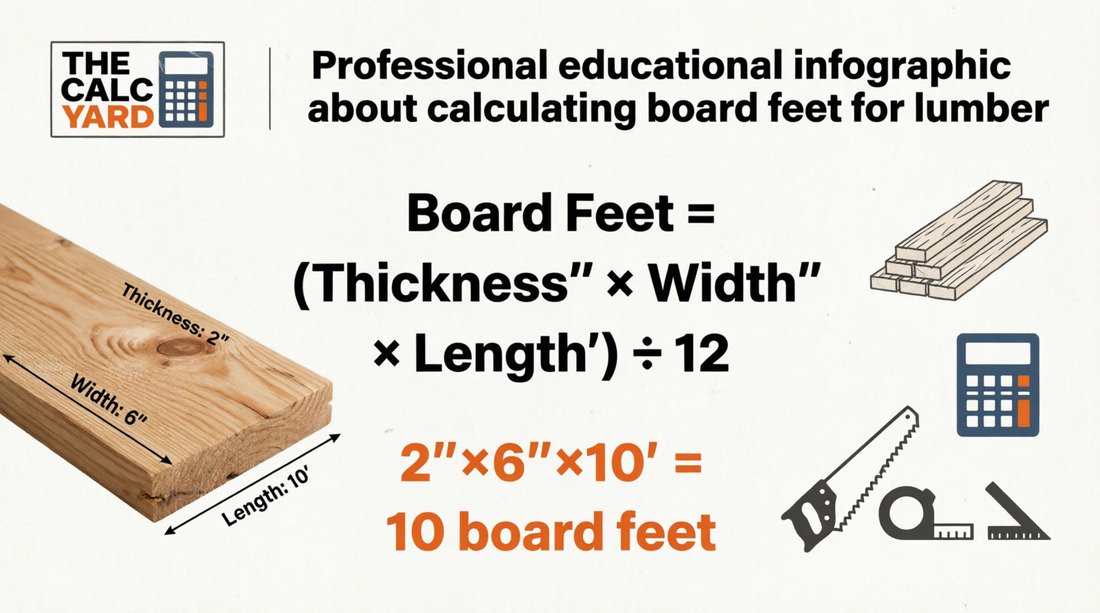
Board feet = (Thickness in inches × Width in inches × Length in feet) ÷ 12
Below you’ll find step-by-step examples for single boards and whole projects, the nominal-vs-actual thickness trap that causes most errors, and how log rules estimate board feet in a log. If you’d rather skip the arithmetic, TheCalcYard’s board foot calculator does the tally for you.
What Is a Board Foot, Exactly?
A board foot measures volume, not area. The easiest way to picture it: one board foot is one square foot of wood surface at one inch thick. Because it’s a volume, shape doesn’t matter; a skinny 6-foot board and a wide, short offcut can contain the same board footage.
Useful equivalents:
| Unit | Equivalent to 1 Board Foot |
|---|---|
| Cubic inches | 144 in³ |
| Cubic feet | 1/12 ft³ (≈ 0.0833 ft³) |
| Liters | ≈ 2.36 L |
| Coverage | 1 sq ft of surface at 1″ thick |
Why does the unit exist? Hardwood is typically sold in random widths and lengths, so counting pieces or square footage wouldn’t tell you how much wood you’re actually getting. Volume does, and thickness is part of that volume. You’ll also see wholesale lumber priced per MBF, which means 1,000 board feet.
The Board Foot Formula: Three Equivalent Forms
Use whichever matches the units in front of you:
| Form | Formula | When to Use |
|---|---|---|
| Standard | BF = (Thickness × Width × Length in feet) ÷ 12 | Most common—length is in feet |
| All inches | BF = (Thickness × Width × Length in inches) ÷ 144 | When all measurements are in inches |
| Surface area | BF = Surface area in sq ft × Thickness in inches | Fastest for panels and tabletops |
Where does the ÷ 12 come from? A board foot is 144 cubic inches, and 1 foot equals 12 inches. If your length is in feet, converting to inches and dividing by 144 simplifies to just dividing by 12. Same math, fewer steps.
Form 3 works because 1 board foot covers exactly 1 square foot at 1 inch thick, so a 4/4 tabletop covering 15 square feet contains 15 board feet of wood.
How to Calculate Board Feet in Lumber: Worked Examples
Example 1: A Single Board
A board is 2″ thick, 6″ wide, and 10 feet long:
(2 × 6 × 10) ÷ 12 = 120 ÷ 12 = 10 board feet
Example 2: A 5/4 Hardwood Board
“5/4” (said “five-quarter”) is nominal 1.25″ thickness. A 5/4 board 8″ wide and 6 feet long:
(1.25 × 8 × 6) ÷ 12 = 60 ÷ 12 = 5 board feet
At a hypothetical $6 per board foot, that board costs $30. (Prices vary widely by species, grade, and region — this is illustration only.)
Example 3: The Per-Lineal-Foot Shortcut
Board feet per foot of length = Thickness × Width ÷ 12. A few common nominal sizes:
| Nominal Size | Board Feet per Linear Foot |
|---|---|
| 1×6 | 0.5 |
| 1×8 | 0.67 |
| 1×12 | 1.0 |
| 2×4 | 0.67 |
| 2×6 | 1.0 |
| 2×8 | 1.33 |
| 2×10 | 1.67 |
| 2×12 | 2.0 |
So an 8-foot 2×6 contains 8 board feet — no calculator needed.
Example 4: A Whole Project
You’re building a tabletop 6 ft × 30 in out of 4/4 lumber:
- Area: 6 × 2.5 = 15 sq ft
- Board feet: 15 sq ft × 1″ thick = 15 BF
Most woodworkers add roughly 10–20% for waste, defects, and grain matching; that’s 16.5–18 BF, so plan to buy around 17 board feet.
Example 5: Tallying a Small Order
Three boards: 6 BF + 5 BF + 7.5 BF (that last one is an 8/4 board, 9″ wide, 5′ long: 2 × 9 × 5 ÷ 12 = 7.5) = 18.5 BF total. At $6/BF, the order is about **$111.**
Nominal vs. Actual Thickness: The Mistake That Skews Your Numbers
Here’s the rule that trips people up: lumber is bought and sold by nominal dimensions, the rough size before surfacing, not the measured size of the finished board. Surfaced 4/4 hardwood commonly comes in around 13/16″ thick, though the exact dimension varies by mill, but you still tally and price it as a full 1″. Don’t measure a surfaced board and recalculate; the sale is based on nominal.
The “Quarters” System for Hardwood
Hardwood thickness is expressed in quarter-inches:
| Hardwood Label | Nominal Thickness |
|---|---|
| 4/4 | 1″ |
| 5/4 | 1.25″ |
| 6/4 | 1.5″ |
| 8/4 | 2″ |
| 10/4 | 2.5″ |
| 12/4 | 3″ |
Softwood Dimensional Lumber
A 2×4 is counted as 2″ × 4″ in board foot math even though it measures about 1.5″ × 3.5″ dressed. In practice, softwood dimension lumber is usually priced by the piece or by the linear foot, so board foot math shows up mostly with hardwood, rough-sawn stock, and slabs.
Rule of thumb: Use nominal dimensions for buying and tallying; use actual dimensions when fitting parts together in the shop.
Nominal vs. Actual Reference Table
| Nominal Size | Actual Size |
|---|---|
| 1×4 | 3/4″ × 3-1/2″ |
| 2×4 | 1-1/2″ × 3-1/2″ |
| 2×6 | 1-1/2″ × 5-1/2″ |
| 2×8 | 1-1/2″ × 7-1/4″ |
| 2×10 | 1-1/2″ × 9-1/4″ |
| 2×12 | 1-1/2″ × 11-1/4″ |
| 4×4 | 3-1/2″ × 3-1/2″ |
How to Tally Board Feet for a Lumber Order
For multiple boards, calculate each one and add the results. In standard hardwood trade practice, a tally uses:
- Nominal thickness (quarters)
- Width, rounded to the nearest whole inch
- Length, tallied in whole feet (conventions vary by seller)
Important: Individual sellers’ tallying methods can vary slightly, so expect small differences between your estimate and the invoice.
Practical notes:
- Cost: Total board feet × price per board foot. If a price is quoted per MBF, divide by 1,000; $600/MBF is $0.60/BF.
- Waste: Finished projects almost always consume more lumber than the parts list suggests, because of cuts, defects, and matching grain. A 10–20% cushion is common practice, but the right number depends on the species, the design, and how selective you are.
How to Calculate Board Feet in a Log
A log’s board footage is an estimate of yield: how many board feet of lumber a mill could reasonably saw from it. These estimates come from log rules, and North America uses three standard ones: Doyle, Scribner, and International ¼-inch.
Measuring Log Diameter Correctly
All log rules start from two measurements:
| Measurement | How to Measure |
|---|---|
| D | Small-end diameter, measured inside the bark, in inches (average two perpendicular measurements for irregular logs) |
| L | Log length, in feet (standard lengths: 8, 10, 12, 14, 16 feet; any extra is trim allowance) |
Why the small end? The small end is the most restrictive part of the log — the sawyer must cut boards that will fit through this end. Measuring inside the bark is critical; including bark overestimates the board footage.
For irregular logs: Take two diameter measurements at right angles, average them, and round to the nearest inch.
The Doyle Rule
The simplest and most widely used rule in private timber transactions, especially in the eastern US for hardwoods.
Formula:
BF = ((D - 4)² × L) ÷ 16
Worked Example:
A 16″ diameter, 16-foot log:
BF = ((16 - 4)² × 16) ÷ 16
BF = (12² × 16) ÷ 16
BF = 144 board feet (Doyle scale)
Strengths & weaknesses: Doyle is simple and widely understood. Its weakness is built into the formula: subtracting a flat 4 inches means it underestimates small logs and slightly overestimates very large ones.
The International ¼-Inch Rule
The International ¼-Inch Rule is generally regarded as the most accurate of the three log rules. It accounts for log taper and saw blade thickness.
Unlike Doyle, the International rule uses a table rather than a single formula:
| Diameter (inches) | 8 ft log | 10 ft log | 12 ft log | 14 ft log | 16 ft log |
|---|---|---|---|---|---|
| 6 | 10 | 15 | 15 | 20 | 20 |
| 8 | 15 | 25 | 30 | 35 | 40 |
| 10 | 30 | 40 | 50 | 60 | 65 |
| 12 | 45 | 55 | 70 | 85 | 95 |
| 14 | 65 | 80 | 100 | 115 | 130 |
| 16 | 85 | 110 | 130 | 155 | 180 |
| 18 | 110 | 140 | 170 | 200 | 230 |
| 20 | 140 | 175 | 210 | 250 | 290 |
| 22 | 170 | 215 | 260 | 305 | 355 |
| 24 | 205 | 260 | 315 | 370 | 430 |
Table values adapted from USDA Forest Service and University of Missouri Extension data.
To use this table:
- Find the diameter of the small end of the log (inside bark) in the left column
- Find the length of the log across the top
- The intersection is the estimated board feet
For a 16″ diameter, 16-foot log: approximately 180 board feet (International ¼” rule).
The Scribner Rule
Commonly used in the Western United States and Pacific Northwest for softwood lumber. Developed from diagrams of log cross-sections showing how 1-inch-thick boards could be sawn from a log.
Key points:
- No simple formula — referenced via tables or scale sticks
- For a 16″ diameter, 16-foot log: commonly cited as approximately 150 board feet
- Moderately accurate for small to medium logs
- Widely used in commercial softwood transactions
Same Log, Different Answer: A Comparison
The choice of log rule significantly affects the estimate:
| Log | Doyle | Scribner | International ¼” |
|---|---|---|---|
| 8″ × 8′ | 8 BF | ≈ 13 BF | ≈ 15 BF |
| 16″ × 16′ | 144 BF | ≈ 150 BF | ≈ 180 BF |
Important: Always clarify which log rule the seller or buyer is using before agreeing to a price. If you’re unsure, ask the buyer/seller directly — this is standard practice in timber transactions.
Why Don’t the Numbers Match Reality Exactly?
Real yield depends on:
- Log taper — the difference in diameter between the small and large ends
- Defects — knots, rot, checking, or other imperfections
- Sawing method — plain-sawn, quarter-sawn, or live-sawn
- Saw kerf — the thickness of the saw blade removes wood that becomes sawdust
As a rough sanity check: 1 cubic foot of solid wood equals 12 board feet. Sawing turns much of the rest of the log into slabs, edgings, and sawdust, actual recovery varies widely by species, log quality, and milling setup.
Bottom line: Treat any log rule result as a planning estimate, not a guarantee. Actual yield may differ significantly from the estimate, particularly for logs with significant defects or taper.
Common Board Foot Mistakes
| Mistake | What Happens | Fix |
|---|---|---|
| Measuring surfaced lumber and using actual thickness | Undercounts hardwood board feet (and your budget) | Always tally by nominal size (4/4 = 1″, etc.) |
| Mixing inches and feet (÷ 12 vs ÷ 144) | Results off by a factor of 12 | ÷ 12 when length is in feet; ÷ 144 when everything is inches |
| Rounding inconsistently during the tally | Small per-board errors compound across an order | Apply trade conventions: width to nearest inch, length to whole feet |
| Treating a log scale as a promise | Disappointment at the mill | Remember all log rules are yield estimates |
| Skipping the waste allowance | Mid-project lumber runs short | Add ~10–20% depending on the project |
| Measuring diameter at the wrong end | Overestimates board footage | Always measure at the small end |
| Including bark in log diameter | Overestimates board footage | Measure inside the bark |
Skip the Math: Use the Board Foot Calculator
Once you’re tallying a dozen boards with fractional thicknesses, hand math gets error-prone. The board foot calculator on TheCalcYard lets you enter thickness, width, length, and quantity, then totals the board footage for the whole order, handy for double-checking a quote before you pay.
Try TheCalcYard Board Foot Calculator: https://thecalcyard.com/board-foot-calculator/
Frequently Asked Questions
Q: How many board feet is a 2×4 that’s 8 feet long?
A: (2 × 4 × 8) ÷ 12 = 5.33 board feet, using nominal dimensions. In practice, softwood studs are usually sold by the piece, not the board foot.
Q: Why do I divide by 12?
A: Because thickness and width are in inches but length is in feet. Dividing by 12 reconciles the mixed units against the 144-cubic-inch definition of a board foot. If your length is already in inches, divide by 144 instead.
Q: Is a board foot the same as a square foot?
A: No. A square foot measures area only; a board foot adds thickness. A surface covering X square feet contains X board feet of wood only if it’s 1 inch thick (BF = sq ft × thickness in inches). Also note that plywood and other panel goods aren’t sold by the board foot; they’re priced per sheet by thickness.
Q: Should I use actual or nominal thickness?
A: Nominal for buying, selling, and tallying. Actual dimensions only matter for how parts fit in your build.
Q: How accurate is the Doyle rule?
A: It’s an estimate. Doyle noticeably underestimates small logs and overestimates very large ones; the International ¼” rule generally tracks actual mill yield more closely. Always confirm which rule a timber buyer or seller is using.
Q: What does MBF mean?
A: One thousand board feet. A price of $900/MBF equals $0.90 per board foot.
Q: How do I convert board feet to cubic units?
A: 1 BF = 144 cubic inches = 1/12 cubic foot ≈ 0.00236 cubic meters. Going the other way: 1 cubic foot = 12 BF, and 1 cubic meter ≈ 423.8 BF.
Q: How much extra lumber should I buy beyond the calculated board feet?
A: A common cushion is 10–20% above your calculated board footage, depending on the number of parts, the species’ defect rate, and how much you care about matching grain and color across pieces.
Q: How do I measure a log that isn’t perfectly round?
A: Take two diameter measurements at right angles, average them, then round to the nearest inch. This provides a more accurate average diameter for the log rule calculation.
Q: Should I factor defects into my log calculations?
A: Yes. If you can see rot, large knots, or other defects, actual usable lumber will be less than the log rule estimate. Some buyers will deduct for defects during inspection.
Conclusion
Board feet come down to one formula, thickness × width × length ÷ 12, plus two habits that keep the math honest: tally by nominal dimensions and keep your units straight. For logs, remember that any board foot figure from Doyle, Scribner, or International ¼” is a yield estimate shaped by the rule you choose.
Run a hand calculation on a board or two so the unit makes sense, then let a calculator handle the full tally.
For fast, reliable board foot calculations on any project, visit TheCalcYard’s Board Foot Calculator.
1 thought on “How to Calculate Board Feet: Formula, Examples, and Log Rules”