
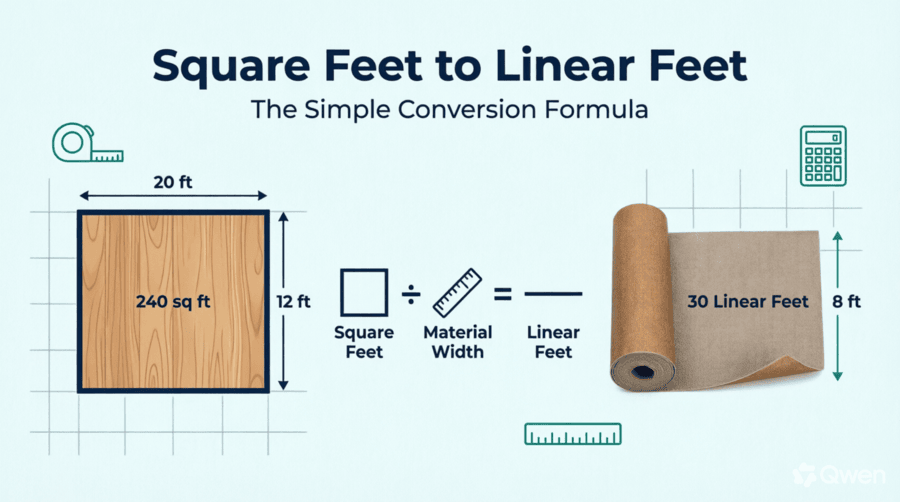
You need to convert square feet to linear feet, but the supplier quotes the material by length. These two measurements are different, so there is no fixed conversion that works for every material. You need one more number first: the width of the material.
Linear feet = Square feet ÷ Material width (in feet)
For example, if you need 240 square feet of material that comes in an 8-foot width:
240 ÷ 8 = 30 linear feet
Change the width and the answer changes too. That’s the entire concept behind this conversion, and once you understand why, the math takes seconds.
Square Feet vs. Linear Feet: What’s the Difference
Square feet (sq ft) measure area, a two-dimensional space. A 10-foot by 20-foot room covers 10 × 20 = 200 sq ft.
Linear feet (LF) measure length along a single line, with no width involved. A 12-foot countertop has 12 linear feet, whether it’s 20 inches deep or 30 inches deep.
Because square feet already include width in the calculation and linear feet don’t, converting between them only works once you introduce (or remove) that width. This is why 240 square feet can equal 60 linear feet, 40 linear feet, or 20 linear feet, depending entirely on how wide the material is:
| Square Feet | Material Width | Linear Feet Needed |
|---|---|---|
| 240 sq ft | 2 ft | 120 LF |
| 240 sq ft | 3 ft | 80 LF |
| 240 sq ft | 4 ft | 60 LF |
| 240 sq ft | 5 ft | 48 LF |
| 240 sq ft | 6 ft | 40 LF |
| 240 sq ft | 8 ft | 30 LF |
| 240 sq ft | 10 ft | 24 LF |
| 240 sq ft | 12 ft | 20 LF |
This table applies only to 240 square feet. For any other area, run the formula with your own numbers rather than scaling the table.
How to Convert Square Feet to Linear Feet
The formula
Linear feet = Square feet ÷ Width in feet
Example: You need 240 square feet of material that’s 6 feet wide.
240 ÷ 6 = 40 linear feet
Example: The same 240 square feet, but the material is only 4 feet wide.
240 ÷ 4 = 60 linear feet
Narrower material always requires more linear feet to cover the same area, because each linear foot of it covers less surface.
When the width is given in inches
Most rolled materials, like fabric, vinyl, or laminate, are sold in widths measured in inches (12″, 24″, 36″, 48″, 54″). Convert to feet before dividing, or use this version of the formula directly:
Linear feet = (Square feet × 12) ÷ Width in inches
Example: 240 square feet of 48-inch-wide material.
240 × 12 ÷ 48 = 60 linear feet
That matches converting 48 inches to 4 feet first and dividing 240 by 4. Either method works; just don’t divide square feet by a width that’s still in inches; the units won’t match, and the result will be wrong.
How to Convert Linear Feet to Square Feet (the Reverse Calculation)
If you already know the linear footage and the width, multiply instead of divide:
Square feet = Linear feet × Width in feet
Example: 40 linear feet of 6-foot-wide material.
40 × 6 = 240 sq ft
If the width is in inches:
Square feet = (Linear feet × Width in inches) ÷ 12
Example: 40 linear feet of 48-inch-wide material.
40 × 48 ÷ 12 = 160 sq ft
Worked Examples by Material
Carpet
Carpet rolls have a fixed width, commonly 12 feet, while a room’s needs are usually calculated in square feet.
A room needs 240 sq ft of carpet, and the roll is 12 feet wide:
240 ÷ 12 = 20 linear feet
That 20 linear feet is the raw material length for 240 sq ft of coverage. It doesn’t account for seams, pattern matching, staircases, or trimming around obstacles, so you often order more than the pure area calculation.
Fabric
Fabric is typically sold by the linear yard or linear foot, based on a fixed bolt width.
You need 240 sq ft of fabric that’s 54 inches wide.
Convert the width: 54 ÷ 12 = 4.5 feet
Then divide: 240 ÷ 4.5 = 53.33 linear feet
Since fabric is usually cut and sold in whole-foot or half-yard increments, you’d round up to at least 54 linear feet, and add extra for pattern repeats if the fabric has one.
Countertops
Countertops are usually discussed in linear feet (the run along the cabinets), but square footage matters for estimating slab material or sealant coverage.
A countertop run is 25 linear feet, 25.5 inches deep.
Convert depth to feet: 25.5 ÷ 12 = 2.125 feet
Multiply: 25 × 2.125 = 53.125 sq ft
This shows why “25 linear feet of countertop” alone doesn’t tell you the surface area; you need the depth too.
Trim and Baseboard
Trim is bought by linear feet because you only care about total length, not coverage. If your room needs 40 linear feet of baseboard, you need 40 feet of material, plus extra to cover waste from mitered corners and doorway cuts. You normally don’t need to convert baseboard to square feet.
Fencing
Fencing is measured in linear feet along the property line, but that number alone doesn’t tell you how much fence surface you’re covering (relevant for paint, stain, or panel counts).
A fence line is 200 linear feet, and the fence is 6 feet tall:
200 × 6 = 1,200 sq ft of surface area on one side
Lumber
Lumber is sometimes priced by the linear foot, but don’t confuse that with board feet, which measure volume (length × width × thickness), not length.
A board is 12 feet long and 6 inches (0.5 ft) wide. Its face area is:
12 × 0.5 = 6 sq ft
Its length is still 12 linear feet regardless of width or thickness. If you’re pricing lumber by volume rather than length or face area, use board feet instead; our board foot calculator handles that conversion directly, and our guide on how to calculate board feet walks through the formula and log rules in detail.
Common Mistakes to Avoid
Assuming a fixed ratio exists. “240 sq ft = 40 linear ft” is only true for 6-foot-wide material. Change the width and the answer changes.
Dividing by a width still in inches. 240 ÷ 48 mixes square feet with inches and gives a meaningless number. Convert to feet (or use the ×12 formula) first.
Treating the area calculation as your final order quantity. Square-footage-to-linear-footage math tells you the raw amount needed to cover an area. It doesn’t include waste from seams, cuts, pattern repeats, or irregular room shapes. Add a buffer (commonly 5 to 15 percent, depending on the material and how complex the layout is) before placing an order.
Confusing linear feet with board feet. Linear feet measure length only. Board feet measure volume and require thickness as well as width. They are not interchangeable terms.
Is “Linear Square Feet” a Real Unit?
No. “Linear square feet” isn’t a standard measurement; it mixes a one-dimensional term (linear feet) with a two-dimensional one (square feet). People sometimes use the phrase loosely to mean “the length and coverage of a material,” but for any actual calculation, use square feet for area and linear feet for length, and convert between them with the material width when needed.
Frequently Asked Questions
How many linear feet is 1 ft?
One foot of length equals 1 linear foot. “Linear” just specifies that you’re measuring length, not area.
What is 12×12 in linear feet?
A 12-inch length is 1 linear foot. A 12-inch by 12-inch area is 1 square foot, a different measurement. If you’re converting that 1 square foot into linear feet, you still need the material width. At a 12-inch (1 ft) width, 1 sq ft ÷ 1 ft = 1 linear foot.
How many linear feet are in 240 sq ft?
It depends on the material width. Divide 240 by the width in feet: 60 LF at 4 feet wide, 40 LF at 6 feet wide, 30 LF at 8 feet wide, and so on.
Is linear the same as square feet?
No. Linear feet measure length only. Square feet measure area (length × width).
How do I convert sq ft to linear feet?
Divide the square footage by the material’s width in feet: Linear feet = Square feet ÷ Width.
How do I convert linear ft to sq ft?
Multiply the linear footage by the material’s width in feet: Square feet = Linear feet × Width.
How do I calculate linear feet?
For a straight run, measure and add up the lengths directly. To derive linear feet from a known area, divide the square footage by the material width.
What does 25 linear feet mean?
It means 25 feet of length. The area it covers depends on the material’s width; for example, 25 linear feet of 4-foot-wide material covers 100 sq ft (25 × 4).
How much is 40 linear feet?
40 linear feet is 40 feet of length. At 5 feet wide, that covers 200 sq ft; at 2 feet wide, it covers 80 sq ft.
What is 200 linear feet in feet?
200 linear feet equals 200 feet. It’s not a measure of area or volume, just straight-line length.
How long is 2 linear feet?
2 linear feet is 2 feet, or 24 inches, of length.
What is 8 ft in linear feet?
8 feet equals 8 linear feet. The same applies to any length: 12 ft = 12 linear ft, 15 ft = 15 linear ft.
What is linear ft vs sqft?
Linear feet describe length only. Square feet describe area. A 10-foot piece that’s 2 feet wide is 10 linear feet and 20 square feet (10 × 2) at the same time; they’re just two different measurements of the same object.
The Bottom Line
Square feet and linear feet measure different things, so converting between them always requires the material’s width. Once you have that number, the math is simple division or multiplication:
- Linear feet = Square feet ÷ Width
- Square feet = Linear feet × Width
Get the width right, keep your units consistent (convert inches to feet before dividing), and add a reasonable buffer for waste before you place an order.
1 thought on “Square Feet to Linear Feet: How to Convert Using Material Width”