
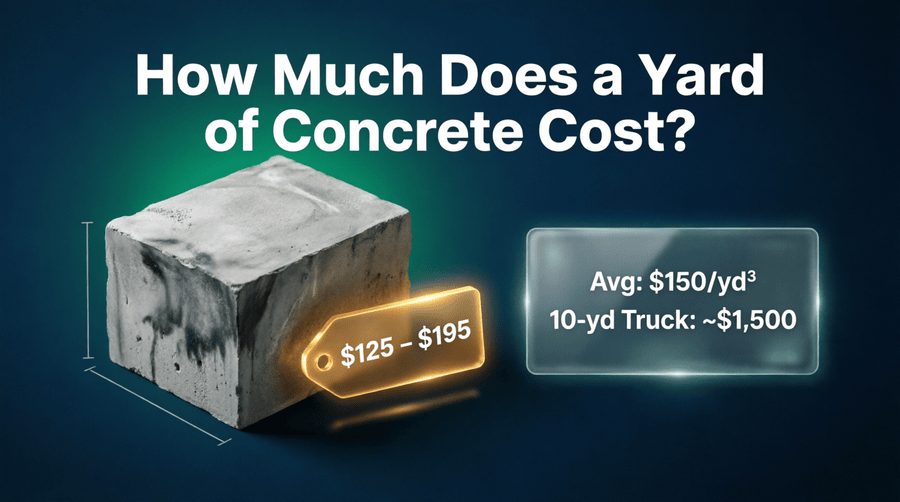
If you are wondering how much does a yard of concrete cost, the short answer is that a cubic yard of ready-mix concrete typically ranges from $125 to $195 delivered in most U.S. markets in 2026. This includes a common planning midpoint near $150 to $165 per cubic yard for a standard 3,000 PSI residential mix delivered inside the plant’s normal service radius. A full 10-yard truckload usually lands somewhere between $1,250 and $1,950.
That range is wider than most cost articles admit, and there is a reason for it. Published figures disagree because they are measuring different things. Some quote the material only. Some quote material plus delivery. Some are built on industry averages that are a year or two old by the time they are republished. HomeGuide’s 2026 guide puts delivered concrete at $119 to $147 per cubic yard including delivery up to 20 miles, Angi reports an average near $130 per cubic yard with a typical range of $110 to $150, while Concrete Network reports a nationwide range of $160 to $195 per cubic yard and a 2025 average ready-mix price of $179.95. The NRMCA-derived weighted average that several calculators cite for 2024 sits around $179.89 per cubic yard.
None of those is wrong. They are different samples, different years, and different definitions of “the price.”
What this guide gives you instead of a single misleading number: how to calculate your own cubic yards, how to convert a per-yard quote into the number that actually lands on your invoice, and what the fees are that turn a $150 quote into a $260 effective cost on a small pour.
To get your volume in under a minute, run your dimensions through the concrete calculator before you call a single supplier. Yardage first, then price.
Quick Answer: What You Can Expect to Pay
| What you are pricing | Typical 2026 figure | What it covers |
|---|---|---|
| Ready-mix, delivered | $125 to $195 per yd³ | Standard residential mix, delivery inside the plant’s included radius |
| Common planning midpoint | About $150 to $165 per yd³ | Reasonable single number for a first budget |
| Full 10-yard truckload | About $1,250 to $1,950 | Standard mix, full load, no short-load penalty |
| High-strength or specialty mix | Add roughly $15 to $40 per yd³ | 4,000 to 5,000 PSI, fiber, colour, accelerators |
| Bagged concrete equivalent | Roughly $225 to $330 per yd³ | Convenient for tiny pours, expensive by volume |
| Plain concrete poured and finished | About $6 to $12 per sq ft | Material plus labour, not just the concrete |
Treat every figure here as a planning range, not a quote. Ready-mix is a local commodity with a short delivery radius, so the only number that is truly accurate is the one your nearest plant gives you for your volume, your mix, and your delivery date.
What “a Yard of Concrete” Actually Means
When a supplier says “a yard,” they mean one cubic yard, a unit of volume:
1 cubic yard = 27 cubic feet = a 3 ft by 3 ft by 3 ft cube
This trips people up because “yard” on its own is a length, and “square yard” is an area. Concrete is sold by volume because the plant is batching and hauling a specific quantity of wet material, not covering a surface.
One cubic yard weighs roughly 3,700 to 4,050 pounds, which is why a truck carrying 10 yards is running near its legal load limit and why plants care so much about delivery distance. Weight is also the reason a “partial load” costs a plant almost as much to deliver as a full one.
If you are working between units, the cubic yard calculator and this walkthrough of converting cubic feet to cubic yards handle the arithmetic.
How Much Does a Yard of Concrete Cost Delivered?
The advertised per-yard price is the starting point, not the bill. A delivered invoice can include any combination of the following.
| Charge | Typical 2026 figure | When it applies |
|---|---|---|
| Concrete material | $125 to $195 per yd³ | Always |
| Delivery inside the included radius | Often built into the per-yard price | Commonly 15 to 20 miles from the plant |
| Mileage beyond the radius | Roughly $5 to $15 per yd³, or a per-mile rate | Job site outside the free zone |
| Short-load fee | Roughly $25 to $75 per yd³ below the minimum, or a flat $50 to $150 | Orders under about 8 to 10 yd³ |
| Weekend or after-hours delivery | Roughly $80 to $150 per load | Saturday pours, early or late scheduling |
| Excess unloading time | Often charged per minute past 5 to 10 free minutes per yard | Slow pours, poor access, undermanned crews |
| Pump truck | Roughly $500 to $1,500 | Truck cannot reach the pour area |
| Fuel or environmental surcharge | Supplier-specific | Increasingly common as a line item |
| Sales tax | Varies by state and locality | Usually on material |
HomeGuide’s published model, for instance, adds $9.50 per mile beyond 20 miles and $53 per yard below a 10-yard minimum. That is one supplier-pricing model, not a national fee schedule. Your plant may structure it entirely differently.
The practical takeaway: ask for the total delivered price for your exact order, then divide it yourself.
The Number That Actually Matters: Effective Cost Per Yard
Effective cost per cubic yard = total invoice ÷ cubic yards delivered
This single calculation explains almost every “why was my concrete so expensive?” complaint.
Say a supplier quotes $155 per cubic yard with a $175 delivery charge and a $60 per yard short-load fee on orders under 6 yards.
Ordering 8 cubic yards:
- Material: 8 × $155 = $1,240
- Delivery: $175
- Short-load: none
- Total: $1,415
- Effective: $1,415 ÷ 8 = $176.88 per yard
Ordering 2 cubic yards:
- Material: 2 × $155 = $310
- Delivery: $175
- Short-load: 2 × $60 = $120
- Total: $605
- Effective: $605 ÷ 2 = $302.50 per yard
The concrete did not get more expensive. The fixed costs got spread over a quarter as much material. This is the central economics of buying concrete, and it is why a 1-yard order can cost nearly as much as a 3-yard order in absolute dollars.
Consequence worth thinking about: if you are ordering 4 yards and a full-rate minimum kicks in at 6, price both. Ordering the extra material and using it for a walkway pad or a set of post footings sometimes costs less than paying the short-load penalty on the smaller order.
How to Calculate How Many Cubic Yards You Need
Price per yard is useless until you know your yardage. For a rectangular slab:
Cubic yards = length (ft) × width (ft) × thickness (in) ÷ 324
The 324 comes from 27 cubic feet per yard × 12 inches per foot. If you prefer the long way:
- Convert thickness to feet: thickness (in) ÷ 12
- Multiply: length × width × thickness (ft) = cubic feet
- Divide by 27 = cubic yards
Worked example, 12 ft by 16 ft patio at 4 inches:
12 × 16 × 4 ÷ 324 = 768 ÷ 324 = 2.37 cubic yards
Check it the long way: 4 ÷ 12 = 0.333 ft. 12 × 16 × 0.333 = 64 cubic feet. 64 ÷ 27 = 2.37. Same answer.
For footings, post holes, round pads, steps, or an L-shaped pour, break the job into simple shapes and add the volumes, or use the concrete calculator, which handles slabs, footings, columns, and multiple identical sections in one pass and outputs cubic yards, cubic feet, cubic metres, bag count, truckloads, and estimated cost. For setting posts specifically, the volume maths is different enough to deserve its own treatment: see how much concrete fence posts need.
How Much Waste Should You Add?
A 5% to 10% overage is the common planning allowance, and the calculator has a field for it. Whether you use the low or high end depends on the job:
- Toward 5%: tight forms on a flat, compacted, screeded subgrade with measurements you took twice
- Toward 10% or more: uneven or soft subgrade, hand-dug footings, irregular shapes, forms that may bow, a long haul from truck to form
Running short mid-pour is the expensive failure. A second truck means a second delivery charge, a short-load fee, and a potential cold joint where the fresh concrete meets concrete that has already begun to set. Ordering half a yard too much costs you a small surplus you can dump into a spare form.
How Much Does a Yard of Concrete Cover?
One cubic yard is 27 cubic feet, so coverage is simply 324 ÷ thickness in inches.
| Slab thickness | Coverage per cubic yard | Yards needed per 100 sq ft |
|---|---|---|
| 2 inches | 162 sq ft | 0.62 |
| 3 inches | 108 sq ft | 0.93 |
| 4 inches | 81 sq ft | 1.23 |
| 5 inches | 64.8 sq ft | 1.54 |
| 6 inches | 54 sq ft | 1.85 |
| 8 inches | 40.5 sq ft | 2.47 |
| 12 inches | 27 sq ft | 3.70 |
At 4 inches thick, one cubic yard covers 81 square feet.
These are exact volume conversions, not field results. Real coverage drops when the subgrade dips, when forms spread, or when a “4-inch” slab is really 4.5 inches in the middle because nobody screeded the base flat. An extra half-inch of average thickness across a 400 sq ft slab adds about 0.6 cubic yards, which is a real amount of money.
Cost by Project Size
The figures below are concrete and delivery only, calculated at $125 to $195 per cubic yard, before short-load fees and before any labour, base, forms, or reinforcement. Volumes include no waste allowance.
| Slab | Thickness | Cubic yards | Concrete delivered |
|---|---|---|---|
| 10 × 10 (100 sq ft) | 4 in | 1.23 | $154 to $241 |
| 10 × 12 (120 sq ft) | 4 in | 1.48 | $185 to $289 |
| 12 × 16 (192 sq ft) | 4 in | 2.37 | $296 to $462 |
| 12 × 20 (240 sq ft) | 4 in | 2.96 | $370 to $577 |
| 20 × 20 (400 sq ft) | 4 in | 4.94 | $617 to $963 |
| 20 × 20 (400 sq ft) | 5 in | 6.17 | $772 to $1,204 |
| 20 × 20 (400 sq ft) | 6 in | 7.41 | $926 to $1,444 |
| 24 × 24 (576 sq ft) | 4 in | 7.11 | $889 to $1,386 |
Two things stand out. First, every job under about 5 yards is short-load territory at most plants, so add the surcharge before you trust the low end of these ranges. Second, thickness is expensive: taking a 20 × 20 slab from 4 inches to 6 inches adds 2.47 cubic yards, roughly 50% more concrete.
What a 20 × 20 Slab Actually Costs to Pour
This is where most cost articles quietly mislead people. A 20 × 20 slab at 4 inches needs 4.94 cubic yards, so the concrete runs roughly $620 to $960 delivered. The finished slab costs considerably more, because the concrete is often less than half the job.
A complete pour typically also involves:
- Grading and excavation
- A compacted gravel or crushed-stone base (price yours with the gravel calculator)
- Forms and stakes
- Reinforcement (rebar or welded wire, where the design calls for it)
- Vapour retarder, where the slab is enclosed or heated
- Placing, screeding, floating, edging, jointing, and finishing labour
- Control joint cutting
- Curing, and sometimes sealing
- A pump, if the truck cannot back to the form
- Permits, where required
Plain concrete poured and finished by a contractor generally runs about $6 to $12 per square foot, with colored, stamped, or stained finishes at roughly $8 to $18 per square foot. At those rates a 400 sq ft slab commonly lands somewhere between $2,400 and $4,800 installed. If a bid comes in near the material cost, that bid is not including labour.
Ready-Mix vs Bags: Where the Crossover Sits
Bagged concrete has no minimum order, no delivery fee, and no short-load penalty. It is also far more expensive per unit of volume and enormously more work.
Bag yields vary by product, so always use the yield printed on the bag. Common approximate yields:
| Bag size | Approximate yield | Bags per cubic yard |
|---|---|---|
| 40 lb | 0.30 cu ft | About 90 |
| 50 lb | 0.375 cu ft | About 72 |
| 60 lb | 0.45 cu ft | About 60 |
| 80 lb | 0.60 cu ft | About 45 |
Bags needed = required cubic feet ÷ yield per bag, rounded up.
At a typical $5 to $7 per 80 lb bag, one cubic yard of bagged concrete works out to roughly $225 to $315 in material, before you account for a mixer rental and several hours of labour. That is meaningfully more than ready-mix per yard, and it arrives one 80-pound sack at a time.
Rough guide to the crossover:
- Under about 0.5 cubic yards (post holes, a small pad, a repair): bags almost always win
- 0.5 to 1.5 cubic yards: genuinely close, and it depends on your plant’s minimum and short-load policy
- Above about 1.5 to 2 cubic yards: ready-mix usually wins on total cost, and wins decisively on time, consistency, and finish quality
The quality argument matters as much as the price one. Forty-five hand-mixed bags will not have consistent water content, and a large slab poured in batches over three hours risks cold joints. For a full bag-count breakdown on a common size, see how many bags of concrete a 10 × 10 slab needs.
What Drives Your Price Up or Down
Mix strength (PSI). Higher strength means more cement per yard, and cement is the expensive ingredient. A standard 3,000 PSI residential mix sits at the bottom of the range; 4,000 to 5,000 PSI mixes and fibre-reinforced or colored mixes typically add $15 to $40 per yard. Do not down-spec strength to save money. The mix should follow the application, the load, the exposure conditions, and local code.
Location. Ready-mix cannot travel far before it starts setting, so you are buying from a local market with local aggregate, fuel, labour, and demand conditions. Urban markets with high land and labour costs price well above rural plants near a quarry. This is the single biggest reason national averages should be treated as a sanity check rather than a budget.
Order size. The dominant factor for homeowners. Fixed costs per delivery do not scale down.
Distance from the plant. Most plants include 15 to 20 miles in the per-yard price and charge beyond it.
Timing. Saturday pours, after-hours delivery, rush orders, and peak-season scheduling all carry surcharges at many plants. Hot-weather or cold-weather mixes with accelerators or retarders add cost.
Site access. If the chute cannot reach the form, you are renting a pump or paying a crew to wheelbarrow it, and both are expensive.
How to Compare Quotes Without Getting Burned
Call two or three plants and ask every one of these:
- Price per cubic yard for the mix you need, by PSI
- What the minimum order is
- Whether a short-load fee applies, and how it is structured
- What delivery radius is included, and the charge beyond it
- Whether there is a fuel or environmental surcharge
- How much unloading time is included, and the rate after that
- Whether weekend or after-hours delivery costs extra
- Whether tax is included in the quoted figure
- The total delivered price for your exact yardage
Then compare the totals. A plant at $145 per yard with a $200 delivery charge and a $75 per yard short-load fee is more expensive on a 3-yard order than a plant at $170 per yard with delivery included and a 3-yard minimum. Sticker price ranks suppliers badly; effective cost per yard ranks them correctly.
Where People Lose Money
Trusting a national average. The published figures for 2026 span $110 to $195 per yard. That spread is the whole ballgame on a small job.
Ordering exactly the calculated volume. No allowance, uneven base, and you are ordering a second truck.
Measuring the excavation instead of the form. Calculate the space concrete will actually occupy, not the hole you dug.
Forgetting to convert inches to feet. Multiplying 12 × 16 × 4 without dividing by 12 or 324 answers 12 times too large. If your yardage looks implausible, this is usually why.
Treating an irregular pour as a rectangle. Break L-shapes, thickened edges, and steps into separate volumes.
Not having the crew ready. Concrete starts setting on arrival. Excess unloading time is billable, and a slow pour on a hot day can leave you finishing material that is already stiffening.
Cutting base prep or reinforcement to hit a budget. These are the cheapest parts of the job and the most expensive to fix after the slab cracks.
Frequently Asked Questions
How much does a yard of concrete cost delivered?
Roughly $125 to $195 per cubic yard in most U.S. markets in 2026, with a common planning midpoint near $150 to $165 for a standard residential mix. Published guides vary widely because some quote material only and others include delivery. Get a local quote before committing to a budget.
How much does a yard of concrete cover at 4 inches thick?
81 square feet. The formula is 324 ÷ thickness in inches, so 3 inches covers 108 sq ft and 6 inches covers 54 sq ft.
How many yards is a full concrete truck?
About 10 cubic yards for a standard mixer, though capacity ranges roughly 8 to 11 yards depending on the truck and local weight limits. A full load delivered generally runs about $1,250 to $1,950.
How much does it cost to pour a 20 × 20 concrete slab?
The concrete alone is about 4.94 cubic yards at 4 inches, or roughly $620 to $960 delivered. A finished, contractor-poured slab of that size commonly runs around $2,400 to $4,800 once base, forms, reinforcement, labour, and finishing are included.
How much should a 12 × 16 concrete slab cost?
It needs 2.37 cubic yards at 4 inches, so roughly $300 to $460 for concrete and delivery, plus a likely short-load fee at that size. Poured and finished, expect somewhere around $1,150 to $2,300 depending on your market and finish.
What is the cheapest way to get concrete?
For anything above roughly 1.5 cubic yards, a full-rate ready-mix order from a nearby plant, comparing total delivered price across two or three suppliers. For very small pours, bags. The savings come from avoiding short-load and distance penalties, not from finding a cheaper mix.
What is “poor man’s concrete”?
An informal term, used loosely for two different things: a low-cement mix of soil or sand and Portland cement, sometimes called soil-cement, and the practice of dry-pouring bagged mix into a form and wetting it in place. Both produce material considerably weaker and less predictable than properly batched and mixed concrete. Neither is appropriate for structural work, vehicle loads, or anything you want to last.
Can I pour concrete directly on dirt?
Concrete can be placed on soil, but whether it should be depends on the soil. A compacted granular base gives uniform support, drains water away from the underside, and provides a level surface so the slab is a consistent thickness. On expansive clay, poorly drained soil, or uncompacted fill, placing directly on dirt invites settlement and cracking. Your soil conditions and local code decide this, not a general rule.
Do I need rebar or wire mesh in a 4-inch slab?
There is no universal answer. Reinforcement does not prevent cracking; it controls crack width and keeps cracked sections working together. Whether a given slab needs rebar, welded wire, fibre, or nothing depends on the loads, the soil, the slab dimensions, the joint layout, and local requirements. Follow the project’s specification. For anything structural or vehicle-bearing, get a design rather than a rule of thumb.
How thick should my slab be?
Thickness follows use, loads, soil, and code, not convention. Do not pick a thickness from an article, including this one, for anything carrying vehicles, structures, or unusual loads. Check what your jurisdiction requires and what the application demands.
How long until concrete can carry load?
Foot traffic is commonly possible after 24 to 48 hours, light vehicle traffic after about 7 days, and concrete typically reaches its specified design strength at 28 days. Cold weather slows all of it. Follow your supplier’s and contractor’s guidance for your mix and conditions.
Is it cheaper to lay pavers or pour concrete?
Poured concrete is usually cheaper per square foot to install; pavers cost more up front but are repairable in sections and do not crack across the whole surface. The right answer depends on how much you value repairability and appearance against initial cost.
The Practical Sequence
- Measure the form, not the hole, and take the measurements twice.
- Calculate cubic yards, then add 5% to 10% for waste based on how confident you are in the subgrade and forms.
- Call two or three local plants and ask for the total delivered price for that yardage, including every fee.
- Divide total by yards to get the effective cost, and compare suppliers on that figure.
- Check whether bumping to the full-rate minimum costs less than paying the short-load penalty.
- Budget the rest of the job separately. Base, forms, reinforcement, and labour usually cost more than concrete.
Work in that order and the per-yard price stops being a source of surprises. Start with your dimensions in the concrete calculator, take the yardage to your local plant, and price the job from a real quote instead of a national average.