
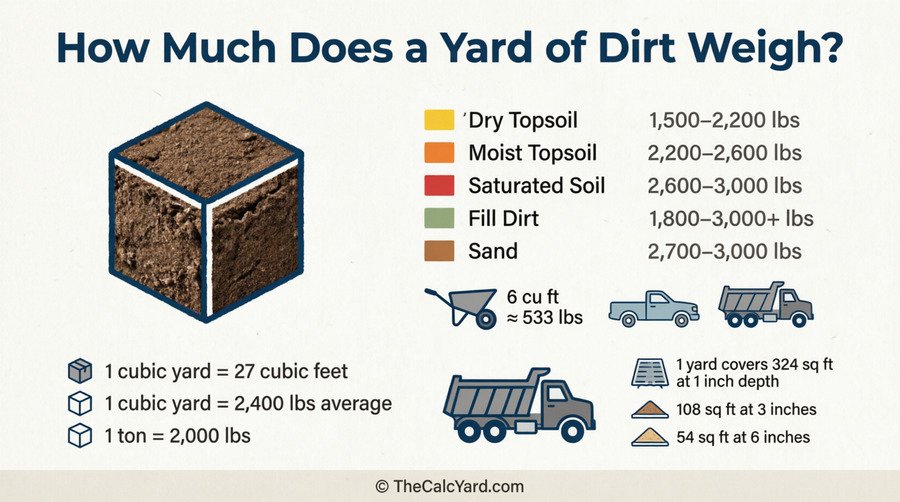
A cubic yard of dirt usually weighs between 2,000 and 2,800 pounds (1 to 1.4 tons). Dry, loose topsoil can be closer to 1,500 to 2,000 pounds. Wet, clay-heavy, or compacted soil can exceed 3,000 pounds. If you need one number for a quick estimate, use 2,400 pounds (1.2 tons) per cubic yard for moist soil and label it as an assumption.
“A yard” in landscaping and bulk material sales means a cubic yard, which is a measure of volume: 3 ft × 3 ft × 3 ft = 27 cubic feet. Weight depends on what fills that volume and how much water it holds. When a supplier gives you a weight per yard for their product, use that number instead of any general figure on this page.
How Much Does a Yard of Dirt Weigh by Type?
These are planning ranges, not product specifications. Actual weights vary by supplier, region, and moisture.
| Material | Pounds per cubic yard | Short tons per cubic yard | Pounds per cubic foot |
|---|---|---|---|
| Dry, loose topsoil | 1,500 to 2,200 | 0.75 to 1.1 | 56 to 81 |
| Moist topsoil | 2,200 to 2,600 | 1.1 to 1.3 | 81 to 96 |
| Saturated topsoil | 2,600 to 3,000 | 1.3 to 1.5 | 96 to 111 |
| Fill dirt, dry or loose | 1,800 to 2,300 | 0.9 to 1.15 | 67 to 85 |
| Fill dirt, wet, clay-heavy, or compacted | 2,500 to 3,000+ | 1.25 to 1.5+ | 93 to 111+ |
| Black dirt | Varies by blend | Ask the supplier | Ask the supplier |
| Sand (typical) | 2,700 to 3,000 | 1.35 to 1.5 | 100 to 111 |
Tons in this article are US short tons (2,000 lb). Published supplier figures overlap but do not match exactly. Some quote about 2,000 pounds for dry fill dirt and 2,000 to 2,700 for typical soil, while others put wet clay above 3,000. That spread is real, not an error, and it is why a range is more honest than a single figure.
A quick reality check from soil science
The USDA Natural Resources Conservation Service defines bulk density as the mass of soil per unit volume, including the pore spaces between particles, and notes that it depends on soil texture, organic matter, and how particles are packed. South Dakota State University Extension gives 1.33 g/cm³ (about 82.9 lb per cubic foot) as the bulk density of soil with 50 percent pore space.
Multiply that by 27, and you get about 2,240 pounds per cubic yard of dry soil. Water then adds to it. Water weighs about 62.4 pounds per cubic foot, so a fully saturated soil with 50 percent pore space could add roughly 840 pounds per yard on top of the dry weight. That is how a yard of soil goes from about 2,200 pounds dry to about 3,000 pounds soaked. This is an illustration of the physics, not a measured value for any specific product.
What Changes the Weight of a Yard of Dirt
- Moisture is usually the biggest swing. Soil after a heavy rain can weigh hundreds of pounds more per yard than the same soil in dry weather.
- Soil texture matters because sand, silt, and clay pack and hold water differently. Clay holds water especially well.
- Organic matter lowers density. Compost-rich blends are lighter than dense mineral soil.
- Compaction removes air space. Loose delivered soil weighs less per yard than the same soil compacted in place.
- Rocks and debris in fill dirt can raise or lower the average weight.
- Supplier blend matters because “topsoil,” “fill dirt,” and “black dirt” are commercial names, not standardized soil classes.
How Much Does a Yard of Fill Dirt Weigh?
Fill dirt is subsoil or mixed excavated material used for grading and raising ground levels, and it isn’t a standardized product. Dry, loose fill often runs about 1,800 to 2,300 pounds per cubic yard. Wet, clay-heavy, or compacted fill commonly reaches 2,500 to 3,000 pounds or more.
If you are hauling it yourself, ask the supplier for an estimated weight per yard, since your vehicle’s payload depends on it.
How Much Does a Yard of Black Dirt Weigh?
There is no reliable standard weight for black dirt, because the term is a marketing description rather than a soil classification. One supplier’s black dirt may be organic-rich topsoil; another’s may be blended with compost or sand. Organic-heavy blends tend to be lighter than dense mineral soil, but the only trustworthy figure is the supplier’s.
Ask three questions: what is in the product, what does it weigh per cubic yard, and is that weight for dry, moist, or wet material? If you have nothing else, use a topsoil range and treat it as an assumption.
How Much Does Half a Yard of Dirt Weigh?
Half a cubic yard is 13.5 cubic feet, and it weighs half of whatever a full yard weighs.
| Assumed weight per yard | Half a yard |
|---|---|
| 2,000 lb | 1,000 lb |
| 2,400 lb | 1,200 lb |
| 2,800 lb | 1,400 lb |
How to Calculate Dirt Weight
Weight = cubic yards × weight per cubic yard
Example: 1.5 cubic yards at 2,400 lb per yard is 1.5 × 2,400 = 3,600 lb. You can also use a cubic yard calculator to simplify your project estimates
If you only have dimensions in feet, find the volume first:
Cubic yards = (length × width × depth) ÷ 27
Example (illustrative): a 12 ft by 10 ft area filled 6 inches (0.5 ft) deep is (12 × 10 × 0.5) ÷ 27 = 2.22 cubic yards. At 2,400 lb per yard, that is about 5,333 lb, or 2.7 tons. It is an estimate, not a scale reading.
Weight per cubic foot is the weight per yard divided by 27. At 2,400 lb per yard, that is 88.9 lb per cubic foot.
Weight of common quantities
| Cubic yards | At 2,000 lb/yd | At 2,400 lb/yd | At 2,800 lb/yd |
|---|---|---|---|
| 1 | 2,000 lb (1 ton) | 2,400 lb (1.2 tons) | 2,800 lb (1.4 tons) |
| 2 | 4,000 lb (2 tons) | 4,800 lb (2.4 tons) | 5,600 lb (2.8 tons) |
| 5 | 10,000 lb (5 tons) | 12,000 lb (6 tons) | 14,000 lb (7 tons) |
| 10 | 20,000 lb (10 tons) | 24,000 lb (12 tons) | 28,000 lb (14 tons) |
Order extra for settling
Compacted soil and settled beds need more material than the raw volume suggests. Suppliers commonly recommend adding about 10 to 15 percent. Dirt also swells when dug: ground that is broken up traps air, and a commonly cited figure is about 20 percent more volume, which varies by soil.
How Many Yards Is 3,000 Pounds of Dirt?
Divide the weight by the soil’s weight per yard.
| Assumed weight per yard | 3,000 lb equals |
|---|---|
| 2,000 lb | 1.5 cubic yards |
| 2,400 lb | 1.25 cubic yards |
| 2,800 lb | about 1.07 cubic yards |
So 3,000 pounds (1.5 tons) is roughly 1.1 to 1.5 cubic yards, depending on the soil.
How Much Will One Yard of Dirt Cover?
Coverage in square feet = 324 ÷ depth in inches
The 324 comes from 27 cubic feet × 12 inches per foot.
| Depth | Coverage of 1 cubic yard |
|---|---|
| 1 inch | 324 sq ft |
| 2 inches | 162 sq ft |
| 3 inches | 108 sq ft |
| 4 inches | 81 sq ft |
| 6 inches | 54 sq ft |
| 12 inches | 27 sq ft |
These figures are theoretical. Uneven ground, settling, and spillage mean most projects need extra.
Will One Yard of Dirt Fit in a Pickup?
It may fit by volume, but weight is the real limit. Estimate your bed volume as length × width between the wheel wells × height to the rail. As an illustration, a 6.5 ft bed that is about 4 ft wide and filled to a 1.5 ft height holds about 39 cubic feet, or roughly 1.4 cubic yards. Measure your own bed, since sizes vary.
Now check weight. One yard at 2,400 pounds is 2,400 pounds of cargo before you add the driver, passengers, and tools. Many half-ton pickups are rated for payloads somewhere between roughly 1,500 and 2,500 pounds, with some configurations higher. Ford lists a maximum available F-150 payload of up to 2,440 pounds when properly equipped. Payload is the combined weight of cargo and people the truck is rated to carry, and it is printed on the Tire and Loading Information label on the driver’s door jamb.
To check your truck:
- Read the payload figure on the door jamb label.
- Subtract the weight of everyone and everything already in the truck, plus accessories like a bedliner or tonneau cover.
- Compare what remains to your calculated soil weight.
If the numbers are close, haul half a yard per trip or have it delivered. Wet soil deserves extra caution.
How Many 40-Pound Bags of Topsoil Are in a Yard?
By weight, divide the yard’s weight by 40.
| Assumed weight per yard | 40-lb bags |
|---|---|
| 2,000 lb | 50 |
| 2,400 lb | 60 |
| 2,800 lb | 70 |
| 3,000 lb | 75 |
By volume, use the bag’s stated size: bags = 27 ÷ cubic feet per bag. A 0.75 cubic foot bag gives 36 bags per yard, a 1 cubic foot bag gives 27, a 1.5 cubic foot bag gives 18, and a 2 cubic foot bag gives 13.5.
Bagged products are often lighter or fluffier than bulk soil, so the weight-based count and the volume-based count can disagree. When you are filling a space, trust the volume printed on the bag.
How Many Wheelbarrows Are in a Yard of Dirt?
Loads = 27 ÷ wheelbarrow capacity in cubic feet
| Wheelbarrow size | Full-volume loads per cubic yard |
|---|---|
| 2 cu ft | 13.5 |
| 3 cu ft | 9 |
| 4 cu ft | 6.75 |
| 5 cu ft | 5.4 |
| 6 cu ft | 4.5 |
Real work takes more trips than the table shows. Manufacturers usually rate wheelbarrows by capacity, and one equipment rental company advises planning on about 4.5 to 5 cubic feet as a realistic load for heavy material even in a 6 cubic foot barrow. For dense wet soil, a partial load is often the better assumption.
How heavy is a wheelbarrow full of dirt?
Multiply the barrow’s volume by the soil’s weight per cubic foot. A full 6 cubic foot barrow of soil at 88.9 lb per cubic foot holds about 533 pounds of soil, before the barrow’s own weight. That exceeds the rated load of many wheelbarrows and is more than most people can safely control. A realistic load of 3 cubic feet holds about 267 pounds at the same density.
Volume capacity and safe load capacity are different numbers. Check your wheelbarrow’s stated maximum load, since heavier contractor models are often rated around 500 pounds while lighter ones are rated lower.
How many wheelbarrows equal a ton?
Loads per ton = (2,000 ÷ weight per yard × 27) ÷ wheelbarrow capacity
For soil at 2,400 lb per yard, one ton is 0.83 cubic yards, or 22.5 cubic feet. That is 3.75 full loads in a 6 cubic foot barrow, or 7.5 loads at 3 cubic feet per trip.
Sand, Gravel, and Other Bulk Materials
A cubic yard is 27 cubic feet for every material, but the weights differ. Typical sand runs about 2,700 pounds per cubic yard (1.35 tons), and commonly published figures range from roughly 2,400 to over 3,000 pounds depending on type and moisture. Bulk sand is rarely bone dry, so the damp end of that range is a realistic default for delivered material. The same formulas above work once you have the material’s weight per yard.
Using sand at 2,700 lb per yard (an assumption):
- One ton of sand is 2,000 ÷ 2,700 = 0.74 cubic yards, or about 20 cubic feet.
- Wheelbarrows per ton at 3 cubic feet per load is about 6.7 loads, or about 3.3 loads at 6 cubic feet.
- Wheelbarrows per cubic yard at 3 cubic feet per load is 9.
- One dump truck load (say 10 cubic yards, or 270 cubic feet) is 90 wheelbarrow loads at 3 cubic feet each.
Shovelfuls vary too much with the shovel and how full it is loaded to give one figure. Measure your own by filling a wheelbarrow of known size and counting.
How much sand is in a truckload?
In the US, the vehicle people call a tipper elsewhere is a dump truck. Most standard tandem-axle dump trucks hold about 10 to 16 cubic yards by volume, but weight limits usually cap the load first. Many suppliers quote a tandem as carrying roughly 12 to 16 tons of material, with single-axle trucks carrying less and tri-axles more. Legal limits vary by state, so ask the hauler.
At 1.35 tons per cubic yard, a 12 to 16 ton sand load works out to about 9 to 12 cubic yards. For soil at 1.2 tons per cubic yard, the same tonnage is about 10 to 13 cubic yards.
How much does sand cost?
Prices change with region, sand type, and delivery distance, so treat these as 2026 ballpark ranges from supplier and cost guides, then get local quotes:
- Bulk sand by the ton: commonly quoted from about $15 to $50 per ton for the material, with fill sand cheapest, concrete sand in the middle, and masonry or play sand highest.
- Bulk sand by the yard: about $25 to $60 per cubic yard for material.
- Delivery: usually charged separately, often as a flat fee or per ton.
- Bagged sand: costs several times more per ton than bulk. A 50-pound bag runs a few dollars, which works out to roughly $160 to $240 per ton.
Material cost = tons × price per ton, plus delivery. As an illustration, 30 tons at $15 to $50 per ton is $450 to $1,500 before delivery. At 1.35 tons per yard, 30 tons is about 22 cubic yards, which is roughly two tandem loads. A single 10- to 12-yard truckload is about 13.5 to 16 tons, or roughly $200 to $800 for the material at that same range. Confirm whether a quote is per ton or per yard and whether delivery is included.
Fill sand is generally the cheapest type. It is meant for backfill and leveling, not concrete or mortar.
Is building sand the same as concrete sand?
No. In US practice, concrete sand is a coarse, washed sand graded to ASTM C33 and used in concrete and as paver bedding. Mason sand is finer, graded to ASTM C144, and used for mortar. “Building sand” is a looser term whose meaning depends on the supplier and country. The two specified sands are not interchangeable: mortar made with concrete sand is gritty, and paver bedding made with mason sand can shift. Follow your project specification.
How many bags of cement can you mix in a wheelbarrow?
There is no fixed number, because it depends on the product and the amount you need to mix. For premixed concrete, an 80-pound bag yields about 0.6 cubic feet of mixed concrete (per Quikrete’s technical data, which follows the ASTM C387 standard), so a 6-cubic-foot wheelbarrow could not hold the finished volume of more than a few bags while leaving room to mix. Hand-mixers commonly do two to three bags per batch. Pure Portland cement is sold in different bag sizes and is mixed with sand and aggregate, so follow the mix ratio on the label.
Common Mistakes When Estimating Dirt Weight
- Assuming every yard weighs 2,000 pounds. It is a handy round number for examples, not a universal value.
- Ignoring moisture. Rain-soaked soil can be much heavier than dry soil.
- Confusing yards and tons. A yard measures volume and a ton measures weight. You need a density to convert between them.
- Treating all 40-pound bags as equal volume. The contents differ in density.
- Judging a truckload by fit alone. Check payload, not just bed space.
- Assuming all wheelbarrows are the same size or safe at full volume. Check both the capacity and the load rating.
- Treating black dirt as a standard product. Ask what is in it.
- Ordering the exact calculated volume. Add for settling and spillage.
FAQ
Does wet dirt weigh more than dry dirt?
Yes. Water adds mass without adding volume, so a cubic yard can weigh hundreds of pounds more when saturated.
How many cubic feet are in a yard of dirt?
27 cubic feet (3 ft × 3 ft × 3 ft).
Is a yard of dirt the same as a cubic yard?
In bulk material sales, yes. Saying “cubic yard” avoids confusion with a linear yard.
Should I order dirt by the yard or by the ton?
Yards are easier to match to a project’s volume, and tons are what trucks are limited by. Since moisture changes weight, ordering by volume avoids paying for water weight. Ask your supplier how they measure and price the load.
Bottom Line
A yard of dirt usually weighs between 2,000 and 2,800 pounds, with dry topsoil lighter and wet or compacted soil heavier. For a quick estimate, use 2,400 pounds per cubic yard and state that it is an assumption. For anything involving a truck, trailer, or wheelbarrow, get the supplier’s weight, multiply by the number of cubic yards, and compare the result to the actual payload or load rating.