
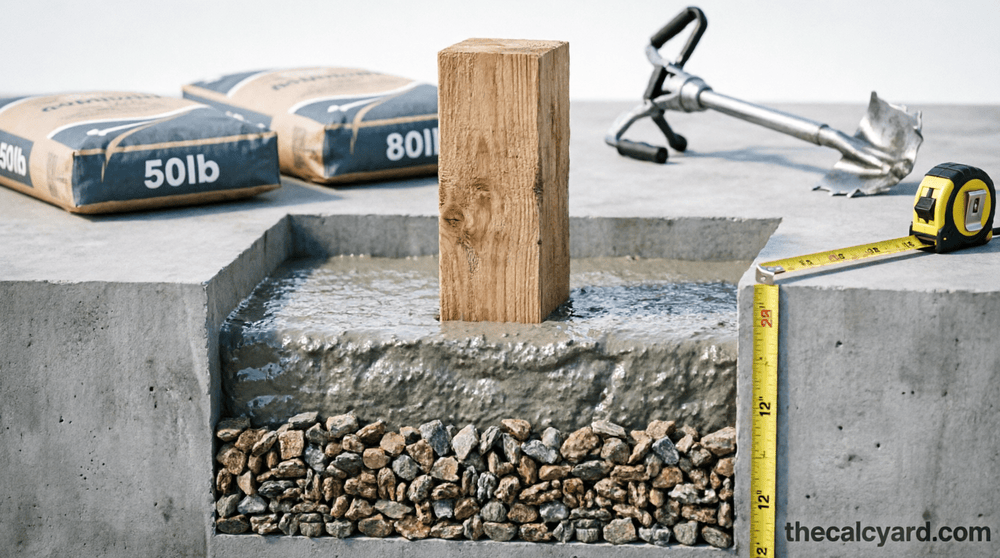
When planning your project, knowing exactly how much concrete for fence posts you need is the first step to building a sturdy, long-lasting fence. There’s no single number that works for every job. A post set in a 10-inch hole needs a lot less concrete than one set in a 14-inch hole, and a 4×4 wood post displaces far less volume than a 6×6.
The honest answer is: it depends on your hole size, your post size, and which concrete product you’re using. But don’t worry, you can figure out your exact number in just a few minutes with basic measurements, a simple formula, or our free calculator below.
This guide walks through that formula, works through a real example with the actual math shown, and explains how bag counts change depending on the concrete mix you buy.
What Actually Determines the Amount of Concrete You Need
Before calculating concrete for fence posts, it helps to know what’s driving the number up or down. The amount of concrete for fence posts you need depends on:
- Hole diameter — a wider hole holds more concrete, even at the same depth
- Hole depth — deeper holes need more volume, but not all of that depth is filled with concrete (more on that below)
- Post dimensions — the post itself takes up space inside the hole, so a thicker post means less room for concrete
- Gravel or base material — some installation methods put a few inches of gravel at the bottom of the hole for drainage, which reduces the space concrete fills
- The concrete product’s yield — every bag of concrete produces a specific volume once mixed, and that yield varies by weight and by brand
Because these variables change from job to job, a “most posts need 2 bags” statement is only true under specific conditions. Once you know your own hole size, post size, and product, the calculation is straightforward.
How to Calculate Concrete for Fence Posts
When calculating concrete for fence posts, the math is based on the volume of a cylinder, since most post holes are round (whether dug by hand with a post-hole digger or with a power auger).
Step 1: Find the hole’s volume.
Volume = π × radius² × depth (radius is half the diameter)
Step 2: Subtract the post’s volume, since the post occupies space inside the hole that concrete won’t fill. For a round post, use the same cylinder formula with the post’s radius. For a square post (like a standard 4×4 or 6×6), multiply width × width × depth instead.
Step 3: Adjust for the depth that concrete doesn’t actually fill. Most installation instructions call for a few inches of soil or sod at the top of the hole rather than concrete all the way to grade, and some methods add a gravel layer at the bottom for drainage. Only the concrete-filled portion of the hole counts toward your volume.
Step 4: Convert to cubic feet and divide by the bag’s yield to get your bag count.
It sounds like more steps than it is — in practice, it’s one subtraction and one division. Here’s what it looks like with real numbers.
Worked Example: Calculating Concrete for Fence Posts (4×4 Wood Post)
Assumptions for this example:
- Post: standard 4×4 wood post, actual dimensions 3.5 in × 3.5 in
- Hole diameter: 12 inches (radius 6 inches)
- Total hole depth: 30 inches
- Gravel base: 6 inches at the bottom, for drainage
- Soil/sod cap: 4 inches left unfilled at the top
- Concrete-filled depth: 30 − 6 − 4 = 20 inches
Hole cross-sectional area: π × 6² = 113.1 sq in
Post cross-sectional area: 3.5 × 3.5 = 12.25 sq in
Net area to fill with concrete: 113.1 − 12.25 = 100.85 sq in
Concrete volume: 100.85 sq in × 20 in = 2,017 cubic inches
Converting to cubic feet (1 cubic foot = 1,728 cubic inches):
2,017 ÷ 1,728 ≈ 1.17 cubic feet of concrete for this one post.
That 1.17 cubic feet is the number you take to the bag yield chart.
How Many Bags You’ll Need — and Why It Depends on the Product
Bag yield isn’t standard across every product. Based on published manufacturer data for Quikrete concrete products, common yields are:
| Bag size | Product type | Yield (mixed) |
|---|---|---|
| 40 lb | Standard concrete mix | ~0.30 cu ft |
| 50 lb | Fast-setting concrete mix | ~0.375 cu ft |
| 60 lb | Standard concrete mix | ~0.45 cu ft |
| 80 lb | Standard concrete mix | ~0.60 cu ft |
Other brands, such as Sakrete, sell similar bag weights but may list slightly different yields, so it’s worth checking the specific bag you buy.
Applying these yields to the 1.17 cubic feet needed in the worked example above:
- 50-lb fast-setting bags: 1.17 ÷ 0.375 ≈ 3.1 → 4 bags (rounding up, since you can’t buy a partial bag)
- 60-lb standard bags: 1.17 ÷ 0.45 ≈ 2.6 → 3 bags
- 80-lb standard bags: 1.17 ÷ 0.60 ≈ 1.95 → 2 bags
Same hole, same post — a different number of bags depending entirely on which product is on the shelf. This is why generic “how many bags per post” answers can be misleading without knowing the bag size involved.
As a smaller-scale reference point, Quikrete’s own installation literature states that two 50-lb bags of its Fast-Setting Concrete Mix will set a 4-inch-diameter post in a 10-inch-diameter hole, 2 feet deep. Run that scenario through the same formula (filling to about 4 inches below grade, no gravel), and the math lands close to 2 bags as well — a useful sanity check that the calculation method holds up against real manufacturer guidance.
Is Fast-Setting Concrete Suitable for Fence Posts?
Yes, using fast-setting concrete for fence posts is a widely used and manufacturer-approved option for typical residential projects. Quikrete markets its Fast-Setting Concrete Mix specifically for fence posts, mailbox posts, and similar applications, with a no-mixing installation method: the dry mix is poured directly into the hole around the post, then saturated with water. According to the manufacturer’s data sheet, it sets in approximately 20 to 40 minutes, though the post shouldn’t be put under load (like attaching fence panels or gates) for several hours afterward.
Traditional concrete mix — the kind you mix with water in a wheelbarrow before pouring — works just as well structurally and is often preferred for posts that will carry more load, such as gate posts, since some installers feel more confident with a fully mixed, uniform pour. Both approaches are legitimate; the right one depends on your timeline, the tools you have on hand, and the type of post.
Whichever product you choose, follow that product’s own instructions for water quantity, hole preparation, and cure time, since these details vary between brands and between fast-setting and standard formulas.
Factors That Can Push Your Number Up or Down
A few things commonly change the final amount of concrete for fence posts needed beyond the base calculation:
Frost depth and local requirements. In regions with freezing winters, local building departments or fence codes may require post holes to extend to a certain depth to resist frost heave. That depth varies significantly by climate and jurisdiction, so it isn’t something a general guide can state as a fixed number — check with your local building authority if you’re unsure, especially for permanent structures.
Soil conditions. Loose, sandy, or previously disturbed soil may require a wider hole for stability, which increases the concrete volume needed. Dense clay or rocky soil can behave differently and may call for adjustments to hole shape.
Gravel or drainage layers. Some installation methods call for several inches of gravel at the bottom of the hole to help water drain away from the base of the post, reducing the risk of wood rot. This isn’t universal; some methods skip gravel entirely, so follow the method or product instructions you’re actually using rather than assuming a fixed gravel depth applies to your project.
Irregular hole shape. Hand-dug holes are rarely perfect cylinders. A hole that’s wider at the top than the bottom, or unevenly shaped, will typically use somewhat more concrete than the calculated volume suggests.
Estimating Concrete for Multiple Posts
Once you know the concrete volume for one post, a multi-post fence is simple multiplication, as long as every post uses the same hole size, post size, and depth.
Using the worked example above (1.17 cubic feet per post), a fence with 8 identical posts would need:
8 × 1.17 = 9.36 cubic feet total
- At 0.375 cu ft per 50-lb fast-setting bag: 9.36 ÷ 0.375 ≈ 25 bags
- At 0.60 cu ft per 80-lb standard bag: 9.36 ÷ 0.60 ≈ 16 bags
Keep in mind that corner posts, gate posts, and end posts often use larger posts or wider holes than line posts, since they carry more lateral load. If your fence design calls for different post sizes at different points, calculate those separately rather than applying one number across the whole project.
Common Mistakes to Avoid
Assuming one bag count applies to every post. As shown above, the same post in a slightly different hole size, or with a different bag product, can need a noticeably different quantity.
Filling the entire hole depth with concrete. Most installation guidance leaves several inches at the top for soil or sod, and some methods include a gravel base at the bottom. Calculating volume based on total hole depth, rather than the actual concrete-filled portion, will overestimate what you need.
Ignoring the post’s own volume. For thicker posts, especially 6×6 posts, the post itself displaces a meaningful amount of space. Skipping this subtraction step leads to over-ordering.
Mixing up bag yields between products. A 50-lb fast-setting bag and a 60-lb standard bag are close in weight but don’t produce the same volume of concrete. Check the yield printed on the specific bag you’re buying rather than assuming it matches another product.
Not accounting for waste. Spilled mix, uneven digging, and the odd oversized hole are normal on real job sites. Rounding your bag count up rather than down, and picking up one extra bag for the project, avoids a mid-job trip back to the store.
Calculating Your Own Project
The formula above works for any post size, hole size, or product. When figuring out concrete for fence posts, you just need your own measurements and the yield listed on your bag. If you’d rather skip the manual math, TheCalcYard’s concrete calculator for fence posts lets you enter your hole diameter, depth, post size, and bag type to get a bag count directly, using the same volume calculation shown here.