
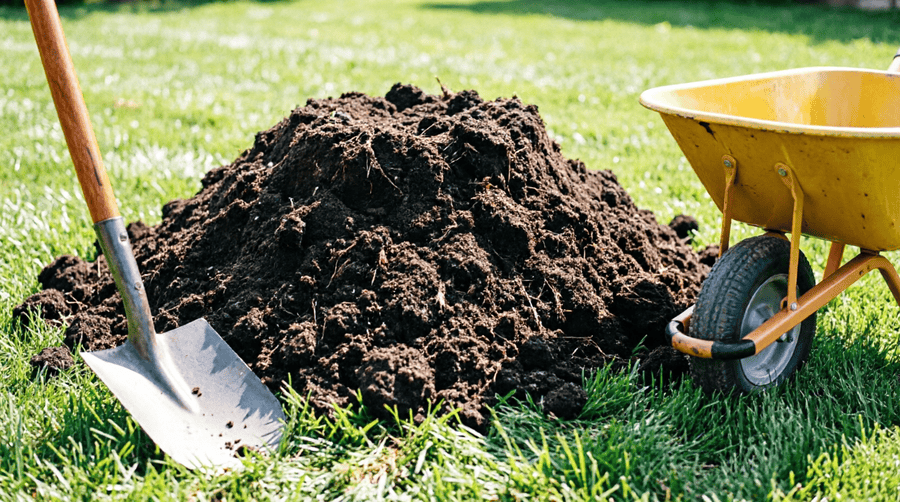
How much does a yard of dirt cost? For the material alone, you can expect to pay $10 to $50, depending on the type of soil. Once you add delivery, the total typically lands between $60 and $150 or more per yard, since most suppliers charge a flat delivery fee of $50 to $150 per truckload regardless of how much dirt is on it.
That last part matters more than most buyers expect. The per-yard price you see advertised is rarely what you pay. Delivery fees, order minimums, and soil type can shift your total bill significantly, and this guide walks through each of those factors so you can budget accurately before you call a supplier.
What “A Yard of Dirt” Actually Means
“A yard” in this context is short for a cubic yard, a measurement of volume rather than area. One cubic yard equals 27 cubic feet, roughly the size of a cube measuring 3 feet on each side.
This is easy to confuse with a square yard, which measures a flat surface (9 square feet) and tells you nothing about depth or volume. If a supplier quotes you a price “per yard” for dirt, they mean per cubic yard, not per square yard.
Dirt Price by Type
Price per cubic yard varies by composition, how finely the material is screened, and what it’s meant for.
| Material | Typical Price (per cubic yard) | Best Used For |
|---|---|---|
| Fill dirt | $8 to $25 | Raising low spots, backfilling, filling depressions |
| Topsoil | $10 to $50 | Lawns, planting beds, improving existing soil |
| Black dirt | $15 to $25 (up to $65 for screened, premium grades) | Landscaping, garden topdressing |
| Garden soil/planting mix | $30 to $60+ | Raised beds, container gardening, new planting areas |
Fill dirt is the cheapest because it isn’t screened for rocks or debris and isn’t meant to support plant growth. It’s meant to occupy space. Topsoil and garden soil cost more because they’re processed and blended to support root growth.
“Black dirt” isn’t a strict industry standard; it’s a regional marketing term. What one supplier sells as black dirt might be closer to fill dirt at another, so ask what’s actually in it (organic matter content, screening, whether it’s blended) rather than relying on the name alone.
How Much Does a Yard of Dirt Cost Delivered?
The advertised per-yard price is only part of the bill. Delivery fees typically add $50 to $150 per truckload, and that charge is usually flat regardless of whether you order 1 yard or 10.
Most suppliers also set a minimum order, often 5 to 10 cubic yards, to qualify for standard or free delivery. Order less than that and you may still pay the full delivery fee, which can make a single yard of dirt cost far more per yard than a bulk order would.
To get an accurate delivered quote, ask each supplier:
- What is the price per cubic yard for the material I want?
- Is delivery included, or charged separately?
- Is there a minimum order to qualify for delivery?
- Is there a distance or fuel surcharge for my address?
- Do you offer a discount for larger orders?
Get this in writing (or at least in an email or text) from two or three suppliers before committing. A lower per-yard price with a high delivery minimum can end up more expensive than a slightly higher price with no minimum, especially for small projects.
How Much Area Does 1 Yard of Dirt Cover?
Coverage depends entirely on how deep you spread it. The formula is:
Coverage (sq ft) = (Cubic Yards × 324) ÷ Depth in inches
For one cubic yard:
| Depth | Coverage Area |
|---|---|
| 1 inch | 324 sq ft |
| 2 inches | 162 sq ft |
| 3 inches | 108 sq ft |
| 4 inches | 81 sq ft |
| 6 inches | 54 sq ft |
| 12 inches (1 ft) | 27 sq ft |
These numbers show what one yard covers at a given depth mathematically. They aren’t recommendations for how deep to apply soil, since that depends on your project (topdressing a lawn needs far less depth than filling a low spot).
How to Calculate How Much Dirt You Need
- Measure the length of the area in feet.
- Measure the width in feet.
- Decide the average depth you need, in inches.
- Multiply length × width × depth (in inches).
- Divide the result by 324.
Formula: Cubic Yards = (Length × Width × Depth in inches) ÷ 324
If you’ve measured depth in feet instead of inches, use:
Cubic Yards = (Length × Width × Depth in feet) ÷ 27
Example: Leveling an Uneven Yard
Say you have a 1,000 sq ft area that needs an average of 3 inches of fill to level it out.
1,000 × 3 ÷ 324 = 9.26 cubic yards
In practice, round up and order 9.5 to 10 cubic yards, since fill settles over time and irregular ground rarely fills perfectly evenly. If your yard has scattered low spots rather than one uniform depression, measure each section separately and add the totals together instead of using one average depth for the whole yard, since a single average can under- or overestimate uneven terrain significantly.
For a faster estimate that does this math for you, use our Cubic Yard Calculator.
What Does 1 Yard of Dirt Look Like?
Mathematically, it’s a 3 ft × 3 ft × 3 ft cube. In reality, a dumped pile never looks like a cube. Gravity spreads it into a lower, wider mound, and the exact shape depends on the soil’s moisture content and how it was dumped.
For scale:
- 4 cubic yards (108 cubic ft) forms a mound roughly 6 feet wide and 3 feet high when piled, enough to notably cover part of a driveway.
- 20 cubic yards (540 cubic ft), a typical full dump truck load, forms a long pile or windrow that can dominate a residential driveway or yard.
How Many Bags of Dirt Equal a Yard?
This depends on the bag size, since bagged soil isn’t sold in a standard volume. One cubic yard equals 27 cubic feet, so:
- 1 cubic foot bags: 27 bags per yard
- 0.75 cubic foot bags: 36 bags per yard
- 0.5 cubic foot bags: 54 bags per yard
Bagged soil is convenient for small jobs like a few planters, but it costs considerably more per cubic yard than buying in bulk. For anything beyond a small garden bed, bulk delivery is almost always the cheaper option, provided you can meet the supplier’s delivery minimum.
Common Mistakes When Buying Dirt
- Ordering by the yard without checking delivery minimums. A single yard can cost more delivered than 5 yards would, because the delivery fee doesn’t scale down.
- Confusing fill dirt with topsoil. Fill dirt is cheaper but isn’t suited for planting; using it under a lawn or garden bed can lead to poor drainage or growth issues.
- Guessing at depth instead of measuring it. Small errors in depth estimates compound over large areas and either leave you short or paying for excess material.
- Not accounting for settling. Loose fill compacts over time, so a project that measures out to exactly the amount needed today may need a top up later.
- Comparing only the per-yard price. Always compare total delivered cost between suppliers, not just the quoted material price.
Common Measurement Questions
Is 3 cubic feet the same as 1 yard? No. A cubic yard is 27 cubic feet, so 3 cubic feet is only about 1/9 of a yard.
Is a yard 3 feet or 4 feet? A linear yard is exactly 3 feet. When buying dirt, you’re dealing with a cubic yard, a three-dimensional measurement of 3 ft × 3 ft × 3 ft, not a single linear distance.
FAQ
How much money is a yard of soil? Typically $10 to $50 for the material itself, with a total delivered cost of roughly $60 to $150 or more once delivery fees are included.
Is 1 yard the same as 1 cubic yard? Yes, in landscaping and bulk material sales, “a yard” is shorthand for “one cubic yard.”
Is it cheaper to buy dirt in bulk or in bags? Bulk is almost always cheaper per cubic yard for anything beyond a small planting bed, as long as you meet the supplier’s delivery minimum. Bags make sense mainly for small quantities where bulk delivery isn’t practical.
Does delivery cost more for smaller orders? Effectively, yes. Most delivery fees are flat per truckload, so the fee per cubic yard is much higher on a small order than on a large one.
Getting an Accurate Estimate
Before you call a supplier, measure your project area and estimate the volume you actually need. Use our Cubic Yard Calculator to run the math automatically, so you order enough material to finish the job without paying for unnecessary excess or an extra delivery trip.
1 thought on “How Much Does a Yard of Dirt Cost?”