
If you are trying to figure out how many square feet in a cubic yard, you will quickly realize there is no single answer. You just ordered a cubic yard of gravel, mulch, or topsoil, and now you are standing in the driveway looking at the pile, trying to calculate how much ground it will actually cover.
Here’s the catch: there’s no single answer; a cubic yard measures volume. Square feet measure area. Spread that same pile thin, and it covers a lot of ground. Pile it thick, and it barely covers a corner.
The Short Answer:
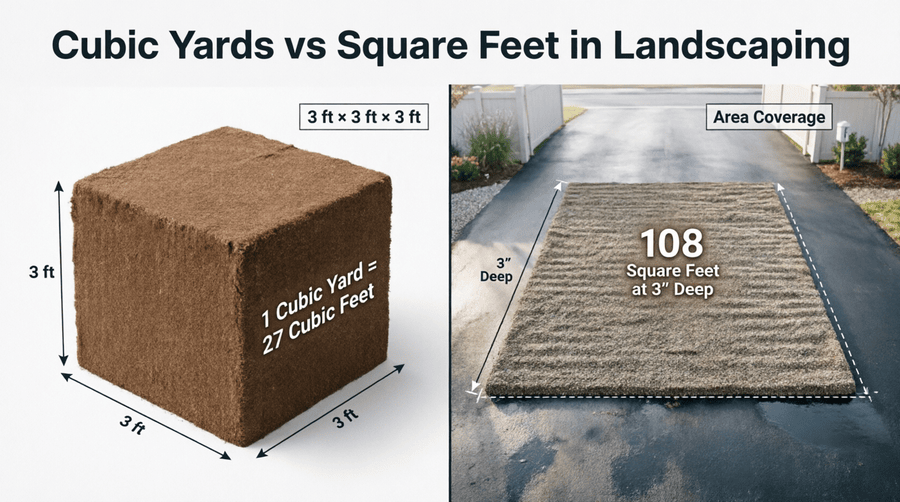
- 1 cubic yard = 27 cubic feet (3 ft × 3 ft × 3 ft)
- There is no fixed number of square feet in a cubic yard. It depends on depth.
- At 1 inch deep: 1 cubic yard covers 324 sq ft
- At 3 inches deep: 1 cubic yard covers 108 sq ft
- At 4 inches deep: 1 cubic yard covers 81 sq ft
- At 6 inches deep: 1 cubic yard covers 54 sq ft
Here’s something most guides get wrong: they try to give you a single number. There isn’t one. A cubic yard of gravel and a cubic yard of mulch cover the same area at the same depth, because coverage is about volume, not weight. The material doesn’t matter for the math; only the depth matters.
What’s the Difference Between Square Feet and Cubic Yards?
Square feet measure area. Length times width. Flat. Two dimensions. Your patio, your garden bed, your driveway that’s all square feet.
Cubic yards measure volume. Length times width times depth. Three dimensions. When you buy gravel, you’re buying volume. Suppliers price it by the cubic yard.
One cubic yard is 27 cubic feet. One square yard is 9 square feet. Those two numbers get mixed up constantly, because they’re both tied to “a yard.” But one describes a cube. The other describes a flat square. Not the same thing.
How Many Square Feet in a Cubic Yard? (Coverage Chart)
| Depth | Area Covered by 1 Cubic Yard |
|---|---|
| 1 inch | 324 sq ft |
| 2 inches | 162 sq ft |
| 3 inches | 108 sq ft |
| 4 inches | 81 sq ft |
| 5 inches | 64.8 sq ft |
| 6 inches | 54 sq ft |
| 8 inches | 40.5 sq ft |
| 12 inches | 27 sq ft |
Double the depth, and coverage gets cut in half. Every time. The volume doesn’t change you’re just deciding how thin or thick to spread it.
How Do I Convert Cubic Yards to Square Feet?
Use this:
Square feet = cubic yards × 324 ÷ depth in inches
Working in feet instead? Use this:
Square feet = cubic yards × 27 ÷ depth in feet
Same answer either way. The 324 comes from 27 cubic feet in a cubic yard × 12 inches per foot.
Example: You’ve got 2 cubic yards of mulch. You want it 3 inches deep.
2 × 324 ÷ 3 = 216 square feet.
Example: You’ve got 3 cubic yards. You want a 4-inch layer.
3 × 324 ÷ 4 = 243 square feet.
Check your work with the cubic yard calculator; plug in your dimensions, and it converts it for you.
How Do I Calculate Cubic Yards From Square Feet?
Most of the time, you’re working the other way around. You know the area. You know the depth you want. You need to know how much to order.
- Measure your area in square feet (length × width)
- Choose your depth in inches
- Calculate: sq ft × depth ÷ 324 = cubic yards
- Round up 10% for waste, compaction, and settling
- Order that number from your supplier
Example: 500 sq ft at 3 inches.
500 × 3 ÷ 324 = 4.63 cubic yards. Round up to 5 cubic yards.
Example: 1,000 sq ft at 2 inches.
1,000 × 2 ÷ 324 = 6.17 cubic yards. Round up to 7 cubic yards.
For gravel-specific pricing, see the gravel calculator — it adds weight and delivery cost on top of the volume.
How Big Is 1 Cubic Yard — and What Does It Look Like?
Picture a cube: 3 feet long, 3 feet wide, 3 feet tall. That’s 1 cubic yard. It’s also 27 cubic feet, since 3 × 3 × 3 = 27.
Don’t confuse the top of that cube with the whole thing. The top face is 9 square feet; that’s just the surface you’d see looking down. The entire cube, everything inside it, is 27 cubic feet. A cubic yard is the whole box, not the face on top.
In real-world terms, 1 cubic yard is roughly the size of a large front-load washing machine, or about a pickup bed loaded level (not heaped). Two cubic yards is just double that.
And yes; one cubic yard is the volume of a 3 ft × 3 ft × 3 ft cube. But that doesn’t mean a real pile of gravel looks like a perfect cube sitting in your driveway. Dump it out and it’ll mound up however gravity and the material let it. Spread it 6 inches deep, and it flattens out to 54 square feet — nothing cube-shaped about that. The cube is just how you picture the volume. It’s not how the material behaves once it hits the ground.
What This Looks Like on a Job Site
Say you’re pouring a concrete slab. Plans call for 4 inches thick. The slab is 20 × 30 feet — that’s 600 sq ft.
- Cubic yards needed: 600 × 4 ÷ 324 = 7.4 cubic yards
- Order: Round up to 8 cubic yards — you don’t want the truck to run short halfway through the pour
Or say you’re spreading mulch in a garden bed. The bed is 12 × 8 feet — 96 sq ft. You want it 3 inches deep.
- Cubic yards needed: 96 × 3 ÷ 324 = 0.89 cubic yards
- Order: 1 cubic yard — suppliers sell by the yard anyway, so there’s no reason to split hairs here
Now a messier one, because real projects rarely give you clean numbers. Say you’re covering a 17 × 23 foot area at 3.5 inches deep. The area is 391 sq ft.
391 × 3.5 ÷ 324 = 4.22 cubic yards. Order 4.5 to be safe.
Materials at a Glance
| Material | Common Depth | Coverage per Cubic Yard |
|---|---|---|
| Mulch | 2–3 inches | 108–162 sq ft |
| Topsoil | 4–6 inches | 54–81 sq ft |
| Gravel (driveway base) | 4 inches | 81 sq ft |
| Concrete slab | 4 inches | 81 sq ft |
| Gravel (pathway) | 2 inches | 162 sq ft |
How Deep Should You Go?
- Mulch: 2–3 inches. Enough to suppress weeds, not so thick it starts to rot.
- Topsoil for lawn: 4–6 inches. That’s about the minimum grass roots need.
- Gravel pathway: 2–3 inches. Fine for foot traffic.
- Driveway gravel base: 4–6 inches, plus compaction.
- Concrete slab: 4 inches. Standard for patios and walkways.
These are starting points, not rules. Check your project’s actual requirements before you order.
How Many Cubic Feet Are in a Square Yard?
A square yard is area — 9 square feet. A cubic yard is volume — 27 cubic feet. There’s no direct conversion between them unless you bring depth into it, same as with square feet and cubic yards.
If you had a square yard of surface (9 sq ft) and covered it 1 foot deep, you’d need 9 cubic feet of material — a third of a cubic yard.
3 Common Mistakes to Avoid
- Confusing cubic yards with square yards. A square yard is 9 sq ft (area). A cubic yard is 27 cu ft (volume). They’re different things measuring different things.
- Forgetting to convert inches to feet. If your depth is in inches and you’re using the feet-based formula, you’ll get the wrong answer. Use the inch formula (× 324), or convert your depth to feet first.
- Ordering exact amounts. Always round up 10–15%. Material settles, compacts, and gets wasted during spreading. Running short means another delivery fee — and another wait.
Common Questions About Cubic Yards and Square Feet
How do I convert cubic yards to square feet? Divide 324 by your depth in inches, then multiply by the number of cubic yards.
What is the size of 1 cubic yard? 27 cubic feet. Same volume as a 3 ft × 3 ft × 3 ft cube.
How do I convert area to cubic yards? Multiply your area in square feet by the depth in inches, then divide by 324.
What does 1 cubic yard look like? About the size of a large washing machine, or a pickup bed loaded level. A real pile will spread and settle rather than sit as a neat cube.
For concrete slab projects, use the concrete calculator for bag counts and total cost once you know your cubic yardage.
3 thoughts on “How Many Square Feet Are in a Cubic Yard?”