
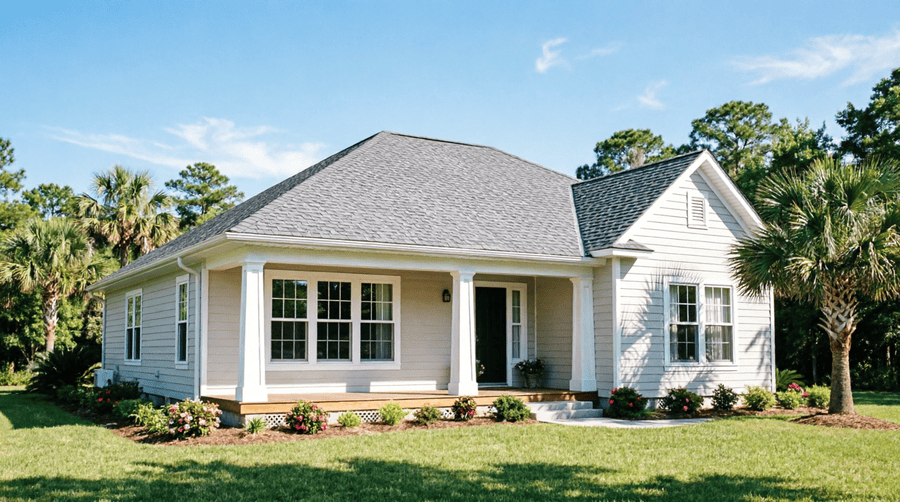
How much does a new roof cost Hanahan SC? If you’re getting quotes, expect most residential projects to fall between $8,000 and $28,000, with a typical architectural shingle roof on a standard single-family home in the $12,000–$19,000 range. Larger homes, steeper roofs, metal roofing, or a roof that needs a full tear-down to the decking will push toward the top of that range or past it.
That’s a large window, so it’s no surprise that prices vary as they do in coastal wind zone Hanahan — where no two roofs are the same size, shape, or condition. Below are tips to help you understand what affects cost, plus information to help you estimate the cost for your own roof, and what questions to ask before signing a contract.
How Much Does a New Roof Cost Hanahan SC? (Quick Answer)
Roofing contractors typically price a job by the roofing square, a unit equal to 100 square feet of actual roof surface, not the square footage of your house. Statewide, South Carolina roofing costs typically run in the neighborhood of $4.50 to $9 per square foot installed for asphalt shingles, with the low end covering basic three-tab shingles on a simple roof and the high end reflecting architectural shingles, tear-off, and more complex installations.
Charleston-area pricing tends to sit above the state average. Local contractors serving the Charleston metro report typical 2026 roof replacements running $11,500 to $28,000, and that’s consistent with what Berkeley County homeowners are generally quoted. A few things push Lowcountry pricing higher than the statewide figure:
- Hanahan falls in a high-wind coastal zone, and code-compliant materials and installation methods for that zone cost more than standard inland requirements.
- Salt air and humidity mean contractors often spec corrosion-resistant fasteners and flashing, adding to material costs.
- Labor rates in the greater Charleston market run higher than in more rural parts of the state.
None of this means every Hanahan roof costs $20,000-plus. A smaller, simple roof in good condition with standard architectural shingles can still come in under $12,000. The point is that a national average or a generic South Carolina number isn’t a reliable stand-in for a Hanahan quote; your roof’s size, pitch, material, and condition will move the number more than location alone.
A quick math reminder before you go further: cost per square foot × total roof area = a rough project estimate. Multiply that per-square-foot price by your roof’s actual surface area (not your home’s floor plan square footage) to get in the right ballpark. The next section shows why those two numbers are rarely the same.
Roof Replacement Cost by Roof Size
Your roof’s surface area is almost always larger than your house’s floor area, because the roof slopes and often extends past the exterior walls. The table below shows rough cost ranges for a few common house sizes, but read the assumptions underneath it first; they matter.
| House floor area | Assumed roof area (6/12 pitch) | Roofing squares | Estimated cost range* |
|---|---|---|---|
| 1,500 sq ft | ~1,677 sq ft | ~17 squares | $9,300 – $15,300 |
| 2,000 sq ft | ~2,236 sq ft | ~22 squares | $12,100 – $19,800 |
| 2,500 sq ft | ~2,795 sq ft | ~28 squares | $15,400 – $25,200 |
| 3,000 sq ft | ~3,354 sq ft | ~34 squares | $18,700 – $30,600 |
*Estimated using $550–$900 per roofing square installed, a range reflecting Charleston-area architectural shingle pricing.
Assumptions worth restating clearly:
- These figures assume a single-story home, where floor area and roof footprint are roughly the same. A two-story home with 2,500 square feet of living space typically has a footprint and roof closer to what a 1,200–1,300 square foot single-story home would need, since only the ground floor sits under the roofline.
- They assume a fairly simple gable roof at a 6/12 pitch, which is a common residential pitch but not universal. A steeper or more complex roof (hips, dormers, multiple sections) will have more surface area than this table shows, even on the same footprint.
- They don’t include extra waste for cuts, overhangs, or unusually cut-up rooflines, which commonly adds another 10–15% to the material order.
- They’re a planning tool, not a quote. Only a measured, on-site (or professionally scoped) estimate reflects your actual roof.
What Affects Roof Replacement Cost?
A roofing quote is really a stack of separate line items. The biggest ones:
Material. Asphalt shingles cost the least up front; metal, tile, and slate cost more but often last longer. More on this below.
Roof size. Straightforward — more roofing squares means more material and more labor hours.
Pitch. Steeper roofs need more material to cover the same footprint and take longer to install safely. Covered in detail further down.
Complexity. A roof with multiple planes, valleys, dormers, or a chimney takes more time to cut, flash, and seal than a simple rectangular roof of the same size.
Tear-off. Removing old shingles and disposing of them adds labor and dump fees. South Carolina’s residential code generally permits up to two layers of shingles before a full tear-off is required, so a roof with two existing layers will need everything stripped before the new material goes on, typically adding a noticeable amount to the labor bill.
Decking condition. If the plywood or OSB sheathing underneath the shingles has rot or water damage, your contractor will need to replace sections of it. This is usually priced separately, often per sheet, since it can’t be confirmed until the old roofing comes off.
Flashing and ventilation. Metal flashing around chimneys, skylights, and roof-to-wall junctions, plus ridge and soffit ventilation, are part of a properly installed roof system — not optional add-ons, even though some low bids leave them out.
Underlayment. Synthetic or felt underlayment goes between the decking and the shingles as a secondary water barrier. Coastal, storm-exposed homes often benefit from upgraded underlayment.
Labor and contractor. Rates vary by company and crew experience. The cheapest bid isn’t always the best value if it skips steps that matter for a coastal climate.
Permits. Hanahan requires permits for building construction, reconstruction, alteration, and repair work, which includes roof replacement. The city verifies that your contractor holds a South Carolina contractor’s license and a City of Hanahan business license before issuing the permit, a useful thing to confirm yourself before you sign anything. Contact the city’s Building and Codes Department at (843) 576-5260 to confirm current permit requirements and fees for your specific project, since these can change and aren’t something to guess at.
Disposal. Dumpster or hauling fees for old shingles and debris are usually built into the quote but worth asking about directly.
Accessibility. A roof that’s hard to access, steep driveways, limited yard space for staging materials, multiple stories — can add labor time.
Current material prices. Shingle manufacturers raised prices industry-wide in 2025, and that increase has carried into 2026 project pricing across the state.
Storm demand. After a significant wind or hail event, demand for roofing crews spikes locally, which can affect both pricing and how quickly you can get on a schedule.
How Much Does Each Roofing Material Cost?
Asphalt shingles (3-tab). The most affordable option, typically the least expensive per square foot installed. Lifespan generally runs in the 15–20 year range. A reasonable choice for budget-conscious projects, though they carry lighter wind ratings than architectural shingles, which matters more in a coastal wind zone.
Architectural (dimensional) shingles. The most common choice for South Carolina homes today. They cost more than 3-tab shingles per square foot but typically carry 25–30-year manufacturer warranties, better wind resistance, and a heavier, more dimensional appearance. For a coastal city like Hanahan, the added wind performance is usually worth the price difference.
Metal roofing. Substantially more expensive up front — often close to double the cost of architectural shingles per square foot, sometimes more depending on the panel profile. In exchange, metal roofs commonly last 40–70 years, handle wind well, and can lower cooling costs in South Carolina’s hot summers. It’s a longer-horizon investment rather than a like-for-like swap for shingles.
Other materials, tile, slate, and synthetic slate, show up occasionally in the Charleston area, usually on higher-end or historic homes, but they’re far less common on standard residential re-roofs and come with pitch and structural requirements that not every home can support. If you’re considering one of these, get a structural opinion along with the roofing quote, since some are considerably heavier than shingles or metal.
No material is universally “best.” The right choice depends on your budget, how long you plan to stay in the home, your roof’s pitch, and how much weight your structure can support.
Does Roof Pitch Affect Roofing Cost?
Yes, in two separate ways.
Material. A steeper roof has more actual surface area than a flatter roof over the same footprint, because the slope stretches the surface. That means more shingles, more underlayment, and more nails for the same size house.
Labor. Roofs up to roughly a 6/12 pitch are considered walkable, and crews can generally work at close to standard pace and cost. Above that, most crews need additional fall-protection equipment and move more slowly and carefully, which adds labor hours. Exactly how much this adds varies by contractor and by how steep the roof actually gets, estimates in the roofing industry commonly range from a modest bump to as much as 40–50% more labor cost on very steep pitches, so it’s worth asking your contractor directly how they price pitch rather than assuming a fixed percentage.
Here’s how pitch translates to extra roof area over a flat footprint, using standard pitch multipliers:
| Pitch | Multiplier | Extra area over footprint |
|---|---|---|
| 3/12 | 1.031 | ~3% |
| 4/12 | 1.054 | ~5% |
| 5/12 | 1.083 | ~8% |
| 6/12 | 1.118 | ~12% |
| 8/12 | 1.202 | ~20% |
| 10/12 | 1.302 | ~30% |
| 12/12 | 1.414 | ~41% |
You can find your own roof’s pitch and its multiplier with TheCalcYard’s roof pitch calculator, or see the full roof pitch chart for how pitch translates to degrees and percent slope.
How to Measure Roof Square Footage From the Ground
You can get a rough estimate of your roof size without climbing anything, which is useful for budgeting before you call a contractor.
- Measure your home’s footprint. Walk the perimeter and measure length and width, or pull the dimensions from a plat or listing if you have one. Multiply length by width for your base footprint in square feet.
- Find your roof’s pitch. Use a level and a tape measure: hold the level horizontal against the roof surface, measure 12 inches out from one end, and measure straight down to the roof from that point. If you measure 6 inches of rise over that 12-inch run, your pitch is 6/12.
- Apply the pitch multiplier. Use the table above (or the calculator link) to find the multiplier for your pitch, then multiply your footprint by it. That gives you an estimated roof surface area.
- Add a waste allowance. Add roughly 10% for a simple roof or up to 15–20% for one with dormers, valleys, or multiple sections, to account for cuts and overlap.
- Convert to squares. Divide the total by 100 to get roofing squares, the unit contractors use to price and order material.
The catch: a ground measurement is an estimate, not a substitute for a professional one. It doesn’t reliably account for overhangs, dormers, multiple roof planes at different pitches, or an attached garage or porch roof with its own line. If your roof is anything other than a simple rectangle, treat your ground-level number as a planning figure and get an actual measurement from a contractor, a roof-measurement report, or a satellite-based tool, before you compare quotes or order material.
Is $30,000 Too Much for a Roof?
Not automatically; it depends entirely on what’s being replaced. A $30,000 quote is on the high side for a small, simple asphalt shingle roof on a single-story home, and worth a second opinion if that’s what you’re looking at. But it’s a reasonable, even modest, number for a large or multi-story home, a steep or complex roofline, a full tear-off with decking replacement, or premium materials like metal, tile, or slate.
Rather than judging a number in isolation, compare it against your roof’s actual size and scope:
- How many roofing squares is the quote covering?
- What material, and what’s the warranty?
- Does it include tear-off of existing layers?
- Does it include decking repair, and if so, how is that priced if more is found once the old roof comes off?
- Does it include upgraded underlayment, ventilation, and flashing, or are those extra?
A $30,000 roof on a 3,500-square-foot home with a steep, cut-up roofline and metal panels can be a fair price. The same number for a straightforward 1,500-square-foot asphalt shingle roof would be worth questioning.
How Long Do Roofs Last in South Carolina?
Asphalt shingle roofs in South Carolina typically last 20–30 years, with architectural shingles at the upper end of that range thanks to heavier construction and better wind resistance. Coastal exposure salt air, humidity, UV intensity, and storm frequency tends to push actual lifespan toward the shorter end of the range compared to shingles installed further inland.
Metal roofing generally lasts much longer, often 40–70 years, and holds up well to wind and storm exposure, which is part of why it shows up more often on coastal rebuilds and long-term-hold properties.
Can shingles last 50 years? Standard three-tab or architectural asphalt shingles are not typically rated or expected to reach 50 years, even with excellent maintenance most manufacturer warranties top out around 25–30 years for architectural products. Materials that can realistically reach or exceed 50 years are generally metal roofing, natural slate, and some premium synthetic shingle products designed to mimic slate or shake, not standard asphalt.
Ways to Compare Roofing Quotes
Two quotes with different numbers aren’t necessarily comparing the same job. Before you decide based on price alone, check that each quote spells out:
- Itemized pricing broken down by material, labor, tear-off, and disposal, rather than one lump number
- The exact material and product line, including brand and shingle series, not just “architectural shingles”
- Whether tear-off is included, and how many layers it covers
- How decking repair is priced if rot or damage is found once the old roof is removed
- What warranty applies, both the manufacturer’s material warranty and the contractor’s workmanship warranty
- Whether disposal and dump fees are included in the total
- Whether the permit is included, and who’s pulling it. Remember, in Hanahan, you as the homeowner should not be the one pulling the permit on the contractor’s behalf
- The total project price, not just the price per square. A low per-square price with a long list of add-ons can end up costing more than a straightforward higher quote
FAQ
What is the average cost to replace a roof in SC? Statewide, figures generally fall somewhere between roughly $6,000 and $19,000 for an average home, with a commonly cited average in the $8,000–$16,000 range depending on the data source and roof size used. Coastal areas like Berkeley and Charleston counties tend to run above the statewide average because of wind-rated material requirements and higher local labor costs.
How much is a new roof in Charleston, SC? Local contractors report typical 2026 residential roof replacements running from about $11,500 to $28,000, depending heavily on roof size, pitch, and material.
How long do roofs last in SC? Asphalt shingles typically last 20–30 years; architectural shingles trend toward the higher end. Metal roofing commonly lasts 40–70 years.
What time of year is the cheapest to replace a roof? There’s no single fixed “cheap season,” but scheduling outside of peak storm-repair demand, generally avoiding the immediate aftermath of hurricane season, tends to mean more contractor availability and potentially more competitive pricing, since crews aren’t backed up with storm-damage jobs.
How much is 100 square feet of roof? 100 square feet of roof is one “roofing square” the standard unit contractors price by. At a typical Charleston-area installed rate of roughly $550–$900 per square for architectural shingles, 100 square feet of roof costs somewhere in that range, though your actual price depends on the full scope of the job.
What are the different types of roofs? Roof shape (gable, hip, flat/low-slope, gambrel, and combinations of these) is separate from roofing material (asphalt shingle, metal, tile, slate). Most Hanahan homes are gable or hip roofs finished with asphalt or architectural shingles.
What type of roof lasts the longest? Slate and standing-seam metal roofs generally have the longest lifespans among common residential options, often exceeding 50 years with proper maintenance, though they also carry a higher upfront cost than asphalt shingles.
Getting an Accurate Estimate
A ground-level measurement and the cost ranges above are useful for setting a realistic budget before you start calling contractors, but they’re not a substitute for a real quote. Roof pitch, complexity, decking condition, and current material pricing all move the final number, and the only way to know your actual cost is to get a few detailed, itemized estimates from licensed South Carolina roofing contractors.
If you want to double-check the pitch and rough area of your own roof before those calls, TheCalcYard’s roof pitch calculator gives you pitch, angle, rafter length, and estimated roof area from a simple rise-and-run measurement a good starting point for the conversation with your contractor.