
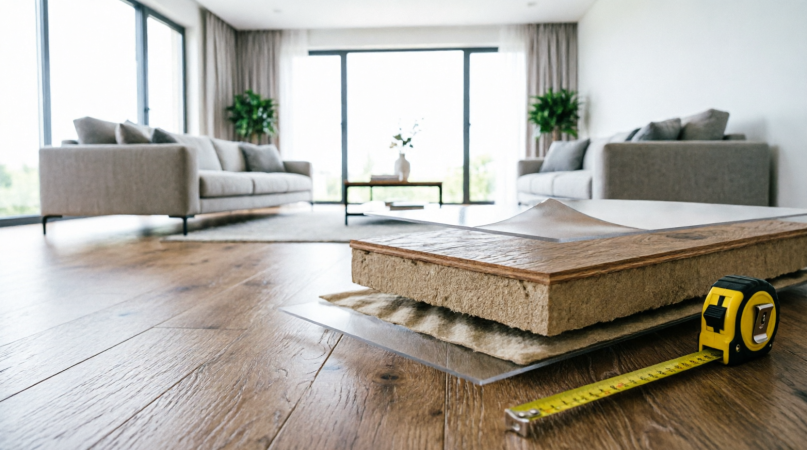
Luxury vinyl plank flooring has become a top choice for homeowners who want the look of real wood without the high maintenance. High-quality luxury vinyl plank flooring features a printed wood-look layer protected by a clear wear layer, built on a flexible or rigid core. While this luxury vinyl plank flooring wipes clean easily and fits various budgets, buyers must navigate significant variations in product quality. Crucially, a floor’s “waterproof” label applies to the planks themselves, not necessarily the entire installed floor system.
Before making a purchase, focus on five critical factors: the wear layer thickness (measured in mils), the total core thickness (in millimeters), the approved installation method, the manufacturer’s specific subfloor moisture requirements, and the total installed cost—not just the price of the boxes.
What Is Luxury Vinyl Plank Flooring?
LVP is a resilient flooring material primarily composed of PVC (polyvinyl chloride). The planks are typically rectangular, with popular retail dimensions including 5″ x 48″, 6″ x 48″, 7″ x 60″, and 9″ x 72″.
A standard LVP plank consists of four main components, though construction varies by manufacturer:
- Wear Layer: A transparent, durable coating on top that defends against scuffs, scratches, and stains.
- Decorative Layer: A high-resolution printed image of wood, often enhanced with an embossed texture for realism.
- Core: The structural body of the plank, which can be flexible vinyl or a rigid composite.
- Backing or Attached Pad: An optional underlayment bonded to the bottom for added comfort and sound absorption.
Rigid-core planks feature a stiffer foundation, commonly marketed as SPC (stone plastic composite) or WPC (wood plastic composite, sometimes featuring a foamed, cushioned core). Flexible planks are thinner and more pliable. Because brands use these terms differently, always verify the specific product’s technical specification sheet rather than relying on marketing labels.
How LVP Differs From Similar Floors
| Floor Type | Shape | Key Difference |
|---|---|---|
| LVP | Long planks | Vinyl construction with a realistic wood-look print. |
| Luxury Vinyl Tile (LVT) | Tiles | Same vinyl family as LVP, but typically features a stone or ceramic look. |
| Sheet Vinyl | Large rolls | Fewer seams, making it highly water-resistant, but requires a different installation approach. |
| Laminate | Planks | Features a fiberboard core with a printed layer; generally more sensitive to moisture than LVP. |
| Hardwood | Planks | Made of real wood; can be sanded and refinished multiple times. |
Luxury Vinyl Plank Flooring Pros and Cons
LVP is highly versatile, but its real-world performance depends heavily on product quality and proper installation.
| Advantage / Disadvantage | What It Means in Practice | What Buyers Should Check |
|---|---|---|
| Wood-look variety (Pro) | Available in countless colors, widths, and textures. | Request a physical sample to view the surface texture in your home’s lighting. |
| Easy cleaning (Pro) | Routine sweeping and damp mopping handle most dirt. | Review the maintenance instructions in the warranty to avoid voiding it. |
| Spill resistance (Pro) | Ordinary spills wipe up easily when seams are tightly locked. | Confirm if the product is officially listed as waterproof and understand its limitations. |
| Comfort and sound (Pro) | Softer underfoot than tile; attached pads significantly reduce noise. | Check the pad type and thickness, and whether adding a second underlayment is permitted. |
| Installation options (Pro) | Floating click-lock or glue-down methods suit various DIY skill levels. | Verify the installation method the manufacturer approves for your specific subfloor. |
| Wide price range (Pro) | Options span from budget-friendly to premium grades. | Base your decision on wear layer, warranty, and total installed cost. |
| Subfloor sensitivity (Con) | Dips, ridges, and debris can telegraph through or stress the locking joints. | Strictly follow the flatness requirements outlined in the installation guide. |
| Variable durability (Con) | Scratch and dent resistance differ wildly between products. | Prioritize wear-layer thickness and read the warranty scope carefully. |
| Damage risks (Con) | Sharp objects, heavy point loads, extreme heat, and strong sunlight can cause harm. | Check manufacturer limits regarding radiant heat and direct sunlight exposure. |
| Repair limitations (Con) | Individual planks can be replaced, but only if you have spares and the system allows it. | Always buy extra boxes from the same production lot for future repairs. |
| End-of-life options (Con) | Recycling programs for PVC flooring are not widely available. | Ask the retailer or manufacturer about any take-back or recycling programs. |
Note: No LVP is completely scratch-proof, and no reputable warranty promises a fixed lifespan under all possible conditions.
Is Luxury Vinyl Plank Flooring Waterproof?
Many LVP products are aggressively marketed as “waterproof,” meaning the plank material itself will not swell, warp, or rot when exposed to moisture. However, this does not automatically make the installed floor, the seams, or the subfloor waterproof. This claim is highly specific to each product, so you must confirm it in the manufacturer’s official documentation.
Three concepts often get confused:
- Water-resistant: Handles minor spills and ambient humidity for a limited time, but may not tolerate standing water.
- Waterproof plank: The plank material does not absorb water, but water can still infiltrate at seams, edges, and expansion gaps.
- Complete installed floor system: Includes planks, seams, perimeter transitions, and the subfloor. The system is only as strong as its weakest link.
Different water situations behave differently:
- Spills: Wipe them up promptly. Most quality LVP handles this effortlessly.
- Standing water or leaks: Water can seep through seams or edges and pool underneath the planks, potentially damaging a wood subfloor or encouraging mold growth.
- Flooding: Always check the manufacturer’s warranty language. Many explicitly exclude flood damage.
- Moisture rising through concrete: This process is slow and invisible. A plank’s waterproof rating does not stop subsurface moisture from causing adhesive failure or microbial issues underneath.
Is Luxury Vinyl Plank Flooring Good for Basements?
LVP can be an excellent choice for a basement, but only after the concrete slab has been rigorously tested for moisture and the manufacturer’s specific requirements are met. In a basement, the primary risk is the concrete slab, not the plank itself.
Key steps before installing over a basement slab:
- Test the slab for moisture: Manufacturers of resilient flooring generally mandate moisture testing on concrete prior to installation. Excess moisture from slabs can cause debonding and microbial growth. The in-slab relative humidity probe method is covered by ASTM F2170. Keep in mind that results only reflect the slab’s condition at the exact time of the test.
- Compare results to your product’s limit: ASTM F710 sets a maximum of 75 percent relative humidity when using the probe method and recommends a moisture retarder under on-grade and below-grade slabs. Individual flooring manufacturers may set stricter limits, so always defer to their specific guidelines.
- Check flatness: ASTM F710 calls for a slab to be flat to within 3/16 inch across a 10-foot radius.
- Fix water problems first: Cracks that leak, poor exterior drainage, and recurring dampness must be corrected before any new flooring is installed.
- Follow the product’s underlayment rules: Some planks have an attached pad and strictly prohibit adding a second one. Others require a dedicated vapor barrier. There is no universal rule.
- Control temperature and humidity: Keep the basement environment within the temperature and humidity range stated in the installation guide.
Remember: Waterproof planks do not replace the need for proper moisture testing or adequate drainage.
How to Choose the Best Luxury Vinyl Plank Flooring
The “best” LVP depends entirely on the room, foot traffic, subfloor condition, and your budget. Evaluate these factors in order:
- Wear layer and finish: This is your primary defense against scuffs and scratches.
- Core type and total thickness: This affects stiffness, underfoot comfort, and how well the floor masks minor subfloor imperfections.
- Installation method: Decide between floating click-lock and glue-down based on your subfloor.
- Moisture claims and warranty limits: Read the fine print to understand exactly what is excluded.
- Attached pad: This significantly affects sound dampening and warmth.
- Plank size and texture: This dictates the visual appearance and the number of seams you will see.
- Subfloor compatibility: Ensure the product is rated for your specific substrate (concrete, plywood, or existing flooring).
- Total project cost: The plank price is only one part of the overall budget.
The thickest plank is not automatically the best choice. Total thickness and wear-layer thickness measure two entirely different things.
Luxury Vinyl Plank Flooring Thickness
When evaluating luxury vinyl plank flooring, total thickness is measured in millimeters (mm), while wear-layer thickness is measured in mils. One mil equals one-thousandth of an inch (0.0254 mm). For context, a 20-mil wear layer is approximately 0.51 mm thick, and a 12-mil wear layer is about 0.30 mm thick.
For example, retailer listings for premium luxury vinyl plank flooring like COREtec Originals Classics show an 8 mm plank with a 20-mil wear layer, alongside a 6.5 mm plank with a 12-mil wear layer. The 8 mm measurement describes the entire plank, while the 20-mil measurement describes only the protective top surface.
While thickness aids in comfort and subfloor forgiveness for your luxury vinyl plank flooring, the wear layer, finish quality, and installation conditions matter just as much. There is no universal minimum thickness that applies to every home, so rely on the manufacturer’s residential and commercial ratings as your guide.
Best Luxury Vinyl Plank Flooring Brands
Judge a brand by its documented specifications, installation instructions, warranty terms, and the specific product line—not the brand name alone. Warranties and specifications change frequently by collection.
COREtec is one of the most frequently searched brands. The table below uses retailer listings as a reference, as manufacturer collection pages can sometimes be difficult to navigate. Specifications are retailer-reported and should be confirmed against the official COREtec product sheet before purchase.
| Product Line | Total Thickness | Wear Layer | Core | Attached Pad | Installation | Warranty (as listed) |
|---|---|---|---|---|---|---|
| Originals Classics (8 mm) | 8 mm | 20 mil | WPC | Cork | Floating or direct glue | Limited lifetime residential, 10-year commercial |
| Originals Classics (6.5 mm) | 6.5 mm | 12 mil | WPC | Cork | Floating or direct glue | Limited lifetime residential, 10-year commercial |
| Originals Premium (7″ x 60″) | 10.25 mm | 20 mil | Rigid core | 3.75 mm attached pad | Not confirmed | Limited lifetime residential, 10-year commercial |
| Originals Enhanced (9″ x 72″) | 8.1 mm | 20 mil | WPC | Not confirmed | Floating or direct glue | Commercial WPC 15-year listed; residential not confirmed |
Sources for these rows include Paneltown, Floors To Your Home, and Floors Center. Retailers sometimes disagree on specifications; for instance, one listing for COREtec One Plus shows 6.3 mm where others show 6.5 mm. Treat all listing data as provisional, and read the exact warranty for your specific collection, including its exclusions.
No single brand wins for every project. Compare similar product lines from at least two or three reputable brands, and match them to your room’s specific moisture, traffic, and subfloor conditions.
Luxury Vinyl Plank Flooring Reviews
When reading reviews, look for patterns rather than fixating on star averages. Useful signals include:
- Repeated complaints: Multiple reviewers mentioning the same issue (e.g., gapping, denting, color mismatch) is a major red flag.
- Installation context: A complaint about buckling or gaps may reflect an uneven subfloor or skipped acclimation period, rather than a defective product.
- Warranty experiences: Look for details on how claims were actually handled, not just the headline coverage promises.
- Time in service: A review written a week after installation reveals very little about long-term wear and durability.
Always distinguish between actual product defects and poor installation or unsuitable site conditions before concluding.
Luxury Vinyl Plank Flooring Price per Square Foot
As of 2026, published U.S. cost guides estimate luxury vinyl plank flooring material costs at roughly $2 to $7 per square foot, with professional installation labor adding about $1 to $4 per square foot. These are national, third-party editorial estimates for luxury vinyl plank flooring, not localized contractor quotes, and regional prices can vary significantly.
One home improvement guide lists luxury vinyl plank flooring at about $2 to $7 per square foot, with labor adding $1 to $4. Another guide provides a broader all-in range of $2.50 to $13.50 per square foot for vinyl flooring generally, while specifically listing luxury vinyl plank flooring materials at $2 to $10 per square foot. A third source estimates luxury vinyl at $3 to $15 per square foot installed across both plank and tile formats. This wide spread exists because quality tiers, regional labor rates, and included services differ drastically.
As a real-world retailer example for luxury vinyl plank flooring, a COREtec One Plus listing recently showed $6.19 per square foot, or $195.11 per 31.52-square-foot carton. Prices fluctuate often, so always check current local listings.
Luxury Vinyl Plank Flooring Installation Cost
Break your budget into distinct parts, as some guides bundle these costs while others do not:
| Cost Item | Typical Range (per sq ft) | Notes |
|---|---|---|
| Flooring material | About $2 to $7 | Varies heavily by quality tier and brand. |
| Installation labor | About $1 to $4 | Higher for complex layouts, stairs, or glue-down methods. |
| Removal and disposal | About $1 to $4 | Depends on the type and amount of existing flooring. |
| Underlayment | Varies | Skip this if the plank has an attached pad that prohibits another. |
| Subfloor leveling/repair | Varies widely | Depends entirely on how uneven the existing subfloor is. |
| Trim and transitions | Priced per piece | Often billed separately from the square footage cost. |
DIY installation can cut labor costs significantly, but it still requires proper tools, meticulous subfloor preparation, and strict adherence to the manufacturer’s instructions to avoid voiding the warranty.
How to Estimate the Total Flooring Cost
Use these two basic budgeting formulas:
- Material cost = Ordered square feet × Material price per square foot
- Installed estimate = (Floor area × Installed price per square foot) + Any excluded items (like removal or leveling)
First, measure the floor. Multiply length by width for each rectangular section, then add them together. Next, add a waste allowance for cuts, layout adjustments, and mistakes. Many installers suggest roughly 5% to 10% for simple, straight layouts, and more for diagonal patterns or rooms with many obstacles. This range is a common trade rule of thumb, so confirm it with your specific installer or manufacturer.
Illustrative examples: These assume a mid-range plank at $4.00 per square foot, installation labor at $2.50 per square foot of actual floor area, and a 10% waste allowance on material only. Labor is not charged on waste. Removal, leveling, underlayment, and trim are excluded.
| Area | Material to Order (with 10% waste) | Material Cost | Labor | Estimated Total | Per Sq Ft of Floor |
|---|---|---|---|---|---|
| 200 sq ft | 220 sq ft | $880 | $500 | $1,380 | $6.90 |
| 500 sq ft | 550 sq ft | $2,200 | $1,250 | $3,450 | $6.90 |
| 1,000 sq ft | 1,100 sq ft | $4,400 | $2,500 | $6,900 | $6.90 |
Boxes are sold in fixed coverage increments, so you must round up. With a 31.52-square-foot carton, a 220-square-foot order requires 7 cartons (220 ÷ 31.52 = 6.98), which covers 220.64 square feet. Do not add labor or trim costs twice if your chosen “installed price” already includes them. These are budgeting figures, not formal contractor quotes.
Luxury Vinyl Plank Flooring Installation
Installation steps vary by product, so always follow the manufacturer’s specific guide. At a planning level, the process involves:
- Measuring the room and ordering material using a calculated waste allowance.
- Inspecting and preparing the subfloor. It must be clean, dry, and flat (ASTM F710 calls for flatness within 3/16 inch over 10 feet).
- Checking moisture levels, especially on concrete slabs.
- Choosing the installation system: floating click-lock or glue-down. Not every plank allows both methods.
- Acclimating the planks in the room if the instructions require it.
- Planning the layout, including plank direction, the starting wall, staggered seams, and transition placements.
- Installing the floor, leaving the perimeter expansion gap the manufacturer specifies for floating floors.
- Finishing edges and transitions, then inspecting the floor and following the maintenance guidance.
Common mistakes to avoid:
- Installing over an uneven, dirty, or damaged subfloor.
- Ignoring underlying moisture problems.
- Using an incompatible underlayment, or adding a second pad when the plank strictly prohibits it.
- Skipping perimeter expansion gaps.
- Failing to follow the written instructions, which can instantly void the warranty.
- Assuming waterproof planks mean moisture control is unnecessary.
Which Is Better, Vinyl or PVC?
This comparison is slightly misleading because PVC (polyvinyl chloride) is the primary plastic polymer that most vinyl flooring is made from. LVP is a type of vinyl flooring, meaning vinyl flooring is generally PVC-based. They are not competing materials.
If you meant to compare LVP with another vinyl format, the real choices are:
- LVP versus sheet vinyl: Planks with a wood look and click-lock options, versus continuous rolls with fewer seams.
- LVP versus LVT: The exact same construction, but offered in plank or tile shapes.
Choose based on format, thickness, wear layer, and installation method, not by the word “PVC.”
Which Is Better, Vinyl Flooring or Tile?
Neither material wins in every scenario. LVP is generally easier to install and warmer underfoot, while tile is harder and more resistant to extreme heat and heavy wear.
| Factor | LVP | Ceramic or Porcelain Tile |
|---|---|---|
| Upfront cost | Generally lower. | Generally higher; guides list tile at about $7 to $50 per sq ft installed. |
| Water exposure | Resists spills; seams and subfloor still matter. | Tile itself is water-tolerant; grout and substrate need proper care. |
| Comfort | Softer and warmer underfoot. | Harder and colder. |
| Scratch/impact wear | Varies by wear layer; can dent or gouge under heavy loads. | Typically very hard; can chip or crack under sharp, heavy impact. |
| Repair | Replace individual planks if spares are available. | Replace tiles; matching grout and tile batches can be difficult. |
| Installation | Often manageable for DIY, especially floating methods. | More demanding; usually requires a professional. |
| Subfloor needs | Flat, dry, approved substrate. | Rigid, flat, highly stable substrate. |
| Maintenance | Simple sweeping and damp mopping. | Grout cleaning and periodic sealing may be needed. |
| Basements | Possible with strict moisture testing and controls. | Possible, with the same rigorous moisture considerations. |
Choose tile for areas with high heat, heavy wear, or when you want an authentic stone look. Choose LVP when comfort, budget, or simpler installation are your top priorities.
Is Luxury Vinyl Plank Flooring Worth It?
For many homeowners, the answer is yes—provided they want a wood look, easy care, and a flexible budget, and their subfloor and moisture conditions are suitable. It is a highly practical choice for kitchens, hallways, bedrooms, and well-prepared basements.
However, another flooring type may be better if you want real wood that can be refinished, need a surface that tolerates high heat or direct, harsh sunlight, or desire a specific natural material. No credible source supports promising a particular lifespan or resale value increase, so do not build your budget around those assumptions.
Frequently Asked Questions
What are the disadvantages of luxury vinyl plank?
The main downsides are sensitivity to uneven subfloors, variable scratch and dent resistance, potential damage from extreme heat or heavy point loads, limited repair options, and a lack of widespread recycling programs. Moisture trapped below the floor can still cause issues even with waterproof planks. Product quality, installation precision, and site conditions determine how much these factors impact you.
What is a luxury vinyl plank?
It is a plank-shaped vinyl floor featuring a printed decorative layer under a clear wear layer, built on a flexible or rigid core. It differs from sheet vinyl (which comes in continuous rolls) and luxury vinyl tile (which uses the same construction but in tile shapes).
Which is best, vinyl or PVC?
They overlap significantly. PVC is the polymer used to make most vinyl flooring, including LVP. If you are comparing vinyl formats, evaluate LVP, LVT, and sheet vinyl based on thickness, wear layer, and installation method.
Which one is better, vinyl or tiles?
It depends entirely on the project. LVP is usually cheaper, warmer, and easier to install. Tile is harder, handles heat exceptionally well, and resists wear, but it costs more and is much harder to install.
Is luxury vinyl plank flooring worth it?
Often, yes, for people who value a wood aesthetic, easy cleaning, and flexible pricing. Always check the wear layer, core type, warranty, moisture requirements, and total installed cost before buying.
Is LVP flooring suitable for basements?
It can be highly suitable, but only after the concrete slab passes the moisture test required by the manufacturer, is perfectly flat, and any underlying water problems are permanently fixed.
How thick should luxury vinyl plank flooring be?
There is no universal rule. Total thickness is measured in millimeters, and the wear layer is measured in mils. Use the manufacturer’s specific ratings for your intended use case as your guide.
External References
- Bob Vila, cost to install vinyl plank flooring
- HomeGnome, vinyl flooring installation cost
- Inch Calculator, vinyl flooring installation cost
- GCP Applied Technologies, ASTM F710 overview
- ASTM F2170 overview
- Ferguson, COREtec One Plus listing
- Floors To Your Home, COREtec Originals Premium listing
- Paneltown, COREtec Originals Classics listings
- Floors Center, COREtec Originals Enhanced listing
- Official COREtec collection page (confirm specs here before publishing)
6 thoughts on “Luxury Vinyl Plank Flooring: Pros, Cons, Cost, and How to Choose”