
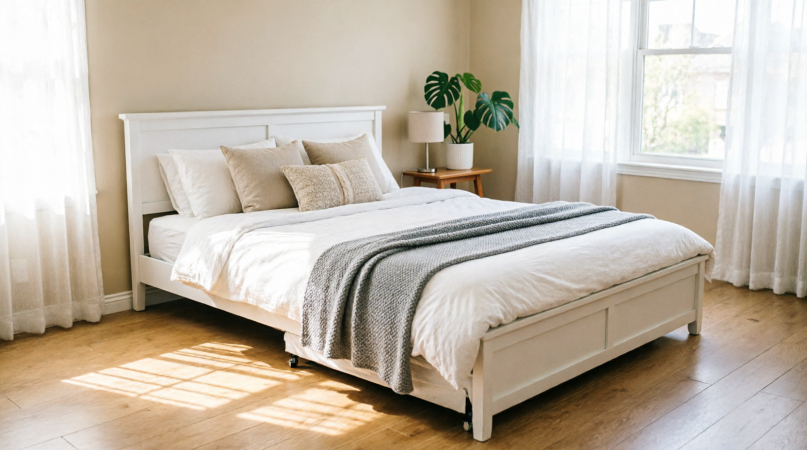
A trundle bed is essentially a second bed that hides underneath your main bed or daybed. Built on wheels or a lift frame, it stays tucked away during the day and rolls out whenever you need an extra sleeping spot. It’s a smart fit for guest rooms, kids’ rooms, and compact apartments where a permanent second bed simply won’t work.
Here’s the thing though — a trundle bed comes with more limitations than a standard bed. Things like mattress thickness, size, weight capacity, and floor clearance all vary depending on the model you pick. That’s why the manufacturer’s own specs matter far more than any general advice you’ll find online.
7 Key Facts at a Glance
- A trundle is a hidden second sleeping platform, not a full standalone bed.
- The main bed and the trundle often use different mattress sizes.
- Mattress thickness is the number one compatibility issue buyers run into.
- Many trundles sit very low to the floor, while pop-up versions rise to match the height of the main bed.
- Adults can sleep on some trundles, but only if the model’s weight rating and sleeping surface are suitable.
- A daybed refers to a frame style, while a trundle is an add-on platform. They overlap but aren’t the same.
- A box spring isn’t always required and can actually prevent a trundle from sliding properly.
Table of Contents
- What Is a Trundle Bed?
- How Does a Trundle Bed Work?
- What Is the Point of a Trundle Bed?
- Trundle Bed Sizes and Mattress Compatibility
- Can an Adult Sleep in a Trundle Bed?
- Trundle Bed Advantages and Disadvantages
- Trundle Bed vs. Daybed
- Can You Use a Regular Mattress on a Trundle or Daybed?
- Do You Need a Box Spring With a Daybed or Trundle?
- How to Choose a Trundle Bed
- Where to Find Trundle Beds
- Frequently Asked Questions
What Is a Trundle Bed?
A trundle bed is a low-profile sleeping platform that slides beneath a primary bed or daybed. Pull it out, and it becomes a second bed for a guest or a sibling. Push it back in, and it disappears completely under the main frame.
Two terms often get mixed up here. A daybed is a frame with a back and sides that doubles as both a sofa-style seat and a bed. A trundle, on the other hand, is the pull-out platform itself, and it can sit under a daybed or a regular bed frame.
How Does a Trundle Bed Work?
There are two main designs you’ll come across, and they behave quite differently. It’s worth knowing which one a product uses before you buy.
Pull-out (drawer-style) trundles roll out on casters and stay close to the floor. The sleeping surface sits well below the main bed, and the mattress needs to be thin enough to slide back underneath without catching.
Pop-up trundles use a lift mechanism that raises the lower bed to roughly the height of the main bed. These are generally easier to get on and off, and they work well for guests of all ages. They tend to cost more — retailer guides suggest they can run $100 to $200 higher than comparable pull-out designs, though that’s a rough estimate rather than a fixed rule.
One thing to keep in mind: a pop-up trundle doesn’t automatically join the main bed into one large, level surface. Couples should only expect that on systems specifically designed for it.
What Is the Point of a Trundle Bed?
The whole idea is simple — you get a second sleeping spot without permanently sacrificing floor space. During the day, the room has one bed. At night, it can sleep two people.
That makes a trundle bed useful for:
- Guest rooms and home offices that host visitors only occasionally
- Children’s rooms where friends sleep over or siblings share
- Studios and small bedrooms where a separate guest bed isn’t practical
- Vacation rentals, where it adds sleeping capacity (though the low height and capacity should be clearly disclosed to guests)
Trundle Bed Sizes and Mattress Compatibility
Start with the standard US mattress sizes, then check what the specific frame allows. Standard dimensions describe mattresses, not trundle frames.
Table A: Common US Mattress Sizes
| Mattress Type | Common US Dimensions | Typical Use with a Trundle | What to Verify Before Buying |
|---|---|---|---|
| Twin | 38 x 75 inches | Most common for daybeds and trundles | Frame’s interior width and length |
| Twin XL | 38 x 80 inches | Taller sleepers, some longer frames | Whether the frame is long enough |
| Full | 54 x 75 inches | Larger main bed, or a wider trundle on some frames | Whether the trundle platform is also full-width |
| Queen | 60 x 80 inches | Usually the main bed only | Trundle size, which is often smaller |
Standard dimensions are 38 x 75 inches for twin, 54 x 75 inches for full, and 60 x 80 inches for queen. Twin XL measures 38 x 80 inches. Some sources list twins at 74 inches long, so tolerances vary slightly.
Main Bed and Trundle Often Differ
A trundle must fit within the space under the main frame, so it’s usually the same width as the main bed or narrower. Listings for a full-size bed with a trundle commonly pair a full upper mattress with a twin lower one. A queen bed with a trundle won’t necessarily have a queen-size trundle. Always check each mattress size separately.
Sizes can also differ between manufacturers. Some listings use a different mattress size or thickness on the lower bed than on the main bed. Take IKEA’s VIHALS series as an example. In several of IKEA’s international listings, the trundle only fits an 80 x 200 cm mattress up to 12 cm thick — that’s about 31.5 x 78.7 inches and 4.7 inches thick, separate from the main bed’s mattress. IKEA also states that the trundle cannot be used as a freestanding single bed. The listings reviewed were for non-US markets, so check IKEA’s current US product page for exact US specifications.
Mattress Thickness and Clearance
Thickness is the compatibility problem buyers most often miss. For a pull-out trundle, the mattress has to clear the underside of the upper frame while sliding.
You can estimate the limit yourself. Measure from the floor to the underside of the upper frame, then subtract the trundle platform height. What remains is the maximum mattress thickness.
Illustrative example: If the space under the upper frame measures 12 inches and the trundle platform is 4 inches tall, the available height is 12 – 4 = 8 inches. Leave a little margin for the mattress cover and bedding, so a 6 to 7 inch mattress is safer. These numbers are an example, not a model specification.
Typical figures vary by design. Retailer guides say pull-out trundles often limit mattresses to roughly 6 to 8 inches, and pop-up styles may allow thicker ones. Listings for specific frames show the range. One metal twin daybed lists a recommended 8 inch maximum for the daybed mattress and 6 inches for the trundle mattress. Another pop-up model lists a trundle that fits a mattress up to 9.5 inches thick. These are illustrations of how widely the numbers vary, not standards. Always follow the manual for the frame you buy.
Can an Adult Sleep in a Trundle Bed?
Yes, some trundle beds can work for adults, but not all of them. Suitability depends entirely on the model.
Check these points:
- Weight capacity. Look at the trundle’s own rating, not just the main bed’s. The trundle’s rating is often lower. In one listing, the daybed was rated for 400 lb and the trundle for 250 lb — an example of the gap that can occur. Also confirm whether the rating covers the mattress and sleeper combined.
- Mattress length. A standard twin is 75 inches long. Taller adults may need a twin XL, which only some frames accept.
- Sleeping height. A pull-out trundle sits low. Getting up from it can be hard for older adults, and a pop-up is usually the better choice for adults who will sleep on it regularly.
- Mattress thickness. Clearance limits can force a thin mattress, which affects comfort for longer stays.
For occasional adult guests, a pop-up trundle with a stated capacity that suits the guest is the most practical option. For nightly adult use, a regular bed is usually the more comfortable choice.
Trundle Bed Advantages and Disadvantages
Table B: Trade-offs at a Glance
| Factor | Advantage | Potential Limitation | Best For |
|---|---|---|---|
| Space | Second bed with no extra floor footprint when stored | Needs open floor space to roll out | Small rooms with a clear pull-out zone |
| Storage | Bedding stays hidden under the main bed | Hard to reach stored items under the frame in some designs | Occasional guest use |
| Accessibility | Pop-up styles rise closer to bed height | Pull-out styles sit low | Pop-up for adults and older guests |
| Comfort | Fine for sleepovers and short stays | Thin mattresses are common | Kids and short visits |
| Mattress choice | Standard sizes available | Thickness limits restrict options | Buyers who check specs first |
| Everyday use | Efficient for occasional use | May be less comfortable for nightly use | Guests, siblings, sleepovers |
Not every model has every drawback. Frame design drives most of them, which is why the specifications matter so much.
Trundle Bed vs. Daybed
These categories overlap, but they describe different things. A daybed is a frame style. A trundle is an additional sleeping platform that can be paired with a daybed or with a regular bed frame.
Table C: Trundle Bed, Daybed, and Daybed With Trundle
| Feature | Trundle Bed | Daybed | Daybed with Trundle |
|---|---|---|---|
| What it is | Pull-out second sleeping platform | Frame that works as sofa and bed | Daybed plus a stored second bed |
| Sleeping spots | Adds one under a main bed | One | Two |
| Works as seating | Not by itself | Yes | Yes, when the trundle is stored |
| Mattress count | Needs its own | One | Two, checked separately |
| Main concern | Clearance and thickness | Rail height and mattress fit | Both sets of limits |
A daybed does not have to include a trundle, and a trundle does not have to go under a daybed.
Can You Use a Regular Mattress on a Trundle or Daybed?
Often yes for daybeds, but only if it meets the frame’s limits. For trundles, a regular mattress is the main place people go wrong.
A standard twin mattress matches the nominal size of most daybeds and many trundles. Nearly all daybeds and trundles take a twin, and a few longer frames take a twin XL. But a standard mattress is often too thick for a pull-out trundle, and the daybed and trundle in the same set can have different limits. Check the maximum thickness for each one, and measure the frame’s interior dimensions before ordering.
Do You Need a Box Spring With a Daybed or Trundle?
Usually not. A box spring isn’t an automatic requirement, and adding one can actually cause problems.
What matters is that the mattress has even, stable support. Many daybeds and trundles come with slats or a solid platform. A box spring would raise the mattress height and make a daybed less practical as seating. On a trundle, extra height can mean it no longer slides under the frame.
Slat spacing matters because mattress makers set their own limits. Many manufacturers want support such as slats no more than about 3 inches apart, while another brand lists under 5 inches. Check your mattress maker’s support guidance. Some frames, including certain wrought-iron daybeds, may still need a box spring or foundation, so follow the frame’s instructions first. Never add a box spring to a trundle without confirming it will still close.
How to Choose a Trundle Bed
Match the bed to how often it will be used and who will sleep on it. A guest bed used a few nights a year has different needs than a shared kids’ room.
Table D: Pre-Purchase Checklist
| Check | Why It Matters |
|---|---|
| Main mattress size | Sets the footprint and bedding |
| Trundle mattress size | Often different from the main bed |
| Maximum mattress thickness | Decides whether the trundle can slide |
| Weight capacity (main and trundle) | Ratings often differ |
| Clearance under the frame | Confirms the trundle fits |
| Support system | Slats or platform, and spacing |
| Pull-out space needed | Room must stay clear of furniture |
| Assembly and returns | Large boxes, long assembly, return terms |
A few other points help:
- Mechanism. Choose pop-up for adults, older guests, or frequent use. Pull-out is fine for kids and short stays.
- Material. Wood, metal, and upholstered frames each have trade-offs in weight, cleaning, and durability. No material is best for everyone, so compare the stated capacity and construction details.
- Ease of use. Look for locking casters and a smooth roll. A trundle that’s hard to move will rarely get used.
- Independent use. Some trundles, like IKEA’s, cannot be used on their own. Confirm this if you may want to use it as a separate bed.
Where to Find Trundle Beds
You’ll find trundle beds and daybeds with trundles at furniture retailers, mattress shops, and online marketplaces such as IKEA and Amazon. Don’t rely on a product title alone.
On any listing, check the main and trundle mattress dimensions, the maximum mattress thickness, weight limits, frame material, slat support, assembly requirements, and return terms. Prices and availability change often, so confirm them at the time you buy.
Frequently Asked Questions
Is it okay to sleep on a daybed every night? Yes, if the manufacturer allows regular use, the frame has proper support, and the mattress is comfortable for you. The frame and the mattress are separate questions, so check both.
What are the downsides of a daybed? Seating comfort depends on the back support and cushions. Mattress thickness can be limited by rail height. Daybeds take up room, and managing pillows and bedding for both sitting and sleeping can be fiddly.
What is the best daybed for sleeping? There’s no single best one. Compare mattress compatibility, frame support, intended frequency of use, room size, and whether you need a trundle. A well-supported frame with a mattress you find comfortable matters more than the style.
What is the healthiest surface to sleep on? No single surface is healthiest for everyone. A mattress that is supportive and comfortable for you, in good condition, on a suitable base is the practical goal. If you have back pain or a medical condition, ask a healthcare professional.
What size mattress fits a daybed with a trundle? Check the daybed and trundle separately. Twin (38 x 75 inches) is the most common for both, and twin XL (38 x 80 inches) fits some frames. The product’s specifications take priority over general sizes.
Can I put a regular mattress on a daybed? Usually, if it’s the right size and thin enough for the rails and any trundle clearance. Check the frame’s maximum thickness first.
Conclusion
A trundle bed is one of the most space-efficient ways to add a sleeping spot, but it only works well if the mattress, clearance, and capacity all fit. Before buying, measure the space under the frame, read the maximum mattress thickness, and compare the trundle’s weight rating to the main bed’s. For adult or frequent use, a pop-up model is usually the safer choice.