
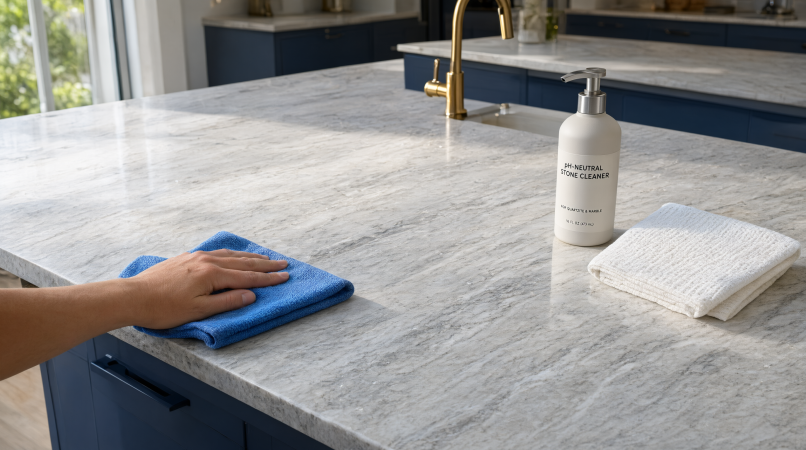
Grab a microfiber cloth, warm water, and a drop of dish soap—that’s your everyday cleaning kit for quartzite. A pH-neutral stone cleaner works just as well. Stay away from vinegar, lemon juice, scrubbing powders, and harsh chemicals unless your supplier specifically says they’re fine.
Here’s the thing about quartzite: not every slab labeled “quartzite” behaves the same way. Some are hard and acid-resistant like true quartzite should be. Others have softer minerals or act more like marble. When you’re not sure what you’re working with, play it safe and treat it gently.
Quick Answer: The Everyday Cleaning Method
- Brush away crumbs with a soft cloth
- Mix a few drops of mild dish soap into warm water
- Wipe the surface with a damp microfiber cloth
- Go over it again with a clean, water-dampened cloth
- Dry thoroughly with a soft towel
That’s really all most kitchens need on a regular basis. Keep reading for the details on what works, what doesn’t, how to handle stains, and when sealing matters.
What Is the Best Thing to Clean Quartzite Countertops With?
Mild dish soap in warm water gets the job done. It cuts through grease, won’t break the bank, and plays nice with your stone. A pH-neutral stone cleaner is your other solid option. The Natural Stone Institute and other natural stone care experts consistently recommend gentle, non-abrasive cleaners, water, and soft cloths for countertops like these.
Use soap sparingly. Too much leaves a cloudy film that makes the stone look dull, and that residue actually attracts more dirt. If your counter looks streaky after cleaning, you’re probably dealing with leftover soap or water minerals—not damage to the stone itself.
| Cleaning option | Suitable use | Important consideration |
|---|---|---|
| Mild dish soap and warm water | Routine cleaning | Use a few drops and rinse well |
| pH-neutral stone cleaner | Routine cleaning | Follow the label and your slab supplier’s guidance |
| Plain water and microfiber cloth | Dust and fresh, light residue | Dry afterward to prevent water marks |
| Specialized stone stain remover | One specific stubborn stain | Match the product to the stain and confirm it suits your finish |
No single branded cleaner works best for every slab. What works depends on your stone, its finish, and any sealer on it. If your fabricator gave you a care sheet, that’s your first reference.
How to Clean Quartzite Countertops Step by Step
Remove debris, wipe with mild soapy water on a soft cloth, rinse with a clean damp cloth, and dry completely. Here’s how:
Clear the surface. Move everything off the counter. Pick up crumbs with a soft cloth or hand brush instead of sweeping them across the stone—grit can scratch over time.
Mix your cleaner. Add a few drops of mild dish soap to warm water, or use a stone-safe cleaner as the label directs.
Wipe gently. Use a damp microfiber cloth or nonabrasive sponge. Work in sections and pay extra attention around the stove, sink, and coffee station.
Rinse. Go over the surface with a second cloth dampened with plain water to pick up soap residue.
Dry. Buff with a clean, soft towel. Drying prevents water spots and mineral rings, especially near sinks and in areas with hard water.
Inspect. Look at the counter from a low angle with light across it. Streaks usually mean leftover soap. A dark spot that won’t dry out might be an absorbed stain.
Skip aggressive scrubbing, homemade chemical blends, and frequent polishing products. A gentler approach almost always works better on stone.
How to Clean Quartzite Countertops Naturally
“Natural” cleaning for quartzite really just means keeping things simple:
- Mild dish soap and warm water for grease and food
- Plain water on a microfiber cloth for light residue
- A clean, dry cloth to finish
- Blotting spills quickly instead of wiping them wider
- Gentle pressure instead of scrubbing
Plenty of popular “natural” cleaners are acidic or abrasive—exactly what stone doesn’t like. Just because something is plant-based or homemade doesn’t make it safe for your counter.
How to Clean Quartzite Countertops With Vinegar
Don’t make vinegar your go-to. It’s acidic, and acids can dull or etch calcium-based minerals found in some stones sold as quartzite. Acid also wears down protective sealer over time.
True quartzite is mostly quartz and handles acid well—that’s why you’ll see conflicting advice online. The problem is you often can’t tell from the label alone whether your slab is pure. Geologist Karin Kirk from the Natural Stone Institute has noted in industry interviews that quartzite-labeled slabs vary widely, and when in doubt, you should treat the stone like marble. Since neutral soap cleans just as effectively, vinegar offers little upside and some risk.
Want to know if your slab tolerates acid? Ask your fabricator or supplier. Some people test with a drop of lemon juice or vinegar in a hidden spot or on an offcut—if the spot turns dull or etched, the slab is acid-sensitive. That test itself is a risk on your countertop, though, so getting a supplier’s answer is safer.
Note that engineered quartz is different. It’s made with resin, and many manufacturers warn against harsh acidic or alkaline cleaners, so follow your brand’s care guide.
Can You Use Baking Soda on Quartzite?
For routine cleaning, you don’t need it. Baking soda is a mild abrasive, and scrubbing a dry paste across polished, honed, or leathered surfaces can leave dull patches, especially on slabs with softer minerals.
Baking soda does have a role in stain removal, though. The Natural Stone Institute lists baking soda and water as a poultice for oil-based stains. A poultice is a paste that sits on the stain and draws it out as it dries—no scrubbing involved. That’s a different use than scouring the counter.
Advice for engineered quartz and natural quartzite isn’t interchangeable, so confirm with your slab supplier before applying any paste to a visible area.
What Not to Use on Quartzite Countertops
| Product or method | Recommendation | Reason |
|---|---|---|
| Vinegar, lemon, and acidic cleaners | Avoid as a default | Can dull or etch acid-sensitive minerals and wear down sealer |
| Abrasive powders and scouring pads | Avoid | Can scratch or dull the finish |
| Strong, general-purpose chemical cleaners | Avoid unless approved for your stone | May damage the finish or degrade sealer |
| Cream cleansers with scrubbing particles | Avoid | Abrasive particles can dull the surface |
| Rust removers and products with hydrofluoric acid | Never use | Can attack silicate minerals, including quartz |
| Unapproved waxes, polishes, and coatings | Avoid | Can leave residue or change the look of the stone |
Never mix bleach with ammonia or other cleaners. The combination can release toxic gases. Ventilate the room and use one product at a time.
Formulas for a brand can differ by country and product line, so a name alone doesn’t tell you if it’s safe. Read the label and look for explicit approval for natural stone.
How to Remove Stains From Quartzite Countertops
Start by figuring out what caused the mark, because treatment depends on the source. Also separate stains from damage: a stain is something absorbed into the stone, while an etch is a dull spot where the surface itself has been eaten away. Cleaning can lift a stain, but it can’t fix an etch.
The Natural Stone Institute’s basic spill advice applies everywhere: blot the spill right away instead of wiping it, flush with plain water and mild soap, rinse several times, and dry thoroughly. Repeat if needed.
| Problem | What to check | Recommended approach |
|---|---|---|
| Coffee or tea | Is it a surface film or a mark that stays after cleaning? | Blot, clean with soap and water, then try a stone-safe stain remover or poultice if it persists |
| Oil or grease | Does the spot darken the stone and return after wiping? | Use a stone-compatible degreaser or an oil-stain poultice |
| Food residue | Is anything still sitting on top of the surface? | Soft cloth and mild soapy water |
| Water marks or mineral deposits | Does it wipe off, or is the stone itself dull? | Dry well; use a mineral-deposit product only if confirmed safe for your slab |
| White or dull patches | Residue, etching, or finish wear? | Diagnose first before applying anything |
| Rust-colored marks | Is a metal item the source? | Use a stone-specific rust treatment or call a professional |
How to Remove Coffee Stains From Quartzite
Blot the spill immediately, then clean with mild soap and water and dry it. Fast action helps a lot—sealed and dense quartzite often resists staining when spills don’t sit. If a shadow remains after cleaning and drying, the coffee has likely soaked in. At that point, choose a poultice or stone stain remover designed for organic stains and follow its instructions.
Some coffee stains don’t come out completely. That’s more likely on porous slabs, stones with worn sealer, and stains that have sat for days.
How to Remove Stubborn Stains From Quartzite
A poultice is the standard stone-care tool for deep stains. The Natural Stone Institute describes it as an absorbent material mixed with a liquid cleaner or chemical, applied over the stain so the stain moves out of the stone and into the paste as it dries. It often takes 24 to 48 hours to dry and may need repeating. Some stains never come out entirely.
Before using one:
- Identify the stain. Oil-based, organic (coffee, food), and metal stains each need a different approach.
- Choose a product made for your type of stone and check it against your finish.
- Follow the label and its safety directions. Some poultice liquids are chemicals that require ventilation and gloves.
- Test in a hidden area if the instructions say to.
Don’t improvise with bleach, hydrogen peroxide, or solvents unless a trustworthy stone-care source recommends them for your exact stain and stone. If a stain is large, dark, or in a high-visibility area, call a stone restoration professional.
Does Quartzite Leave Water Marks?
It can. Three possibilities:
- Dried water residue or mineral deposits: Common near sinks and with hard water. These often wipe off with a damp cloth and thorough drying.
- A moisture mark inside the stone: A dark spot where water has been absorbed. It typically fades as the stone dries.
- Surface damage: A permanent dull ring that doesn’t change with cleaning, suggesting etching.
Dry the counter after cleaning, especially around the sink. If deposits stay, use a mineral-deposit remover only if the label and your supplier confirm it’s safe for your slab.
How to Clean Leathered Quartzite Countertops
Leathered quartzite has a textured, slightly bumpy finish. That texture holds crumbs, soap, and moisture more than a smooth polished surface does, so it needs extra attention.
- Use a soft cloth, or a soft nonabrasive brush for texture that holds debris
- Clean in small sections and work along the texture, not across it, where practical
- Use as little cleaner as you can and rinse thoroughly—soap can hide in the low points
- Dry completely so water doesn’t sit in the grooves
- Follow your fabricator’s instructions for your specific finish and sealer, because leathered finishes aren’t all alike
- Blot spills quickly. Textured surfaces can show stains more readily because of the extra surface area, though this varies by slab
How to Disinfect Quartzite Countertops Safely
Cleaning and disinfecting are two different steps. Cleaning removes dirt and residue. Disinfecting uses a product to kill germs on a surface that’s already been cleaned. Most daily kitchens only need cleaning.
If you want to disinfect, say after raw meat has touched the counter:
- Clean the surface first with soap and water
- Choose a disinfectant whose label says it’s safe for your countertop type, or ask your slab supplier which one they approve
- Follow the label for dilution, how long the surface must stay wet, ventilation, and whether you must rinse afterward
- Rinse and dry if the label requires it
Don’t assume a household disinfectant is safe for stone just because it’s common. Strong chemicals can dull a finish or wear down sealer. And as mentioned above, never combine bleach with ammonia or other cleaners.
How to Seal Quartzite Countertops
A penetrating sealer fills the stone’s pores so liquids are slower to soak in. It helps resist stains, but it doesn’t make stone stainproof, and it doesn’t protect against etching.
Whether you need to seal depends on the slab. Porosity varies among quartzites. Dense, tightly bonded slabs may absorb very little, while others take in water readily. Many fabricators pre-seal slabs before installation, so ask your supplier whether yours was sealed, which product they used, and what they recommend going forward.
Before sealing, check the surface condition and whether an existing sealer is still working.
How to Clean Quartzite Countertops Before Sealing
- Clean off grease and dirt with soap and water or an approved stone cleaner
- Rinse as directed, so no soap film remains
- Let the stone dry completely. The sealer manufacturer will specify the wait, and it can be many hours or longer after a heavy cleaning
- Confirm the surface is clean and dry, with no stains you want to treat first
- Apply the sealer exactly as the label directs
Sealing over moisture, grease, or residue can trap contaminants or cause patchy results, so don’t rush it.
What Is the Best Sealer for Quartzite Countertops?
There’s no single best sealer for every slab. Instead, evaluate products against these criteria:
| Criterion | What to look for |
|---|---|
| Stone compatibility | Explicitly labeled for natural quartzite or natural stone |
| Finish compatibility | Confirmed for polished, honed, or leathered surfaces, as applicable |
| Food-surface suitability | Labeled safe for kitchen countertops after curing |
| Stain protection type | Water repellent only, or also oil repellent |
| Appearance | Whether it’s a color enhancer or leaves the look unchanged |
| Instructions | Clear application, wait times, and curing time |
Choose a penetrating (impregnating) sealer, not a topical coating that sits on the surface. Check the manufacturer’s current product page and safety data sheet before buying.
How Often Should Quartzite Countertops Be Sealed?
There’s no universal schedule. Some sources suggest every year, others every few years, and some sealers are marketed for much longer protection. What matters is your slab, how heavily you use it, and the sealer you chose.
A common check is the water drop test: place a small puddle of water, roughly 3 inches across, on the counter and watch it for 15 to 30 minutes. If the stone darkens noticeably, it’s absorbing water, and it may be time to reseal. Treat that as a rough guide, not a rule. Test a few spots (near the sink and stove especially) and follow your sealer manufacturer’s recommended method when it gives one.
How to Polish Quartzite Stone
Cleaning isn’t polishing. Cleaning removes residue and restores clarity. It doesn’t remove scratches, etching, or worn spots.
A polished surface that looks dull after cleaning may simply have soap film. Rinse and dry again before assuming damage.
Polishing products must be compatible with your stone and finish. A product that suits polished surfaces can ruin a leathered or honed one.
Don’t use steel wool, abrasive compounds, or power buffers as a DIY routine.
Persistent dull spots, scratches, or etch marks usually need a professional stone restoration specialist.
Quartz vs. Quartzite: What Is the Difference for Cleaning?
The names are similar, but the materials aren’t, and neither are their care needs.
| Feature | Natural quartzite | Engineered quartz |
|---|---|---|
| Material | Natural metamorphic rock | Manufactured surface made from quartz and other components, commonly including resin |
| Composition | Varies by slab | Depends on the manufacturer |
| Sealing | May be appropriate depending on porosity and treatment | Usually does not need conventional natural-stone sealing; check the manufacturer |
| Cleaning | Follow natural-stone and fabricator guidance | Follow the manufacturer’s care guide |
| Product compatibility | Depends on the stone, finish, and sealer | Depends on the resin, finish, and product |
Don’t carry cleaning advice from one to the other without checking. For example, an engineered quartz care sheet that approves a certain cleaner doesn’t mean it’s safe for natural stone.
Branded cleaners like Cif are sold in different formulations in different markets. Cream cleansers can contain abrasive particles, so check the exact product label and the countertop manufacturer’s guidance before using one.
Practical downsides of quartzite: it can stain if unsealed or poorly sealed, slabs vary a lot, some labeled quartzites are softer or more acid-sensitive than expected, and an etched or heavily stained surface may need professional restoration.
Frequently Asked Questions
What is the best thing to clean quartzite countertops with?
Mild dish soap diluted in warm water, applied with a soft microfiber cloth and dried afterward. A pH-neutral stone cleaner is another good option. Always follow your slab supplier’s care instructions.
Is vinegar safe on quartzite?
Not as a default. Many slabs sold as quartzite contain minerals that acids can dull, and acid can degrade sealer. Some very pure quartzites may tolerate it, but mild soap and water cleans equally well with less risk.
Can I use granite cleaner on quartzite?
Often yes, if the label says it’s pH-neutral and approved for natural stone, including quartzite. Check the product label, because some granite cleaners aren’t approved for every stone type or finish.
What should you not use on quartzite?
Avoid vinegar and other acids, abrasive powders, scouring pads, harsh chemical cleaners, rust removers containing hydrofluoric acid, and unapproved polishes or waxes. Never mix bleach with ammonia.
Does quartzite leave water marks?
It can. Dried water minerals and moisture marks are common near sinks. Wipe and dry the surface after cleaning. If a ring stays after drying and doesn’t wipe off, it may be etching.
Will coffee stain quartzite?
It can, particularly on porous or poorly sealed slabs or when spills sit. Blot immediately and clean with soap and water. Dense, well-sealed quartzite often resists coffee better than most stones, but no stone is stainproof.
Can I use baking soda on quartz countertops?
Check the manufacturer’s care guide first. Many recommend only mild soap and water. Baking soda is mildly abrasive, so it’s not a routine cleaner for engineered quartz or natural quartzite.
Does vinegar damage engineered quartz?
Brief contact is unlikely to cause immediate harm, but many manufacturers warn against acidic cleaners and prolonged exposure. Mild soap and water is the usual recommendation, so follow your brand’s guide.
What is the best natural cleaner for engineered quartz?
Warm water with a few drops of mild dish soap and a soft cloth. Avoid scrubbing powders and harsh chemicals, and confirm with your manufacturer’s care instructions.
Can you use Cif on quartz?
Check the exact product and your manufacturer’s guidance. Cream cleansers may contain abrasive particles that can dull surfaces, and formulations differ by market. Mild soap and water is the safer choice.
What are the disadvantages of quartzite?
It can stain if not sealed properly, slabs vary in density and mineral content, some slabs react to acids, it’s usually pricier than many alternatives, and etching or deep stains may require professional restoration.
How do you remove stubborn quartzite stains?
Identify the stain first, then use a poultice or stone-safe stain remover made for that stain type. Follow the instructions, allow full drying time, and repeat if needed. For large or dark stains, hire a stone restoration professional.
The Bottom Line
For nearly every day of the year, how to clean quartzite countertops comes down to a few habits: use mild soap and warm water, blot spills quickly, rinse, and dry. Reserve stain removers, poultices, and sealers for when you actually need them, and match every product to your specific slab and finish. If you’re not sure what you have, ask your fabricator or supplier before trying anything stronger than soap.