
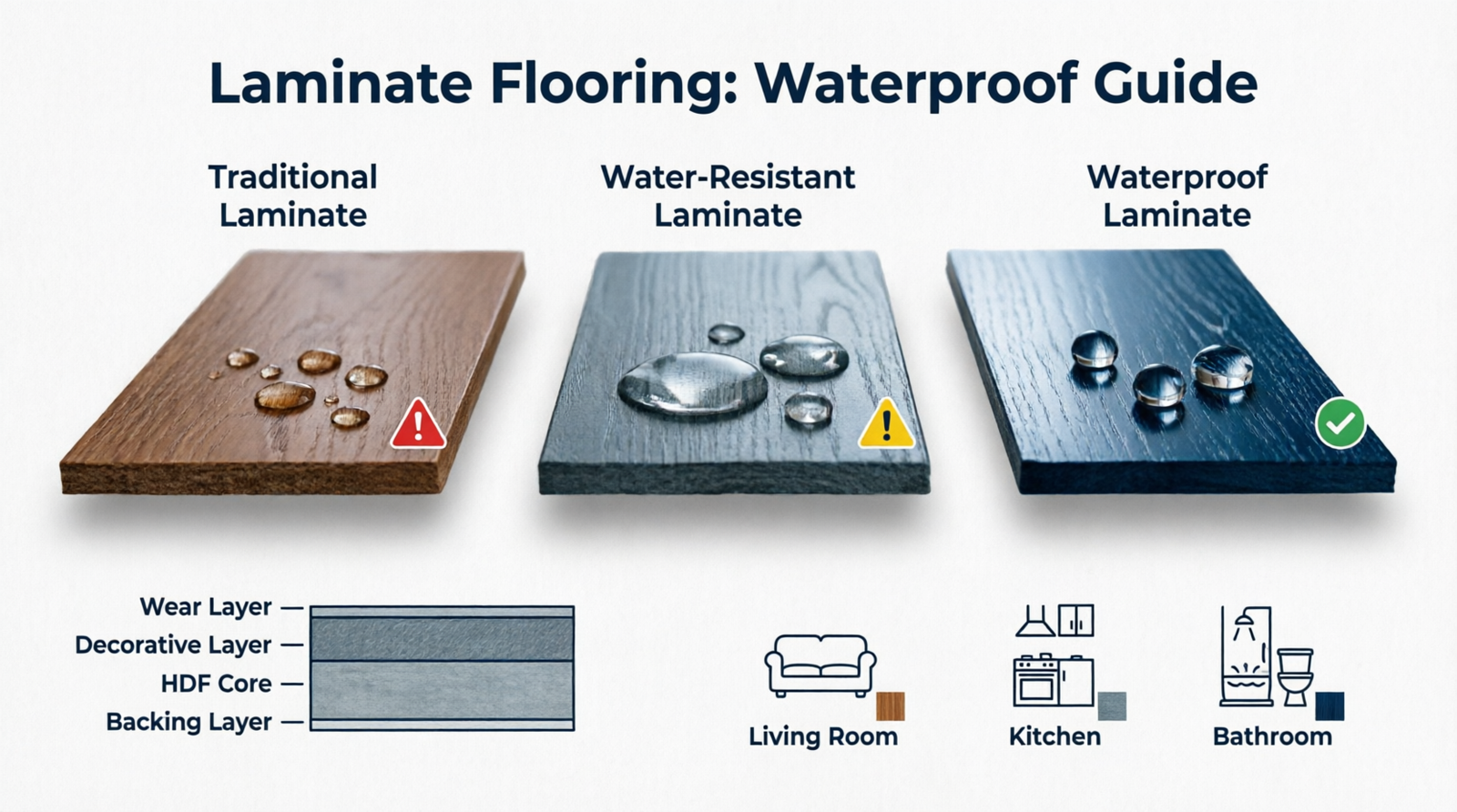
If you are searching online and asking, “laminate flooring is it waterproof?”, here is the straightforward answer: standard laminate flooring isn’t completely waterproof. The surface can handle everyday spills just fine. However, once water seeps into the seams, edges, or underneath the planks, that fiberboard core starts to swell.
Many homeowners wonder, “laminate flooring is it waterproof?” You will find some laminate products marketed as water-resistant or even waterproof. But what each one can actually handle depends entirely on the manufacturer’s rating, how you install it, and what the warranty covers.
If you are still asking, “laminate flooring is it waterproof?” after checking the specs, Floor & Decor’s own help center spells it out clearly. They note that laminate is water-resistant rather than fully waterproof. Ultimately, if you want to know once and for all, “laminate flooring is it waterproof?”, they point to vinyl and hybrid resilient flooring as better options for rooms with lots of moisture.
Why Laminate Reacts to Water: How It’s Built
To understand why water causes problems, you need to know how laminate planks are constructed. Most have four distinct layers:
- Wear layer: This clear protective coating on top resists scratches and stains.
- Decorative layer: A printed image showing wood, stone, or whatever pattern you chose.
- Core: Usually high-density fiberboard (HDF), which is basically compressed wood fibers.
- Backing layer: A balancing layer underneath that keeps the plank from warping.
That top layer does a decent job shedding water. The real problem, however, is the wood-fiber core in the middle. When water sneaks in through a seam, a cut edge, or from below, those fibers soak it up and expand.
Consequently, that is what causes the swollen edges, raised joints, and buckling that people associate with water-damaged laminate. So, the actual question isn’t really whether the surface can handle a spill. Instead, it is whether water can reach that core, and how long it stays there.
Waterproof vs. Water-Resistant Laminate Flooring
Stores and websites throw these terms around pretty loosely. Therefore, don’t take them at face value until you check the spec sheet.
- Water-resistant means the product can handle some water exposure for a limited time, as long as you follow certain conditions.
- Waterproof means the manufacturer claims the product—or at least its core—won’t be damaged by water under specific conditions.
Importantly, that doesn’t mean the entire installed floor is protected from flooding, leaks, or water trapped underneath.
| Flooring Type | Level of Water Protection | Main Limitation | Best-Suited Applications |
|---|---|---|---|
| Traditional Laminate | Surface resists light spills; core is vulnerable. | Swells if water reaches seams, edges, or the underside. | Living rooms, bedrooms, hallways, dry areas. |
| Water-Resistant Laminate | Treated core, coatings, or tighter locking systems slow water entry. | Protection is time-limited and depends on perimeter sealing and prompt cleanup. | Kitchens, mudrooms, entryways, and sometimes bathrooms (if approved). |
| Waterproof-Rated Laminate | Manufacturer claims defined water protection of the plank and core. | The claim covers specific conditions only; leaks, flooding, and subfloor moisture can still cause problems. | Spill-prone rooms where the manufacturer approves use. |
Those protection periods vary by product. For example, Floor & Decor lists some HydroShield laminates as water-resistant for up to 24 hours. Meanwhile, some AquaGuard laminates get 30 hours, and the AquaGuard Performance line is marketed as waterproof.
Keep in mind that those numbers apply only to those specific products under the retailer’s stated conditions. They are not a general standard for all laminate.
What Happens When Water Gets Under Laminate Flooring?
A quick spill you wipe up within minutes won’t cause problems for any laminate. However, things get tricky when water sits around or comes from somewhere other than the surface.
- Seams and edges: Water travels through the joints between planks and along the room perimeter. This is especially true where the floor meets walls, cabinets, tubs, and doorways.
- Swelling and buckling: Once the core absorbs water, it expands. Planks swell at the edges, lift at the joints, or buckle across the room if there is nowhere for that expansion to go.
- Trapped moisture: Water that gets beneath the planks stays there because the surface layer slows drying. Unfortunately, that leads to staining, odors, and mold on the subfloor or underlayment.
- Leaks and flooding: A dishwasher leak, failed supply line, or flooded basement is a long-duration event. A rating built around a limited number of hours doesn’t make that safe exposure.
In general, laminate cores are moisture-sensitive, and water entering a joint is how damage usually starts. What depends on the product is how long a specific plank tolerates water and whether you can dry it out and save it.
Is It Better to Get Waterproof Laminate Floors?
Often yes for spill-prone rooms, but it is not a one-size-fits-all answer. Paying more for added water protection makes sense when:
- The room sees regular moisture: This includes kitchens, areas around sinks, mudrooms, and entryways where wet shoes are common.
- Kids or pets are in the house: Spilled drinks, tracked-in snow, and pet accidents happen frequently. Sometimes, they sit for a while before anyone notices.
- You mop often: A protected core gives you more margin for error.
Conversely, it matters less in bedrooms, dens, and other dry rooms where standard laminate performs just fine.
Before you pay that premium, check three things:
- The exact rating: Is it water-resistant or waterproof, and for how long?
- Installation requirements: Some products require flexible silicone around the perimeter to earn their rating. For instance, Floor & Decor’s HydroShield listing states its 24-hour rating applies when the room perimeter is sealed with 100% flexible silicone sealant.
- Warranty terms: Read what is excluded, like flooding, plumbing failures, or installation without the required sealing.
Regarding price, one HydroShield listing at Floor & Decor showed $1.79 per square foot for 10 mm planks. That is a single product, not a national average, and prices change often. Furthermore, labor, underlayment, trim, and subfloor prep add to the total cost.
Is Laminate Flooring Suitable for Bathrooms?
It depends entirely on the product and the room.
- Powder room (toilet and sink, no shower or tub): Splashes are modest, so a water-resistant laminate approved for bathrooms works reasonably well.
- Full bathroom with a tub or shower: This is possible only with a product the manufacturer explicitly approves for bathroom use. It must be installed exactly as instructed, usually with perimeter sealing.
- Wet room or shower floor: This is not a good fit for laminate. Instead, use tile or a product made for continuous wet conditions.
When homeowners search online asking, “laminate flooring is it waterproof?”, the answer often depends on the specific room and product. In fact, some manufacturers directly address the “laminate flooring is it waterproof” debate by approving certain laminates for full bathrooms.
For example, Floor & Decor states that its HydroShield and AquaGuard lines are suitable for bathrooms, kitchens, and basements when installed to its requirements. This shows that under strict conditions, the answer to “laminate flooring is it waterproof” can indeed be yes.
However, other brands restrict or discourage bathroom use for at least part of their ranges. Therefore, before you make a final decision based on the query “laminate flooring is it waterproof”, always check the specific product’s installation guide.
Key factors for a bathroom install include:
- Seams, perimeter sealing, and transitions: These are the main entry points for water and where installers often cut corners.
- Plumbing leaks: A slow leak behind a toilet or tub can ruin planks over time. A rating for surface spills won’t cover it.
- Humidity and subfloor moisture: Poor ventilation and damp concrete or wood subfloors cause problems even without a visible spill.
- Warranty and local rules: Bathroom use can void a warranty if the product isn’t approved for it.
Waterproof Laminate vs. Vinyl Flooring
Luxury vinyl plank (LVP) is the most common alternative to laminate. Its core is typically made from plastic-based materials rather than wood fiber. Consequently, many vinyl products handle standing water better. Additionally, sheet vinyl comes in large rolls with few seams, which helps in wet rooms when installed well.
| Factor | Waterproof-Rated Laminate | Luxury Vinyl Plank (LVP) | Sheet Vinyl |
|---|---|---|---|
| Water Protection | Defined by product rating; wood-fiber core remains a consideration at seams. | Many products are waterproof at the plank level; check the label. | Surface is waterproof; seams and edges must be installed correctly. |
| Scratch & Wear | Often strong; check AC rating. | Varies by wear layer thickness. | Can dent or tear; varies by product. |
| Comfort Underfoot | Firm, can feel hard or hollow without good underlayment. | Slightly softer and warmer in many products. | Softer and quieter. |
| Installation | Floating locking planks are common. | Floating or glue-down, depending on product. | Roll installation; seams need care. |
| Cleaning | Damp mop with approved cleaner; avoid excess water. | Easy to clean; follow manufacturer instructions. | Easy to clean. |
| Relative Cost | Often lower to mid-range. | Often mid-range. | Often lowest. |
| Suitable Rooms | Living areas, kitchens, and approved bathrooms. | Kitchens, bathrooms, basements, laundry rooms. | Bathrooms, laundry rooms, kitchens. |
Neither wins in every category. Waterproof vinyl is usually the lower-risk choice for bathrooms and laundry rooms. Meanwhile, laminate often appeals for its look and rigid feel in drier rooms. Ultimately, no flooring is automatically waterproof in every installation.
Is Laminate Flooring Scratch-Resistant?
Mostly yes, but not scratch-proof. Scratch resistance and water resistance are separate properties. Therefore, a floor can score well on one and poorly on the other.
If you are wondering, “laminate flooring is it waterproof?”, you should also know that laminate’s wear layer is generally harder than many other surfaces. Manufacturers describe this durability using Abrasion Class (AC) ratings. AC3 is commonly used for moderate residential traffic, while AC4 and AC5 indicate heavier-duty use.
For example, one Hampstead water resistant laminate flooring option at Floor & Decor is listed as AC3 and 10 mm thick. Meanwhile, some AquaGuard products are listed as AC5. So, once you settle the question of “laminate flooring is it waterproof” for your specific space, don’t forget to check the AC rating to ensure it can also resist daily scratches and wear.
Even so, laminate can scratch, chip, or dent. Grit under shoes, dragged furniture, and pet nails are the usual culprits. To protect the surface:
- Place felt pads under furniture legs.
- Use mats at entrances to catch sand and dirt.
- Sweep or vacuum regularly with a hard-floor setting.
- Lift furniture instead of dragging it.
Remember, a waterproof laminate isn’t automatically scratch-proof either, so check both ratings.
What’s the Best Way to Clean and Mop Laminate Floors?
You can mop laminate, but keep it light. The goal is a damp mop, not a wet one.
- Remove loose dirt first: Sweep, dust mop, or vacuum with a hard-floor setting to remove grit that can scratch the surface.
- Use a microfiber mop: Wring it until it is only slightly damp.
- Use water or a manufacturer-approved cleaner: Always follow the dilution instructions on the label.
- Work with the plank direction and dry as you go: Don’t leave puddles or damp patches.
- Wipe up spills promptly: The faster you remove liquid, the less chance it has to reach a seam.
- Follow the manufacturer’s guidance: Some say wet mopping is fine when the perimeter is sealed; others don’t. Floor & Decor says some of its laminates can be wet mopped or even steam mopped, but that is specific to those products. Many manufacturers advise against steam, so confirm before using it.
Additionally, avoid abrasive pads, wax, oil soaps, and harsh chemicals unless the manufacturer approves them. They can dull or damage the surface and leave residue.
Why Are My Laminate Floors Still Dirty After Mopping?
Floors that look dirty or cloudy after mopping usually have one of these causes:
- Cleaner residue: Too much product or a cleaner that leaves a film attracts dirt and shows streaks. Use less, or switch to one the manufacturer recommends.
- A dirty mop pad or water: Reusing a soiled pad spreads grime around. Rinse or swap pads frequently.
- Too much water: Excess moisture dries slowly and leaves marks and streaks. Wring the mop out more.
- Hard-water spots: Mineral deposits leave a dull film. Try a damp cloth with a manufacturer-approved cleaner, then dry the area.
- Wrong cleaner: Oil-based or waxy products build up. Switch to a cleaner made specifically for laminate.
Here is a simple test: wipe a small spot with a clean, barely damp microfiber cloth. If the haze comes off, residue is the likely cause. If it stays, check with the manufacturer before trying anything stronger.
What Are the Disadvantages and Common Problems With Laminate Flooring?
Laminate is popular because it is affordable and looks like wood or stone. However, it has real limitations:
- Moisture sensitivity: Products without added water protection can swell or buckle if water reaches the core.
- Surface wear: Scratches, chips, or worn spots appear in high-traffic areas or under furniture.
- Noise and feel: Some floating installs sound hollow or feel hard underfoot, though underlayment helps.
- Limited repair options: Damaged planks typically need to be replaced, and swollen planks usually can’t be returned to their original shape.
- Subfloor dependence: The subfloor must be flat, clean, and dry. Problems underneath show up on the surface.
Fortunately, these aren’t inevitable for every product. A well-chosen, correctly installed laminate in a suitable room performs well for years.
How Long Does Laminate Flooring Last?
There is no single reliable number. Lifespan depends on wear layer quality, traffic, installation, maintenance, and moisture exposure.
Furthermore, a warranty isn’t the same as expected service life. Some products carry lifetime residential warranties (Floor & Decor lists this for several of its lines). However, warranties have exclusions, and a floor can wear out or be damaged long before any warranty “ends.”
Therefore, treat warranty length as a sign of manufacturer confidence in the product, not a prediction of how long your floor will last.
Which Flooring Is 100% Waterproof?
No installed floor is guaranteed waterproof in every situation. Real-world performance depends on the whole system: the flooring, seams, transitions, perimeter, underlayment, and subfloor.
| Flooring | Water Behavior | What to Watch |
|---|---|---|
| Ceramic or Porcelain Tile | The tile itself doesn’t absorb meaningful water. | Grout can absorb moisture and needs sealing; tile alone doesn’t waterproof a shower or the subfloor. |
| Luxury Vinyl Plank (Waterproof-Rated) | Many products have waterproof cores. | Water can still collect under planks at open seams or edges; check the specific warranty. |
| Sheet Vinyl | Waterproof surface with few seams. | Seams and edges must be sealed correctly. |
| Waterproof-Rated Laminate | Defined protection for the plank under stated conditions. | Rating depends on installation and has limits. |
| Standard Laminate | Limited. | Not for wet areas. |
If you are constantly asking, “laminate flooring is it waterproof?”, and the room has regular, heavy water exposure, tile or waterproof vinyl is usually the safer choice. For a better option than tile, many homeowners look at waterproof LVP for its warmth and softer feel.
After all, if your main search query is “laminate flooring is it waterproof?”, you will quickly find that traditional laminate falls short. This makes tile the undisputed benchmark for very wet areas.
Frequently Asked Questions
Can laminate flooring be 100% waterproof?
No product is guaranteed waterproof in every real-world situation. Some laminates carry waterproof ratings for stated conditions, but seams, edges, leaks, and flooding can still cause damage.
Can I mop laminate flooring?
Yes, with a slightly damp microfiber mop. Avoid soaking the floor or leaving standing water, and follow your manufacturer’s instructions.
What should you not use on laminate floors?
Avoid excess water, steam (unless approved), wax, oil soaps, abrasive pads, and harsh chemicals. They can dull the finish, leave residue, or let water into the seams.
How often should you wash a laminate floor?
Sweep or vacuum as needed, often weekly in busy homes, and damp mop when it looks dirty, typically every week or two. Clean spills immediately.
What is the average lifespan of laminate flooring?
It varies widely with product quality, traffic, and care. Warranty length isn’t a reliable measure of service life.
Is vinyl flooring waterproof?
Many luxury vinyl products and sheet vinyl are waterproof at the material level, but performance still depends on seams, installation, and the product’s warranty.
What is a good alternative to laminate flooring?
Waterproof luxury vinyl plank, sheet vinyl, and porcelain or ceramic tile are common choices, especially for wet rooms.
Is waterproof laminate worth the extra cost?
It can be in kitchens, mudrooms, and homes with kids or pets. It’s less important in dry rooms.
Conclusion
Standard laminate isn’t waterproof, but water-resistant and waterproof-rated laminates work well in the right rooms when the manufacturer’s rating, installation steps, and warranty all line up. Before you buy, read the specification sheet for the exact product, confirm the room it’s approved for, and check whether perimeter sealing is required. For bathrooms with regular water exposure, tile or waterproof vinyl is usually the lower-risk choice.
1 thought on “Laminate Flooring Is It Waterproof? 5 Best Tips”