
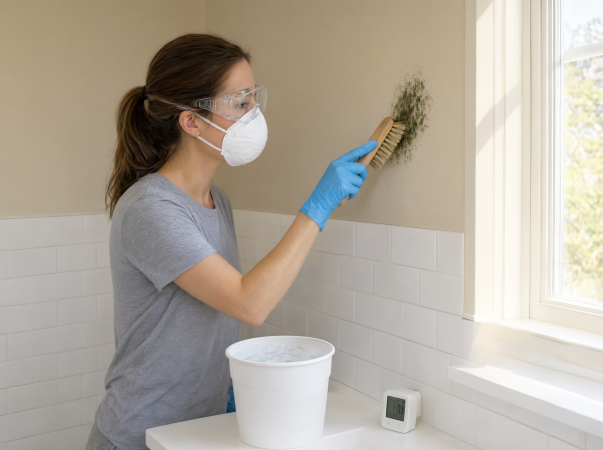
Getting rid of mold really comes down to four things — and skipping any one of them is why most people end up scrubbing the same spot again a month later. You need to clean the hard surfaces, toss anything porous that’s gone too far, dry everything out properly, and actually fix whatever’s feeding the moisture in the first place. Just killing the mold? That’s not enough. Spraying some product on it and walking away? Also not enough. If the dampness stays, the mold comes back. Period.
Here’s a useful baseline from the U.S. Environmental Protection Agency (EPA): if the moldy patch is smaller than roughly 10 square feet — think a 3-foot-by-3-foot area — you can usually handle it yourself. Anything bigger than that, significant water damage, or mold you suspect is lurking in your HVAC system? That’s a different conversation, and I’ll get to it below.
What follows is a complete walkthrough: what mold removal actually involves, how to do it without putting your health at risk, the right approach for bathroom walls and wood, the honest truth about bleach versus vinegar, and the exact moment you should stop DIY-ing and call a mold removal company.
Mold Removal vs. Mold Remediation: What’s the Difference?
People use these two terms like they’re interchangeable, but they’re not quite the same thing.
Mold removal is the hands-on work — scrubbing visible mold off surfaces and physically pulling out materials that can’t be salvaged.
Mold remediation is the bigger picture. It covers tracking down the moisture source, setting up containment when the job calls for it, hauling out contaminated materials, drying the structure, and then verifying that the problem is actually resolved.
One thing worth understanding up front: you can’t eliminate every single mold spore from indoor air. Spores float around outside and inside all the time — they’re just part of the environment. The realistic goal isn’t a sterile space. It’s removing the unwanted growth, drying things out, and fixing whatever allowed the mold to take hold in the first place.
Can You Do Mold Removal Yourself?
Usually, yes — as long as the problem is small and straightforward. Here’s a quick way to decide.
| Situation | Typical approach |
|---|---|
| Less than about 10 sq ft of mold on hard, cleanable surfaces (tile, sealed wood, painted walls in good condition) | DIY is generally reasonable (EPA guideline) |
| More than 10 sq ft, or a lot of water damage | Consult EPA remediation guidance and consider a professional |
| Mold on drywall, ceiling tile, carpet, or insulation that stayed wet | Remove and replace the affected material; surface cleaning is not enough |
| Suspected mold inside walls, ceilings, or floors | Professional assessment recommended |
| Mold near or inside HVAC components or ducts | Consult EPA’s air duct guidance; usually professional work |
| Flooding, sewage, or other contaminated water | Professional help; contaminated porous materials are generally discarded |
| Mold keeps returning after cleaning | Find the moisture source; a professional can help locate hidden leaks |
That 10-square-foot number is a guideline, not a hard rule. A tiny patch can still be a red flag for a hidden leak, and some people really shouldn’t be anywhere near mold cleanup — which brings us to the next point.
Who Should Not Clean Up Mold
The Centers for Disease Control and Prevention (CDC) is pretty clear on this: if you have asthma, COPD, or another chronic lung condition, or if your immune system is compromised, you shouldn’t stay in a moldy home or be present during cleanup. Their materials also say kids shouldn’t be the ones doing the scrubbing. If any of that describes someone in your household, get a healthy adult or a professional to handle it, and talk to a doctor about whether you should stay somewhere else while the work happens.
How to Remove Mold Yourself: Step by Step
Let’s walk through it in the order that actually matters.
1. Find and stop the moisture source first. This is the step everyone wants to skip, and it’s the reason mold keeps coming back. Check for plumbing leaks, roof or window leaks, condensation on cold surfaces, a bathroom exhaust fan that’s given up, or poor drainage outside. Cleaning without fixing the cause is a losing game.
2. Decide whether DIY is appropriate. Use the table above. If you hit any of the stop conditions, call a professional. No ego about it.
3. Protect yourself. The CDC recommends at minimum a NIOSH-approved N95 respirator, non-latex gloves (nitrile, vinyl, or rubber), and goggles without open vent holes — because open vents let dust right in. For longer jobs like tearing out moldy drywall, they recommend stepping up to a half-face or full-face respirator. Long sleeves and pants, too. A respirator cuts your exposure, but let’s be honest: it doesn’t make a large or hazardous job safe for a homeowner.
4. Prepare the area. Keep other people and pets out. Close the interior doors to the work area. Don’t run a fan that blows mold-laden dust into other rooms, and don’t dry-brush or dry-scrub the mold — that just launches spores into the air.
5. Remove materials that can’t be cleaned. Porous stuff like ceiling tiles, carpet, and soaked drywall or insulation usually has to go. Mold grows into those materials, not just on them. Bag the moldy debris before you carry it through the house.
6. Clean hard surfaces. Scrub with detergent and water, then rinse or wipe with clean water. This is the EPA’s recommended baseline for hard surfaces, and it works.
7. Dry completely. Use a fan, a dehumidifier, and ventilation. EPA guidance says to dry wet materials within 24 to 48 hours to prevent mold from getting a foothold.
8. Check your work. Visible mold should be gone, mold-damaged material should be removed, and that musty smell should be gone too. Don’t paint or caulk over mold — FEMA and CDC guidance both say that won’t stop it from growing underneath.
9. Monitor. Check the area over the next few weeks. If new growth shows up, moisture is still present somewhere.
How to Remove Mold From Bathroom Walls
Bathrooms are basically mold’s favorite room. You’ve got heat, steam, and cool surfaces all hanging out together, so condensation is almost always the culprit. Leaks around tubs, showers, and supply lines are the next most common cause.
For painted walls, tile, and grout in good condition:
- Run the exhaust fan and crack a window if you can. Wear gloves, goggles, and a respirator.
- Scrub with a soft brush or sponge and dish detergent mixed with warm water.
- Wipe with a clean damp cloth, then dry the surface with a towel and a fan.
- If you decide to use a disinfectant or a product labeled for mold and mildew, follow the label exactly — contact time, ventilation, surface compatibility, all of it. And never, ever combine products.
When cleaning isn’t enough:
- Mold on caulk or sealant that keeps coming back usually means the caulk needs to be cut out and replaced once the area is fully dry.
- Soft, bubbling, stained, or crumbling drywall — or paint that keeps peeling — suggests moisture is inside the wall. Surface cleaning won’t touch that.
- Mold on the opposite side of a wall from a shower, tub, or sink can mean a slow leak behind the finish.
Prevention tips that actually work: Run the exhaust fan during showers and for a while afterward. Most guides suggest roughly 20 minutes, though recommendations vary. Make sure the fan vents outdoors, not into the attic. Squeegee or wipe wet surfaces after use, hang towels so they dry, and fix dripping fixtures fast.
How to Remove Mold From Wood
Wood needs more care than tile because it absorbs water and can hold mold below the surface. The approach depends on what kind of wood you’re dealing with.
Finished or sealed wood (furniture, trim, sealed floors):
The mold is usually sitting on the finish, not in the wood itself. Wipe with a cloth dampened with detergent and water — don’t soak it. Too much water can swell, warp, or stain the wood. Dry it immediately and thoroughly with a fan and good airflow.
Unfinished or porous wood (framing, subfloors, rough boards):
Light surface growth can sometimes be cleaned with detergent and a damp scrub brush, followed by complete drying. But because wood is porous, the growth may extend deeper than you can see.
Avoid heavy sanding of extensive mold. Sanding throws contaminated dust into the air, and small, light surface work with proper protection is a very different thing from sanding a large moldy area.
If the wood is soft, dark throughout, structurally affected, or the mold covers a large area, get a professional evaluation. Rot and structural damage are their own problems, separate from mold, but they often show up together.
Whatever the wood type, figure out why it got wet. A damp crawl space, a roof leak, or a plumbing problem will keep feeding the mold no matter how many times you clean it.
Black Mold Removal: What You Need to Know
Here’s something a lot of people get wrong: “black mold” isn’t one specific species. Plenty of molds look black or dark green, and color alone tells you nothing about the species or how harmful it is. The name usually gets attached to Stachybotrys chartarum, which tends to grow on materials that have stayed very wet for a long time — soaked drywall paper is a classic example. The CDC has pointed out that “toxic mold” isn’t really an accurate term, and the health effects of Stachybotrys are similar to those of other common molds.
What that means for you in practice:
- Don’t delay cleanup to identify the species. Whatever it is, it needs to come out and the moisture needs to be fixed.
- The cleanup method depends on the surface and the size, not the color. Small patches on hard surfaces: detergent and water. Large areas or porous materials: remove them, or call a professional.
- Routine testing usually isn’t needed to decide whether to clean. If you can see mold or smell it, you already know there’s a problem.
- Call a professional if black growth is widespread, showed up after flooding, or you suspect it’s inside walls.
Mold Removal Products, Sprays, and Chemicals
Three product types get mixed up all the time, so let’s sort them out. General cleaners (detergents) lift and remove growth. Disinfectants and biocides kill organisms on surfaces. Products labeled for mold and mildew make specific claims and should list the surfaces and directions right on the label.
One thing worth remembering: a product that kills mold still leaves dead mold behind, and dead mold can still trigger allergies in some people. The EPA is clear on this — killing isn’t enough. The mold has to be removed.
| Product or method | Appropriate use | Important limitations | Safety considerations |
|---|---|---|---|
| Detergent and water | First choice for hard, nonporous surfaces | Won’t fix mold in porous materials or the moisture source | Low hazard; still wear gloves and eye protection; dry fully |
| Commercial mold/mildew sprays | Hard surfaces where the label lists the use | Surface treatment only; claims vary by product; won’t reach mold inside drywall or wood | Follow label for ventilation, contact time, and surfaces; check for an EPA registration number if it claims to kill |
| Bleach-based products | Hard, nonporous surfaces when a disinfectant is wanted (for example, where someone in the home is immune-compromised, per EPA) | EPA does not recommend biocides like bleach as routine practice; poor choice for porous materials | Ventilate; never mix with ammonia, vinegar, or other cleaners (toxic gases); can damage some surfaces and fabrics |
| White vinegar | Occasional use on hard surfaces by people who prefer it | Not endorsed by EPA for mold cleanup; results vary by mold species; can damage some surfaces | Never mix with bleach; may etch natural stone; ventilate |
| Baking soda | Mild abrasive for scrubbing and deodorizing | Little evidence it reliably kills mold; does not treat moisture | Low hazard; rinse and dry |
I’m not ranking brands here because label directions, availability, and surface compatibility all differ by product. Read the label and the manufacturer’s safety data sheet before using anything.
Bleach vs. Vinegar vs. Baking Soda for Mold
Which is better for killing mold, bleach or vinegar? There’s no universal answer. Bleach is a stronger disinfectant on nonporous surfaces, but the EPA doesn’t recommend it as routine practice in mold cleanup, and it doesn’t penetrate porous materials at all. The CDC notes that bleach or dish detergent can be used on mold, and some public-health guidance that allows bleach caps the mix at no more than 1 cup of household bleach per gallon of water. The product label always controls. Vinegar is milder, and the evidence for it is mixed. A 2015 laboratory study that gets cited a lot online found that vinegar of about 4 percent acetic acid affected Penicillium chrysogenum but not Aspergillus fumigatus — which is exactly why “vinegar kills mold” shouldn’t be treated as a blanket claim.
What mold is not killed by vinegar? It varies by species and conditions, and there’s no complete list you can actually rely on. The lab result above is one example of a common household mold that vinegar didn’t control.
What kills mold better, vinegar or baking soda? Vinegar has some evidence of antifungal action on certain molds. Baking soda has very little evidence as a mold killer and is mainly useful as a gentle scrubbing aid. Neither of them removes the moisture problem, which is the part that actually matters long-term.
What is the best natural mold killer? There’s no authoritative, universal “natural mold killer.” Detergent, water, scrubbing, and thorough drying are the best-supported low-chemical approach on hard surfaces.
Can I leave vinegar on mold overnight? I wouldn’t. No authoritative source supports leaving vinegar sitting overnight, and extra moisture on a surface works against drying. Apply, wipe, and dry. Always follow the label of any commercial product instead.
Will mold come back after vinegar? It can. If moisture, condensation, or a leak is still there, mold can regrow after any treatment. Mold also comes back when it was inside a porous material that only got treated at the surface.
And one more time, because it matters: never mix bleach with vinegar, ammonia, or other cleaners. Mixing can release toxic gases.
What Kills Mold Immediately? Is Anything 100% Effective?
Short answer: no household product is a guaranteed, instant, universal solution. Effectiveness depends on the mold species, the surface, how deep the growth goes, contact time, and whether the area stays wet afterward.
Killing mold and removing mold are two different things. Dead mold can still cause allergic reactions in some people, per the EPA.
On hard surfaces, scrubbing with detergent and water removes mold physically — that’s the baseline method. On porous materials, removal and replacement is often the only reliable fix.
Any product advertised as a 100% fix for every mold, every surface, and every contamination level is overpromising. Full stop.
Can You Wipe Mold Off Walls Safely?
Sometimes, yes. Wiping can work on painted or sealed walls in good condition with a small patch of surface growth. Wear gloves, goggles, and a respirator, use a damp cloth with detergent and water (not dry wiping), and dry the wall afterward.
Wiping is not enough when:
- The drywall is soft, swollen, bubbled, or stained through.
- The growth returns within days or weeks.
- The patch is larger than about 10 square feet.
- You suspect mold behind the wall, wallpaper, or paneling.
In those cases, the wall material may need replacing, and a professional assessment is a reasonable next step.
Warning Signs of Mold-Related Health Problems
You’ll see lists online titled “10 warning signs of mold toxicity.” Here’s the honest truth: there’s no authoritative, agreed-upon list of ten symptoms, and the idea of mold “toxicity” isn’t well supported for typical home exposures. What public-health agencies actually describe is more specific:
- Allergic symptoms: sneezing, runny or stuffy nose, itchy or watery eyes, skin irritation.
- Respiratory irritation: cough, wheezing, throat irritation.
- Asthma worsening in people who already have asthma.
- Lung infections — a concern mainly for people with weakened immune systems or chronic lung disease.
These symptoms are common and nonspecific. They can come from colds, pollen, dust, and plenty of other causes, so they can’t prove mold is the culprit, and symptoms can’t identify a mold species. A lot of these ease up once the mold and moisture are dealt with. If you have persistent, severe, or worsening symptoms — especially trouble breathing — talk to a healthcare professional.
Why Does Mold Come Back After Cleaning?
Mold needs moisture. It comes back when the moisture does. The usual suspects:
- Unrepaired plumbing or roof leaks
- Condensation on windows, pipes, and exterior walls
- High indoor humidity
- Weak or missing ventilation in bathrooms and kitchens
- Porous materials that stayed damp
- Hidden moisture inside walls, ceilings, or floors
Targets worth knowing:
- Dry water-damaged areas and items within 24 to 48 hours (EPA).
- If you can, keep indoor relative humidity below 60 percent, ideally 30 to 50 percent (EPA and FEMA guidance). A basic hygrometer, usually around $10 to $50 at hardware stores, will measure it for you.
These numbers are guidelines. Climate and building design matter. In humid regions or tightly sealed homes, staying in range may require a dehumidifier and ongoing attention.
Mold Removal in Cars
Car mold usually starts with trapped moisture somewhere: a leaking door or window seal, a clogged sunroof or AC drain, wet carpet, or a spilled drink that never fully dried.
- Find and fix the water source (seals, drains, leaks) before cleaning anything.
- Remove wet items like floor mats and take them out to dry.
- Clean hard surfaces (plastic, vinyl) with detergent and water, wearing gloves and a respirator.
- Dry the interior completely. Open the doors, use fans, and consider a dehumidifier in a garage. Wet carpet and padding can hold moisture for a surprisingly long time.
- Don’t spray chemicals into the AC or vents indiscriminately. Persistent musty smells from the vents are better handled by a qualified technician.
Mold deep in seats, headliners, carpet padding, or the ventilation system often needs professional detailing or remediation.
When to Hire a Mold Removal Company
Think about calling a mold removal company when the problem goes beyond the DIY conditions above: larger areas, flooding or sewage, hidden mold, HVAC contamination, repeated regrowth, or a household member who shouldn’t be near mold.
A professional mold remediation project usually goes beyond just cleaning. It can include assessing moisture sources, containing the work area, removing affected materials, cleaning and drying, and then verifying the work is complete. Not every company follows the same procedure, though, so vetting matters.
How to evaluate a mold removal company:
- Ask about their experience with mold remediation specifically, and ask for references.
- Request a written scope of work and an itemized estimate.
- Ask how they’ll identify and address the moisture source.
- Ask how they’ll contain the work area and handle debris when relevant.
- Ask about insurance and any credentials that apply. Licensing rules vary by state and sometimes by city, so check your state’s requirements instead of assuming.
The EPA suggests asking contractors to follow recognized guidelines, such as the EPA’s remediation guide or those from ACGIH or IICRC.
Be cautious about anyone who promises a guaranteed result without finding the moisture cause. That’s a red flag every time.
How to Find Mold Removal Near Me
A search for “mold removal near me” or “mold removal company near me” will hand you a long list, so you need a checklist to narrow it down.
- Check service areas and availability. Confirm the company actually serves your address.
- Look at several sources of reviews and call references.
- Get two or three written estimates with a clear scope of work.
- Ask what happens to the moisture problem. A company that only offers to spray and leave isn’t addressing the cause.
- Verify state and local requirements for licensing or certification where they exist.
- Check your insurance. Some policies cover mold only when it follows a covered water event, so read your policy and ask your insurer before work begins.
TheCalcYard does not provide local mold removal services. Use the checklist above to compare providers in your area.
Frequently Asked Questions About Mold Removal
How can I remove mold myself? For a small area (under about 10 square feet) on a hard surface, wear a respirator, gloves, and goggles, scrub with detergent and water, and dry completely. Discard porous materials that are moldy. Fix the moisture source — that’s the part that keeps it from coming back.
What kills mold immediately? Nothing is instant and guaranteed for every situation. Bleach and other disinfectants can kill mold on nonporous surfaces, but the mold still has to be removed, and the EPA doesn’t recommend biocides as routine practice.
What does 100% kill mold? No product is 100% effective on all mold, all materials, and all conditions. Anyone telling you otherwise is selling something.
Is it safe to wipe mould off walls? On small patches of hard, sealed surface with proper protection, yes. Porous or damaged walls may need replacement. (Mould is the British spelling of mold.)
Can mold come back after cleaning? Yes. If moisture remains, mold can regrow after any treatment.
When do I need a professional? For large areas, flooding, sewage, hidden mold, HVAC involvement, recurring growth, or if you or a household member has asthma, chronic lung disease, or a weakened immune system.
Bottom Line
The most reliable mold removal plan is actually pretty simple: protect yourself, clean what can be cleaned with detergent and water, remove what can’t, dry everything within 24 to 48 hours, and figure out why it got wet in the first place. Chemicals are a supporting tool, not the fix. If the problem is large, hidden, or keeps coming back, a professional assessment is the safer next step.
1 thought on “Mold Removal: How to Remove Mold Safely and Keep It From Coming Back”