
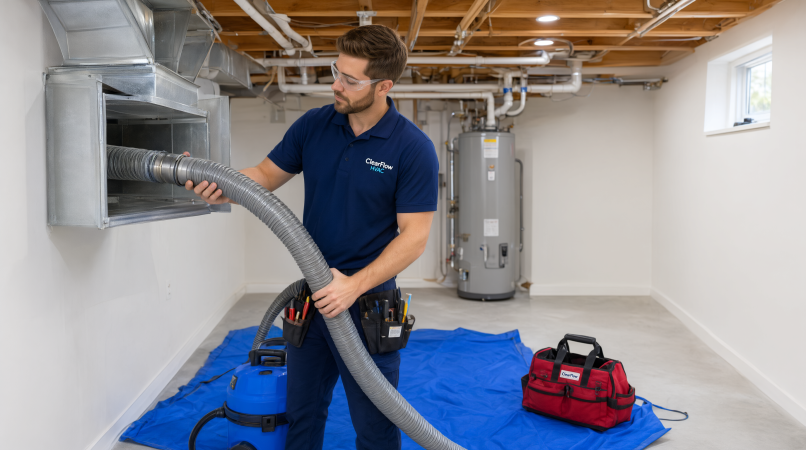
Thinking about booking an air duct cleaning service? You’re probably wondering if it’s actually worth the money or just another aggressive upsell. The truth is, duct cleaning isn’t a routine maintenance task like changing your car’s oil. According to the Environmental Protection Agency (EPA), you should only consider it when there’s a specific, visible problem—such as rodent infestations, heavy debris clogging the system, or visible mold growth.
In the US, most homeowners pay a few hundred dollars for a standard single-system home. However, prices fluctuate wildly based on your provider, home size, and the scope of work. The breakdown below explains exactly what the service covers, when it’s actually worth paying for, what drives the air duct cleaning service cost, and how to avoid inflated sales pitches.
What an Air Duct Cleaning Service Actually Includes
A legitimate job goes way beyond just wiping down the visible vent covers. A thorough professional air duct cleaning service tackles the accessible parts of your entire ductwork system. Because scopes of work vary wildly between companies, getting the details in writing is non-negotiable. Here is what a standard, high-quality visit should look like:
- Initial Inspection: The technician evaluates your accessible ductwork, registers, and air handler to assess the level of contamination.
- Property Protection: Drop cloths go down to protect your floors and furnishings near the work zones.
- Negative Pressure Containment: This is critical. The system is hooked up to a HEPA-filtered vacuum collector to create negative pressure. This ensures that loosened dust is pulled out of the home, not blown into your living spaces.
- Agitation and Extraction: Using specialized tools like air whips, compressed air, or rotary brushes, the technician dislodges stubborn debris from the supply and return ducts while the vacuum continuously extracts it.
- Register and Grille Cleaning: Covers are removed, washed, and reinstalled (confirm this is explicitly in your quote).
- Access Closure: If the technician had to cut new access holes to reach deep into the ducts, they must be properly sealed and restored.
- Final Walkthrough: A reputable provider will show you the results, often using before-and-after photos or a camera inspection.
Air Vent Cleaning vs. Full Duct Cleaning
Don’t let marketing jargon confuse you. Air vent cleaning usually just means wiping down the visible grilles and registers. That does not mean the ducts behind the walls have been touched. Use this quick breakdown to know what you are actually paying for:
| Service Level | What It Typically Covers | What to Confirm in Writing |
|---|---|---|
| Vent or Register Cleaning | Grilles, registers, and nearby visible surfaces. | Whether any duct interior is actually being cleaned. |
| Full Duct Cleaning | Accessible supply and return ducts, plus registers. | Number of systems, trunk lines, and returns included. |
| Optional HVAC Component Cleaning | Blower, evaporator coil, drain pan, plenums. | Whether this is priced separately or bundled. |
| Related Add-Ons | Dryer vent cleaning, sanitizing, sealing, mold/pest remediation. | Exactly why it is needed and the total cost, in writing. |
Packages are named differently by every company. Always compare line items, not marketing labels.
Does Cleaning Air Ducts Really Make a Difference?
Sometimes, but primarily when there is a clear, underlying issue. The EPA explicitly states that you should consider cleaning if there is substantial visible mold growth inside hard-surface ducts or on other HVAC components. However, they also point out that a little dust on your return registers is completely normal and doesn’t automatically mean your whole system is heavily contaminated.
Be highly skeptical of exaggerated claims:
- Health Miracles: The EPA notes that there is no conclusive proof that routine duct cleaning prevents illness. If you are experiencing unexplained respiratory symptoms, consult a doctor first.
- Energy Savings: Cleaning the ducts alone rarely improves system efficiency. Dirty filters, duct leaks, and aging equipment are much bigger culprits. (Sealing leaky ducts, which is a different service, can save energy).
- Mold Removal: Cleaning is useless if you don’t fix the moisture source. If insulated ducts get wet or moldy, the EPA advises replacing them entirely, as they cannot be effectively cleaned.
Signs Your Ducts May Need Professional Attention
How do you know if you actually need an air duct cleaning service near me? Look for these specific red flags. Keep in mind, none of these automatically mean your ducts are filthy, but they do warrant a professional inspection.
| What You Notice | Possible Next Step | Why |
|---|---|---|
| Heavy dust/debris blowing from supply registers | Professional inspection, possibly cleaning | EPA lists this as a primary reason to consider cleaning. |
| Visible mold in hard-surface ducts or HVAC components | Inspection, moisture correction, then cleaning | Cleaning without fixing moisture will not last. |
| Rodent or insect activity in ducts | Pest control followed by cleaning | EPA lists infestation as a valid reason for cleaning. |
| Dust after major renovation | Inspection | Construction debris can easily enter open ducts. |
| Weak airflow or uneven temperatures | Check filter, registers, blower, and duct leaks first | Many causes exist besides dirty ducts. |
| Persistent musty odor | Look for a moisture source | The smell may not be coming from the ducts at all. |
| Higher energy bills | HVAC tune-up and duct leak check | Cleaning alone rarely explains or fixes this. |
Note: “Clogged ducts” are far less common than clogged filters, closed dampers, or failing equipment. Check those first.
How Often Should Air Ducts Be Cleaned?
There is no universal calendar schedule. The right timing depends entirely on your home’s specific conditions: recent renovations, moisture issues, pest problems, heavy shedding pets, or poor filter maintenance.
It is crucial not to confuse duct cleaning with other essential tasks:
- Filter Changes: Follow your HVAC manufacturer’s schedule. This is the single most effective way to keep dust out of your system.
- Routine HVAC Maintenance: Have a licensed technician service your coils, drain pans, and blowers annually.
- Duct Cleaning: Only done when specific conditions justify it.
Is it okay to never clean your ducts? Absolutely. In many homes with no visible contamination, no moisture issues, and a strict filter-changing habit, routine cleaning is entirely unnecessary. Preventing dirt and water from entering the system in the first place is your best defense.
Residential vs. Commercial Air Duct Cleaning Services
Commercial air duct cleaning services deal with a completely different beast. These systems are larger, more complex, and often come with strict scheduling and documentation demands.
| Factor | Residential | Commercial |
|---|---|---|
| System Complexity | Usually one or two forced-air systems. | Multiple air handlers, large trunk lines, varied zones. |
| Access | Attics, crawl spaces, basements. | Above ceilings, mechanical rooms, rooftop units. |
| Scheduling | Daytime appointments. | Often after hours to limit business disruption. |
| Scope | Ducts, registers, sometimes blower. | Ducts, air handlers, coils, and other components under contract. |
| Documentation | Basic invoice and photos. | Written specifications, inspection reports, and verification. |
| Pricing | Typically by system, vent count, or size. | Custom bid based on building size and conditions. |
| Standards | ACR, The NADCA Standard (industry guidance). | ACR, NADCA General Specification, or project-specific requirements. |
Note on Standards: ACR (Assessment, Cleaning, and Restoration of HVAC Systems) is the NADCA standard. It is an industry guideline, not a federal law. NADCA regularly updates this standard, and building owners frequently write it into commercial contracts. For those researching ductwork cleaning TR19, note that TR19 is a prominent ventilation hygiene standard used in the UK. US readers will more commonly encounter ACR and NADCA standards. Always verify which local codes apply to your property.
How Much Does an Air Duct Cleaning Service Cost?
Prices fluctuate based on your local market, the provider, and the scope of work. As of late 2026, national data provides a baseline, though your actual quote may vary:
- Thumbtack reports a national average range of $225 to $619, with most homeowners paying around $374 for a standard single-system home.
- Angi data (summarized by industry partners) suggests a range of $271 to $509, averaging around $389.
Remember, these are marketplace estimates for typical residential setups. Large homes, hard-to-reach attics, severe contamination, or multiple HVAC systems will push the price higher.
What Drives the Price Up?
- Home or Building Size: More square footage means more duct length and registers.
- Number of Systems: Each separate HVAC unit is typically priced individually.
- Accessibility: Tight crawl spaces or cramped attics require more labor time.
- Contamination Level: Heavy debris, pest droppings, or mold remediation requires specialized handling.
- Add-Ons: Services like dryer vent cleaning, coil cleaning, duct sealing, or sanitizing are usually extra.
Cleaning Is Not Replacement
If you are searching for “how much does 20 ft of ductwork cost,” you are looking at ductwork installation or replacement, which is a completely different job with its own pricing structure. Cleaning is priced by scope or system. If a technician suddenly recommends replacing your ducts, ask for a detailed explanation and get a separate, itemized quote.
Beware of Rock-Bottom Prices
If a company advertises a “$49 whole-house special,” read the fine print. These teaser rates often cover only a single vent or a superficial inspection, with aggressive upsells once the technician is in your home. Always demand a written, comprehensive quote before any work begins.
How to Choose the Best Air Duct Cleaning Service
Finding the best air duct cleaning service near you requires a bit of legwork. Whether you are searching for an air duct cleaning service near Birmingham, Manchester, or any other local area, the vetting process remains the same. Start with local referrals, ask your trusted HVAC contractor, or search the NADCA member directory. Once you have a few names, vet them thoroughly.
Questions to Ask Before Booking:
- Can you provide a written, itemized quote detailing exactly what will be cleaned?
- Does this price include both supply and return ducts, registers, and the blower compartment?
- Do you use negative pressure containment with HEPA-filtered collection equipment?
- Are you fully licensed and insured in this state/county?
- Can you provide proof of relevant industry training or certification? (For those exploring duct cleaning jobs, understanding these certification requirements is the first step to professional credibility).
- How will you verify the work was completed (e.g., before-and-after photos)?
- Will you get my written approval before performing any additional, unquoted work?
Major Red Flags to Avoid:
- High-pressure sales tactics demanding same-day decisions.
- Claims that the EPA recommends routine duct cleaning (they explicitly do not).
- Grandiose health promises, like “curing” your allergies.
- Unexplained, automatic add-ons for chemical sanitizers or sealants.
- Vague quotes that do not define the scope of work.
- A “mold” diagnosis without providing visual evidence or a third-party test.
Chemical Warning: The EPA states that no chemical biocides are currently registered for use in internally insulated duct systems. Any application of biocides or sealants should be a conscious, informed decision made after cleaning, never a default upsell.
Can You Clean Air Ducts Yourself?
You can handle the basics. Homeowners can safely vacuum or wash accessible register covers, swap out filters on schedule, and keep the area around floor and wall vents clear of furniture and debris.
However, cleaning the full duct system is a different story. Standard household vacuums simply lack the suction power and containment capabilities to do the job effectively, and you risk blowing dust deeper into your home or damaging flexible duct liners.
Call a professional if the contamination is extensive, access is difficult, pests are involved, or the ductwork/insulation shows signs of damage. If you suspect older duct wrap contains asbestos, do not disturb it. Have it assessed by a qualified abatement professional.
Frequently Asked Questions
What is done in air duct cleaning?
A technician inspects the system, protects your home, attaches a HEPA vacuum collector to create negative pressure, agitates and extracts debris from the ducts, cleans the registers, and securely closes any access points.
What are the three types of ducts?
While classifications vary, residential and commercial systems most commonly use sheet metal, flexible ducting, and fiberboard (or fiberglass duct board). The material matters, as cleaning methods must be adjusted to avoid damaging the interior.
Can AC ducts be on the floor?
Yes, floor supply or return openings are common in certain home designs, such as slab foundations or crawl space homes. However, floor registers naturally collect more debris and require more frequent vacuuming. Always ensure the layout complies with local building codes and manufacturer guidelines.
What is the “2 foot rule” for ducts?
There is no single, universally recognized “2-foot rule” in HVAC. This phrase might refer to specific clearance requirements, return air placement, or installation practices that vary by local mechanical code. Always defer to your local jurisdiction and equipment manufacturer instructions.
How many years does ductwork last?
Lifespan depends heavily on the material, installation quality, moisture exposure, and physical wear. Well-maintained sheet metal ductwork can last 15 to 25 years or more, while flexible ducts may degrade faster if exposed to pests or moisture. A licensed technician can assess your system’s condition.
What should be the gap between AC and ceiling?
This depends on whether you are referring to a ceiling-mounted air handler, a return vent, or a supply register. Generally, HVAC professionals recommend maintaining at least a few inches of clearance around units for proper airflow and serviceability, but specific gaps are dictated by the manufacturer’s installation manual and local mechanical codes.
What are the signs that my air ducts are clogged?
Noticeable weak airflow from vents, uneven heating or cooling across different rooms, excessive dust blowing out of registers, or a persistent musty odor can all indicate restricted airflow or contamination. Always check your air filter first, as a clogged filter is the most common culprit.
Conclusion
Hiring an air duct cleaning service is a smart investment when you have a clear, justified reason: visible mold, active pest infestations, heavy debris, or post-renovation contamination. Without those specific triggers, routine cleaning is not recommended by the EPA. Before handing over your credit card, demand a written scope of work, verify what is included, and ensure any underlying moisture or pest issues are resolved at the source. When comparing providers, request at least two detailed, written quotes for the exact same scope, and don’t hesitate to ask exactly how they will prove the job was done right.