
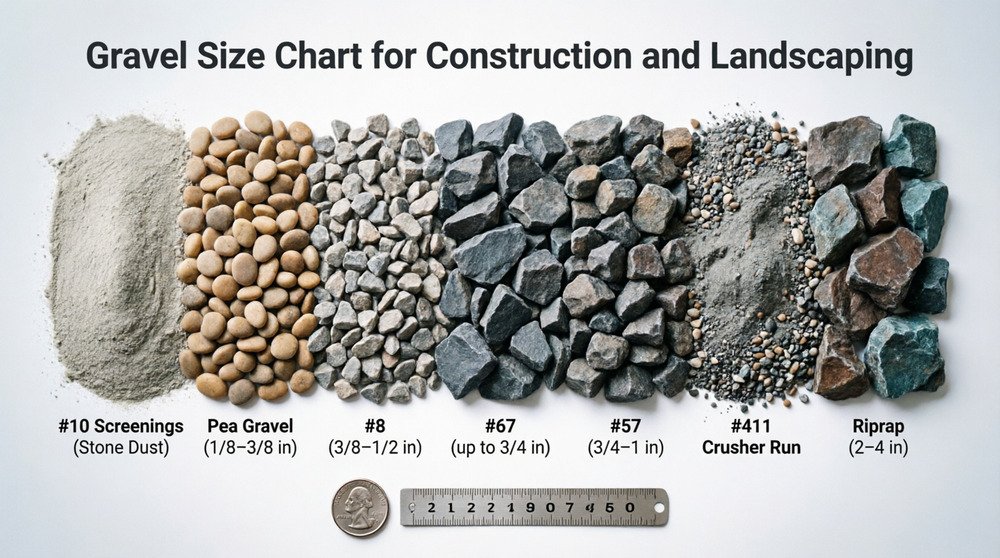
A gravel size chart is your primary tool for matching the right aggregate dimensions to your specific construction, landscaping, or drainage project. In the United States, gravel and crushed stone are categorized by numbered grades, nominal particle sizes, and sieve-based specifications.
The most important fact to know upfront: Numbered grades like #57 and #67 refer to specific particle-size distributions, not just a single stone diameter. Choosing the wrong size or type (such as using rounded pea gravel instead of angular crushed stone for a driveway) can lead to shifting surfaces, poor drainage, or structural failure.
This guide provides a definitive gravel size chart, explains the practical differences between common grades, and shows you exactly how to calculate the volume and tonnage you need for your project.
The Ultimate Gravel Size Chart
The following table outlines the standard U.S. aggregate grades, their approximate size ranges, and their most common, proven applications.
| Grade or Product Name | Size Range (Inches) | Size Range (Millimeters) | Description and Characteristics | Best Common Uses |
|---|---|---|---|---|
| #1 Stone (Riprap) | 2.5 to 4 inches | 63 to 100 mm | Very large, coarse, angular stones. | Erosion control, riverbanks, heavy-duty retaining wall backfill. |
| #2 Stone | 1.5 to 2.5 inches | 38 to 63 mm | Coarse, heavy aggregate with minimal fines. | Deep drainage bases, septic drain fields, heavy erosion control. |
| #3 Stone | 0.5 to 2 inches | 12 to 50 mm | Coarse, angular crushed stone. | Road bases, railroad ballast, primary stabilization layers. |
| #4 Stone | 1.5 to 2.5 inches | 38 to 63 mm | Coarse drainage or base stone. | French drains, sub-base layer underneath #57 stone. |
| #57 Stone | 0.5 to 1 inch | 12 to 25 mm | Clean, angular crushed stone. The most popular all-purpose grade. | Driveways, concrete mixes, French drains, general construction. |
| #67 Stone | Up to 0.75 inches | Up to 19 mm | Clean, angular crushed stone, slightly smaller than #57. | Slab bases under concrete, concrete aggregate, tight drainage. |
| #8 Stone | 0.375 to 0.5 inches | 9.5 to 12.5 mm | Small, angular, pea-sized crushed stone. | Landscaping, walkways, drainage layers, asphalt mixes. |
| #10 Stone (Screenings) | Less than 0.25 inches | Less than 6.35 mm | Fine stone dust and tiny particles. | Base layer for pavers and bricks, pathway filler, asphalt patching. |
| #411 (Crusher Run) | Up to 1 inch with fines | Up to 25 mm with fines | A blended mix of #57 stone and fine stone dust. | Compacted driveway bases, road bases, parking areas. |
| Pea Gravel | 0.125 to 0.375 inches | 3 to 9.5 mm | Naturally rounded, smooth, small stones. | Decorative beds, playgrounds, walkways, non-structural landscaping. |
| River Rock | 1 inch to several inches | 25 mm to 100+ mm | Smooth, water-worn, rounded stones of various sizes. | Dry creek beds, garden borders, decorative slope erosion control. |
Note: Exact grading limits can vary slightly by region and supplier. Always request the supplier’s sieve-analysis specification if your project requires strict engineering compliance.
Deep Dive: Understanding the Most Popular Gravel Sizes
What is #57 Gravel and What Does It Look Like?
#57 gravel is the industry standard for many residential and commercial projects. Under common ASTM specifications, it has a nominal maximum size of about 1 inch, with most stones ranging from 1/2 inch to 3/4 inch.
It consists of clean, angular, crushed rock. The angular edges are critical because they allow the stones to lock together under pressure, providing stability. It is commonly gray, white, or tan, depending on the local quarry’s source rock (such as limestone or granite).
#57 vs. #67 Gravel: What is the Difference?
Homeowners and contractors frequently ask if #57 or #67 gravel is bigger. #57 is larger.
- #57 gravel has a nominal maximum size of 1 inch. It leaves more open void space, making it excellent for drainage applications like French drains or as a base for concrete where water needs to escape.
- #67 gravel has a nominal maximum size of 3/4 inch. Because the particles are smaller and more uniform, they pack together more tightly. This makes #67 a superior choice for a smooth, stable base layer directly underneath a poured concrete slab or paving stones.
What is #411 Gravel (Crusher Run)?
#411 is a dense-graded blend. It combines the larger stones of #57 gravel with fine stone dust (screenings). When compacted, the fine dust fills the voids between the larger stones, creating a hard, semi-solid surface. This is the preferred material for the top layer of a gravel driveway that needs to support vehicle traffic without shifting.
Driveway Gravel Size Guide: Choosing the Right Material
Selecting the right gravel for a driveway is not just about picking a size. It requires a layered approach to ensure longevity and prevent rutting.
- Subgrade Preparation: Never dump gravel directly onto soft, unprepared dirt. Organic topsoil must be removed, and the area should be graded to shed water. For vehicle-bearing driveways, laying a commercial-grade geotextile fabric over the compacted subgrade prevents the gravel from sinking into the mud over time.
- Base Layer: Use a coarse, stable material like #3 or #4 stone, or a thick layer of #411 crusher run. This layer must be compacted with a mechanical plate compactor to create a solid foundation.
- Surface Layer: For the top 2 to 3 inches, #57 gravel is a popular choice for drainage, but it will shift under tires. For a smoother, more stable driving surface, a top layer of #411 crusher run or smaller angular gravel (like #8) is recommended because it compacts firmly.
Can you use pea gravel for a driveway? Generally, no. Pea gravel is naturally rounded. Rounded stones act like ball bearings under the weight of a vehicle, causing the surface to shift, scatter, and develop deep ruts. Pea gravel is strictly for decorative landscaping or very low-traffic pedestrian walkways.
How Gravel Size is Measured
Gravel size is not determined by measuring individual stones with a ruler. It is measured through a sieve analysis.
A representative sample of the aggregate is passed through a stack of wire mesh screens (sieves) with progressively smaller openings. The weight of the material retained on each sieve is measured to calculate the percentage of the total sample that falls into specific size ranges.
When a product is labeled “3/4-inch minus,” it means 100 percent of the material passes through a 3/4-inch sieve, and it includes all smaller particles down to fine dust. A “clean 3/4-inch” stone has had most of the fine dust washed or screened out.
How to Calculate How Much Gravel You Need
Understanding gravel size is only half the equation. You must also calculate the volume and weight to order the correct amount and avoid costly overages or project-stalling shortages.
Step 1: Calculate Cubic Yards
For a standard rectangular area, use this proven formula: Cubic Yards = (Length in feet × Width in feet × Depth in inches) ÷ 324
Example: You want to cover a 20-foot by 20-foot driveway area with 4 inches of #57 gravel.
- Calculation: (20 × 20 × 4) ÷ 324
- Calculation: 1,600 ÷ 324 = 4.94 cubic yards.
To ensure accuracy and account for uneven ground or compaction, it is standard practice to add a 5 to 10 percent overage.
For a fast, precise estimate tailored to your exact dimensions, use the Gravel Calculator or the Cubic Yard Calculator to determine your total volume.
Step 2: Convert Cubic Yards to Tons
Gravel is often sold by the ton. The conversion depends on the material’s bulk density. On average, a cubic yard of dry, clean crushed stone weighs about 1.35 to 1.4 tons, while dense-graded materials with fines can weigh up to 1.5 tons per cubic yard.
Estimated Tons = Cubic Yards × Tons per Cubic Yard
Using the previous example of 4.94 cubic yards and an average density of 1.4 tons per cubic yard:
- 4.94 × 1.4 = 6.92 tons.
For specific weight data, review our guide on how much does a yard of gravel weigh. If you are planning a driveway project, our detailed breakdown of figuring gravel yards tons driveway will help you finalize your order.
Common Mistakes to Avoid When Buying Gravel
- Assuming all “3/4-inch” gravel is the same: A clean #67 stone drains water rapidly. A “3/4-inch minus” crusher run compacts into a hard surface. They are not interchangeable.
- Forgetting compaction: Clean, open-graded stones like #57 do not compact like dirt. They settle into place, but they will not form a solid, interlocking matrix unless they are mixed with fines (like #411).
- Ignoring regional naming conventions: While ASTM standards are widely used, some local quarries use proprietary names for their blends. Always ask the supplier for the gradation specs, not just the marketing name.
- Skipping the geotextile fabric: Placing gravel directly on clay or loam without a separation fabric will inevitably result in the gravel mixing with the soil, creating mud and destroying the driveway’s structural integrity.
Frequently Asked Questions
What are the standard sizes of gravel? Standard sizes range from fine stone dust (#10 screenings, under 1/4 inch) to large riprap (#1 stone, 2.5 to 4 inches). The most common all-purpose sizes for residential projects are #57 (1/2 to 1 inch) and #67 (up to 3/4 inch).
Is 3/4-inch gravel the same as #57? No. #57 gravel has a nominal maximum size of 1 inch, though many stones are 3/4 inch. #67 gravel has a strict maximum size of 3/4 inch. If a supplier sells generic “3/4-inch gravel,” you must verify if it is clean (like #67) or contains fines (like crusher run).
Can you use #57 gravel for a driveway? Yes, but with caveats. Clean #57 gravel is excellent for the base layer of a driveway because it drains well. However, for the top driving surface, it may shift under tires. A blended material like #411 crusher run is better for the top layer because it compacts firmly.
Does #57 gravel need to be compacted? Clean #57 gravel does not compact in the traditional sense because it lacks fine particles to fill the voids. It is typically “seated” or leveled with a rake or the back of a tractor bucket. Dense-graded materials like #411, however, must be mechanically compacted to achieve stability.
What is #10 gravel used for? #10 gravel, also known as stone screenings or stone dust, is a fine material under 1/4 inch. It is primarily used as a leveling and bedding layer under concrete pavers, patio stones, and artificial turf, or as a filler for asphalt patching.
Can I just put gravel over dirt? You can, but it is not recommended for any area that will bear weight or foot traffic. Unprepared dirt will turn to mud, and the gravel will sink. You should remove topsoil, grade the area for drainage, lay a geotextile fabric, and then add the gravel.
What size gravel is best for a French drain? Clean, washed #57 or #8 gravel is ideal for French drains. The stones must be “clean” (washed of fine dust) to ensure maximum void space for water to flow freely. Using crusher run or dirty gravel will clog the drain over time. For exact volume calculations for this project, see our guide on how much gravel for French drain.
How much will 1 ton of #57 gravel cover? Coverage depends on the depth and the specific density of the stone. As a general rule, 1 ton of #57 gravel will cover approximately 60 to 80 square feet at a depth of 2 inches, or 30 to 40 square feet at a depth of 4 inches.
Final Takeaway
Selecting the right gravel size is a balance of drainage requirements, load-bearing needs, and compaction behavior. Numbered grades like #57 and #67 provide reliable, standardized options for most construction and landscaping tasks, while blended materials like #411 offer superior stability for driveways.
Always verify the exact gradation with your local supplier, prepare your subgrade properly, and calculate your volume carefully. When you are ready to order, use our Gravel Calculator to ensure you purchase the right amount of material for a successful, long-lasting project. If you are exploring alternative base materials, you may also find our crushed concrete calculator useful for estimating recycled aggregate volumes.
Important Note: This guide provides general educational information for understanding gravel sizes and estimating project quantities. Aggregate grading, product names, and bulk densities can vary by region, quarry, and supplier. Always verify exact material specifications with your local supplier before ordering. For engineered projects, retaining walls, or heavy-load driveways, consult local building codes and a qualified professional. All volume and weight calculations provided are estimates and should include a standard overage to account for compaction, settling, and site variations.
1 thought on “Gravel Size Chart: Standard Sizes, Uses, and How to Calculate What You Need”