
Figuring out how much soil to buy shouldn’t require a civil engineering degree. But get the math wrong, and you’re either paying for a second delivery or staring at a half-empty raised bed. That’s exactly where a reliable dirt calculator comes in handy.
Here is the quick version: multiply your length, width, and depth (all in feet) to get cubic feet, then divide by 27. If your depth is measured in inches, there’s an even faster shortcut:
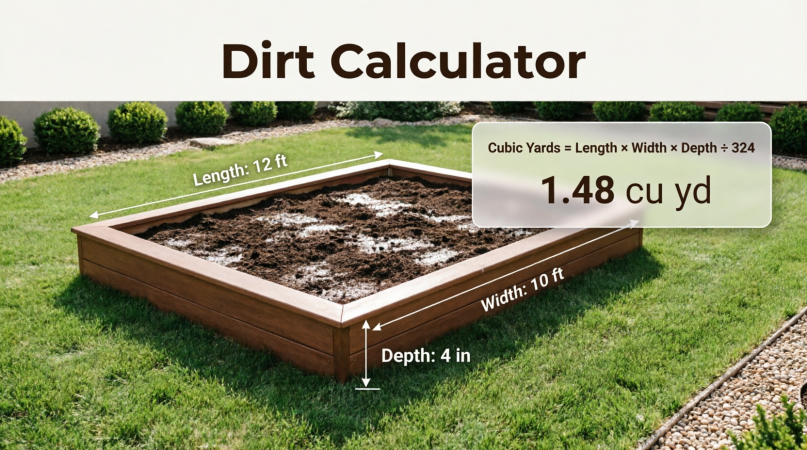
Cubic yards = Length (ft) × Width (ft) × Depth (in) ÷ 324
So, a 12 ft by 10 ft area filled 4 inches deep works out to roughly 1.48 cubic yards. That’s the raw geometric volume. In practice, you might order a bit more depending on the material, how it settles, and how your supplier packages it.
A dirt calculator handles all that arithmetic for you. It takes your measurements, works out the volume, and gives you the answer in cubic yards—the standard unit most bulk suppliers use. But understanding the math behind it means you can double-check any online result, catch mistakes before you place an order, and feel completely confident about what you’re buying.
This guide walks through the full process: the formulas, garden bed specifics, fill projects, circular and odd-shaped areas, bags versus bulk, weight, cost, and the common slip-ups that lead to ordering too much or too little.
Table of Contents
- How to Calculate Cubic Yards of Dirt
- Dirt Calculator Formulas for Different Shapes
- Garden Bed Dirt Calculator
- Fill Dirt Calculator: Leveling and Filling Low Areas
- Topsoil, Garden Soil, Fill Dirt, and Compost
- Dirt Volume Chart by Area and Depth
- Settling, Compaction, and How Much Extra to Order
- How Many Bags of Dirt Make a Cubic Yard?
- How Much Does a Cubic Yard of Dirt Weigh?
- How Much Does Dirt Cost?
- Common Dirt Calculation Mistakes
- Frequently Asked Questions
How to Calculate Cubic Yards of Dirt
When most people ask how to calculate yards of dirt, what they really mean is cubic yards—a measure of volume, not distance or area. A cubic yard is a cube that’s 3 feet long, 3 feet wide, and 3 feet tall. Multiply those together (3 × 3 × 3) and you get 27 cubic feet. It’s not the same as a linear yard or a square yard, and that distinction matters every time you place an order.
Bulk dirt suppliers sell by the cubic yard, and many deliver by weight. Getting your volume right is step one. Here’s how to calculate cubic yards of dirt from scratch.
Step 1: Measure the Length and Width
Grab a tape measure and measure the area you want to fill, working in feet. For a rectangle or square, you only need two numbers. If you can, round to the nearest tenth of a foot. If you’re working in feet and inches, convert the inches by dividing by 12—so 8 feet 6 inches becomes 8.5 feet.
Step 2: Decide on the Depth
This is where most mistakes happen. Think about how deep the dirt will be once it’s spread and finished, then write that number down in inches. The right depth depends entirely on the project. A thin layer for leveling a lawn is very different from a foot or more for a deep planting bed. Check your plant requirements or consult a local University Extension soil guide to lock in the right depth for your specific plants.
Step 3: Calculate Cubic Feet
Convert your depth from inches to feet by dividing by 12, then multiply everything together: Cubic feet = Length (ft) × Width (ft) × Depth (ft)
Step 4: Convert Cubic Feet to Cubic Yards
Divide by 27: Cubic yards = Cubic feet 27
That 27 comes from the 3 ft × 3 ft × 3 ft cube. You have to divide by 27, not 3, because you’re converting a volume, and volume scales in all three directions. If you’d rather skip the conversion step, an online dirt calculator will take your dimensions and return the result directly.
The Inches Shortcut: Divide by 324
When your length and width are in feet but your depth is in inches, you can combine both steps into one: Cubic yards = Length (ft) × Width (ft) × Depth (in) ÷ 324
The number 324 is just 27 × 12. Dividing depth in inches by 12 converts it to feet, and dividing by 27 converts cubic feet to cubic yards. This shortcut only works when length and width are in feet and depth is in inches. Drop inches into a formula that expects feet, and your answer will be 12 times too large.
Worked Example: 12 ft by 10 ft at 4 Inches Deep
Let’s walk through a realistic example for a garden area that needs a 4-inch layer of soil.
- Area: 12 ft × 10 ft = 120 square feet
- Depth in feet: 4 ÷ 12 = 0.3333 feet
- Volume in cubic feet: 120 × (4 ÷ 12) = 40 cubic feet exactly
- Cubic yards: 40 ÷ 27 = 1.4815, or about 1.48 cubic yards
Check with the shortcut: 12 × 10 × 4 ÷ 324 = 480 ÷ 324 = 1.4815. Same answer.
Keeping the depth as the fraction 4 ÷ 12 until the last step avoids rounding errors. For small projects the difference barely matters. For a large area, rounding early can add up to a noticeable amount of wasted money.
A Handy Rule: How Much Area Does One Cubic Yard Cover?
One cubic yard covers 324 square feet at a depth of 1 inch. Divide 324 by the depth in inches to find coverage at other depths:
| Depth | Area covered by 1 cubic yard |
|---|---|
| 1 inch | 324 sq ft |
| 2 inches | 162 sq ft |
| 3 inches | 108 sq ft |
| 4 inches | 81 sq ft |
| 6 inches | 54 sq ft |
| 12 inches | 27 sq ft |
These are geometric coverage values before any allowance for settling or handling.
Dirt Calculator Formulas for Different Shapes
Not every yard is a clean rectangle. The approach stays the same no matter what: find the area in square feet, multiply by the depth in feet, and divide by 27. Only the area formula changes.
Square and Rectangular Areas
Area = Length × Width This is the standard case. For a square, length and width are the same number.
Circular Areas
For a round planting bed, tree ring, or circular fill, use: Area = π × Radius² (where π is about 3.1416 and the radius is half the diameter). Then:
- Cubic feet = Area (sq ft) × Depth (ft)
- Cubic yards = Cubic feet ÷ 27
Example: A circular planting area is 10 feet across and needs 6 inches of soil.
- Radius: 10 ÷ 2 = 5 feet
- Area: 3.1416 × 5² = 78.54 square feet
- Depth: 6 inches = 0.5 feet
- Cubic feet: 78.54 × 0.5 = 39.27 cubic feet
- Cubic yards: 39.27 ÷ 27 = 1.45 cubic yards
A common error is entering the diameter where the formula needs the radius. Because the radius is squared, that mistake makes the area four times too large.
Triangular Areas
Area = ½ × Base × Height Example: A triangular corner bed has a base of 12 feet and a height of 8 feet. Area = 0.5 × 12 × 8 = 48 square feet. At 6 inches deep: 48 × 6 ÷ 324 = 0.89 cubic yards.
Irregular Areas and Uneven Ground
For an L-shaped patch or an odd-shaped lot, break the space into simple shapes. Sketch the area, divide it into rectangles and triangles, calculate each section’s volume separately, and add them together.
If the ground isn’t level, a single average depth can mislead you. Split the site into sections where the depth is roughly consistent. For complex grading—such as a sloping lot or drainage work—refer to The Engineering ToolBox for material density specifics, or hire a qualified professional to draft a site plan.
Garden Bed Dirt Calculator
A raised bed is basically a simple box, so the volume is length × width × soil depth. Cubic feet = Length (ft) × Width (ft) × Soil depth (ft) Cubic yards = Cubic feet ÷ 27
Example: A raised bed is 4 feet wide, 8 feet long, and filled with 10 inches of soil.
- Area: 4 × 8 = 32 square feet
- Soil depth: 10 ÷ 12 = 0.8333 feet
- Cubic feet: 32 × (10 ÷ 12) = 26.67 cubic feet
- Cubic yards: 26.67 ÷ 27 = 0.99 cubic yards
Use the Soil Depth, Not the Wall Height
Use the depth the soil will actually fill, not automatically the full height of the bed frame. A 12-inch bed that you fill to within 2 inches of the top holds 10 inches of soil. If the bottom contains other material—logs, branches, gravel—subtract that layer from the soil depth.
Multiple Beds and Blends
For several beds, calculate each separately and add the results. If your beds differ in size, don’t average them—add their individual volumes.
Many gardeners mix topsoil with compost. The garden bed dirt calculator math gives you the total volume of finished mix needed. If you’re blending your own at a 2:1 ratio (two parts soil to one part compost), multiply the total volume by those fractions to find exactly how much of each ingredient to buy.
Fill Dirt Calculator: Leveling and Filling Low Areas
Filling a depression or raising a grade uses the same volume math. The difference is that depth often changes across the site, and the material has a different purpose.
Cubic yards = Area (sq ft) × Average depth (in) ÷ 324
Example: A low area is 20 feet by 15 feet, and you measure an average fill depth of 5 inches.
- Area: 20 × 15 = 300 square feet
- Cubic yards: 300 × 5 ÷ 324 = 4.63 cubic yards
Why a Rough Average Can Be Off
Suppose that 300 square feet isn’t uniform. A 12 ft by 15 ft section is 3 inches deep and an 8 ft by 15 ft section is 8 inches deep.
- Section A: 180 sq ft × 3 in ÷ 324 = 1.67 cubic yards
- Section B: 120 sq ft × 8 in ÷ 324 = 2.96 cubic yards
- Total: 4.63 cubic yards
If you had simply averaged 3 and 8 inches to get 5.5, you would have calculated 5.09 cubic yards—roughly 10 percent too much. A fill dirt calculator approach only works accurately when you section the area properly.
When Fill Is More Than a Volume Problem
Fill under a driveway, slab, or building is a different beast. Structural fill must meet specified material types and be placed in controlled layers. Always follow local building codes and guidance from a qualified engineer for load-bearing projects.
Topsoil, Garden Soil, Fill Dirt, and Compost
“Dirt” is a casual word. Suppliers sell several different products, and the right one depends on what you’re doing. Check the USDA Soil Taxonomy to understand the basic composition of soils in your region.
- Topsoil: Used for planting beds and lawns. Composition varies, so ask your supplier how it was screened.
- Garden soil / Raised-bed mix: A blend of soil, compost, and organic material. Read the label, since a “bag” isn’t a standard size.
- Fill dirt: Used to fill depressions or build up a base. It’s often subsoil with little organic matter. Don’t use it if you plan to grow plants directly in it.
- Compost: An organic amendment. It improves a soil mix but isn’t a one-for-one replacement for soil.
For a planting bed, a common approach is fill dirt underneath and a layer of topsoil on top. Calculate each layer separately with its own depth so you order the right amount of each product.
Dirt Volume Chart by Area and Depth
This table shows cubic yards for common areas and depths, using Area (sq ft) × Depth (in) ÷ 324. Values are geometric volumes before any allowance for settling.
| Area | 2 inches deep | 4 inches deep | 6 inches deep |
|---|---|---|---|
| 100 sq ft | 0.62 cu yd | 1.23 cu yd | 1.85 cu yd |
| 200 sq ft | 1.23 cu yd | 2.47 cu yd | 3.70 cu yd |
| 500 sq ft | 3.09 cu yd | 6.17 cu yd | 9.26 cu yd |
| 1,000 sq ft | 6.17 cu yd | 12.35 cu yd | 18.52 cu yd |
To use the chart, find your area and depth. For an area that sits between rows, add rows together. For example, 300 square feet at 4 inches is the 100 sq ft value plus the 200 sq ft value: 1.23 + 2.47 = 3.70 cubic yards.
Settling, Compaction, and How Much Extra to Order
The number from a dirt calculator is the volume of the finished space. It isn’t automatically the quantity to order.
- Geometric volume: The space you want to fill.
- Handling losses: Material spilled or left in the wheelbarrow.
- Settling and compaction: Loose soil contains air. After it’s watered or walked on, it settles.
There’s no single correct percentage to add. If your area needs 1.48 cubic yards and you add a 10% buffer, you’d order 1.63 cubic yards.
- For planting beds: Order the calculated amount plus a modest buffer.
- For engineered fill: Follow the project specification. Compacted fill requires more loose material than the finished volume.
How Many Bags of Dirt Make a Cubic Yard?
Bagged soil is sold by volume in cubic feet. Number of bags = Required volume ÷ Volume per bag
Since one cubic yard is 27 cubic feet:
| Bag size | Bags per cubic yard (exact) | Whole bags to buy |
|---|---|---|
| 0.75 cu ft | 36 | 36 |
| 1 cu ft | 27 | 27 |
| 1.5 cu ft | 18 | 18 |
| 2 cu ft | 13.5 | 14 |
You can’t buy half a bag, so you’d buy 14 two-cubic-foot bags to get at least a full cubic yard. For anything over a cubic yard or two, bulk delivery is almost always cheaper and easier to manage.
How Much Does a Cubic Yard of Dirt Weigh?
Volume and weight are different. You can only convert between them if you know the density of the specific material. Weight = Volume × Bulk density
Weight depends on moisture, composition, and compaction. A cubic yard of dry topsoil weighs about 2,000 pounds, but can reach 3,000 pounds when saturated. Dry sandy soil is heavier, while dry clay can be lighter.
Don’t use volume alone to decide what a vehicle can carry. A volume calculation says nothing about whether a pickup can safely haul the load. Check your vehicle’s payload rating. A cubic yard of wet soil can easily exceed the payload limit of a standard half-ton truck.
How Much Does Dirt Cost?
Prices vary wildly by region and material. Estimated material cost = Cubic yards required × Price per cubic yard
If a supplier quotes $40 per cubic yard and you need 1.48 cubic yards, material cost is $59.20. But if delivery adds a flat $75, the total jumps to $134.20. For small orders, delivery fees often cost more than the soil itself. Always ask if the price is per yard or per ton, and if delivery is included.
Common Dirt Calculation Mistakes
- Mixing inches and feet: Entering 4 inches where the formula expects 0.33 feet makes the answer 12 times too large.
- Using square feet as cubic feet: Area alone isn’t volume. You must include depth.
- Forgetting to divide by 27: Cubic feet aren’t cubic yards.
- Dividing by 3 instead of 27: A cubic yard is 3 feet in three directions.
- Entering diameter instead of radius: For circles, halve the diameter first.
- Confusing cubic yards with tons: One is volume, the other is weight.
- Using the full height of a raised bed: Use the actual soil depth you’ll fill to, not the wood height.
Frequently Asked Questions
How do I calculate cubic yards of dirt? Multiply length (ft) × width (ft) × depth (ft) to get cubic feet, then divide by 27. If depth is in inches, multiply length × width × depth and divide by 324.
How many cubic feet are in a cubic yard of dirt? There are exactly 27 cubic feet in one cubic yard (3 ft × 3 ft × 3 ft).
How do I calculate yards of dirt when depth is in inches? Use the shortcut: length (ft) × width (ft) × depth (in) ÷ 324.
How much dirt do I need for a garden bed? Multiply the bed’s length by its width by the depth of soil it will hold. A 4 ft by 8 ft bed filled 10 inches deep needs about 0.99 cubic yards.
Is a cubic yard of dirt the same as a ton? No. A cubic yard measures volume, and a ton measures weight. A cubic yard of soil often weighs around one ton, but it depends heavily on moisture and material type.
How much area will one cubic yard of dirt cover? At 1 inch deep, a cubic yard covers about 324 square feet. At 4 inches, it covers about 81 square feet.
Final Takeaway
Measure the area, decide the finished depth, and apply one formula: length (ft) × width (ft) × depth (in) ÷ 324 gives you your cubic yards. Break irregular spaces into simple shapes, use the real soil depth for raised beds, and treat the result as the starting point for your order. Before you buy, confirm the product type, the weight, and the delivery terms with your local supplier.
Measure twice, buy once. It’s the oldest rule in construction, and it applies to dirt just as much as it does to lumber.