
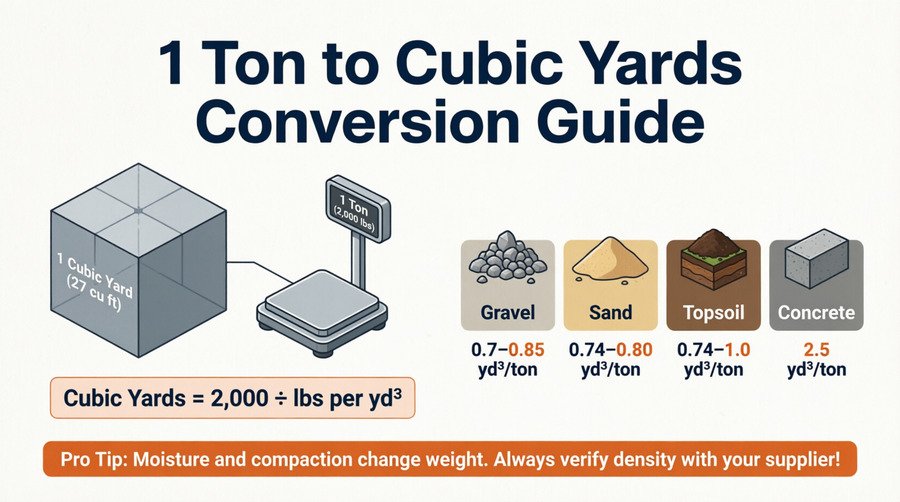
1 ton how many cubic yards? The quick answer is that it depends on the material. A ton measures weight, while a cubic yard measures volume, meaning there is no universal conversion. However, as a general rule, 1 U.S. short ton (2,000 pounds) of gravel, sand, or fill dirt equals roughly 0.7 to 0.9 cubic yards.
The Basic Math You can easily calculate this yourself if you know the material’s density. The formula is straightforward: Cubic Yards = 2,000 ÷ Weight per cubic yard (in lbs)
For instance, if your material weighs 2,700 lbs per cubic yard, the math looks like this: 2,000 ÷ 2,700 = 0.74 cubic yards per ton.
Quick Reference: Cubic Yards in 1 Ton by Density
Here is a handy reference chart based on the standard U.S. short ton (2,000 lbs). If you know your material’s weight per cubic yard, you can find the exact conversion below:
| Weight per cubic yard | Cubic yards in 1 ton | Tons in 1 cubic yard |
|---|---|---|
| 1,500 lb | 1.33 | 0.75 |
| 2,000 lb | 1.00 | 1.00 |
| 2,400 lb | 0.83 | 1.20 |
| 2,700 lb | 0.74 | 1.35 |
| 3,000 lb | 0.67 | 1.50 |
| 4,000 lb | 0.50 | 2.00 |
Note: The “Tons in 1 cubic yard” column answers the reverse question. Simply divide the weight per cubic yard by 2,000.
1 Ton How Many Cubic Yards: Conversions by Common Material
The numbers below are solid planning estimates. Keep in mind that real-world weights fluctuate based on rock type, moisture levels, and how the material is graded. Always double-check the exact weight per cubic yard with your supplier before finalizing an order.
| Material | Typical weight per cubic yard (estimate) | Cubic yards in 1 ton | Tons in 1 cubic yard |
|---|---|---|---|
| Gravel and crushed stone (including #57) | 2,400 to 2,900 lb | 0.69 to 0.83 | 1.2 to 1.45 |
| Sand, dry to damp | 2,500 to 2,700 lb | 0.74 to 0.80 | 1.25 to 1.35 |
| Topsoil | 2,000 to 2,700 lb | 0.74 to 1.00 | 1.0 to 1.35 |
| Fill dirt | 2,400 to 3,000 lb | 0.67 to 0.83 | 1.2 to 1.5 |
| Fresh concrete | About 4,000 lb | About 0.50 | About 2.0 |
Two quick takeaways: First, a “yard” of gravel, sand, or fill dirt almost always weighs more than a ton, not less. Second, best soil for landscaping is the lightest of the bunch and can hover right around 1 ton per yard if it is dry and loose.
Why You Cannot Directly Swap Tons for Yards
A ton is strictly a unit of weight. A cubic yard is a unit of volume, representing a space that is 3 feet long, 3 feet wide, and 3 feet high (totaling 27 cubic feet). Bridging the gap between the two requires knowing the “bulk density” essentially, how heavy a specific volume of that material is.
Several factors throw off bulk density:
- Material composition: Granite, limestone, clay, and organic-rich soil all have inherently different weights.
- Moisture content: Water adds significant weight without expanding the volume. Wet sand or dirt will weigh noticeably more than their dry counterparts.
- Particle size and grading: A well-graded mix of fine and coarse particles packs together much tighter than uniform, open-graded stone.
- Compaction: Loose material sitting in a truck bed takes up more space than that same material once it is compacted on the ground.
This is exactly why a ton of sand, a ton of gravel, and a ton of concrete will fill different amounts of space.
Short Tons vs. Metric Tonnes vs. Long Tons
In U.S. landscaping and construction, “ton” almost exclusively refers to the short ton (2,000 lbs). However, other definitions exist, and they will completely change your math:
| Unit | Pounds |
|---|---|
| U.S. short ton | 2,000 lb |
| Metric tonne | About 2,204.62 lb (1,000 kg) |
| British long ton | 2,240 lb |
If your supplier quotes you in metric tonnes, convert to pounds first. For example, 1 metric tonne of material at 2,700 lbs per cubic yard equals 2,204.62 ÷ 2,700 = 0.82 cubic yards, not 0.74.
Step-by-Step Conversion Formulas
Tons to Cubic Yards Formula: Cubic Yards = (Tons × 2,000) ÷ Pounds per cubic yard. Example: You have 5 tons of aggregate, and your supplier lists the density at 2,500 lbs per cubic yard.
- Convert tons to pounds: 5 × 2,000 = 10,000 lbs
- Divide by the density: 10,000 ÷ 2,500 = 4 cubic yards. Result: 5 short tons of this aggregate equals exactly 4 cubic yards.
Cubic Yards to Tons Formula: Tons = (Cubic Yards × Pounds per cubic yard) ÷ 2,000. Example: You need 6 cubic yards of material that weighs 2,400 lbs per cubic yard.
- Multiply volume by density: 6 × 2,400 = 14,400 lbs
- Divide by 2,000: 14,400 ÷ 2,000 = 7.2 short tons. Pro tip: If your supplier already provides density in “tons per cubic yard,” skip the division. Just multiply: Tons = Cubic Yards × Tons per cubic yard. (e.g., 6 cubic yards × 1.25 tons/yd³ = 7.5 tons).
Converting Cubic Feet to Tons: Always convert your volume units first, then apply the density.
- Cubic yards = Cubic feet ÷ 27
- Tons = (Cubic yards × Pounds per cubic yard) ÷ 2,000
Example: You have 54 cubic feet of material at 2,400 lbs per cubic yard.
- 54 ÷ 27 = 2 cubic yards
- 2 × 2,400 = 4,800 lbs
- 4,800 ÷ 2,000 = 2.4 short tons. Remember, dividing by 27 only changes the volume measurement. It does not magically give you a weight.
Material-Specific Breakdowns
How Many Cubic Yards Is 1 Ton of Gravel? Typically, one ton of gravel equals about 0.7 to 0.85 cubic yards, assuming a density between 2,400 and 2,900 lbs per cubic yard.
| Assumed gravel density | Cubic yards per ton |
|---|---|
| 2,400 lb/yd³ | 0.83 |
| 2,500 lb/yd³ | 0.80 |
| 2,700 lb/yd³ | 0.74 |
| 3,000 lb/yd³ | 0.67 |
Keep in mind that “gravel” is not a single product. Crushed limestone, granite, and river rock all have different densities, and moisture adds another layer of variation.
How Many Yards Is 1 Ton of #57 Gravel? The “#57” designation refers to the stone size, not the rock type, so its weight depends entirely on what it is made of. Suppliers generally quote between 2,400 and 2,750 lbs per cubic yard, which translates to 0.73 to 0.83 cubic yards per ton. At a standard 2,700 lbs/yd³, one ton gets you 0.74 cubic yards. Advice: Always ask your supplier three things: the specific rock type, the exact weight per cubic yard, and whether they sell by the ton or by the yard.
How Many Tons Is 20 Cubic Yards of Gravel? At 2,700 lbs/yd³: 20 × 2,700 = 54,000 lbs, which is 27 short tons. At 2,400 lbs/yd³: 20 × 2,400 = 48,000 lbs, which is 24 short tons. That is a massive amount of weight. Always verify the delivery truck’s legal payload capacity before assuming it can all arrive in a single trip.
How Many Cubic Yards Is 1 Ton of Sand? One ton of sand usually equals 0.74 to 0.80 cubic yards (assuming 2,500 to 2,700 lbs per cubic yard). Conversely, 1 cubic yard of sand weighs roughly 1.25 to 1.35 tons. Wet sand is significantly heavier than dry sand, making it tricky to compare a quote by the ton versus a quote by the yard. Always clarify if the supplier’s numbers are for dry, damp, or wet sand.
How Many Cubic Yards Is 1 Ton of Dirt or Soil? For soil, the conversion ranges from about 0.67 to 1.1 cubic yards per ton, depending heavily on the composition.
| Soil density assumption | Cubic yards per ton |
|---|---|
| 1,800 lb/yd³ | 1.11 |
| 2,000 lb/yd³ | 1.00 |
| 2,400 lb/yd³ | 0.83 |
| 2,700 lb/yd³ | 0.74 |
| 3,000 lb/yd³ | 0.67 |
Note: These are theoretical calculations based on listed densities, not guaranteed ranges for every soil type.
- Topsoil: Contains organic matter and is often blended with compost, making it lighter. A safe planning range is 2,000 to 2,700 lbs/yd³ (about 0.74 to 1.0 cubic yards per ton).
- Fill dirt: Mostly mineral soil, making it noticeably heavier. Sandy fill, clay fill, and mixed excavation materials all vary, so do not apply topsoil math to fill dirt.
- Moisture: Wet soil can weigh drastically more than dry soil of the same volume, which is critical for both ordering and hauling.
Is 1 Yard of Dirt a Ton? Not automatically. “A yard of dirt” refers to one cubic yard (a volume). At 2,400 lbs/yd³, it weighs 1.2 tons. At 2,000 lbs/yd³, it weighs exactly 1 ton. In reality, a yard of dirt is quite often heavier than a single ton.
Loose Volume vs. Compacted Volume: Soil measured in the truck, in its natural state in the ground, and after compaction represent three entirely different volumes. Compacted soil takes up less space than the loose soil delivered to your site. If your project has strict compaction requirements, rely on the engineer’s or geotechnical specifications rather than a generic online converter, and always order a little extra to be safe.
Real-World Conversion Examples
(Assuming a standard density of 2,700 lbs per cubic yard for these examples. Swap in your actual density for real projects.)
| Quantity | Calculation | Result |
|---|---|---|
| 1 ton to yards | 2,000 ÷ 2,700 | 0.74 yd³ |
| 5 tons to yards | 10,000 ÷ 2,700 | 3.70 yd³ |
| 7 tons to yards | 14,000 ÷ 2,700 | 5.19 yd³ |
| 12 tons to yards | 24,000 ÷ 2,700 | 8.89 yd³ |
| 20 tons to yards | 40,000 ÷ 2,700 | 14.81 yd³ |
| 50 tons to yards | 100,000 ÷ 2,700 | 37.04 yd³ |
| 3 yards to tons | 3 × 2,700 ÷ 2,000 | 4.05 tons |
| 10 yards to tons | 10 × 2,700 ÷ 2,000 | 13.5 tons |
| 50 yards to tons | 50 × 2,700 ÷ 2,000 | 67.5 tons |
| 60 yards to tons | 60 × 2,700 ÷ 2,000 | 81 tons |
So, to answer questions like “Is 3 cubic yards equal to 3 tons?” or “Is 20 tons the same as 20 yards?” the answer is only yes if the material weighs exactly 2,000 lbs per cubic yard. At a more common 2,700 lbs/yd³, 3 cubic yards actually weigh 4.05 tons, and 20 tons will only fill about 14.81 cubic yards.
Dump Trucks: Understanding Weight vs. Volume Limits
A truck’s weight rating and its physical bed size are two separate limits, and whichever is reached first will cap your load.
- Volume limit: Cubic yards = (Length ft × Width ft × Average load depth ft) ÷ 27
- Weight limit: Cubic yards = Material payload (in lbs) ÷ Pounds per cubic yard
Example: A truck with a 40,000 lb usable material payload hauling aggregate at 2,500 lbs/yd³ is limited to 40,000 ÷ 2,500 = 16 cubic yards by weight. However, if the physical bed only holds 12 cubic yards, the bed size becomes the limiting factor.
How Many Cubic Yards Are in a 20-Ton Dump Truck? A “20-ton payload” does not automatically mean 20 cubic yards. If 20 tons (40,000 lbs) is the maximum allowed material weight:
- At 2,500 lbs/yd³: 40,000 ÷ 2,500 = 16 cubic yards
- At 2,700 lbs/yd³: 40,000 ÷ 2,700 = 14.81 cubic yards. The actual load is further restricted by the truck’s body size and legal axle/gross weight limits, which vary by state and vehicle configuration.
Can a Pickup Carry 1 Ton of Gravel? One ton of gravel is 2,000 lbs before you add passengers, tools, or fuel. At 2,700 lbs/yd³, that is only about 20 cubic feet, so it will easily fit in a standard truck bed. The issue is weight, not space. Many “half-ton” pickups have a payload rating close to or even below 2,000 lbs once fully equipped, and that payload must also cover everyone and everything else in the vehicle. Check the yellow Tire and Loading Information label on the driver’s side door jamb. It states the vehicle’s maximum combined weight for occupants and cargo. If 2,000 lbs of gravel plus passengers exceeds that number, plan on making two trips or scheduling a delivery.
Is a 4500 Truck a 1-Ton Truck? No. “1-ton” is a traditional, somewhat outdated class label (like a 3500 or F-350 series) that no longer reflects actual payload capacities. A “4500” is a medium-duty chassis cab model that sits in a higher weight class entirely. Model numbers are marketing terms, not precise payload ratings. Always check the specific truck’s Gross Vehicle Weight Rating (GVWR) and payload on its door label or the manufacturer’s spec sheet.
Can You Convert Tons to Square Yards?
You cannot convert tons directly to square yards. A ton is weight, and a square yard is area. To figure out how much area a ton of material will cover, you need two extra pieces of information: the material’s density and the depth you plan to spread it.
The workflow looks like this:
- Tons to cubic yards: (Tons × 2,000) ÷ density
- Cubic yards to cubic feet: multiply by 27
- Depth in feet: inches ÷ 12
- Square feet covered: cubic feet ÷ depth in feet
- Square yards covered: square feet ÷ 9
Example: Spreading 1 ton of gravel (at 2,400 lbs/yd³) at a depth of 3 inches.
- 2,000 ÷ 2,400 = 0.833 cubic yards
- 0.833 × 27 = 22.5 cubic feet
- 3 inches ÷ 12 = 0.25 ft (depth)
- 22.5 ÷ 0.25 = 90 square feet
- 90 ÷ 9 = 10 square yards Keep in mind this ignores waste, compaction, and uneven ground, so it is always wise to order a little extra for real-world projects.
How Many 40-lb Bags Fit in a Cubic Yard?
Bag weight alone does not tell you the volume. You need to check the volume printed on the bag, which is commonly 0.5, 0.75, or 1 cubic foot for soil products.
- 0.5 cu ft bags: 27 ÷ 0.5 = 54 bags per cubic yard
- 0.75 cu ft bags: 27 ÷ 0.75 = 36 bags per cubic yard
- 1 cu ft bags: 27 ÷ 1 = 27 bags per cubic yard
You can divide by weight if you know the exact density (e.g., a cubic yard of soil at 2,400 lbs equals 2,400 ÷ 40 = 60 bags of 40 lbs each). However, bagged soil is often fluffier and lighter than bulk soil, making the volume method much more reliable.
How Much Does a Cubic Yard of Concrete Weigh?
Standard concrete typically weighs around 150 lbs per cubic foot, which translates to about 4,000 lbs per cubic yard (or 2 tons). Therefore, 10 cubic yards of concrete weighs roughly 40,000 lbs, or 20 tons. Keep in mind that mixes vary, and broken concrete rubble is a different story: the gaps between pieces leave voids, meaning loose rubble weighs less per cubic yard than solid, poured concrete.
Visualizing the Volume: What Does 10 Cubic Yards Look Like?
Ten cubic yards equals 270 cubic feet. To put that in perspective, it is the equivalent of a rectangular space measuring 10 feet long, 9 feet wide, and 3 feet deep. A loose pile in your driveway will naturally be taller and narrower than those dimensions, but the total volume remains the same.
Top Conversion Mistakes to Avoid
- Treating a ton as a cubic yard: They measure fundamentally different things (weight vs. volume).
- Using a single density for everything: Gravel, sand, soil, and concrete are not interchangeable.
- Ignoring moisture: Rain-soaked material can weigh significantly more than dry material.
- Mixing loose and compacted volumes: Always clarify which state your quantity refers to.
- Mixing short tons and metric tonnes: Double-check the unit of measurement on every single quote.
- Dividing cubic feet by 27 to get weight: This only converts volume units; it does not calculate weight.
- Confusing truck payload with bed volume: Dense materials will hit the weight limit long before the truck bed is physically full.
- Confusing square yards with cubic yards: One measures flat area, the other measures 3D volume.
Frequently Asked Questions (FAQ)
How many tons are in 1 yard? Divide the material’s weight in pounds by 2,000. For example, at 2,400 lbs, it is 1.2 tons. At 4,000 lbs (concrete), it is 2 tons.
How many cubic yards equal 1 ton? Divide 2,000 by the material’s pounds per cubic yard. At 2,500 lbs/yd³, 1 ton equals 0.8 cubic yards.
Is 1 cubic yard equal to 1 ton? Only if the material weighs exactly 2,000 lbs per cubic yard. Most gravel, sand, and fill dirt weigh considerably more than that.
How many cubic yards are in 12 tons? At 2,700 lbs/yd³, it is about 8.89 cubic yards. At 2,400 lbs/yd³, it is exactly 10 cubic yards.
What is 5 tons in cubic yards? Roughly 3.70 cubic yards at 2,700 lbs/yd³, or 4.17 cubic yards at 2,400 lbs/yd³.
What is 7 tons in cubic yards? Approximately 5.19 cubic yards at a standard 2,700 lbs/yd³.
What is 10 cubic yards in tons? Multiply 10 by the density, then divide by 2,000. At 2,700 lbs/yd³, that is 13.5 tons.
What is 50 cubic yards in tons? At 2,700 lbs/yd³, that equals 67.5 tons.
What is 60 cubic yards in tons? At 2,700 lbs/yd³, that equals 81 tons.
How many tons are in a cubic yard of rock? Typically 1.2 to 1.5 tons for crushed stone and gravel. A standard product at 2,700 lbs/yd³ equals 1.35 tons.
How much dirt is 10 cubic yards? It is 270 cubic feet. At 2,400 lbs/yd³, that translates to 24,000 lbs, or 12 tons.
Is 1 yard of dirt the same as 1 cubic yard? In the context of bulk material ordering, yes. “Yard” is simply industry shorthand for cubic yard.
How much is 20 cubic yards? Twenty cubic yards equals 540 cubic feet. At 2,700 lbs/yd³, it weighs 27 tons.
The Bottom Line
To answer “how many cubic yards are in 1 ton,” simply divide 2,000 by the material’s weight per cubic yard. For gravel, sand, and fill dirt, this usually lands somewhere between 0.67 and 0.83 cubic yards. For topsoil, it can approach a full cubic yard, while fresh concrete will only yield about 0.5 cubic yards per ton.
Always confirm the exact density with your supplier, especially when dealing with wet materials or placing large orders. Finally, always verify the truck’s payload capacity and bed volume before planning your delivery.
To figure out how many cubic yards a project needs from its dimensions, start with TheCalcYard and use its volume tools, then apply the density method above to convert that volume to tons.