
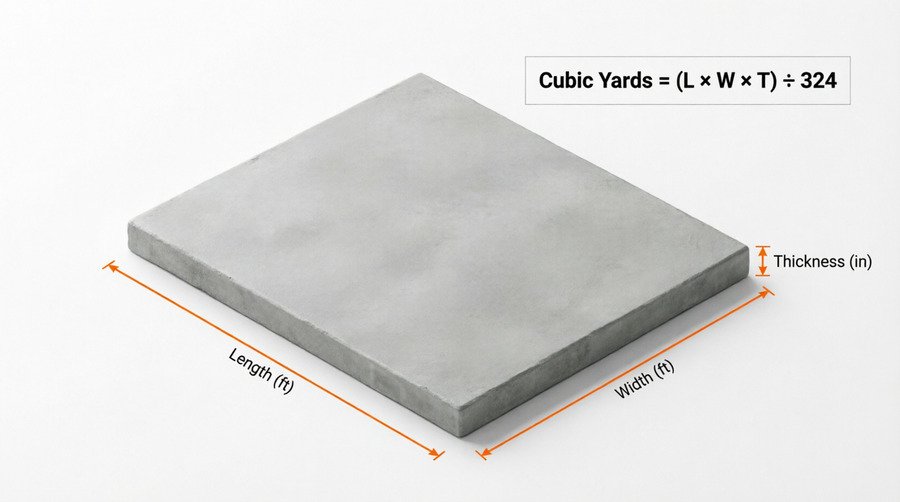
Need to figure out how much concrete to order for a patio, driveway, or foundation? The math is straightforward. For a rectangular slab, multiply the length by the width, multiply by the thickness, and convert to cubic yards:
Cubic Yards = Length (ft) × Width (ft) × Thickness (in) ÷ 324
For example, a 20 × 30 ft slab that is 4 inches thick requires:
20 × 30 × 4 ÷ 324 = 7.41 cubic yards.
In the real world, you never order the exact theoretical amount. Adding a 10% buffer for waste, subgrade dips, and form bowing brings that to roughly 8.15 cubic yards. Most ready-mix suppliers will have you round that up to 8.25 or 8.5 yards.
Nationwide, a basic 4-inch residential slab typically costs between $6 and $12 per square foot installed, though regional labor rates and site conditions can push that higher. Below, we break down the exact math, cost drivers, and the step-by-step process of getting it poured right.
What Exactly Is a Concrete Slab?
At its core, a concrete slab is a flat, horizontal structural element. Indoors, it serves as a foundation or finished floor (which can be polished, stained, or covered in tile). Outdoors, it forms the backbone of patios, sidewalks, driveways, and equipment pads.
Slabs aren’t one-size-fits-all. Depending on the soil conditions, expected loads, and local climate, they might be left unreinforced, reinforced with rebar or welded wire mesh, or post-tensioned with high-strength steel cables.
How to Calculate Concrete for a Slab
You only need three measurements and one conversion factor.
- Measure length and width in feet.
- Determine thickness in inches. (This comes from your engineering plans or local code, not the calculator).
- Apply the formula: Length × Width × Thickness (in) ÷ 324 = cubic yards.
Why the Divisor is 324
This single number handles two necessary conversions. First, dividing inches by 12 converts thickness to feet. Second, dividing cubic feet by 27 converts the volume to cubic yards (since 3 ft × 3 ft × 3 ft = 27 cubic feet). Because 12 × 27 = 324, one clean division does the heavy lifting.
If you prefer to see the math in steps:
- Cubic feet = Length × Width × (Thickness ÷ 12)
- Cubic yards = Cubic feet ÷ 27
Example: A 10 × 20 ft patio, 4 inches thick.
10 × 20 × 4 = 800.
800 ÷ 324 = 2.47 cubic yards.
(In steps: 200 sq ft × 0.333 ft = 66.67 cubic feet. 66.67 ÷ 27 = 2.47 cubic yards).
You can plug your own dimensions into TheCalcYard’s concrete slab calculator. Whether you call it a slab volume estimator or a yardage calculator, the underlying math remains identical: area multiplied by thickness, converted to cubic yards.
Quick Rule of Thumb
Every 100 square feet of slab requires roughly:
| Thickness | Cubic Yards per 100 sq ft |
|---|---|
| 3″ | 0.93 |
| 4″ | 1.23 |
| 5″ | 1.54 |
| 6″ | 1.85 |
| 8″ | 2.47 |
Multiply this factor by your total area divided by 100. For a 450 sq ft patio at 4 inches thick: 4.5 × 1.23 = 5.55 cubic yards (before waste).
Concrete Slab Quantity Chart
The volumes below are net cubic yards (zero waste added), calculated using the standard formula. They represent quantity estimates only, not structural thickness recommendations.
| Slab Size | 3″ Thick | 4″ Thick | 5″ Thick | 6″ Thick |
|---|---|---|---|---|
| 10 × 10 | 0.93 | 1.23 | 1.54 | 1.85 |
| 10 × 20 | 1.85 | 2.47 | 3.09 | 3.70 |
| 12 × 20 | 2.22 | 2.96 | 3.70 | 4.44 |
| 20 × 20 | 3.70 | 4.94 | 6.17 | 7.41 |
| 20 × 30 | 5.56 | 7.41 | 9.26 | 11.11 |
| 20 × 40 | 7.41 | 9.88 | 12.35 | 14.81 |
| 30 × 30 | 8.33 | 11.11 | 13.89 | 16.67 |
Deep Dive: 20 × 30 Slab (600 sq ft)
Notice how drastically thickness impacts your total order:
| Thickness | Cubic Feet | Cubic Yards (Net) | With 10% Waste |
|---|---|---|---|
| 3″ | 150.0 | 5.56 | 6.11 |
| 4″ | 200.0 | 7.41 | 8.15 |
| 5″ | 250.0 | 9.26 | 10.19 |
| 6″ | 300.0 | 11.11 | 12.22 |
Jumping from 4 inches to 6 inches adds nearly 4 cubic yards of concrete to this single slab. Thickness drives volume more than most DIYers realize.
Area Is Not Volume
This is the most common estimating mistake. Square footage measures surface area; cubic yards measure volume. If you need to find your exact area first, use our square footage calculator before converting to volume. You cannot order concrete based on square footage alone. A 1,000 sq ft slab at 4 inches requires significantly less concrete than a 750 sq ft slab at 6 inches. Thickness is always a required variable.
Also, never confuse cubic yards with square yards. Ready-mix is sold strictly by the cubic yard. A square yard is just 9 square feet of surface area and tells you nothing about depth.
Handling Irregular Shapes, Circles, and Thickened Edges
L-Shaped or Irregular Slabs
Don’t try to force an odd shape into one “average” rectangle. Break the blueprint down into simple rectangles, calculate the volume of each using the standard formula, and add them together. Subtract any cutouts (like a planter box) the same way.
Circular Slabs
Use the area formula: Area = π × (diameter ÷ 2)².
For a 10 ft diameter pad at 4 inches thick:
3.1416 × 5² = 78.54 sq ft.
78.54 × 4 ÷ 324 = 0.97 cubic yards.
Thickened Edges and Footings
Many residential slabs feature a thicker perimeter (a monolithic edge) to support walls. Calculate the main field of the slab first, then calculate the extra depth of the edge as a separate volume.
Example: A 20 × 30 ft slab is 4 inches thick overall, with a 12-inch-wide thickened edge that is 12 inches deep.
- Main slab at 4″: 7.41 cubic yards
- A 1 ft wide ring around the inside edge covers: 600 − (18 × 28) = 96 sq ft
- Extra depth in that ring is 12″ − 4″ = 8 inches. So, 96 × 8 ÷ 324 = 2.37 cubic yards
- Total: ~9.78 cubic yards (before waste).
Averaging the thickness across the entire slab will almost always understate the actual quantity. Calculate the pieces separately.
How Much Extra Concrete to Order
The formula gives you a perfect, theoretical volume. Real-world pours always use more due to:
- Soft spots or low areas in the compacted subgrade.
- Forms that bow outward under the pressure of wet concrete.
- Spillage, pump line residue, or concrete left in the truck chute.
- Minor measurement errors in depth or dimensions.
Most contractors add a 5% to 10% overage. Use the lower end for simple, perfectly graded pours, and the higher end for rough subgrades or complex shapes. Running short mid-pour creates cold joints, which severely compromise structural integrity. It is always safer to have a little left over than to come up short.
Note on ordering: Ready-mix suppliers often schedule in quarter-yard or half-yard increments. Many also charge “short-load” fees for orders under a certain threshold (often 4 to 6 yards). A standard mixer truck holds about 8 to 10 cubic yards, so a large slab will require multiple trucks. Always confirm minimums and fees with your local plant.
What about bagged mix? An 80 lb bag yields about 0.6 cubic feet (roughly 45 bags per cubic yard). A 60 lb bag yields about 0.45 cubic feet (roughly 60 bags per yard). Pouring that 10 × 10 ft, 4-inch slab (33.3 cubic feet) would require about 56 bags of 80 lb mix, or 61 bags with a 10% waste buffer. Once you cross the 1-cubic-yard mark, ready-mix delivery is almost always more practical and cost-effective.
How Much Does a Concrete Slab Cost?
Pricing a concrete slab isn’t a one-size-fits-all equation. Costs fluctuate based on region, site accessibility, reinforcement, and finish level. The figures below are approximate US ranges for planning purposes; always get local bids.
Material Cost Only
Material Cost = Cubic Yards × Price per Cubic Yard
Delivered ready-mix typically runs $130 to $200 per cubic yard, depending on mix design (PSI), additives, and haul distance. For our 20 × 30 ft, 4-inch slab ordered at 8.15 cubic yards, a $160/yard price tag equals roughly $1,304 for the concrete alone.
Installed Cost
“Installed” covers everything beyond the raw material: excavation, gravel base, formwork, reinforcement, labor, finishing, joint cutting, and vapor barriers. A basic 4-inch residential slab generally runs $6 to $12 per square foot installed. Thicker, reinforced, stamped, or hard-to-access jobs will push well past that range.
| Example Project | Area | Approx. Installed Range ($6–$12/sq ft) |
|---|---|---|
| 10 × 10 Patio | 100 sq ft | $600 – $1,200 |
| 12 × 20 Patio | 240 sq ft | $1,440 – $2,880 |
| 20 × 30 Garage/Shop | 600 sq ft | $3,600 – $7,200 |
Small projects often carry a higher cost per square foot because setup, delivery fees, and minimum charges are spread over a smaller volume of concrete.
What Drives the Price Up?
- Slab area and overall thickness
- Special mix requirements (air-entrained, fiber mesh, colored)
- Delivery distance, short-load fees, and truck wait-time charges
- Extensive excavation, grading, or imported base material
- Reinforcement type (rebar vs. wire mesh vs. fiber)
- Formwork complexity and decorative finishing (stamped, polished, broom)
- Need for a concrete pump if trucks can’t reach the pour site
- Permit fees and old concrete demolition
Always ask contractors if their bid includes excavation, base prep, reinforcement, and finishing. Scope creep is the number one reason bids look drastically different.
How Thick Should a Concrete Slab Be?
A quantity calculator cannot make this decision for you. Thickness is a structural design choice dictated by expected loads, soil bearing capacity, climate, and local building codes.
As a general rule of thumb in US residential construction:
- 4 inches: Standard for interior floors, patios, and pedestrian walkways.
- 5 to 6 inches (or more): Required for driveways and garage slabs to handle vehicle loads.
Heavy equipment, expansive soils, or commercial applications demand thicker slabs and formal engineering. For anything structural, always defer to your blueprints, a licensed engineer, and local building codes and the International Residential Code (IRC). (Note: URL points to Chapter 4: Foundations of the 2021 IRC, which governs slab and footing requirements).
Types of Concrete Slabs
- Slab-on-grade: Poured directly onto prepared, compacted soil or a gravel base. The most common residential foundation type.
- Suspended slab: Supported above ground by beams, walls, or columns (e.g., upper floors, parking garages).
- Reinforced slab: Embedded with rebar or welded wire mesh to resist tensile forces and control shrinkage cracking.
- Post-tensioned slab: Uses high-strength steel tendons that are tensioned after the concrete cures. This allows for thinner sections or longer spans, common in commercial builds and residential foundations on expansive clay soils.
- Precast slab: Cast and cured in a controlled plant environment, then transported and set with a crane.
Precast vs. Poured: Which is cheaper?
For large, flat areas, poured-in-place concrete is generally cheaper per square foot because it requires less individual handling and shaping. Precast pavers or panels cost more upfront but offer the advantage of easy, localized replacement if damaged. Always compare quotes for your specific layout.
Concrete Slab Construction Sequence
Requirements vary by soil and code, but this is the standard workflow for a slab-on-grade:
- Site Prep: Clear all vegetation, topsoil, and debris.
- Excavation & Grading: Dig to the required depth (slab thickness + base material) and establish a slight slope for drainage.
- Subgrade Compaction: Mechanically compact the soil. Soft, uneven spots guarantee future settlement and cracking.
- Base Layer: Place and compact a 4- to 6-inch layer of gravel or crushed stone, if specified. (Use our gravel calculator to estimate the exact tonnage needed for your sub-base.)
- Formwork: Set straight, heavily braced forms at the exact target elevation.
- Vapor Retarder: Install polyethylene sheeting (typically 10-mil or thicker) under interior slabs to block ground moisture.
- Reinforcement: Position rebar or wire mesh on chairs or dobies. It must sit in the middle or upper third of the slab, not resting on the dirt.
- Placement & Screeding: Pour the concrete, consolidate it to remove air pockets, and strike it off level with a straightedge.
- Finishing: Bull float, edge, and trowel to the specified texture. Timing is critical and depends on the concrete’s bleed water and set time.
- Jointing: Cut or tool control joints to force shrinkage cracks into straight, hidden lines. A good rule of thumb is spacing joints 2 to 3 times the slab thickness in feet (e.g., 8 to 12 feet apart for a 4-inch slab), cut about ¼ of the depth. Use isolation joints where the slab meets walls or columns.
- Curing: Keep the surface moist or seal it with a curing compound, wet burlap, or plastic sheeting. Proper curing is non-negotiable for achieving design strength and surface durability.
Pouring in short: Prep and compact the base, set forms, place reinforcement, pour and screed, finish at the right time, cut joints, and cure. Weather plays a massive role; pouring on a hot, windy, or freezing day requires specialized admixtures and timing adjustments. Large or structural pours should always be handled by experienced crews, and you should verify permit and inspection requirements with your local building department.
Curing Timeline: Light foot traffic is usually safe after 24 to 48 hours. Passenger vehicles should wait about 7 days. Concrete reaches its specified design strength at 28 days. Cold weather slows this entire process down significantly.
Common Terminology Clarified
Slab vs. Footing
A slab is a flat plate that forms a surface and spreads loads across a wide area. A footing is a wider, deeper element designed to carry concentrated loads (like a wall or column) down to stable soil, typically below the frost line in cold climates. Some foundations (monolithic slabs) pour the slab and edge footing simultaneously. Others (stem walls) use separate footings, short walls, and a slab floor. Calculate their volumes separately.
Concrete vs. Cement
Cement is just the fine binding powder (usually Portland cement). Concrete is the final, hardened composite of cement, water, sand, and gravel. You order concrete for a slab. Calling it a “cement slab” is just casual slang.
Which Concrete Mix is Best?
There is no universal “best” mix. Residential slabs typically use ready-mix specified at 3,000 to 4,000 PSI. Slabs exposed to freeze-thaw cycles and deicing salts require air-entrained concrete. For detailed mix design specifications, the Portland Cement Association provides comprehensive resources, though your local code and ready-mix supplier will dictate the final spec for your project.
What are the “Four Types” of Concrete?
There is no single official list of four. People categorize concrete by strength (normal vs. high-strength), density (lightweight vs. normal), use (structural vs. paving), or production method (ready-mix vs. precast). Any “four types” list is just a simplified teaching tool.
What is “Poor Man’s Concrete”?
This is an informal, non-engineered term. It sometimes refers to dumping dry concrete mix into a hole and adding water, or using cheap rubble fill instead of proper concrete. Neither method is an acceptable substitute for properly mixed and placed concrete where structural strength matters.
How Long Does a Concrete Slab Last?
A well-built slab can easily last 50 to 100 years, but there is no fixed expiration date. Longevity hinges on:
- Mix quality, proper placement, and adequate curing.
- Drainage (water pooling under or around a slab causes frost heave and settlement).
- Subgrade and base conditions (expansive or poorly compacted soil is a slab’s worst enemy).
- Correct reinforcement placement and concrete cover.
- Exposure to freeze-thaw cycles and deicing chemicals.
- Proactive maintenance, like sealing control joints and repairing hairline cracks early.
- Keeping actual loads within the slab’s original design parameters.
Common Concrete Slab Mistakes
In Estimating & Ordering:
- Ordering based on square footage alone, ignoring thickness.
- Confusing cubic yards (volume) with square yards (area).
- Forgetting to calculate thickened edges, grade beams, or footings separately.
- Skipping the waste allowance on rough subgrades or complex forms.
- Treating a volume calculator as a substitute for structural engineering.
In Construction:
- Failing to properly compact the subgrade.
- Letting rebar or wire mesh sink to the bottom of the form instead of supporting it in the middle of the slab.
- Finishing too early, or adding water to the surface to make troweling easier (this severely weakens the top layer and causes scaling).
- Skipping control joints or spacing them too far apart.
- Rushing or skipping the curing process entirely.
- Setting forms at the wrong elevation, ruining the drainage slope.
Frequently Asked Questions
Is a concrete slab the same thing as concrete?
No. Concrete is the material. A slab is the shape. A concrete slab is simply a flat structure made out of concrete.
Which is cheaper: slabs or concrete?
This usually stems from a phrasing mix-up. If you mean precast pavers vs. poured concrete, poured is generally cheaper per square foot for large areas. If you mean slab foundation vs. crawlspace/basement, a slab-on-grade is typically the most budget-friendly foundation option, though local soil and climate play a major role.
How many cubic yards are in a 20 × 30 slab?
At 4 inches thick, it’s 7.41 cubic yards. At 5 inches, it’s 9.26. At 6 inches, it’s 11.11. Always add 5% to 10% for real-world waste.
What is the difference between a slab and a footing?
A slab forms the floor/surface and spreads loads over a wide area. A footing carries concentrated, heavy loads from walls or columns down to the soil, usually below the frost line. Some foundation systems pour them together as one unit.
Bottom Line
To order concrete, measure your length and width in feet, confirm your required thickness in inches, and use the Length × Width × Thickness ÷ 324 formula to get your cubic yards. Add a 5% to 10% waste buffer, calculate thickened edges as separate volumes, and remember that thickness and reinforcement are structural decisions dictated by your local building code and engineering plans.
Run your specific dimensions through TheCalcYard concrete slab calculator, and always secure two or three local quotes before finalizing your budget, as regional pricing varies wildly. For more estimation tools, explore the rest of TheCalcYard.