
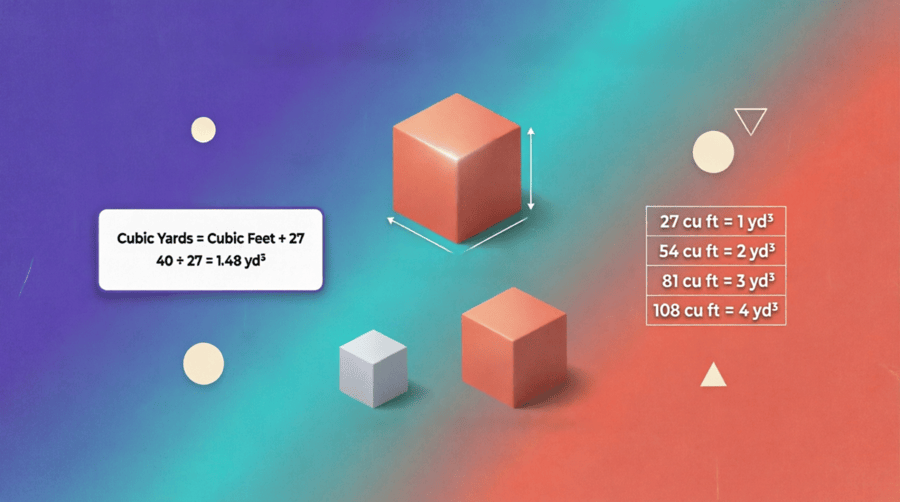
Converting cubic feet to cubic yards comes down to one number: 27. Since a cubic yard contains exactly 27 cubic feet, you divide your cubic foot total by 27 to get cubic yards.
Cubic yards = cubic feet ÷ 27
For example, 40 cubic feet works out to:
40 ÷ 27 = 1.48 cubic yards
This conversion applies to any material measured by volume: mulch, soil, gravel, sand, concrete, and topsoil all use the same math. What changes from material to material is weight and density, not the volume conversion itself. If you’re pricing a delivery, our Cubic Yard Calculator will run these numbers for you directly from your measurements.
Why 1 Cubic Yard Equals 27 Cubic Feet
A cubic foot is the volume inside a cube measuring 1 foot on every side (1 ft × 1 ft × 1 ft). A cubic yard is the volume inside a cube measuring 1 yard on every side. Since 1 yard equals 3 feet, that same cube can be written as 3 ft × 3 ft × 3 ft.
Multiply the three dimensions:
3 × 3 × 3 = 27 cubic feet
That’s the entire reason for the 27. Because volume has three dimensions, converting from a yard to a foot doesn’t multiply by 3, it multiplies by 3 three times. This is the detail that trips people up most often: 1 yard = 3 feet (a length), but 1 cubic yard = 27 cubic feet (a volume). Confusing the two leads directly to ordering the wrong amount of material.
Cubic Feet to Cubic Yards Formula
Cubic yards = cubic feet ÷ 27
Take your volume in cubic feet and divide by 27. If the material is sold in whole cubic yards, round up to make sure you don’t come up short on-site.
Example: You have 81 cubic feet of gravel.
81 ÷ 27 = 3 cubic yards
For quantities that don’t divide evenly, keep a few decimal places and round the final answer to whatever precision your supplier uses.
Common Conversions
| Cubic Feet | Cubic Yards |
|---|---|
| 1 | 0.037 |
| 3 | 0.111 |
| 10 | 0.370 |
| 20 | 0.741 |
| 27 | 1.000 |
| 40 | 1.481 |
| 50 | 1.852 |
| 75 | 2.778 |
| 100 | 3.704 |
| 135 | 5.000 |
Values are rounded to three decimal places. For exact figures, divide by 27 and round only the final result, not the numbers along the way.
Cubic Yards to Cubic Feet (Reverse Conversion)
Going the other direction, multiply instead of divide:
Cubic feet = cubic yards × 27
| Cubic Yards | Cubic Feet |
|---|---|
| 1 | 27 |
| 2 | 54 |
| 3 | 81 |
| 5 | 135 |
So if a supplier quotes you 3 cubic yards of material, that’s the same volume as 81 cubic feet, whether it’s soil, sand, or crushed stone.
How to Calculate Cubic Feet From Measurements
If you’re starting from a length, width, and height rather than a known volume, calculate cubic feet first:
Cubic feet = length × width × height
All three measurements need to be in feet before you multiply.
Example: A storage bed measures 8 feet long, 5 feet wide, and 3 feet deep.
8 × 5 × 3 = 120 cubic feet
To convert that to cubic yards: 120 ÷ 27 = 4.44 cubic yards.
If your measurements are in inches, either convert each one to feet first (divide by 12), or use the inch-based version of the formula:
Cubic feet = (length × width × height) ÷ 1,728
That 1,728 comes from 12 × 12 × 12, the number of cubic inches in one cubic foot.
Square Feet to Cubic Yards: Why You Need the Depth
Square feet measure area. Cubic yards measure volume. You cannot convert one directly into the other, because area alone doesn’t tell you how thick a layer of material you’re placing. A 200-square-foot patio covered 1 inch deep needs far less material than the same patio covered 6 inches deep.
Once you know the depth, the formula is:
Cubic yards = (square feet × depth in inches) ÷ 324
The 324 comes from multiplying the 27 cubic feet in a cubic yard by the 12 inches in a foot (27 × 12 = 324).
Example: You need to cover 100 square feet at different depths.
| Depth | Calculation | Cubic Yards Needed |
|---|---|---|
| 1 inch | 100 × 1 ÷ 324 | 0.31 |
| 2 inches | 100 × 2 ÷ 324 | 0.62 |
| 3 inches | 100 × 3 ÷ 324 | 0.93 |
| 4 inches | 100 × 4 ÷ 324 | 1.23 |
| 6 inches | 100 × 6 ÷ 324 | 1.85 |
For mulch beds, a 2 to 3 inch depth is typical. For a gravel base under a patio, 4 inches or more is common. Check your project’s specific requirements before ordering, since the depth is doing most of the work in this calculation.
If you’re planning a landscaping or driveway job, the Gravel Calculator handles the area-to-volume math for you and adds tonnage and cost estimates on top.
How Many Square Feet Does One Cubic Yard Cover?
There’s no single answer to this, because coverage depends entirely on how deep you spread the material. One cubic yard spread thin covers a lot more ground than the same cubic yard spread thick.
| Depth | Coverage From 1 Cubic Yard |
|---|---|
| 1 inch | 324 sq ft |
| 2 inches | 162 sq ft |
| 3 inches | 108 sq ft |
| 4 inches | 81 sq ft |
| 6 inches | 54 sq ft |
| 8 inches | 40.5 sq ft |
| 12 inches | 27 sq ft |
These are volume-based figures. On an actual job, compaction, an uneven grade, and waste during spreading can all push your real material need higher than the math suggests. For a closer look at how this coverage math works in practice, see How Many Square Feet Are in a Cubic Yard.
Feet, Square Feet, Cubic Feet, and Cubic Yards: How They Relate
These terms get mixed up constantly because they all sound like they’re measuring “size.” They’re not measuring the same thing.
| Unit | Measures | Key Relationship |
|---|---|---|
| Foot | Length | 1 yard = 3 feet |
| Square foot | Area | 1 square yard = 9 square feet |
| Cubic foot | Volume | 1 cubic yard = 27 cubic feet |
Saying a space is “100 square feet” tells you nothing about how many cubic yards of material it needs until you also know the depth. Keeping length, area, and volume mentally separate is the single most useful habit for avoiding ordering mistakes.
Common Mistakes to Avoid
Treating 1 yard and 1 cubic yard as the same thing. A yard is a length (3 feet). A cubic yard is a volume (27 cubic feet). They’re related but not interchangeable.
Forgetting the depth when converting square feet. Square footage alone never converts to cubic yards. You always need a third dimension.
Mixing units mid-calculation. If any measurement is in inches while the rest are in feet, convert everything to the same unit before multiplying, or use the inch-adjusted formula (÷ 1,728 or ÷ 324).
Assuming weight is fixed. A cubic yard is always 27 cubic feet, but a cubic yard of dry sand weighs far more than a cubic yard of mulch. Volume conversions don’t tell you weight. See How Much Does a Yard of Gravel Weigh for typical weight ranges by material.
Not rounding up for bagged material. If a cubic yard doesn’t divide evenly into your bag size, round up. Half a bag isn’t something you can buy.
Worked Example: Bags per Cubic Yard
A common practical question: how many 2 cubic foot bags of mulch equal one cubic yard?
27 ÷ 2 = 13.5 bags
Since you can’t buy half a bag, 14 bags gives you 28 cubic feet of stated volume, slightly more than the 27 you need. This is a volume comparison only. Actual coverage can still differ from the math because of settling and how evenly the material is spread once it’s out of the bag.
What Is 1 Cubic Yard of Soil?
One cubic yard of soil is a volume, equal to 27 cubic feet, nothing more. It is not a fixed weight. Soil density varies with composition and moisture content, so two cubic yards of soil from different suppliers can weigh noticeably different amounts. The same is true for mulch, gravel, and sand: the volume conversion is fixed, but the weight is not. If you’re budgeting a delivery, How Much Does a Yard of Dirt Cost breaks down typical pricing by soil type.
Frequently Asked Questions
Is 27 cubic feet equal to 1 cubic yard? Yes. A cubic yard is a 3 ft × 3 ft × 3 ft cube, and 3 × 3 × 3 = 27 cubic feet.
How do you calculate cubic feet to yards? Divide the cubic foot value by 27. For example, 54 ÷ 27 = 2 cubic yards.
Is 3 cubic feet equal to 1 cubic yard? No. Since 1 cubic yard equals 27 cubic feet, 3 cubic feet is only 3 ÷ 27 = 0.111 cubic yards.
How many feet is 1 yard? 3 feet. Note that this is a length, separate from a cubic yard, which measures volume.
How big is 1 cubic yard in feet? It’s a cube measuring 3 feet long, 3 feet wide, and 3 feet high, for a total of 27 cubic feet.
How do I convert cubic yards to cubic feet? Multiply by 27. For example, 4 cubic yards × 27 = 108 cubic feet.
How do you calculate cubic feet from dimensions? Multiply length × width × height, with all three measured in feet. A 10 ft × 4 ft × 2 ft space equals 80 cubic feet.
How much is 5 cubic yards in feet? 5 cubic yards equals 135 cubic feet (5 × 27). If you’re asking about a cube’s side length rather than total volume, note that cubic yards measure volume, not a linear distance, so there’s no single “feet” answer for that framing.
Is 1 yard equal to 1 cubic yard? No. One yard measures length (3 feet). One cubic yard measures volume (27 cubic feet).
What is 40 cubic feet in cubic yards? 40 ÷ 27 = 1.48 cubic yards.
Why is 1 cubic yard 27 cubic feet? Because a yard equals 3 feet in each of the three dimensions, and 3 × 3 × 3 = 27.
What is 1 cubic yard of soil? 27 cubic feet of soil. Its weight isn’t fixed since it depends on soil type, density, and moisture.
How many cubic feet are in 2 cubic yards? 2 × 27 = 54 cubic feet.
Final Takeaway
The core conversion never changes:
Cubic yards = cubic feet ÷ 27 Cubic feet = cubic yards × 27
Keep the distinction between length, area, and volume clear (1 yard = 3 feet, but 1 cubic yard = 27 cubic feet), and the rest of these calculations become routine. If you’re converting square footage for mulch, soil, or gravel, remember that depth is the missing piece: cubic yards = (square feet × depth in inches) ÷ 324. When you’re ready to turn these numbers into an actual order, the Cubic Yard Calculator and Gravel Calculator will do the arithmetic for you and estimate the cost at the same time.
2 thoughts on “Cubic Feet to Cubic Yards: Conversion Formula, Chart, and Square Footage Guide”