
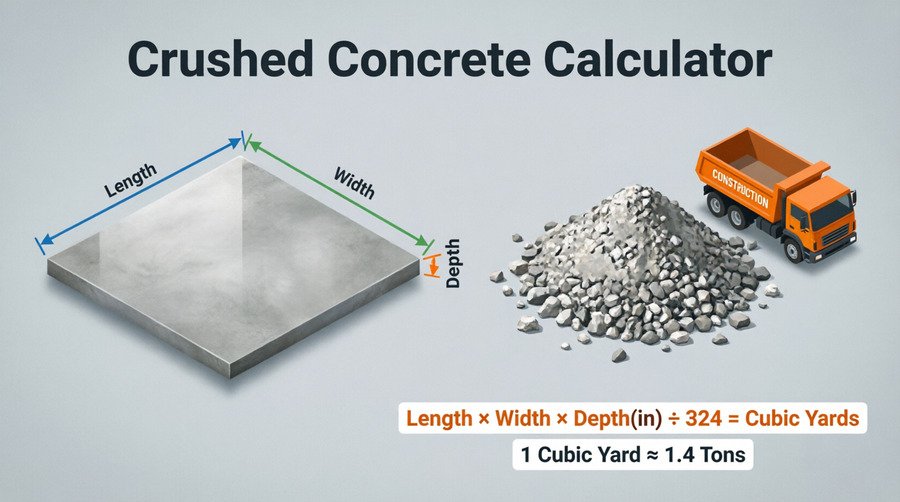
Whether you’re building a driveway or a base layer, a crushed concrete calculator is the best way to figure out exactly how much material you need without the guesswork. The standard formula is straightforward: multiply your length (in feet) by your width (in feet) by your depth (in inches), and then divide that number by 324. The result gives you the total cubic yards.
For instance, if you’re working on a 10 ft × 20 ft area and need it 4 inches deep, the math looks like this:
200 × 4 ÷ 324 = 2.47 cubic yards.
Since most suppliers sell crushed concrete by the ton rather than the yard, you’ll also need to convert volume to weight. Industry standards for loose crushed concrete typically range from 1.2 to 1.5 tons per cubic yard. For the examples in this guide, we’ll use 1.4 tons per cubic yard as a baseline, but always defer to your specific supplier’s density numbers. Using that 1.4 baseline, our 2.47 cubic yard example weighs roughly 3.5 tons.
Below, you’ll find the exact steps, conversion tables, and real-world examples to help you estimate yards, tons, coverage, and total material costs for your driveway, walkway, parking pad, or base layer.
Quick Answers
| Question | Short Answer |
|---|---|
| Formula for cubic yards | Length (ft) × Width (ft) × Depth (in) ÷ 324 |
| Typical weight | 1.2 to 1.5 tons per cubic yard (varies by supplier) |
| Coverage of 1 cubic yard at 4 in | 81 sq ft |
| Coverage of 1 ton at 4 in (at 1.4 t/yd³) | ~58 sq ft |
| Extra material for compaction/waste | 10% to 20% (job-dependent) |
| Typical yard price | Roughly $9 to $25 per ton (before delivery) |
How to Calculate How Much Crushed Concrete You Need
- Measure length and width in feet. If your project area is irregular, break it down into simple rectangles, triangles, or circles, calculate each section, and add them together.
- Determine your finished depth in inches. Always use the average depth of the area, not just the deepest or shallowest point.
- Calculate the cubic yards. Use the formula: Length × Width × Depth (in) ÷ 324.
- Add a waste allowance. Multiply your total by 1.10 to 1.20 to account for compaction, uneven subgrades, and handling loss.
- Convert to tons (if buying by weight). Multiply your final cubic yards by your supplier’s specific tons-per-cubic-yard rate.
Pro Tip: The number 324 is derived from 27 cubic feet (in a cubic yard) multiplied by 12 inches (in a foot). If you prefer measuring depth in feet, simply use: Length × Width × Depth (ft) ÷ 27. (For example, 6 inches becomes 0.5 ft).
Crushed Concrete Calculator Formulas
| What You Need | Formula |
|---|---|
| Cubic yards | L (ft) × W (ft) × D (in) ÷ 324 |
| Tons | Cubic yards × tons per cubic yard |
| Cubic yards from tons | Tons ÷ tons per cubic yard |
| Coverage of a given volume | Cubic yards × 324 ÷ Depth (in) |
| Order quantity | Calculated yards × (1 + allowance) |
| Material cost | Tons × price per ton (or yards × price per yard) |
Note: If your supplier provides density in pounds per cubic yard, calculate short tons like this: (cubic yards × density) ÷ 2,000. (A U.S. short ton is exactly 2,000 pounds).
Allowance and Compaction: Why You Should Order More Than the Math Says
The 324 formula calculates the geometric volume of a perfectly uniform, uncompacted layer. Real-world jobsites are rarely perfect, and you will almost always need more material for two main reasons:
- Compaction: Crushed concrete is delivered loose. When your target depth is the finished, compacted depth, you have to start with more loose material to achieve it.
- Site Conditions: Uneven subgrades, spillage, and shaping during grading eat up extra material.
Most contractors plan for a 10% to 20% overage. This isn’t a strict code requirement, but rather a practical planning habit. Soft, uneven ground or strict compaction specs push you toward the 20% end, while smooth, well-prepared subgrades might only need 10%. Always ask your supplier what they recommend for their specific product.
Coverage by Depth
One cubic yard covers different square footages depending on how thick you lay it. These numbers come from dividing 324 by the depth in inches.
| Layer Depth | Coverage per Cubic Yard |
|---|---|
| 2 inches | 162 sq ft |
| 3 inches | 108 sq ft |
| 4 inches | 81 sq ft |
| 6 inches | 54 sq ft |
| 8 inches | 40.5 sq ft |
| 12 inches | 27 sq ft |
How Much Will 1 Ton of Crushed Concrete Cover?
Coverage per ton hinges entirely on density. Assuming a baseline of 1.4 tons per cubic yard, one ton equals about 0.71 cubic yards (or 19.3 cubic feet). That gives you roughly:
| Depth | Coverage per Ton (at 1.4 t/yd³) |
|---|---|
| 2 inches | ~116 sq ft |
| 3 inches | ~77 sq ft |
| 4 inches | ~58 sq ft |
| 6 inches | ~39 sq ft |
Keep in mind: a denser product covers less area per ton, while a lighter, fluffier product covers more.
How Many Tons Are in a Cubic Yard of Crushed Concrete?
There is no single magic number here. A cubic yard measures volume, while a ton measures weight. The weight per cubic yard fluctuates based on particle size, fines content, moisture levels, and how tightly the pile is packed. Suppliers generally quote between 1.2 and 1.5 tons per cubic yard for loose, delivered material. For context, one supplier publishes 1.3 tons per cubic yard for a specific 1-inch by 3/4-inch recycled concrete product, proving how product-specific this metric is.
Also, wet material weighs more. Rain-soaked stockpiles can easily add several hundred pounds per cubic yard.
| Volume | At 1.2 t/yd³ | At 1.4 t/yd³ | At 1.5 t/yd³ |
|---|---|---|---|
| 1 cubic yard | 1.2 tons | 1.4 tons | 1.5 tons |
| 3 cubic yards | 3.6 tons | 4.2 tons | 4.5 tons |
| 5 cubic yards | 6.0 tons | 7.0 tons | 7.5 tons |
| 10 cubic yards | 12 tons | 14 tons | 15 tons |
| 20 cubic yards | 24 tons | 28 tons | 30 tons |
How Many Yards Is 1 Ton of Crushed Concrete?
Simply divide 1 by your supplier’s tons-per-cubic-yard rate. At 1.2 t/yd³, it’s 0.83 yd³. At 1.3, it’s 0.77 yd³. At 1.4, it’s 0.71 yd³. At 1.5, it’s 0.67 yd³.
How Much Do 3 Cubic Yards of Crushed Concrete Weigh?
Roughly 3.6 to 4.5 tons (or 7,200 to 9,000 pounds), depending on the exact product. Using our 1.4 tons per cubic yard baseline, 3 cubic yards weighs 4.2 tons (8,400 lbs).
How Many Yards Is 20 Tons?
Twenty tons translates to about 13.3 yd³ (at 1.5 t/yd³), 14.3 yd³ (at 1.4), or 16.7 yd³ (at 1.2). Ultimately, the scale tickets from your supplier are the final word.
Quick Reference: Cubic Yards by Area and Depth
Note: These volumes are purely geometric (before adding your waste allowance). The last column converts the 4-inch result to tons using the 1.4 t/yd³ assumption.
| Area | 2 in | 3 in | 4 in | 6 in | Tons at 4 in |
|---|---|---|---|---|---|
| 100 sq ft | 0.62 yd³ | 0.93 yd³ | 1.23 yd³ | 1.85 yd³ | 1.7 |
| 200 sq ft | 1.23 yd³ | 1.85 yd³ | 2.47 yd³ | 3.70 yd³ | 3.5 |
| 500 sq ft | 3.09 yd³ | 4.63 yd³ | 6.17 yd³ | 9.26 yd³ | 8.6 |
| 1,000 sq ft | 6.17 yd³ | 9.26 yd³ | 12.35 yd³ | 18.52 yd³ | 17.3 |
Crushed Concrete Calculator for a Driveway
The math above tells you how much material fits in a space, but it doesn’t dictate how thick your base should be. Base depth depends on soil strength, drainage, local climate, and the vehicle loads the driveway will handle. Many residential aggregate driveways use a properly prepared base in the range of 4 to 6 inches, with more over soft or wet soil. Always confirm with a local contractor. Also, compact the material in lifts (layers) rather than all at once, matching your equipment’s capability.
The three examples below use the 1.4 t/yd³ assumption and a 15% compaction allowance.
| Example Dimensions | Area | Depth | Geometric Volume | With 15% Allowance | Approx. Tons (with allowance) |
|---|---|---|---|---|---|
| 10 ft × 20 ft | 200 sq ft | 4 in | 2.47 yd³ | 2.84 yd³ | 4.0 tons |
| 20 ft × 30 ft | 600 sq ft | 4 in | 7.41 yd³ | 8.52 yd³ | 11.9 tons |
| 12 ft × 50 ft | 600 sq ft | 6 in | 11.11 yd³ | 12.78 yd³ | 17.9 tons |
Working the middle row: 20 × 30 = 600 sq ft. 600 × 4 ÷ 324 = 7.41 yd³. 7.41 × 1.15 (allowance) = 8.52 yd³. 8.52 × 1.4 = 11.9 tons.
Measuring an Irregular Driveway
Break the odd shape into simple geometric pieces, calculate each, and sum them up:
- Rectangle: Length × Width
- Triangle: (Base × Height) ÷ 2
- Circle: π × Radius²
Once you have the total square footage, multiply by your depth in inches and divide by 324. If the depth varies across the site, calculate those sections separately for accuracy.
21AA Crushed Concrete Calculator
“21AA” is a specific Michigan Department of Transportation (MDOT) aggregate designation for dense-graded aggregate under Section 902 of its standard specs. It is not a universal name for all crushed concrete. In Michigan, suppliers frequently produce crushed concrete to meet the 21AA gradation, though the same specification can also be met with natural materials like limestone.
The math for calculating 21AA is identical to any other aggregate. For a 20 ft × 30 ft area at 4 inches deep: 20 × 30 × 4 ÷ 324 = 7.41 cubic yards. For tonnage, use the specific tons-per-cubic-yard rate your supplier publishes for their 21AA product, not a generic figure.
A quick note for engineered or public work: An MDOT manual on recycled concrete notes performance issues on early Michigan projects, such as higher water absorption and lower specific gravity compared to natural stone. Consequently, MDOT limits some uses of crushed concrete in state pavement layers. Residential driveways and private bases just follow your local supplier’s advice, but any project governed by strict specs must comply with them.
Crushed Concrete Cost per Ton and per Yard
Prices fluctuate based on region, product quality, order quantity, and haul distance. Recently published rates often fall between $9 and $25 per ton for pickup at a recycling yard, with cleaner, rebar-free products commanding a premium. Delivery fees are almost always extra.
Converting at our 1.4 tons per cubic yard baseline, that translates to roughly $12 to $35 per cubic yard for the material alone. Treat these as rough ranges, not firm quotes.
| Item | Formula | Example |
|---|---|---|
| Price per ton to price per yard | Price per ton × tons per yd³ | $16 × 1.4 = $22.40 per yd³ |
| Cost of a 20-ton order | 20 × price per ton | At $9–$25/ton: $180 to $500 |
| Project material cost | Tons ordered × price per ton | 17.9 tons × $16 ≈ $286 |
| Estimated total | Material + delivery + tax/fees | Get exact quote from supplier |
(The 17.9 tons in the table comes from the 12 ft × 50 ft driveway example above).
How Much Is a Dump Truck Load?
There is no universal “dump truck load” price. Many residential deliveries range from 10 to 15 tons, but legal payload limits and truck sizes vary wildly. Always ask your supplier:
- How many tons or yards the truck actually carries.
- Whether the quoted price is by weight or volume.
- Whether delivery, fuel surcharges, taxes, and minimum-load fees are already included.
Crushed Concrete vs. Gravel vs. Limestone
| Factor | Crushed Concrete | Natural Gravel | Limestone |
|---|---|---|---|
| Source | Recycled concrete | Naturally occurring | Quarried |
| Price | Often lower where local recycling is available | Depends on source and grade | Depends on grade and quarry |
| Particle Shape | Angular, interlocks well when compacted | Varies; often rounded | Angular when crushed |
| Notes | Quality varies; check for debris/rebar | Rounded types compact poorly | Gradation is the most critical factor |
- Is crushed concrete cheaper than gravel? Often, yes, but not everywhere. Always compare delivered prices for products with the same gradation, and remember that density differences affect how many tons you actually need.
- Which is better, crushed concrete or limestone? Neither wins universally. The Federal Highway Administration (FHWA) considers properly processed and tested reclaimed concrete highly suitable for granular base use. However, they also warn that unsuitable recycled material can cause drainage issues. Compare actual product specs and local availability.
- Pea gravel vs. crushed gravel: Pea gravel is smooth and rounded, meaning it shifts under load. It is not a viable substitute for a compacted structural base. Angular crushed aggregate locks together far better.
Does Crushed Concrete Harden, and How Well Does It Drain?
Hardening: Crushed concrete compacts into a very firm surface. Because it contains leftover unhydrated cement, the material can actually stiffen a base over time when exposed to moisture. However, it will not turn into a solid, monolithic slab, and you shouldn’t expect it to.
Drainage: Drainage performance depends entirely on gradation and fines content. A dense-graded product with plenty of fines (like 21AA) packs tightly and drains relatively slowly. Coarser, open-graded material drains much faster. The FHWA has also noted that some recycled concrete can leach mineral deposits that clog underdrains over time, so avoid using it in or around underdrains unless the specific product is approved for that use. Additionally, alkaline runoff from fresh crushed concrete can impact nearby streams or planted areas, so check local environmental regulations if applicable.
Bags, Wheelbarrows, and Pickup Loads
- 50 lb bags per cubic yard: Divide 27 cubic feet by the bag’s stated volume. If a bag is labeled as 0.5 cubic feet, you need 54 bags per cubic yard. Keep in mind, bagged material is vastly more expensive per ton than bulk. (For context, forty 50-lb bags equal just one ton).
- 80 lb concrete bags: A standard 80 lb bag of ready-mix yields about 0.6 cubic feet. Therefore, one cubic foot of new concrete requires roughly 1.7 bags (round up to 2 in practice). This applies to mixing new concrete, not to laying crushed concrete.
- Wheelbarrows: Three cubic yards equals 81 cubic feet. A standard contractor wheelbarrow rated for 6 cubic feet would take about 14 full loads. However, crushed concrete is heavy: at 1.4 tons per yard, a single cubic foot weighs about 104 lbs. A full 6-cubic-foot barrow would weigh over 600 lbs, which is unmanageable for most. Realistic loads of 2 to 3 cubic feet mean you’re looking at roughly 27 to 40 trips.
- Pickup trucks: Always check your truck’s payload sticker. A standard half-ton pickup with a 1,500 lb payload can only safely carry about half a cubic yard of crushed concrete.
Common Mistakes to Avoid
- Mixing units: The 324 divisor strictly requires feet for length/width and inches for depth.
- Treating yards and tons as interchangeable: Always convert using your supplier’s specific density rate.
- Skipping the compaction allowance: Loose volume shrinks significantly once compacted.
- Using extreme depths: Always calculate using the average depth, not the highest or lowest point.
- Comparing apples to oranges: Ensure you convert per-ton and per-yard quotes to the same unit before comparing prices.
- Assuming all “crushed concrete” is identical: Gradation, fines content, and contamination levels vary wildly between suppliers.
- Treating quantity as design: This calculator estimates volume; it does not determine required base depth, drainage needs, or load capacity.
Frequently Asked Questions
What is “poor man’s concrete”?
It’s an informal, regional term most often used to describe a compacted crushed concrete or similar low-cost aggregate surface. However, the meaning varies. Always select your material and thickness based on actual site loads and conditions, not just a nickname.
What is the cheapest driveway option?
Compacted aggregate like crushed concrete or standard gravel is typically among the lowest-cost options. However, the absolute cheapest choice depends on local material availability, delivery distances, and how much base preparation your specific site requires.
How many cubic feet does a 50 lb bag of gravel cover?
Most 50 lb bags contain about 0.5 cubic feet of material, which covers roughly 3 square feet at a 2-inch depth. Always check the specific product label, as bag volumes differ.
How much is a 50 lb bag of gravel at Lowe’s?
Prices vary by specific product, store location, and market fluctuations. Check the current online listing or call your local store for the most accurate, up-to-date pricing.
Can I pour concrete directly on soil?
No. A proper concrete slab requires a well-prepared subgrade. This usually means compacted native soil topped with a granular base to ensure even support and proper drainage. Always follow local building codes and your project’s specific engineering requirements.
Bottom Line
To get your numbers right, calculate your volume using Length × Width × Depth (in) ÷ 324. Add 10% to 20% to that number for compaction and waste, then convert to tons using your supplier’s specific conversion rate (typically between 1.2 and 1.5 tons per cubic yard). Before you order, confirm the exact product specification, delivery quantity, and total price. Remember, proper grading, drainage, and compaction are just as critical to your project’s success as getting the quantity right. For more construction calculators and guides, browse TheCalcYard.
1 thought on “Crushed Concrete Calculator: Exactly How Many Yards and Tons You Need”