
Table of Contents
- Quick Answer: A Cord of Firewood Is 128 Cubic Feet
- What Is a Cord of Firewood?
- How to Calculate Cubic Feet of Firewood
- How to Calculate How Many Cords You Have
- How Many Cubic Feet Are in a Half Cord?
- How Many Cubic Feet Are in a Face Cord?
- Cord vs. Face Cord vs. Rick
- Firewood Cord Size Chart
- Stacked vs. Loose Firewood
- Stacked Volume vs. Solid Wood
- How Many Pieces of Firewood Are in a Cord?
- Can a Pickup Truck Hold a Cord of Firewood?
- Common Firewood Measurement Mistakes
- Firewood Cord Calculator
- Frequently Asked Questions
- The Takeaway
How Many Cubic Feet in a Cord of Firewood? (Quick Answer: 128 ft³)
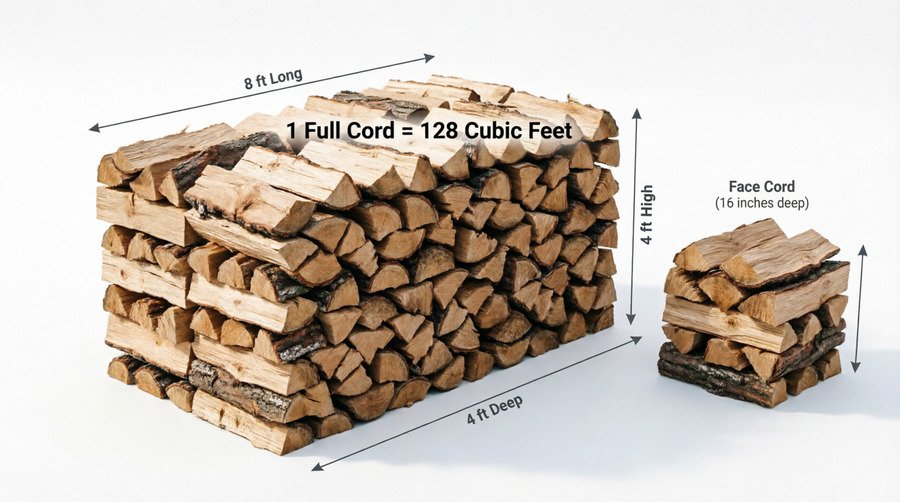
A standard cord of firewood contains exactly 128 cubic feet of neatly stacked wood. The classic, easiest-to-visualize example is a pile measuring 4 feet high, 4 feet deep, and 8 feet long:
4 ft × 4 ft × 8 ft = 128 ft³
Before you buy or measure, keep these three critical details in mind:
- It measures space, not solid wood. The 128 cubic feet includes the wood, the bark, and the air gaps between the pieces.
- The 4 × 4 × 8 shape is just an example. Any neatly arranged stack that totals 128 cubic feet qualifies as a cord, regardless of its exact dimensions.
- Terms like “face cord,” “rick,” and “truckload” are not standard legal units. You must know the exact piece length and stack dimensions to convert them into true cubic feet.
What Is a Cord of Firewood?
The “cord” is the official, legal unit for selling firewood in the United States. The National Institute of Standards and Technology (NIST) defines it in Handbook 130 as the amount of wood contained in a space of 128 cubic feet when the wood is “ranked and well stowed.”
NIST clarifies that “ranked and well stowed” means the pieces are placed in a line or row, touching and parallel to each other, and stacked compactly. This distinction matters because a tidy, tight stack and a pile dumped loosely from a truck might occupy the same physical space, but they hold vastly different amounts of actual wood.
Many state agriculture departments adopt NIST Handbook 130 for firewood sales. Under these model rules, firewood must be sold by the cord, a fraction of a cord, or by the cubic meter. Using ambiguous terms like “face cord,” “rack,” “pile,” or “truckload” in advertising is often prohibited. Since regulations vary, it is always wise to check your local state weights and measures office for specific rules in your area.
How to Calculate Cubic Feet of Firewood
Calculating the volume of stacked firewood is straightforward. Multiply the length, height, and depth, ensuring every measurement is in feet:
Cubic Feet = Length (ft) × Height (ft) × Depth (ft)
If you measured your stack in inches, convert each measurement to feet first: Feet = Inches ÷ 12 (Alternatively, multiply the three inch measurements together and divide by 1,728, which is the number of cubic inches in a cubic foot).
Example: A stack measures 96 inches long, 48 inches high, and 48 inches deep.
- 96 ÷ 12 = 8 ft
- 48 ÷ 12 = 4 ft
- 8 × 4 × 4 = 128 ft³
Pro Tip: Always measure the stack’s depth along the length of the individual pieces. If your logs are cut to 16 inches and stacked in a single row, your depth is 16 inches (or 1.333 feet).
How to Calculate How Many Cords You Have
To find out what fraction of a cord you have, divide the stack’s total volume in cubic feet by 128:
Cords = (Length × Height × Depth) ÷ 128
- Example 1 (One Full Cord): A stack is 8 ft long, 4 ft high, and 4 ft deep. 8 × 4 × 4 = 128 ft³ → 128 ÷ 128 = 1 cord
- Example 2 (An Irregular Stack): A stack is 10 ft long, 4 ft high, and 2 ft deep. 10 × 4 × 2 = 80 ft³ → 80 ÷ 128 = 0.625 cord (or 5/8 of a cord)
- Example 3 (Checking a Delivery): You ordered a full cord. The delivered stack measures 8 ft long, 3.5 ft high, and 4 ft deep. 8 × 3.5 × 4 = 112 ft³ → 112 ÷ 128 = 0.875 cord (You are 16 cubic feet short).
Measurement Tip: Measure the height at several points along the stack and use the average, as stacks often settle or slope. Only measure after the wood is stacked tightly, with pieces touching and parallel, as the legal standard requires.
How Many Cubic Feet Are in a Half Cord?
A half cord is exactly 64 cubic feet of stacked wood (128 ÷ 2 = 64).
A common configuration is 8 ft long, 4 ft high, and 2 ft deep: 8 × 4 × 2 = 64 ft³ → 64 ÷ 128 = 0.5 cord
However, a half cord does not have to be 2 feet deep. A stack that is 4 ft high, 4 ft deep, and 4 ft long also equals 64 ft³. Any neatly stacked arrangement totaling 64 cubic feet is a half cord. Other common fractions include:
- 1/8 cord: 16 ft³
- 1/4 cord: 32 ft³
- 2/3 cord: ~85.3 ft³
How Many Cubic Feet Are in a Face Cord?
A face cord does not have a single, fixed volume. Its size depends entirely on how long the individual pieces of wood are.
Typically, a face cord refers to a stack that is 4 feet high and 8 feet long, but only one piece deep. Therefore, the volume changes based on the cut length of the wood: Face Cord Volume = 4 ft × 8 ft × Piece Length (ft)
For 16-inch pieces:
- 16 ÷ 12 = 1.333 ft
- 4 × 8 × 1.333 = ~42.67 ft³
- 42.67 ÷ 128 = about 1/3 of a cord
This 16-inch scenario is the most common version of a face cord, which is where the “one-third of a cord” rule of thumb originates. However, this rule only applies to 16-inch pieces:
| Piece Length (Stack Depth) | Stacked Volume (4 ft × 8 ft face) | Fraction of a 128 ft³ Cord |
|---|---|---|
| 12 inches | 32 ft³ | 1/4 cord |
| 16 inches | ~42.67 ft³ | ~1/3 cord |
| 24 inches | 64 ft³ | 1/2 cord |
| 48 inches | 128 ft³ | 1 full cord |
State guidance, such as that from the Maine Forest Service, confirms this arithmetic: 24-inch pieces equal a 0.5 cord, and 16-inch pieces equal roughly a 0.33 cord.
How many face cords are in a cord? With 16-inch pieces, it takes three face cords to equal one full cord. With 24-inch pieces, it takes two. Always ask the seller for the exact piece length before comparing prices.
Cord vs. Face Cord vs. Rick
| Term | Typical Meaning | Calculable Volume | Important Caveat |
|---|---|---|---|
| Cord (Standard) | 128 ft³ of ranked, well-stowed wood | 128 ft³ | The only legal, standard unit. 4×4×8 ft is just one example shape. |
| Face Cord | A stack 4 ft high and 8 ft long, one piece deep | 4 × 8 × piece length (e.g., 42.67 ft³ for 16-in) | Not standardized. Volume depends entirely on piece length. |
| Rick | Informal, regional term; sometimes used for a face cord | Only calculable if exact stack dimensions are known | In some Midwestern areas, it means a face cord, but it has no universal legal definition. |
None of these informal terms have a single legal definition. In fact, the NIST model rule explicitly bars terms like “face cord” and “rick” from formal firewood sales. If a seller uses the word “rick,” demand the exact length, height, and depth of the stack, or ask for the quantity in cubic feet.
- Is 2 ricks of wood a cord? Only if the two ricks together total 128 cubic feet. If each rick is 64 ft³ (a 24-inch-deep stack), two make a cord. If each is a 16-inch face cord (~42.67 ft³), it takes three to make a cord.
- Is it better to buy a rick or a cord? Buying by the cord (or by a stated number of cubic feet) makes prices easier to compare and verify. If you must buy by another term, get the exact dimensions in writing and measure the stack upon delivery.
Firewood Cord Size Chart
Note: The dimensions below are common examples. Many other shape combinations can reach the same total volume.
| Quantity | Stacked Cubic Feet | Example Dimensions (L × H × D) |
|---|---|---|
| 1/8 cord | 16 ft³ | 4 ft long × 4 ft high × 1 ft deep |
| 1/4 cord | 32 ft³ | 8 ft long × 4 ft high × 1 ft deep (12-in pieces) |
| 1/3 cord | ~42.67 ft³ | 8 ft long × 4 ft high × 16 in deep |
| 1/2 cord | 64 ft³ | 8 ft long × 4 ft high × 2 ft deep |
| 2/3 cord | ~85.33 ft³ | 8 ft long × 4 ft high × 32 in deep |
| 1 cord | 128 ft³ | 8 ft long × 4 ft high × 4 ft deep |
| 2 cords | 256 ft³ | Two separate 8 × 4 × 4 ft stacks |
Stacked vs. Loose Firewood
The 128-cubic-foot definition strictly applies to wood that is ranked and well stowed. Wood dumped loosely into a truck bed or onto the ground leaves larger, irregular gaps. Consequently, the same amount of actual wood will fill a much larger space.
Because gap size depends on piece length, how the wood is split, crookedness, and how the load was dumped, there is no universal conversion for loose piles.
Some regions do define a loose measurement by law. For example, Maine has a “thrown cord” for bolts tossed loosely into a container. For bolts averaging 12 or 16 inches long, one loose cord is defined as the amount of wood, bark, and air in 180 cubic feet. For 24-inch bolts, it is 195 cubic feet. These figures are specific to Maine’s regulations and should not be applied elsewhere.
This also highlights why the term “loose cord” is risky for buyers: 180 cubic feet of container space is about 1.4 times the volume of a standard 128-cubic-foot stacked cord.
How many cubic feet are in a loose cord? It depends entirely on the local definition in use. Where a loose-cord rule exists, use that figure. Elsewhere, ask the seller to clarify what the quantity means, or insist on a stacked cubic-foot measurement.
Stacked Volume vs. Solid Wood
Because the 128 cubic feet includes air and bark, a cord holds far less than 128 cubic feet of solid timber.
The University of Wisconsin Extension provides average proportions for a standard cord: roughly 62% solid wood, 28% air, and 10% bark. This translates to approximately 79 cubic feet of solid wood. The Maine Forest Service estimates the solid-wood portion of a cord at about 80 to 90 cubic feet.
The exact figure fluctuates based on:
- Piece diameter and shape
- Straightness of the logs
- Amount of bark
- How tightly the stack was built
Treat these as estimates for typical firewood, not exact values for any specific stack.
How Many Pieces of Firewood Are in a Cord?
There is no standard piece count. Because a cord is defined by volume, the number of pieces depends entirely on log length, split size, diameter, and stacking tightness. A cord of small, thin splits will contain vastly more pieces than a cord of large rounds, even though both occupy exactly 128 cubic feet. If a seller quotes a piece count, ask what piece length and split size that estimate assumes.
Can a Pickup Truck Hold a Cord of Firewood?
A full cord almost never fits in a single truckload by volume.
For illustration, a full-size 8-foot truck bed is roughly 8 ft long and 4 ft wide between the wheel wells. If you stack the wood neatly 1.5 ft high, the math is:
- 8 × 4 × 1.5 = 48 ft³
- 48 ÷ 128 = 0.375 cord
This means that load is a little over a third of a cord if neatly stacked, and even less if thrown in loosely. A 16-inch face cord (~42.67 ft³) might fit by volume in a full-size long bed if stacked carefully.
Weight is a separate limiting factor. Seasoned hardwood is heavy, and wet or green wood is even heavier. Volume capacity is not the same as safe payload. Always check the payload rating on your truck’s door-jamb sticker or owner’s manual, and never load beyond it.
How much does a truckload of firewood cost? Prices vary widely by location, wood species, season, moisture content, delivery distance, and whether the wood is stacked for you. No single national figure is reliable. Ask local sellers for the price per cord or per cubic foot to make accurate comparisons.
Common Firewood Measurement Mistakes
- Confusing 4 × 4 × 8 with 4 × 4 × 4. (4×4×8 = 128 ft³, one full cord. 4×4×4 = 64 ft³, a half cord).
- Assuming a face cord is always one-third of a cord. It is only about one-third when the pieces are exactly 16 inches long. Twelve-inch pieces yield one-quarter, and 24-inch pieces yield one-half.
- Treating a “truckload” as a cord. A truckload is not a standard quantity. Bed size, loading height, and piece length drastically alter the volume.
- Mixing up stacked and loose wood. Loose wood takes up significantly more space for the same amount of actual firewood.
- Confusing cubic feet of stack with solid wood. Remember, the 128 cubic feet includes bark and air gaps.
- Ignoring piece length. This single factor decides the true volume of a face cord or rick.
- Converting a cord to weight without knowing the species and moisture. Weight varies drastically with both factors, making a single “weight per cord” figure unreliable.
Firewood Cord Calculator
A firewood cord calculator simply automates the math above: it multiplies length, height, and depth, then divides by 128. If you enter inches, a good calculator will convert them to feet first. For a stack of mixed lengths, add up the cubic feet of each section and divide the grand total by 128.
Keep in mind that a calculator only tells you volume. It cannot tell you how tightly the wood was stacked, how dry it is, or how long a given amount will last.
Frequently Asked Questions
Is a cord of wood 4 ft by 4 ft by 8 ft?
That is the classic, easiest-to-visualize example, and it equals 128 ft³. However, any neatly stacked arrangement that totals 128 ft³ is legally a cord.
Is a cord of wood 4 × 4 × 4?
No. That equals 64 ft³, which is exactly half a cord.
How many cubic feet are in a stacked cord of firewood?
Exactly 128 cubic feet, which includes the wood, the bark, and the air spaces between the pieces.
How long will 1/2 cord of firewood last?
There is no reliable answer based on volume alone. Burn time depends on the wood species, moisture content, appliance efficiency, piece size, airflow, outdoor temperature, your thermostat settings, and the heating system itself. The same applies to questions like “how long does 1 cu ft of firewood last?” or “how much firewood for 2 hours?” Any single figure would just be a guess.
What is the best type of firewood to burn?
It depends on your appliance and usage. Species differ in density, heat output, moisture, and smoke. The U.S. EPA advises burning only dry, split, well-seasoned wood for the best efficiency and lowest emissions.
What’s the worst firewood to burn?
For any species, wet or green wood is the biggest problem, as it burns poorly, produces excessive smoke, and contributes to creosote buildup. Never burn treated, painted, or pressure-treated wood, nor should you burn household trash.
How long should firewood sit before burning?
The EPA recommends seasoning wood for at least six months and burning it at under 20 percent moisture content. Seasoning time varies by species, climate, and how the wood was split and stored, so using a moisture meter is far more reliable than relying on a calendar.
Is firewood ruined if it gets wet?
Not necessarily. Surface moisture from rain usually dries out quickly if the wood is stacked off the ground with good airflow. However, wood that stays wet for long periods can rot or grow mold. The EPA advises storing wood outdoors, off the ground, with only the top covered, since covering the sides traps moisture.
How far from your house should you stack firewood?
No single universal distance is established. Always follow local fire codes and your homeowner’s insurance guidance. Additionally, firewood stored directly against a house can attract pests like termites or carpenter ants.
Will a face cord of firewood fit in a pickup truck?
Yes, a 16-inch face cord (~42.67 ft³) can often fit in a full-size long-bed pickup if stacked carefully, though you must always verify your truck’s specific payload weight limit first.
The Takeaway
A standard cord is 128 cubic feet of neatly stacked firewood, whether that stack measures 4 × 4 × 8 feet or any other shape with the same total volume. Terms like face cords, ricks, loose piles, and truckloads only translate into true cords once you know the exact dimensions and piece length. Multiply length, height, and depth in feet, then divide by 128. With this simple formula, you can verify any firewood delivery yourself and ensure you are getting exactly what you paid for.
2 thoughts on “How Many Cubic Feet Are in a Cord of Firewood?”