
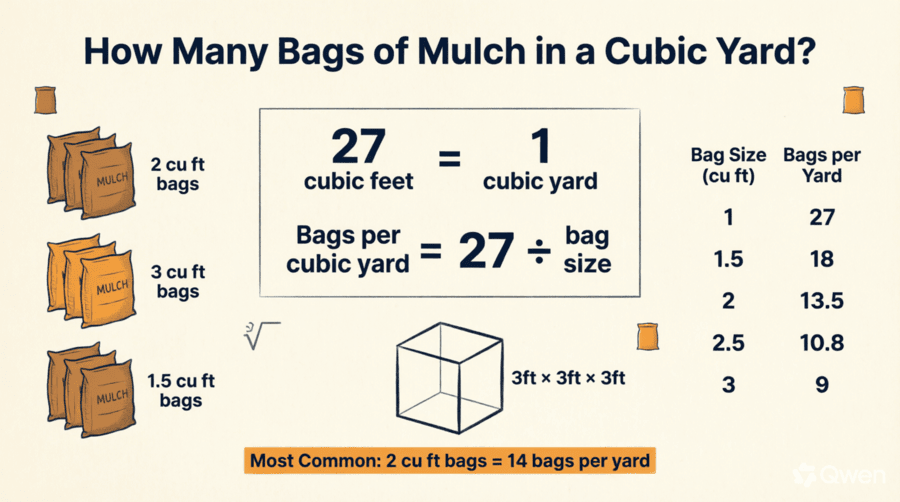
A cubic yard of mulch equals 27 cubic feet, so the number of bags you need depends entirely on the size printed on the bag. Here’s the quick math:
Bags per cubic yard = 27 ÷ cubic feet per bag
| Bag Size | Bags per Cubic Yard (exact) | Bags to Buy (rounded up) |
|---|---|---|
| 1 cu ft | 27 | 27 |
| 1.5 cu ft | 18 | 18 |
| 2 cu ft | 13.5 | 14 |
| 2.5 cu ft | 10.8 | 11 |
| 3 cu ft | 9 | 9 |
The most common bag size at home improvement stores is 2 cubic feet, which works out to 13.5 bags per cubic yard. Since stores don’t sell half bags, you’ll actually need to buy 14 to have a full cubic yard on hand.
Below, you’ll find the formula behind that chart, how to reverse it to find cubic yards per bag, how to figure out how much mulch a specific flower bed needs, and how bag volume relates to coverage area once you factor in depth.
The Formula, Step by Step
A cubic yard is a cube measuring 3 feet on every side:
3 ft × 3 ft × 3 ft = 27 cubic feet
Divide by 27. To find bags per cubic yard for any bag size:
Bags per cubic yard = 27 ÷ (cubic feet listed on the bag)
A few worked examples:
- 1.5-cu-ft bags: 27 ÷ 1.5 = 18 bags
- 2-cu-ft bags: 27 ÷ 2 = 13.5 bags
- 2.5-cu-ft bags: 27 ÷ 2.5 = 10.8 bags
- 3-cu-ft bags: 27 ÷ 3 = 9 bags
Whenever the result includes a fraction, round up. Rounding down leaves you short, and running out of mulch mid-project means a second trip to the store or a mismatched batch if the supplier is out of that product line.
A quick sanity check confirms the math: 18 bags of 1.5 cubic feet each gives you 18 × 1.5 = 27 cubic feet, exactly one cubic yard. Nine bags of 3 cubic feet each gives you 9 × 3 = 27 cubic feet too. Same total volume, just packaged differently.
How Many Bags of Mulch in a Cubic Yard? Understanding Bag Size
Flip the formula to go the other direction:
Cubic yards per bag = cubic feet per bag ÷ 27
- A 2-cu-ft bag holds 2 ÷ 27 ≈ 0.074 cubic yards
- A 3-cu-ft bag holds 3 ÷ 27 ≈ 0.111 cubic yards
- A 1.5-cu-ft bag holds 1.5 ÷ 27 ≈ 0.056 cubic yards
This version of the formula is useful when a supplier quotes bulk mulch by the cubic yard, but you already have a stack of bags at home and want to know how much bulk material they’re worth.
Worked Example: How Many Cubic Yards Are in 20 Bags?
Say you bought 20 bags of 2-cu-ft mulch. Total volume first:
20 × 2 = 40 cubic feet
Then convert to cubic yards:
40 ÷ 27 ≈ 1.48 cubic yards
So 20 bags of standard 2-cu-ft mulch gets you just under 1.5 cubic yards. Here’s how that changes with other bag sizes:
| Bag Size | 20 Bags = Total Cu Ft | ≈ Cubic Yards |
|---|---|---|
| 1.5 cu ft | 30 cu ft | 1.11 yd³ |
| 2 cu ft | 40 cu ft | 1.48 yd³ |
| 2.5 cu ft | 50 cu ft | 1.85 yd³ |
| 3 cu ft | 60 cu ft | 2.22 yd³ |
That number tells you volume, not how much ground it covers. For that, you need one more variable: depth.
How Much Ground Will Your Mulch Cover?
Volume and coverage area are related but not the same thing. The formula that connects them is:
Coverage area (sq ft) = volume (cu ft) ÷ depth (ft)
Depth has to be in feet, so convert inches first by dividing by 12. Using the 20-bag example above (40 cubic feet of 2-cu-ft mulch):
| Mulch Depth | Coverage from 40 Cu Ft |
|---|---|
| 2 inches | 240 sq ft |
| 3 inches | 160 sq ft |
| 4 inches | 120 sq ft |
Here’s the 3-inch calculation shown out: 3 ÷ 12 = 0.25 ft, then 40 ÷ 0.25 = 160 sq ft.
The same logic applies to a full cubic yard (27 cubic feet) on its own:
| Mulch Depth | Coverage from 1 Cubic Yard |
|---|---|
| 2 inches | 162 sq ft |
| 3 inches | 108 sq ft |
| 4 inches | 81 sq ft |
Notice that doubling the depth from 2 inches to 4 inches roughly cuts the coverage area in half. This is why a claim like “one cubic yard covers 100 square feet” is meaningless without stating the depth it assumes. For a broader breakdown of how cubic yards translate to square footage across different materials, see How Many Square Feet Are in a Cubic Yard.
How to Calculate the Mulch You Need for a Specific Bed
Work forward from your actual measurements instead of guessing at bag counts.
Step 1: Find the volume in cubic feet
Cubic feet needed = length (ft) × width (ft) × depth (ft)
Step 2: Convert to cubic yards
Cubic yards = cubic feet ÷ 27
Example: A flower bed measuring 20 feet long by 10 feet wide, mulched 3 inches deep.
Convert depth to feet: 3 ÷ 12 = 0.25 ft
Volume: 20 × 10 × 0.25 = 50 cubic feet
Convert to cubic yards: 50 ÷ 27 ≈ 1.85 cubic yards
If you’re buying 2-cu-ft bags: 50 ÷ 2 = 25 bags
So that bed needs roughly 1.85 cubic yards of bulk mulch, or 25 bags at 2 cubic feet each. If your beds are irregularly shaped, break the space into rectangles or simple sections, calculate each one separately, then add the volumes together before converting to yards or bags.
For dimensions you’d rather not calculate by hand, plug your length, width, and depth into the free Cubic Yard Calculator, then match that volume against the bag sizes carried at your local store.
Bags or Bulk: Which Is the Better Buy?
There’s no universal answer. It depends on quantity, access, and price at the time you’re buying.
Bags tend to make sense when:
- The project needs less than roughly 2 to 3 cubic yards
- You don’t have a truck or trailer to haul bulk material
- Storage space is limited, and you’d rather use what you buy right away
- You’re applying mulch in stages over several weekends
Bulk delivery tends to make sense when:
- You need several cubic yards or more
- A local supplier delivers to your area
- The per-yard bulk price beats the per-bag price once you do the math
- You’d rather not carry and empty dozens of individual bags
Don’t assume bulk is automatically cheaper. Bag prices, bulk prices, and delivery fees all vary by region, mulch type, and supplier. Compare the total delivered cost against the total cost of enough bags to match, not just the sticker price of one bag versus one advertised cubic yard. If you’re also pricing bulk soil or fill for the same project, How Much Does a Yard of Dirt Cost walks through typical bulk delivery pricing that follows the same logic.
Common Mistakes to Avoid
Assuming all mulch bags are the same size. Bag volume varies by brand and product line, commonly 1, 1.5, 2, 2.5, and 3 cubic feet. Check the cubic-foot number printed on the bag before doing any math.
Confusing volume with area. Cubic yards and cubic feet measure volume. Square feet measure area. You can’t convert one to the other without knowing depth.
Forgetting depth changes coverage. The same volume of mulch covers less ground at 4 inches deep than it does at 2 inches deep. Always decide on a depth before estimating coverage.
Round up instead of down. If the math says 13.5 or 10.8 bags, round up to 14 or 11. Rounding down leaves you short by a partial bag’s worth of material.
Measuring the bed incorrectly. No formula fixes a bad measurement. Measure actual length and width, and split oddly shaped beds into smaller sections you can measure accurately.
Treating the estimate as exact. Bag volume is a labeled figure, and mulch settles and varies slightly by texture and moisture. Use these calculations as a reliable planning estimate, not a guarantee down to the cubic inch.
Quick Reference: Bags per Cubic Yard by Size
| Bag Size | Exact Bags per Yard | Bags to Buy |
|---|---|---|
| 1 cu ft | 27 | 27 |
| 1.5 cu ft | 18 | 18 |
| 2 cu ft | 13.5 | 14 |
| 2.5 cu ft | 10.8 | 11 |
| 3 cu ft | 9 | 9 |
FAQ
How many mulch bags are in a cubic yard? It depends on bag size. A cubic yard is 27 cubic feet, so you need 18 bags of 1.5-cu-ft mulch, 13.5 (round up to 14) bags of 2-cu-ft mulch, 10.8 (round up to 11) bags of 2.5-cu-ft mulch, or 9 bags of 3-cu-ft mulch.
How many cubic yards are in a bag of mulch? Divide the bag’s cubic-foot capacity by 27. A 2-cu-ft bag holds about 0.074 cubic yards, and a 3-cu-ft bag holds about 0.111 cubic yards.
How big is 2 cubic feet of mulch? It’s twice the volume of a cubic foot (1 ft × 1 ft × 1 ft), or 3,456 cubic feet. The bag itself may not be shaped like a neat 2 ft × 1 ft × 1 ft block since bags are flexible packaging; the 2 cubic feet refers to the volume of mulch inside, not the bag’s outer dimensions.
Is 12 × 12 × 12 inches a cubic foot? Yes. That’s 1,728 cubic inches, which equals one cubic foot. A cubic yard is 36 in × 36 in × 36 in, which works out to 27 cubic feet, not 3.
How much will 20 bags of mulch cover? It depends on bag size and depth. Twenty 2-cu-ft bags (40 cubic feet total) cover about 240 square feet at 2 inches deep, 160 square feet at 3 inches, or 120 square feet at 4 inches.
How deep should mulch be? Most landscaping mulch is applied 2 to 4 inches deep, though the right depth depends on the plants and area being mulched. Whatever depth you choose, use it consistently in your coverage math since it directly changes how much ground your mulch will cover.
How many cubic feet is 4 ft by 2 ft by 1 ft? Multiply the three dimensions: 4 × 2 × 1 = 8 cubic feet, which equals 8 ÷ 27 ≈ 0.296 cubic yards.
What does 10 cubic yards of mulch look like? Ten cubic yards equals 270 cubic feet of material. There’s no single fixed shape since a delivered pile takes up far less ground space stacked high than it would spread thin across a yard.
The Short Answer
For the most common 2-cu-ft bag, there are 13.5 bags in a cubic yard, so plan to buy 14. For any other bag size, use the same formula:
Bags per cubic yard = 27 ÷ cubic feet per bag
Bag count tells you volume, not coverage. Once you know your bed’s length, width, and target depth, run the numbers through the Cubic Yard Calculator to get an exact volume, then check that figure against the bag sizes sold near you before you buy.