
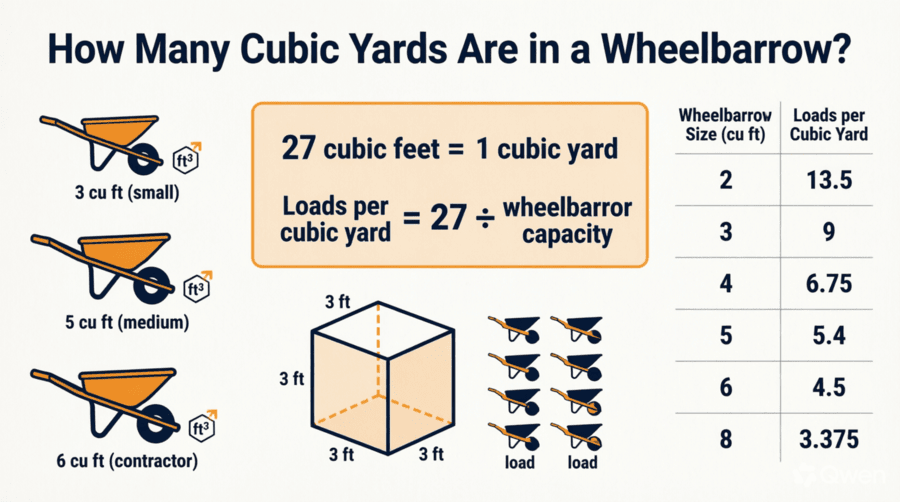
How many cubic yards in a wheelbarrow? It depends on the wheelbarrow’s capacity, because wheelbarrows aren’t all the same size. A small 2 cubic foot garden model holds about 0.07 cubic yards per load, while a 6 cubic foot model holds about 0.22 cubic yards, roughly three times as much.
Since 1 cubic yard equals 27 cubic feet, the conversion always comes down to one formula:
Loads per cubic yard = 27 ÷ wheelbarrow capacity in cubic feet
The chart below covers every common wheelbarrow size, followed by the practical factors (partial loads, heaped loads, wet material, weight limits) that determine how many trips you’ll actually make on a real job.
Wheelbarrow Size to Cubic Yard Conversion Chart
| Wheelbarrow capacity | Cubic yards per full load | Full loads per cubic yard |
|---|---|---|
| 2 cu ft (small/garden) | 0.074 yd³ | 13.5 |
| 3 cu ft (standard single-wheel) | 0.111 yd³ | 9.0 |
| 4 cu ft (small/medium) | 0.148 yd³ | 6.75 |
| 5 cu ft (medium) | 0.185 yd³ | 5.4 |
| 6 cu ft (contractor standard) | 0.222 yd³ | 4.5 |
| 8 cu ft (heavy-duty, often two-wheel) | 0.296 yd³ | 3.375 |
Most single-wheel garden wheelbarrows fall in the 3 to 6 cubic foot range, with 6 cubic feet being the most common size sold for general contractor and landscaping work. Two-wheel heavy-duty models can go up to 8 to 10 cubic feet. If you don’t know your wheelbarrow’s rated capacity, check the tray for a stamped or molded number, or look up the model online. Measuring it yourself (length x width x average depth of the tub) will get you close, but manufacturer ratings are usually based on a level or lightly crested fill, so don’t assume your real average load matches the rating exactly.
If you’d rather skip the arithmetic and start from your project’s actual dimensions, TheCalcYard’s Cubic Yard Calculator converts length, width, and depth straight into cubic yards, which you can then divide by your wheelbarrow’s capacity.
How Many Cubic Yards in a Wheelbarrow? How to Calculate It Yourself
You need two numbers: the total material volume and your wheelbarrow’s capacity, both in the same unit.
Number of loads = total cubic feet ÷ wheelbarrow capacity in cubic feet
Worked example: say you need to move 2 cubic yards of mulch with a 5 cubic foot wheelbarrow.
- Convert cubic yards to cubic feet: 2 x 27 = 54 cubic feet
- Divide by wheelbarrow capacity: 54 ÷ 5 = 10.8 loads
- Round up, since you can’t make a partial trip: about 11 loads
That’s the theoretical number based on full-capacity loads. The next section explains why your real trip count is often higher.
Why Your Actual Trip Count Is Usually Higher Than the Math Says
The 27 ÷ capacity formula assumes every trip is filled to exactly the rated volume. In practice, several things push the real number of loads above the theoretical figure.
Partial loads. If you’re not filling the tray, whether from caution, a heavy material, or an awkward shape, your effective capacity per trip drops. A 6 cubic foot wheelbarrow averaging 4 cubic feet per trip needs 27 ÷ 4 = 6.75 loads instead of the theoretical 4.5.
Weight, not volume, is usually the real limit. A wheelbarrow’s cubic foot rating tells you how much space the tray holds, not how much weight it can safely carry. Loose topsoil and gravel typically run somewhere around 90 to 110 pounds per cubic foot, and wet material weighs noticeably more than dry. Concrete is heavier still, close to 150 pounds per cubic foot. A fully “level-full” 6 cubic foot tray of wet soil or gravel can approach 500 to 600 pounds, which is more than most single-wheel wheelbarrows are rated to carry safely. For dense materials, check the wheelbarrow’s weight rating and load to that limit rather than to the visual fill line.
Heaped versus level loads. Manufacturers usually rate capacity based on a specific fill method (level or lightly crested), so a load piled well above the tray’s rim may exceed the stated cubic footage, while a load kept below the rim for stability will fall short of it.
Terrain and distance. A full load is manageable over a short, flat path. The same load over soft ground, a slope, or a long distance often isn’t, which is another reason contractors commonly load below capacity rather than at it.
Material behavior. Loose gravel and crushed stone can shift or spill during transport, particularly on uneven ground, which further reduces the amount that actually makes it to the destination per trip.
None of this changes the underlying volume math. It changes how much material you can realistically move per trip, which is the number that should go into your planning instead of the wheelbarrow’s rated maximum.
A More Realistic Way to Plan Your Trips
If you’re estimating for an actual job, use your realistic average load rather than the rated capacity:
- Calculate total material volume (for example, 3 cubic yards).
- Convert to cubic feet: 3 x 27 = 81 cubic feet.
- Divide by your realistic average load, not the maximum rating. If a 6 cubic foot wheelbarrow is realistically carrying 5 cubic feet per trip with a heavy material: 81 ÷ 5 = 16.2, so plan on 17 trips rather than the 13.5 you’d get from the full-capacity math.
Wheelbarrow Loads by Material
The 27 ÷ capacity formula is the same for every material. What changes is how close to full you can realistically and safely load the wheelbarrow.
| Material | Typical weight per cubic yard | Practical note |
|---|---|---|
| Soil | Roughly 2,000 to 2,700 lb, more when wet | Dry, loose soil is manageable near full capacity; wet soil gets heavy fast |
| Gravel | Roughly 2,400 to 3,000 lb | Dense and prone to shifting; many people load a 6 cu ft tray to 4 to 5 cu ft in practice |
| Concrete | Roughly 3,700 to 4,100 lb | The heaviest common material by volume; loading to full rated capacity is rarely practical or safe |
For a soil-moving job, TheCalcYard’s guide on how much a yard of dirt costs also covers delivery versus self-hauling, which matters once you’ve worked out how many wheelbarrow trips self-hauling would take.
For gravel, TheCalcYard’s Gravel Calculator works out volume and tonnage together, and the gravel weight guide breaks down why weight varies by material and moisture, which directly affects how full you should load each trip.
For concrete, TheCalcYard’s Concrete Calculator converts your slab, footing, or column dimensions into cubic yards and bag counts before you start estimating trips.
Wheelbarrow Loads in a Cubic Meter
If you’re working in metric, a cubic meter is larger than a cubic yard: 1 cubic meter is approximately 35.315 cubic feet.
| Wheelbarrow capacity | Loads per cubic meter |
|---|---|
| 3 cu ft | 11.8 |
| 4 cu ft | 8.8 |
| 5 cu ft | 7.1 |
| 6 cu ft | 5.9 |
As with the cubic yard figures, these are full-capacity theoretical numbers. Expect more trips if you’re not filling the wheelbarrow.
Why “1 Cubic Yard Equals 1 Ton” Is Not a Safe Assumption
A cubic yard measures volume. A ton measures weight. They’re connected through a material’s density, but one doesn’t automatically tell you the other.
This matters for wheelbarrow planning because two materials that fill a wheelbarrow to the same volume can have very different weights. A cubic yard of dry mulch might weigh under 1,000 pounds; a cubic yard of gravel or concrete can weigh two to four times that. So “how many wheelbarrows make a ton” has no single answer. It depends on the material, its moisture content, and how full each load actually is.
If your project is planned around weight (a delivery quote in tons, for instance) rather than volume, use material-specific density figures instead of a universal conversion.
Common Mistakes to Avoid
- Assuming every wheelbarrow is 6 cubic feet. Garden models are often smaller (2 to 4 cubic feet), so check your actual capacity before estimating.
- Loading to volume capacity instead of weight capacity. For dense materials like wet soil, gravel, or concrete, weight limits you before volume does.
- Treating the load count as exact. The formula gives a theoretical minimum. Real trip counts are typically equal to or higher than the math, rarely lower.
- Forgetting that heaped and level capacities differ. A wheelbarrow’s rated volume is based on one fill method; loading it a different way changes how much it actually holds.
Frequently Asked Questions
How many cubic yards are in a wheelbarrow? It depends on the wheelbarrow’s capacity. A 3 cubic foot wheelbarrow holds about 0.111 cubic yards per full load, a 5 cubic foot model holds about 0.185 cubic yards, and a 6 cubic foot model holds about 0.222 cubic yards.
How many wheelbarrows are in a cubic yard? Using 27 ÷ capacity: a 3 cubic foot wheelbarrow needs about 9 full loads, a 5 cubic foot wheelbarrow needs about 5.4 loads, and a 6 cubic foot wheelbarrow needs about 4.5 loads to move one cubic yard.
Is 1 yard of gravel the same as 1 ton? No. A cubic yard is a volume and a ton is a weight. Depending on the gravel type and moisture, a cubic yard typically weighs somewhere between 2,400 and 3,000 pounds, which is close to but not exactly one ton (2,000 pounds).
How many wheelbarrow loads are in a cubic meter of soil? A cubic meter is about 35.315 cubic feet. That works out to roughly 8.8 loads with a 4 cubic foot wheelbarrow or about 5.9 loads with a 6 cubic foot wheelbarrow, assuming full-capacity trips.
How heavy is a wheelbarrow full of soil? It depends on the soil’s moisture and composition and the wheelbarrow’s size. As a rough guide, loose dry soil runs around 75 to 100 pounds per cubic foot, so a level-full 6 cubic foot tray could weigh somewhere in the 450 to 600 pound range, more if the soil is wet or compacted.
How many wheelbarrows does it take for one yard of concrete? By volume, one cubic yard of concrete is 27 cubic feet, so a 6 cubic foot wheelbarrow represents about 4.5 full loads. Because concrete is heavy, most people load well below the tray’s rated capacity, so the real trip count is usually higher.
Final Takeaway
There’s no single number of wheelbarrows in a cubic yard because wheelbarrow capacity varies from about 2 cubic feet to 8 or more. Once you know your wheelbarrow’s rated capacity, the conversion is simple: divide 27 by that number to get full loads per cubic yard. From there, adjust for the material you’re hauling and how full you can safely and comfortably load each trip, since that real-world number is usually what actually determines how many trips your project takes.
To start from your project’s dimensions instead of a rough estimate, TheCalcYard’s free Cubic Yard Calculator works out the exact volume you need, which you can then divide by your wheelbarrow’s realistic load size.