
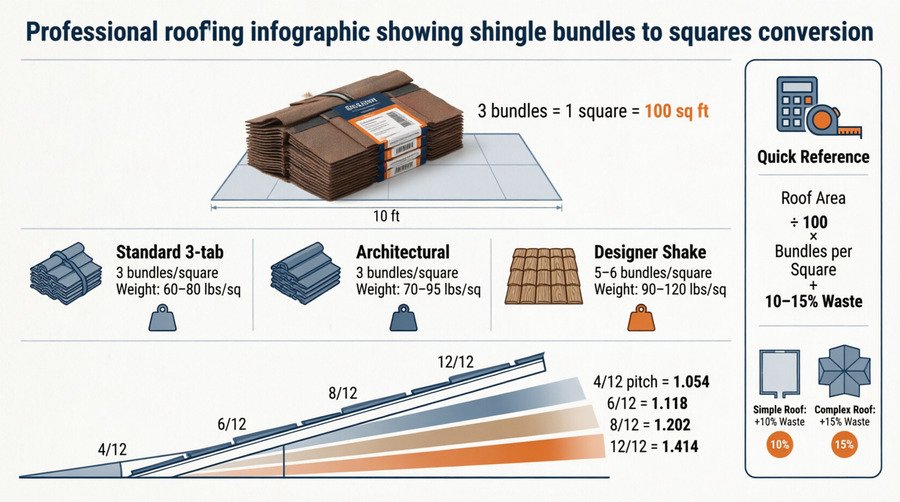
How many bundles of shingles in a square is one of the most critical questions for any roofing project. Getting this wrong means costly delays or wasted money on excess materials.
Short answer: 3 bundles cover 1 roofing square (100 square feet) for most standard asphalt shingles, which works out to about 33.3 square feet per bundle. Thicker designer and shake-style shingles are packaged differently and can take 4, 5, or 6 bundles per square, so confirm the bundles-per-square figure printed on the wrapper before you order.
That single sentence answers the question, but it will not finish your estimate. The number of bundles you actually buy depends on three things: the real roof surface area (not the size of the house), the bundles-per-square rating of the exact shingle you picked, and the extra material your roof’s shape forces you to cut and throw away. This guide walks through all three, with the math shown at every step.
How Many Bundles of Shingles in a Square? Understanding the Basics
These two terms get mixed up constantly, and the confusion is the root of most bad shingle orders.
| Term | What it measures | Fixed value? |
|---|---|---|
| Square | Roof area: 100 square feet of roof surface | Yes, always 100 sq ft |
| Bundle | A package of shingles | No, coverage varies by product |
A square is a unit of area, the same way a gallon is a unit of volume. It never changes. Roofers use it because roof sizes in the thousands of square feet are clumsy to talk about and price: “22 squares” is easier than “2,200 square feet,” and suppliers quote material by the square.
A bundle is a physical package, sized so one person can carry it up a ladder. Manufacturers choose how much roof a bundle covers based on how thick and heavy the shingle is. That is the whole reason the bundles-per-square number moves around.
Why 3 Bundles per Square Is the Default
Standard 3-tab and standard architectural (laminated) shingles are built around a 3-bundle square, so:
100 sq ft ÷ 3 bundles = 33.33 sq ft per bundle
You will see this printed on wrappers as 33.3 sq ft, 33 1/3 sq ft, or occasionally 32.8 sq ft (a few products round the exposure slightly differently). GAF’s Timberline HDZ, the most widely installed architectural shingle in North America, is sold at 33.33 square feet per bundle with 21 pieces in each bundle, which is exactly 3 bundles to the square.
Three bundles is also a practical limit. A bundle from a 3-bundle-per-square product typically weighs somewhere between 50 and 80 pounds, so a square of shingles runs roughly 200 to 250 pounds. Once a shingle gets thicker than that, the manufacturer has to split the same 100 square feet across more packages to keep each one liftable. That is the mechanism behind every exception below.
When It Is Not 3 Bundles per Square
The heavier the shingle profile, the more bundles it takes to cover the same 100 square feet. Some verified examples of how far the range stretches:
| Shingle (example) | Style | Bundles per square | Coverage per bundle |
|---|---|---|---|
| GAF Timberline HDZ | Architectural | 3 | About 33.3 sq ft |
| GAF Grand Sequoia | Designer shake | 5 | 20 sq ft |
| Owens Corning Woodcrest | Designer shake | 6 | About 16.7 sq ft |
Owens Corning publishes Woodcrest at 6 bundles per square with 15 shingles per bundle at a 4 inch exposure. Grand Sequoia is retailed at 20 square feet per bundle, which is 5 bundles to the square. Four-bundle products exist as well, mostly in the same designer and slate-look categories.
These are examples of how much the packaging can vary, not a classification system. A shingle being “architectural” does not guarantee 3 bundles per square, and the product name tells you nothing reliable. Two numbers do: the bundles per square and the coverage per bundle printed on the wrapper or in the manufacturer’s data sheet. When those conflict with a rule of thumb, the wrapper wins.
How to Calculate Your Bundles: 4 Steps
Step 1: Get the actual roof surface area
Not the floor plan. Not the footprint. The sloped surface the shingles sit on. A 2,000 square foot house does not have a 2,000 square foot roof.
If you can measure each roof plane directly, do that: multiply the length by the sloped width for every plane and add them together. If you only know the footprint and the pitch, multiply the footprint by the pitch multiplier for your slope:
Roof area = footprint area × pitch multiplier
| Roof pitch | Pitch multiplier | 1,500 sq ft footprint becomes |
|---|---|---|
| 4/12 | 1.054 | 1,581 sq ft |
| 5/12 | 1.083 | 1,625 sq ft |
| 6/12 | 1.118 | 1,677 sq ft |
| 7/12 | 1.158 | 1,737 sq ft |
| 8/12 | 1.202 | 1,803 sq ft |
| 9/12 | 1.250 | 1,875 sq ft |
| 10/12 | 1.302 | 1,953 sq ft |
| 12/12 | 1.414 | 2,121 sq ft |
The multiplier is simply the sloped length over the horizontal run, from the Pythagorean theorem:
Multiplier = √(12² + rise²) ÷ 12
For a 6/12 pitch: √(144 + 36) ÷ 12 = √180 ÷ 12 = 13.416 ÷ 12 = 1.118.
Two cautions on this shortcut. It assumes one consistent pitch across the whole roof, and the footprint you start with must include the eave and rake overhangs, which the floor plan does not. If your roof has multiple pitches, dormers, or a mix of hips and gables, measure the planes individually instead. TheCalcYard’s Roof Pitch Calculator will convert rise and run into pitch, angle, rafter length, and roof area for you.
Step 2: Convert to roofing squares
Roofing squares = roof area ÷ 100
1,677 sq ft ÷ 100 = 16.77 squares.
Step 3: Multiply by the bundles-per-square rating
Bundles = roofing squares × bundles per square
16.77 × 3 = 50.3 bundles of field shingles.
If the product gives you coverage per bundle instead of bundles per square, divide instead:
Bundles = roof area ÷ coverage per bundle
1,677 ÷ 33.3 = 50.4 bundles. Same answer, and this version is the more accurate one to use when the stated coverage is something odd like 32.8 or 20 square feet.
Step 4: Add waste, then round up
You cannot buy a fraction of a bundle, so 50.3 becomes 51. Always round up, never down.
Then add a waste allowance for the material you will cut off and discard at rakes, valleys, hips, and penetrations. There is no single correct percentage, because waste is driven by roof geometry rather than roof size. Common estimating practice runs roughly:
| Roof type | Typical waste allowance |
|---|---|
| Simple gable, few cuts, no valleys | About 10% |
| Hip roof, or a gable with a valley or two | 10% to 15% |
| Cut-up roof: multiple valleys, dormers, turrets, steep slopes | 15% or more |
These are estimating conventions, not manufacturer requirements. GAF’s own estimating guidance tells contractors to allow extra material for trim and waste and notes that the amount depends on features like steep slopes, rakes, valleys, and dormers, which is the same point: match the allowance to the roof in front of you.
Applied to the example: 50.4 bundles × 1.10 = 55.4, rounded up to 56 bundles.
Worked Example, Start to Finish
Assumptions: 1,200 sq ft footprint including overhangs, uniform 6/12 pitch, simple gable roof, standard architectural shingle at 3 bundles per square, 10% waste. This is an illustrative example, not a measured job.
- Roof area: 1,200 × 1.118 = 1,341.6 sq ft
- Squares: 1,341.6 ÷ 100 = 13.42 squares
- Field shingles: 13.42 × 3 = 40.25 bundles
- Waste: 40.25 × 1.10 = 44.3 bundles
- Round up: 45 bundles, or 15 squares ordered
Notice what changes if the homeowner upgrades to a 5-bundle designer shingle. The roof is identical, but step 3 becomes 13.42 × 5 = 67.1 bundles, and the order rises to about 74 bundles. The roof did not get bigger. Only the packaging changed.
Shingle Bundle Conversion Chart
Read across to the column that matches your product’s bundles-per-square rating. These are field shingles only, before waste.
| Squares | Roof area | At 3 bundles/sq | At 4 | At 5 | At 6 |
|---|---|---|---|---|---|
| 1 | 100 sq ft | 3 | 4 | 5 | 6 |
| 5 | 500 sq ft | 15 | 20 | 25 | 30 |
| 10 | 1,000 sq ft | 30 | 40 | 50 | 60 |
| 15 | 1,500 sq ft | 45 | 60 | 75 | 90 |
| 20 | 2,000 sq ft | 60 | 80 | 100 | 120 |
| 25 | 2,500 sq ft | 75 | 100 | 125 | 150 |
| 30 | 3,000 sq ft | 90 | 120 | 150 | 180 |
| 40 | 4,000 sq ft | 120 | 160 | 200 | 240 |
To go the other direction, divide:
Roofing squares = bundles ÷ bundles per square
30 bundles ÷ 3 = 10 squares = 1,000 square feet of coverage.
What Your Bundle Count Does Not Cover
The calculation above buys field shingles: the ones that cover the open roof planes. A shingle roof needs several other products, each sold and measured separately.
- Starter strip shingles for the eaves and rakes. Sold by linear foot of coverage per bundle, not square feet.
- Hip and ridge cap shingles. Also sold by linear foot, and coverage depends on the installed exposure, so two ridge cap products can cover very different lengths per bundle.
- Underlayment (synthetic or felt), sold by the roll in squares.
- Ice and water shield at eaves and valleys, where code or climate requires it.
- Drip edge, valley metal, and step or counter flashing.
- Roofing nails, sized for the deck and the number of nails per shingle your warranty requires.
- Ridge vent or other ventilation components.
Some manufacturers allow field shingles to be cut down for starter or cap courses under specific installation methods, and some warranties require their own matched accessories instead. That decision belongs to the installation instructions for your specific system, not to a rule of thumb. It matters financially too: on a high-wind warranty, using the manufacturer’s accessories is often a condition of coverage.
How Many Individual Shingles Are in a Bundle?
There is no universal count, and it is the least useful number for estimating.
Piece counts follow the shingle’s dimensions and exposure, so they swing widely: GAF lists 21 pieces per bundle for Timberline HDZ, while Owens Corning lists 15 per bundle for Woodcrest. Standard 3-tab shingles, which are smaller and thinner, usually come with more pieces per bundle than laminated products.
Count pieces only when you need to fill a small repair area or verify what came off the truck. For ordering, coverage per bundle is the number that matters.
How Much Does a Square of Shingles Cost?
Material prices move with asphalt costs, region, and supplier, so any specific figure published today is likely to be wrong within a year. What is stable is how the pricing is structured, and that is worth understanding before you call for a quote:
- Shingles are quoted per square or per bundle. A per-bundle price on a 5-bundle product is not comparable to a per-bundle price on a 3-bundle product. Convert both to a per-square price before you compare.
- Material cost is not installed cost. Installed pricing includes tear-off, disposal, underlayment, flashing, accessories, labor, and overhead, and the shingles themselves are often a minority of the total.
- Designer and impact-rated shingles cost more per square for two reasons at once: a higher price per bundle and more bundles per square.
For a current number, ask a local roofing supplier or building center for a quote on the specific product and quantity. That takes one phone call and beats any published average.
Common Mistakes That Cost Money
- Using the house’s square footage as the roof area. This is the single most common error. Pitch and overhangs mean the roof is always larger than the footprint, sometimes by 40% or more.
- Assuming 3 bundles per square for a designer shingle. Order a 6-bundle product as if it were a 3-bundle product and you will be half a roof short.
- Forgetting starter and ridge cap. These are separate line items with their own coverage figures.
- Rounding down. A partial bundle still requires a whole bundle.
- Adding a flat waste percentage to every roof. A simple gable and a cut-up roof with four valleys do not waste the same amount of material.
- Skipping the waste allowance entirely on a reorder. A second delivery can arrive from a different production run, and color blends between runs do not always match.
- Measuring one plane and doubling it on a roof that is not symmetrical.
Frequently Asked Questions
How many bundles of shingles do I need for 100 square feet? Three bundles for a standard asphalt shingle, since 100 square feet is exactly 1 roofing square. For a designer shingle rated at 4, 5, or 6 bundles per square, you need that many.
How many bundles is 25 squares? 75 bundles at 3 bundles per square (25 × 3). That figure is field shingles before waste, so a real 25 square job usually lands closer to 83 bundles with a 10% allowance.
How many squares is a 1,000 sq ft roof? 10 squares, if 1,000 square feet is the measured roof surface. If it is the house’s floor area, the roof is larger: a 6/12 pitch would put it near 1,118 square feet, or about 11.2 squares.
How many squares are 30 bundles of shingles? 10 squares, or 1,000 square feet, for a 3-bundle-per-square product. For a 5-bundle product, the same 30 bundles cover only 6 squares.
How many square feet does 1 bundle of shingles cover? About 33.3 square feet for standard asphalt shingles. Designer products cover less: 20 square feet per bundle for GAF Grand Sequoia and about 16.7 for Owens Corning Woodcrest.
How many bundles of shingles do I need for a 2,000 sq ft roof? 60 bundles of field shingles if 2,000 square feet is the actual roof surface and the product is rated at 3 bundles per square. With a 10% waste allowance, order about 66. If 2,000 square feet is the house footprint, calculate the roof area first.
How many packages of shingles are in a square? Package and bundle mean the same thing here. Three packages per square for standard products, more for thicker ones.
Do shingle bundles include starter strips and ridge caps? No. Field shingle bundles cover the open roof planes only. Starter strip and hip and ridge cap are separate products with their own coverage, usually stated in linear feet per bundle.
Can I mix bundles from different production runs? It is better not to on the same roof plane. Color blends can shift slightly between runs, which shows up as banding. Order the full quantity at once, including waste.
The Bottom Line
For most asphalt shingle roofs, 1 square equals 100 square feet equals 3 bundles, and roughly 33.3 square feet per bundle. Treat that as a starting point rather than a fixed rule, because thicker shake-style and designer shingles are packaged at 4, 5, or even 6 bundles per square.
The order that actually arrives at your job depends far more on the other two variables: the real sloped roof area, which is always bigger than the house’s footprint, and the waste your roof’s shape forces on you. Get the area right first with the Roof Pitch Calculator, divide by 100, multiply by the bundles-per-square number printed on the wrapper, add a waste allowance that matches how cut up the roof is, and round up. Then price starter, ridge cap, underlayment, and flashing as separate lines, because none of them are in those bundles.
1 thought on “How Many Bundles of Shingles Are in a Square? Coverage, Charts, and How to Estimate Your Roof”