
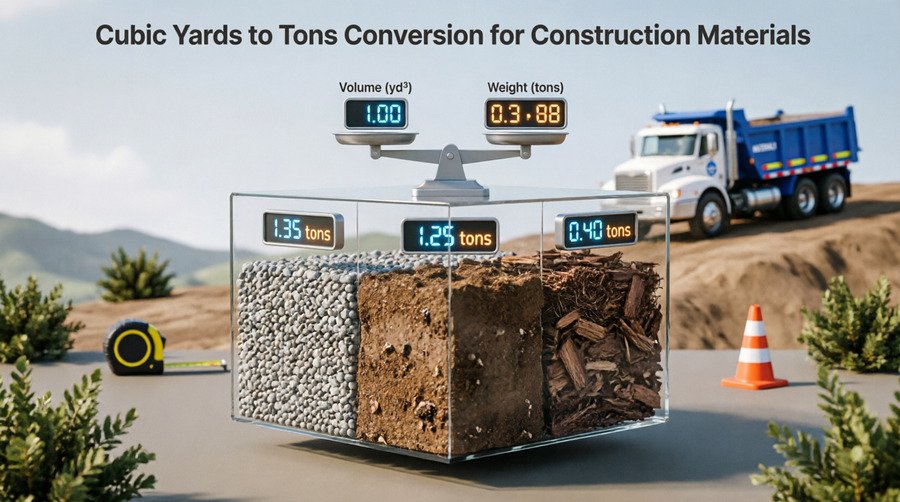
To convert cubic yards to tons, multiply your volume by the material’s weight per cubic yard:
Tons = cubic yards × tons per cubic yard
A cubic yard measures volume. A ton measures weight. Density links them, so the conversion differs for gravel, sand, topsoil, mulch, and concrete. No universal rule says one cubic yard equals one ton.
Example: 5 cubic yards of gravel at 1.35 tons per cubic yard weighs 5 × 1.35 = 6.75 tons.
Two constants do the rest of the work in U.S. units:
- 1 cubic yard = 27 cubic feet
- 1 U.S. short ton = 2,000 pounds
Everything below uses U.S. short tons unless stated otherwise.
The formula, and what each part means
| Term | What it is | Typical source |
|---|---|---|
| Cubic yards | The volume of material your project needs | Measure the area, or use a cubic yard calculator |
| Tons per cubic yard | The material’s bulk density expressed as weight | Your supplier’s product sheet, or a planning estimate |
| Tons | The order weight you will actually be billed for | The result |
If your supplier gives density in pounds per cubic yard instead, divide by 2,000 first:
2,700 lb/yd³ ÷ 2,000 = 1.35 tons/yd³
If the density is in pounds per cubic foot, multiply by 27 first:
100 lb/ft³ × 27 = 2,700 lb/yd³ = 1.35 tons/yd³
How to convert cubic yards to tons in four steps
Step 1: Name the exact product. Not “gravel” but “¾ inch washed #57 limestone” or “crusher run.” Two products both called gravel can differ by 20 percent or more in weight.
Step 2: Get the weight per cubic yard. Ask the quarry or landscape yard for the tons per cubic yard, or the pounds per cubic yard, for that specific product. This single number controls your entire answer.
Step 3: Multiply. Tons = cubic yards × tons per cubic yard.
Step 4: Decide what to do about compaction and waste. Your measured volume is usually the finished, in place volume. Loose delivered material settles, so the tonnage that fills that space is higher than the raw math suggests. See the compaction section below.
Worked example
A driveway needs 11.1 cubic yards of crusher run. The supplier quotes 1.45 tons per cubic yard.
11.1 × 1.45 = 16.10 tons
Adding a 10 percent allowance for compaction and spillage: 16.10 × 1.10 = 17.71 tons, so that you would order 18 tons.
How to convert tons to cubic yards
Reverse the formula:
Cubic yards = tons ÷ tons per cubic yard
Example: 8 tons of material at 1.35 tons per cubic yard.
8 ÷ 1.35 = 5.93 cubic yards
A quick sanity check that catches most errors: run the answer back through the first formula. 5.93 × 1.35 = 8.0 tons. If it does not return your starting number, you divided when you should have multiplied.
Tons per cubic yard by material
These are planning ranges for loose, reasonably dry material. They are estimates, not specifications. Real products vary with rock type, gradation, fines content, and moisture, so a supplier’s figure always beats a chart.
| Material | Approx. lb/yd³ | Approx. tons/yd³ |
|---|---|---|
| Wood mulch | 500 to 1,000 | 0.25 to 0.50 |
| Screened topsoil | 2,000 to 2,700 | 1.00 to 1.35 |
| Pea gravel | 2,500 to 2,800 | 1.25 to 1.40 |
| Crushed stone, #57 or ¾ in clean | 2,500 to 2,800 | 1.25 to 1.40 |
| Crushed limestone | 2,500 to 2,900 | 1.25 to 1.45 |
| River rock | 2,600 to 3,000 | 1.30 to 1.50 |
| Crusher run or road base, loose | 2,700 to 3,100 | 1.35 to 1.55 |
| Dry sand | 2,500 to 2,900 | 1.25 to 1.45 |
| Recycled concrete aggregate | 2,200 to 2,800 | 1.10 to 1.40 |
| Normal weight concrete, cured | about 4,050 | about 2.03 |
Two things to read out of that table. First, mulch and concrete differ by roughly a factor of six for the same volume, which is why a single conversion factor cannot exist. Second, most common driveway and landscaping aggregates cluster between about 1.25 and 1.55 tons per cubic yard, so if a quote lands far outside that band, check whether you are looking at a compacted density or a different unit.
Cubic yards to tons chart for gravel
This chart assumes 1.35 tons per cubic yard, which is 2,700 lb/yd³ or 100 lb/ft³. It is the most widely used planning figure for general gravel and crushed stone, not a universal density.
| Cubic yards | Tons at 1.35 t/yd³ | Tons at 1.25 t/yd³ | Tons at 1.50 t/yd³ |
|---|---|---|---|
| 1 | 1.35 | 1.25 | 1.50 |
| 2 | 2.70 | 2.50 | 3.00 |
| 3 | 4.05 | 3.75 | 4.50 |
| 4 | 5.40 | 5.00 | 6.00 |
| 5 | 6.75 | 6.25 | 7.50 |
| 6 | 8.10 | 7.50 | 9.00 |
| 10 | 13.50 | 12.50 | 15.00 |
| 15 | 20.25 | 18.75 | 22.50 |
| 20 | 27.00 | 25.00 | 30.00 |
The three columns exist to show the size of the risk. At 20 cubic yards, the gap between a light and a heavy product is five tons, which on a delivered order is real money. For anything past a few yards, get the number from the supplier rather than the chart.
To skip the arithmetic for a specific gravel product, the gravel calculator works out volume, estimated weight, and delivered cost from your length, width, and depth in one pass.
How many tons of gravel are in a cubic yard?
Most gravel and crushed stone products fall between roughly 1.25 and 1.55 tons per cubic yard when loose and dry. Pea gravel and clean washed stone sit near the low end because the uniform particle size leaves large voids. Crusher run and dense graded base sit near the high end because the fines pack into those voids.
Compacted in place, dense graded base can reach roughly 1.7 to 1.9 tons per cubic yard. Wet material can add another 5 to 15 percent. Neither of those is the number a landscape yard usually quotes, so ask which condition their figure describes.
Loose volume vs compacted volume: the mistake that costs money
Almost every online calculator, including a simple length by width by depth conversion, gives you the in place volume you want to end up with. Bulk aggregate is delivered loose, and it loses volume when you rake, roll, or drive on it.
So the conversion has two separate jobs:
- Convert volume to weight using density. That is pure math.
- Decide how much extra to order so the finished depth is correct after settling. That is a judgment call.
A common working allowance is 10 to 20 percent extra for compactable materials like crusher run and dense graded base, and a smaller allowance for decorative stone that is not compacted. The right figure depends on the material, the subgrade, and how the material is placed, so confirm it with your supplier or the project spec rather than treating a percentage as a rule.
Converting when density is given in pounds per cubic foot
Some engineering references and spec sheets list bulk density in lb/ft³. Combine the two constants:
Tons = cubic yards × 27 × lb/ft³ ÷ 2,000
Example: 3 cubic yards of aggregate at 100 lb/ft³.
3 × 27 × 100 = 8,100 lb 8,100 ÷ 2,000 = 4.05 tons
Reversed:
Cubic yards = tons × 2,000 ÷ (27 × lb/ft³)
How far will 20 tons of gravel cover?
Weight alone cannot tell you coverage. You need density and depth. Convert weight to volume first, then area volume.
At 1.35 tons per cubic yard:
20 ÷ 1.35 = 14.81 cubic yards
Then, with depth in inches:
Square feet = cubic yards × 324 ÷ depth in inches
14.81 × 324 ÷ 4 = about 1,200 square feet at 4 inches deep
Coverage per cubic yard, before any compaction allowance:
| Depth | Coverage per cubic yard | Coverage per ton at 1.35 t/yd³ |
|---|---|---|
| 2 in | 162 sq ft | 120 sq ft |
| 3 in | 108 sq ft | 80 sq ft |
| 4 in | 81 sq ft | 60 sq ft |
| 6 in | 54 sq ft | 40 sq ft |
These are geometric figures. A rutted or soft subgrade swallows material and reduces real coverage.
How many tons is a dump truck load of gravel?
There is no fixed answer, because a truck’s rating describes payload weight, not volume. A “20 ton truck” can legally carry 20 tons of anything, which is a different number of cubic yards for every material.
At 1.35 tons per cubic yard, 20 tons works out to 20 ÷ 1.35 = 14.81 cubic yards. Whether a given truck can physically hold that volume depends on its body size, and whether it can legally haul it depends on axle limits and local road restrictions. Confirm both with the hauler before planning around a number of loads.
For smaller jobs, a heaped half ton pickup bed holds somewhere around 1 to 1.5 cubic yards of gravel by volume, but a full cubic yard of stone weighs roughly 2,700 pounds, which exceeds the payload rating of most light pickups. Volume capacity and weight capacity are separate limits, and with aggregate, the weight limit is almost always the one you hit first.
Comparing a price per ton with a price per cubic yard
Quarries usually sell by the ton, landscape yards often sell by the cubic yard, and big box stores sell by the bag. Convert everything to one unit before comparing.
- Price per cubic yard = price per ton × tons per cubic yard
- Price per ton = price per cubic yard ÷ tons per cubic yard
Example: $28 per ton at 1.35 tons per cubic yard equals 28 × 1.35 = $37.80 per cubic yard. A yard quoting $46 per cubic yard for the same product is more expensive, before delivery fees.
For bagged material, a 0.5 cubic foot bag is the common big box size, and 27 ÷ 0.5 = 54 bags per cubic yard. That comparison is usually what pushes larger jobs toward bulk delivery.
Common mistakes
- Assuming 1 cubic yard equals 1 ton. It only holds for a material at exactly 2,000 lb/yd³, which is close to some topsoils and almost nothing else.
- Using a gravel density for mulch or topsoil. The error can be several hundred percent.
- Mixing tons and tonnes. A metric tonne is about 10 percent heavier than a U.S. short ton.
- Dividing when you should multiply. Going from volume to weight, the tonnage for dense material should be larger than the yardage. If your answer shrank, you inverted the formula.
- Forgetting the depth conversion. Depth in inches must be divided by 12 before multiplying feet by feet by feet.
- Ordering the exact calculated tonnage. Coming up half a ton short on a delivered load usually means paying a second delivery fee.
Short tons, metric tonnes, and long tons
| Unit | Weight | Where it is used |
|---|---|---|
| U.S. short ton | 2,000 lb | Standard for U.S. aggregate sales |
| Metric tonne | 1,000 kg, about 2,204.6 lb | Metric countries, some engineering specs |
| Long ton | 2,240 lb | Rare in U.S. construction |
A quote of “1.35 tons per cubic yard” in the United States means short tons. If you are converting a metric density, 1,000 kg/m³ equals about 0.843 U.S. short tons per cubic yard.
Frequently asked questions
Is 1 cubic yard the same as 1 ton? No. A cubic yard is a volume and a ton is a weight. They match only for a material weighing exactly 2,000 pounds per cubic yard. Most gravel weighs 2,500 to 3,100 pounds per cubic yard, so one cubic yard is closer to 1.25 to 1.55 tons.
Is 3 cubic yards 3 tons? Only if the material weighs 1 ton per cubic yard. For gravel at 1.35 tons per cubic yard, 3 cubic yards is 3 × 1.35 = 4.05 tons.
How do I convert tons to cubic yards? Divide tons by the material’s tons per cubic yard. Ten tons of gravel at 1.4 tons per cubic yard is 10 ÷ 1.4 = 7.14 cubic yards.
How do I convert cubic yards of gravel to tons? Multiply by the supplier’s tons per cubic yard. Seven cubic yards at 1.35 is 9.45 tons; the same seven yards at 1.25 is 8.75 tons. The difference comes entirely from the product density.
How many cubic yards fit in a 20 ton dump truck? At 1.35 tons per cubic yard, 20 tons is about 14.81 cubic yards, but the truck body size and legal axle limits may allow less. Check with the hauler.
Will a cubic yard of gravel fit in a pickup truck? It may fit by volume in a full size bed, but at roughly 2,700 pounds it exceeds the payload rating of most half ton pickups. Split the load or have it delivered.
Does wet gravel weigh more? Yes. Water occupies the spaces between particles and adds weight without adding volume, commonly 5 to 15 percent for aggregate straight off a wet stockpile. If you are paying by weight, material delivered after heavy rain gives you slightly less stone per ton.
Which density should I use if the supplier will not give one? Use a clearly labeled planning figure such as 1.35 tons per cubic yard for general gravel, treat the result as an estimate, and add an allowance before ordering. Never present a planning estimate as an exact delivered weight.
The short version
The conversion is simple; the density is the hard part.
Tons = cubic yards × tons per cubic yard
Get the tons per cubic yard from the specific product you are buying, not from a generic chart, and remember the two constants behind every step: 27 cubic feet in a cubic yard, 2,000 pounds in a short ton. For an estimate you can act on, work out the volume with the cubic yard calculator, or let the gravel calculator handle volume, weight, and cost together, then confirm the final tonnage with your supplier before the truck is loaded.