
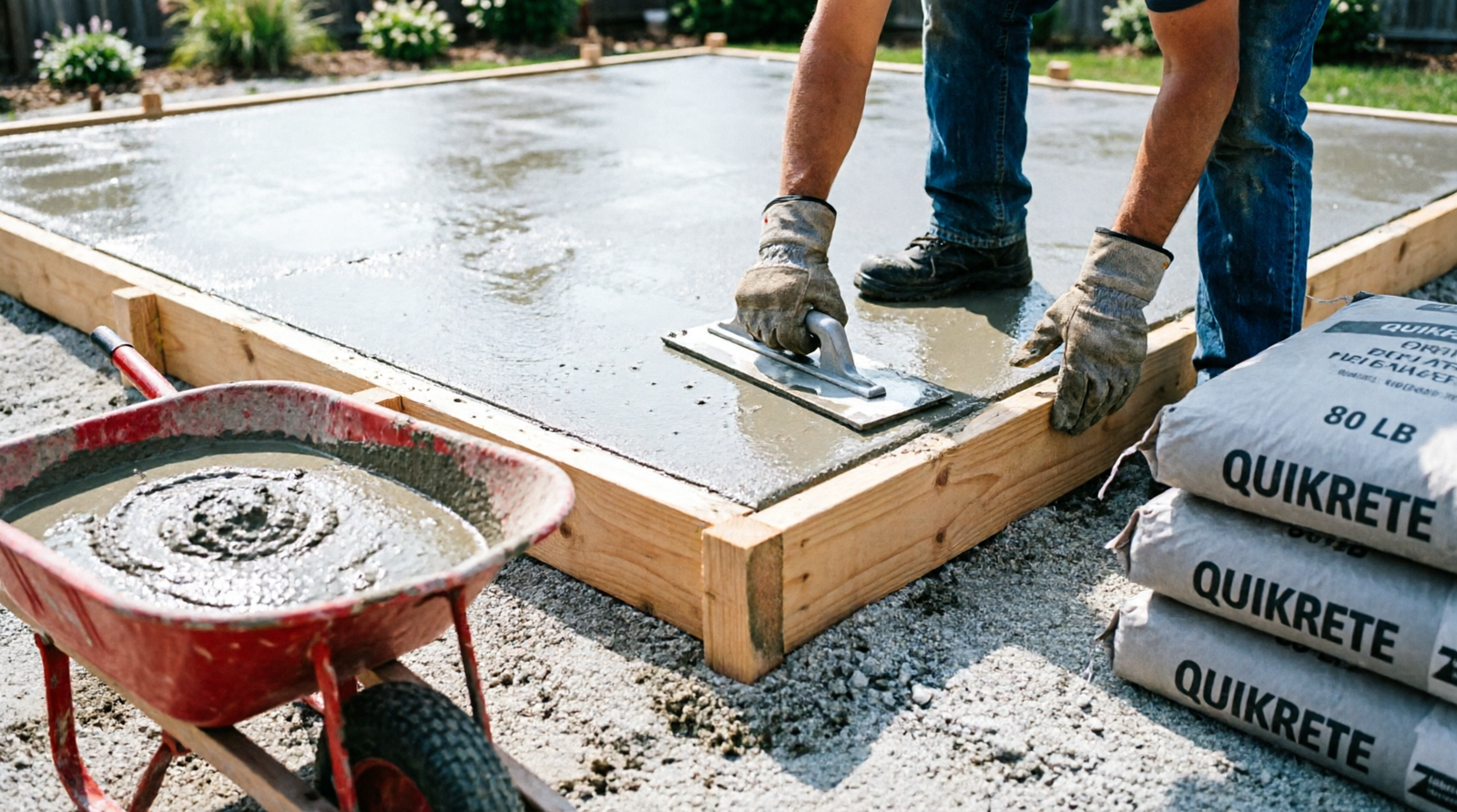
Planning a DIY concrete slab? Getting the bag count right before you start mixing is the difference between a smooth pour and a mid-pour scramble. Come up short, and you risk a “cold joint,” a weak seam where fresh concrete bonds against concrete that has already begun to set. Buy too much, and you’re stuck hauling hundreds of pounds of leftover bags back to the store.
The short answer: For a standard 4-inch slab, buy 62 bags of 80-pound concrete mix, 56 bags for the slab itself, plus a 10% waste buffer. That’s 83 bags of 60-pound mix or 124 bags of 40-pound mix for the same slab.
For a 6-inch slab, you’ll need 93 bags of 80-pound mix (84 bags plus the buffer).
Below is the exact math, the full bag-count tables, and what the project really costs in money, weight, and time.
Understanding Concrete Measurements
Cubic Yards vs. Bags
Ready-mix trucks sell concrete by the cubic yard, and one cubic yard equals 27 cubic feet. A 10×10 slab at 4 inches requires only about 1.23 cubic yards, well below what most suppliers want to deliver, so bagged mix is usually the more practical choice at this size.
Each bag size yields a specific volume of mixed concrete, per manufacturer technical data:
| Bag Size | Yield (cubic feet) |
|---|---|
| 80-pound bag | 0.60 cubic feet |
| 60-pound bag | 0.45 cubic feet |
| 40-pound bag | 0.30 cubic feet |
Sources: Quikrete No. 1101 Concrete Mix technical data and comparable Sakrete product data. Yields vary slightly by manufacturer; always check the label. Some premium “high-yield” blends produce more volume per bag; if you use one, recalculate using the yield printed on its bag.
Why Thickness Matters
Thickness dramatically changes how much material you need. A garden patio or walkway is typically 4 inches, while a driveway, shed foundation, or slab carrying heavy loads usually needs 6 inches. Your local building code may set minimum requirements; check before you build.
Step-by-Step Calculation for a 10×10 Slab
Here’s the exact math for any rectangular slab.
Step 1: Calculate square footage.
10 ft × 10 ft = 100 square feet
Step 2: Convert thickness to feet.
- 4 inches ÷ 12 = 0.333 ft
- 6 inches ÷ 12 = 0.5 ft
Step 3: Find total cubic feet.
- 4-inch slab: 100 sq ft × 0.333 ft = 33.33 cubic feet
- 6-inch slab: 100 sq ft × 0.5 ft = 50 cubic feet
Step 4: Convert to bags and round up.
Divide total cubic feet by your bag’s yield. You can’t buy partial bags, so always round up.
- 4-inch slab: 33.33 ÷ 0.60 = 55.55 → 56 bags
- 6-inch slab: 50 ÷ 0.60 = 83.33 → 84 bags
Bag Count Breakdown by Size and Thickness
These tables include the recommended 10% waste buffer.
For a 4-Inch Thick Slab
| Bag Size | Bags Needed | With 10% Waste |
|---|---|---|
| 80-pound bags | 56 | 62 bags |
| 60-pound bags | 75 | 83 bags |
| 40-pound bags | 112 | 124 bags |
For a 6-Inch Thick Slab
| Bag Size | Bags Needed | With 10% Waste |
|---|---|---|
| 80-pound bags | 84 | 93 bags |
| 60-pound bags | 112 | 124 bags |
| 40-pound bags | 167 | 184 bags |
Pro tip: 80-pound bags mean the fewest trips to the mixer. That said, an 80-lb bag is at the limit of comfortable solo lifting for many people; if that’s you, 60-pound bags are the better trade-off even though the count goes up.
Bags vs. Ready-Mix: Which Should You Choose?
One cubic yard is 27 cubic feet, so an 80-pound bag yielding 0.60 cubic feet works out to:
27 ÷ 0.60 = 45 bags per cubic yard
A 4-inch 10×10 slab needs about 1.23 cubic yards. Here’s how the two options compare:
| Option | Typical Cost* | Pros | Cons |
|---|---|---|---|
| 80-lb bags (62) | $341–$496 ($5.50–$8.00/bag) | No delivery fees; buy as needed; pour on your schedule | ~2.5 tons to haul and hours of mixing |
| Ready-mix (~1.25 yd) | $145–$200 per yard, plus fees | One continuous pour; no mixing; faster | Short-load fees can add $250–$500 at this size |
Cost estimates: bag prices reflect a typical $5.50–$8.00 range for 80-lb mix at major home improvement retailers; ready-mix rates vary significantly by region. Confirm local pricing before budgeting.
About short-load fees: Most ready-mix trucks carry 8–10 cubic yards, and many plants charge per-yard fees on small orders, often enough to add $250–$500 to a pour this size. But practices vary widely: some suppliers have low minimums, and some markets have small-load delivery services built for jobs like this. Get quotes from at least two local plants before deciding.
Bottom line: If you can handle the labor, bags are usually cheaper for a 4-inch slab. For a 6-inch slab, 93 bags and 7,440 pounds of mix, ready-mix delivery becomes much more appealing.
The Weight Reality: Can You Haul 62 Bags?
This is the part most guides skip, and where DIY plans fall apart.
- 62 bags × 80 lbs = 4,960 lbs (about 2.5 tons)
- A 6-inch slab: 93 bags × 80 lbs = 7,440 lbs (about 3.7 tons)
A typical half-ton pickup has a payload of roughly 1,500–2,200 lbs (check the sticker on your driver’s door jamb), so even with a truck you’re making at least three trips. A car trunk handles a few bags at a time; a full-size SUV, maybe 10–15 safely.
Your hauling options:
- Store delivery — Home Depot and Lowe’s deliver bagged concrete, typically $50–$150 depending on distance and location. Often worth every dollar.
- Rent a truck with a higher payload and make fewer trips.
- Multiple trips with two vehicles and a friend splitting the lifting.
Time and Labor Reality
Mixing 62 bags by hand is a serious workout, not an afterthought:
- By wheelbarrow: at 3–5 minutes per bag, expect 3 to 5 hours of continuous mixing before you’ve poured or finished anything.
- With a rented mixer (typically $50–$80/day at home improvement stores and rental centers): 1–2 minutes per bag, so the mixing itself takes an hour or two.
- With help: two people one mixing, one placing and spreading roughly halve the total job.
Plan for a full day for two people, and stage everything (bags, water, tools, forms) before the first bag hits the wheelbarrow.
Mixing and Pouring Tips
Always Add a Waste Buffer
The 10% buffer is a standard rule of thumb. Ground is rarely perfectly level, forms can bow, spills happen, and running short mid-pour creates cold joints, the weak seams that permanently compromise a slab. Extra bags are returnable; a bad pour is not.
Water Ratios Matter
Follow the bag exactly. A standard 80-lb Quikrete bag needs about 3 quarts (2.8 L) of clean water per the manufacturer’s technical data; other brands and blends differ slightly. Never exceed the maximum listed.
Extra water makes concrete easier to pour, and permanently weaker, with more cracking. The mix should look like thick oatmeal: moldable, not runny.
Safety Warning
Wet concrete is caustic; its pH is around 13, highly alkaline, and can cause chemical burns. OSHA warns these burns can cause deep tissue damage and may require skin grafts, often without the victim noticing until later because concrete anesthetizes as it burns. Wear waterproof gloves, long sleeves, and eye protection, and keep clean water nearby to flush any skin contact immediately.
Prepare the Subgrade
Never pour on bare dirt. Remove topsoil, then compact at least 4 inches of gravel base, about 1.23 cubic yards for this slab, a real budget line worth pricing locally. The base provides drainage, prevents frost heave in cold climates, and gives the slab a stable, level foundation.
Ideal pouring temperatures are roughly 50–80°F; avoid extreme heat or cold, and don’t pour onto frozen ground.
Tool Checklist
- Wheelbarrow or rented concrete mixer
- Mixing hoe or drill mixer attachment
- Trowel and float
- Edger tool
- Forms (2×4 lumber) and stakes
- Rebar or 6×6 wire mesh for reinforcement
- Level and tape measure
- Water source
- Safety gear: waterproof gloves, eye protection, long sleeves
Frequently Asked Questions
Can I use 60-pound bags instead of 80-pound bags?
Yes, you’ll just need more of them: 83 sixty-pound bags instead of 62 eighty-pound bags for a 4-inch slab. Choose based on what you can safely lift and haul.
How long does concrete take to cure?
Initial set takes 2–4 hours, after which it’s no longer liquid. It’s typically safe to walk on after 24–48 hours, but it reaches full design strength at 28 days. Keep vehicles and heavy loads off it until then.
Do I need a permit for a 10×10 concrete slab?
Depends on your municipality and the slab’s purpose. Ground-level patios often don’t require one; slabs supporting a shed, garage, or structure usually do. Call your local building department first.
What PSI concrete should I use?
Retail bagged mixes such as Quikrete No. 1101 are rated around 4,000 PSI at 28 days per the manufacturer’s data; that’s the standard for bagged concrete, and fine for patios and walkways. The 3,000 vs. 4,000 PSI decision mainly applies when ordering ready-mix. In freeze-thaw climates, use an air-entrained mix.
Do I need reinforcement?
Yes. Use rebar (supported on chairs at mid-slab height) or 6×6 wire mesh to control cracking and add strength.
Should I add control joints?
The common rule is joints roughly every 8–10 feet for a 4-inch slab, so a 10×10 sits right at the limit. One joint across the middle is cheap insurance that decides where any shrinkage crack forms.
What if I have leftover dry mix?
Unopened bags last 3–6 months when stored properly, on wooden pallets off the ground, kept dry, and covered with a tarp so moisture can’t activate the cement.
Final Thoughts
For a 10×10 slab, the numbers are simple to remember:
- 4 inches thick: 62 bags of 80-lb mix (56 + 10% buffer) — about 5,000 lbs
- 6 inches thick: 93 bags of 80-lb mix (84 + 10% buffer) — about 7,440 lbs
Before pour day: confirm your bag count, plan the hauling, rent a mixer if you can, stage your tools, and check the weather. The prep work, a compacted gravel base, solid forms, and correct water ratios are what make a slab last decades.
Skip the manual math entirely with our free Concrete Calculator for instant estimates on any project size.