
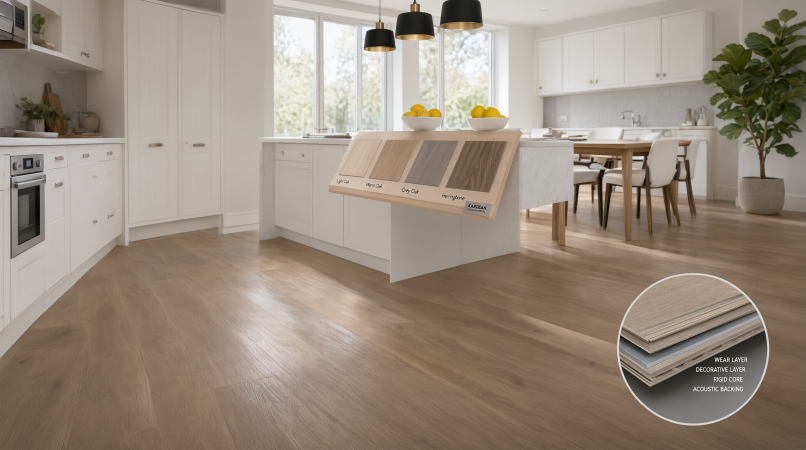
If you have been looking into flooring options for your home, chances are the name Karndean has come up more than once. Karndean flooring is a brand of luxury vinyl tile — commonly called LVT — that is designed to look like real wood or natural stone without the price tag or maintenance headaches that come with those materials. Underneath the surface, it is built from several layers of PVC, with a printed design sealed beneath a tough clear coating. The result is a floor that feels warm under your feet, handles moisture well, and stands up to everyday wear.
In the UK, supply-only prices tend to sit somewhere between £20 and £60 per square metre, depending on which range you go for. On top of that, you will need to budget for fitting and any subfloor preparation. This guide walks you through everything worth knowing — what the different ranges actually offer, what the specifications mean in plain English, where the real costs lie, what can go wrong, and how to make a sensible choice for your home. Prices and specs here are based on retailer listings, cost guides and Karndean’s own documentation checked in November 2026. They do shift over time, so it is always worth double-checking before you place an order.
What Is Karndean Flooring?
One thing that catches people out is that Karndean is not actually a type of flooring material. It is a manufacturer. The material itself is luxury vinyl tile, which most people in the trade shorten to LVT. You will sometimes see LVP (luxury vinyl plank) used as well, usually when sellers are talking about the longer wood-effect formats. So when someone says they have got Karndean in their kitchen, what they really mean is they have got a Karndean-branded LVT floor. The way it is built depends entirely on which range you pick up. If you want a broader look at the whole category rather than just this one brand, there is a separate guide to luxury vinyl plank flooring that covers the lot.
Most Karndean floors follow the same basic construction, working from the top surface down:
- Wear layer — a clear, embossed PVC coating that takes the brunt of daily foot traffic. Karndean puts its K-Guard+ polyurethane surface treatment on top of this for extra protection.
- Decorative layer — a high-resolution printed image that gives the floor its wood, stone or tile appearance.
- Core or backing — flexible PVC in the glue-down ranges, or a rigid core with an acoustic backing attached in the click-fit ranges.
When you start shopping, you will run into four main formats:
| Format | How it is fitted | Typical Karndean ranges |
|---|---|---|
| Glue-down LVT | Bonded to the subfloor with adhesive | Knight Tile, Opus, Van Gogh, Art Select |
| Rigid-core click | Floats; planks lock together | Korlok, Van Gogh Rigid Core |
| Loose lay | Friction-grip backing, little or no adhesive | LooseLay |
| Tile vs plank | Shape only, not a construction type | Offered across most ranges |
Do not fall into the trap of assuming any two Karndean floors are interchangeable. Thickness, wear-layer depth, subfloor requirements and fitting instructions all change from one range to the next.
What Makes Karndean Special?
Three things really set it apart from standard vinyl flooring. First, the realism. Karndean puts a lot of effort into embossed textures, bevelled edges and generously sized planks that are meant to pass as genuine timber or stone rather than looking like a printed sheet. Second, there is the breadth of choice. You will often find the same design available in more than one construction type, so you can fall in love with a particular oak look and then decide whether you want it glued down or clicked together. Third, there is the guarantee. Karndean says its ranges carry a lifetime residential guarantee, though the small print matters — and we will get to that further on.
Karndean Collections: Van Gogh, Oak and Herringbone
Karndean Van Gogh Flooring
Van Gogh is probably the collection people search for by name more than any other. It is a wood-effect range, and the designs stretch from pale French-oak shades like Blush Oak and Greige Oak, through brushed finishes such as Grey, Warm and Golden Brushed Oak, right over to rustic options like Salvaged Barnwood and Canadian Urban Oak. You can get it in both glue-down and rigid-core versions, but the specs are not the same between the two. Retailer listings put the rigid-core version at either 5.5mm or 6.5mm total thickness, always with a 0.55mm wear layer, so make sure you check the exact product code before ordering.
Karndean Oak Flooring
Oak dominates the Karndean catalogue, which means the smart move is to choose by tone rather than getting lost in the names:
- Light and natural oaks — things like Natural Prime Oak and Texas White Ash. These open up smaller rooms and tend to show less dust between cleans.
- Warm and golden oaks — a natural fit for traditional or country-style interiors.
- Grey and greige oaks — Misty Grey and Greige work well in contemporary schemes, though cooler greys can clash if your wall colours run warm.
- Dark and rustic oaks — great at hiding dirt, but they show pale dust and light scuffs more readily.
The best advice here is old-fashioned: order full-size samples and look at them in your own rooms, both in morning light and in the evening when the lamps are on.
Karndean Herringbone Flooring
Herringbone is that classic zigzag pattern made from short rectangular planks laid at right angles to each other. Karndean offers dedicated short-plank formats for it, including Korlok Select herringbone planks that come in at roughly 596mm by 149mm and 6.5mm thick, clicking together as you go. Herringbone costs noticeably more to fit than straight planks because the setting-out and cutting take longer, and wastage runs higher. It is also a pattern that exposes every single alignment mistake, which makes it the one layout where paying for an experienced fitter is genuinely hard to argue against. Karndean publishes a separate herringbone installation guide, and you are better off following that one rather than the standard plank instructions.
Specifications by Collection
| Collection | Format | Total thickness | Wear layer | Installation |
|---|---|---|---|---|
| Knight Tile | Plank and tile | 2.0mm | 0.3mm | Glue-down |
| Opus | Plank and tile | 2.5mm | 0.55mm | Glue-down |
| Van Gogh (glue-down) | Plank | 3.0mm | 0.55mm | Glue-down |
| Van Gogh Rigid Core | Plank | 5.5mm or 6.5mm | 0.55mm | Click-lock |
| Art Select | Plank and tile | 3.0mm | 0.7mm | Glue-down (rigid core also exists) |
| Korlok Select | Plank, tile, herringbone | 6.5mm | about 0.5mm (20 mil) | Click-lock |
| LooseLay | Plank and tile | 4.5mm | 0.5 to 0.55mm | Loose lay |
| Da Vinci | Slim planks | Not confirmed | Not confirmed | Glue-down |
One thing worth flagging: Karndean’s regional websites sometimes quote slightly different wear-layer figures for certain ranges — 0.5mm here, 0.55mm there. Treat the table above as a solid starting point, but always confirm against the UK product page for the specific floor you are buying.
Advantages of Karndean Flooring
- Realistic appearance. The embossing, surface texture and edge detailing give a far more convincing finish than basic sheet vinyl.
- Wide choice. There are dozens of oak, stone and abstract designs spread across several price points.
- Water resistance. The vinyl itself will not swell or rot when it gets wet.
- Easy routine care. A sweep and a damp mop with the right cleaner is the standard maintenance.
- Comfort and sound. It feels warmer and softer underfoot than ceramic tile, and the rigid-core and acoustic-backed products do a decent job of cutting noise transfer to rooms below.
- Underfloor heating compatibility. Karndean allows all of its formats over underfloor heating, as long as the contact temperature stays at or below 27°C.
- Design flexibility. Plank, tile, herringbone, borders and inserts are all on the table.
That said, performance depends on the range you choose, how well it is installed, and how you look after it afterwards. No vinyl floor on the market is scratch-proof or indestructible.
Disadvantages of Karndean Flooring
Karndean is not cheap, and some of its drawbacks are baked into the product. Others come from poor installation rather than any fault in the flooring itself, and it helps to know which is which.
| Disadvantage | Why it happens | How to reduce the risk |
|---|---|---|
| High price compared with basic vinyl | Premium design, embossing, warranty and fitting network | Compare mid-range collections; budget properly for fitting |
| Subfloor preparation costs | Glue-down floors copy every imperfection in the surface below | Allow for smoothing compound, plywood overlay or a damp-proof membrane |
| Scratches and scuffs | Grit, furniture feet and sharp objects abrade or cut the surface | Felt pads, entrance mats, regular sweeping; consider a thicker wear layer |
| Indentation and cuts | Heavy point loads and sharp edges | Use furniture protectors; avoid dragging appliances across the floor |
| Damage from wrong cleaning products | Harsh chemicals, abrasives and steam attack the surface or adhesive | Stick to a pH-neutral cleaner; put the steam mop away |
| Difficult localised repair | Glue-down planks are bonded in place; matching batches can be tricky | Keep spare planks from the same installation batch |
| Moisture beneath the floor | Damp subfloors can undermine both adhesive and the floor itself | Test moisture levels and use a damp-proof membrane where needed |
| Gaps or lifting | Poor subfloor, wrong adhesive, temperature extremes | Professional fitting; follow the installation guide for your specific product |
The first three rows are essentially inherent — you are paying a premium, and you will need preparation work. The rest are largely controllable if you plan ahead. It is also worth knowing that Karndean’s UK guarantee conditions specifically exclude damage from stains, excessive heat, cuts, scratches and scuffs, and from subfloor moisture readings above the limit set out in BS 8203. So those are not warranty matters.
Is Karndean Flooring Waterproof?
The vinyl material itself is waterproof, in the sense that it does not absorb water. That is not quite the same thing as saying the whole room is waterproof. Water can still work its way through gaps at the edges, at joints and at door thresholds, and moisture can rise up from the subfloor underneath.
In practice, here is where things stand:
- Karndean describes its floors as suitable for kitchens and bathrooms.
- The company’s guidance says its floors are not suitable for wet rooms such as shower enclosures, or for areas that will be continually wet. Check the specific guide for the product you are looking at.
- Subfloor moisture still matters. Glue-down floors need the subfloor to read below 75% RH on a hygrometer test; anything above that calls for a surface damp-proof membrane. Rigid-core floors are more tolerant, handling readings up to 95% RH, but beyond that you still need a membrane.
- Silicone sealing around baths, sinks and showers is standard good practice and worth doing regardless.
How Thick Is Karndean Flooring?
Two measurements get mixed up here more often than you would expect. Total thickness is the full depth of the floor, from backing to surface. Wear-layer thickness is just the clear protective coating sitting over the printed design. The wear layer is the better guide to how the surface will hold up over time, because it is the material that actually gets worn away by foot traffic. Total thickness tells you more about comfort, sound reduction and how forgiving the floor will be over a less-than-perfect subfloor.
Is thicker automatically better? Not really. A 6.5mm rigid-core plank with a 0.5mm wear layer might hide subfloor flaws nicely, but it has a thinner wear surface than a 3.0mm Art Select plank sitting at 0.7mm. The trick is matching the product to the room: heavy-traffic spaces benefit from a thicker wear layer, while uneven subfloors tend to favour rigid core.
| Collection | Total thickness | Wear layer | Format |
|---|---|---|---|
| Knight Tile | 2.0mm | 0.3mm | Glue-down plank and tile |
| Opus | 2.5mm | 0.55mm | Glue-down plank and tile |
| Van Gogh glue-down | 3.0mm | 0.55mm | Glue-down plank |
| Van Gogh Rigid Core | 5.5 or 6.5mm | 0.55mm | Click plank |
| Art Select | 3.0mm | 0.7mm | Glue-down plank and tile |
| Korlok Select | 6.5mm | about 0.5mm | Click plank, tile, herringbone |
| LooseLay | 4.5mm | 0.5 to 0.55mm | Loose-lay plank and tile |
How Much Does Karndean Flooring Cost in the UK?
There are really four layers of cost to think about: the material itself, fitting, subfloor preparation, and extras. A quote that just gives you one price per square metre may or may not be covering all of those, so it is always worth asking what is included.
| Collection tier | Typical supply per m² | Typical fitting per m² | Notes |
|---|---|---|---|
| Entry (Knight Tile) | About £20 to £35 | About £17 to £35 | Thinnest wear layer; cost guides vary widely |
| Mid (Van Gogh, Opus) | About £35 to £55 | About £17 to £35 | Tapi lists a Van Gogh straight plank at £44.99 |
| Premium (Art Select) | About £55 to £80 | About £17 to £35 | Tapi lists an Art Select plank at £62.49 |
| Rigid core (Korlok) | About £35 to £55 | Often similar or slightly lower | Faster to fit; less subfloor prep typically needed |
These are indicative ranges pulled from retailers and cost guides in 2026, not firm quotations. Fitting can start at around £17.50 per m² for straightforward glue-down work (Tapi’s starting price) and climb to £35 or more in complex rooms or higher-cost areas. Cost guides put total supply-and-fit somewhere between about £45 and £110 per m², which is a wide spread — but that reflects how much ranges and room conditions can vary. And do check whether any quoted price includes VAT.
Extras worth budgeting for:
- Uplifting old flooring (from around £6.50 per m² at one retailer, £3 to £5 in a cost guide)
- Smoothing compound (from about £7 per m²)
- Plywood overlay (from about £9 per m²)
- Damp-proof membrane (from about £11 per m²)
- Adhesive
- Door trimming and edge strips
Illustrative Budget: 20 m² Room
Here is how the numbers work for a typical-sized room:
The material formula is: required area × (1 + cutting allowance) × price per m², rounded up to whole packs.
Allow 10% for cutting and waste: 20 × 1.10 = 22 m².
Packs are 3.25 m² each: 22 ÷ 3.25 = 6.77, so you would order 7 packs (22.75 m²).
Material at £44.99 per m²: 22.75 × 44.99 = £1,023.52.
Fitting (glue-down, charged on floor area): 20 × £17.50 = £350.
Smoothing compound: 20 × £7 = £140.
Uplift of old floor: 20 × £6.50 = £130.
Total: about £1,644, which works out to roughly £82 per m² of floor area, before adhesive and trims. Swap in an Art Select plank at £62.49 instead, and materials jump to 22.75 × 62.49 = £1,421.65, with the same extras pushing the total to about £2,042 (roughly £102 per m²). These are examples, not quotes. Straight plank layouts usually need around 5 to 10% allowance; herringbone typically needs more.
So why is Karndean expensive? You are paying for a high-definition print, proper embossing, a protected surface, a range of construction options and a guarantee, all sold through a retail partner network. On top of that, fitting is skilled work.
How Is Karndean Flooring Installed?
The installation method depends on the product you have chosen. Always follow the official guide for your specific range rather than relying on general advice.
Subfloor Preparation
Karndean works to BS 8203, the UK code of practice for resilient floor coverings. The subfloor needs to be firm, flat, clean, dry and free from any old adhesive residues. In practice, that means:
- Remove old flooring and any adhesive residue. If the tiles or adhesives are old, have them checked for asbestos before disturbing them.
- Test moisture with a hygrometer. For glue-down installations, you want to see below 75% RH.
- Repair cracks and level the surface with a compatible smoothing compound.
- Lay a damp-proof membrane if the moisture reading is too high.
- Keep the room between roughly 18°C and 27°C, and let the planks acclimatise. Karndean specifies 48 hours for LooseLay.
Glue-Down vs Click-Lock
Glue-down floors are bonded directly to the subfloor with adhesive. They give the most stable finish in larger rooms and over underfloor heating, but they are the least forgiving when the subfloor is not perfectly flat. Click-lock rigid-core floors float over the subfloor, are quicker to fit and hide minor imperfections more effectively, though they still need a sound, dry base to sit on. LooseLay uses a friction-grip backing, is easy to lift and replace individual planks, and has its own moisture limits — it can handle subfloors up to 75% RH, and up to 95% RH if fitted without adhesive.
Can Anyone Lay Karndean Flooring?
Technically, a competent DIYer can fit click or loose-lay products. Glue-down and herringbone installations are better left to professionals, because the subfloor preparation, adhesive selection and setting-out are the areas where mistakes become expensive ones fast. The guarantee also depends on how the floor is installed. Karndean’s UK conditions require installation in line with its own instructions and BS 8203, and the warranty document ties the residential guarantee to professional fitting. Check the terms carefully before you decide to go down the DIY route.
How to Clean Karndean Flooring
Karndean’s recommended cleaning routine is refreshingly straightforward:
- Sweep or vacuum to remove grit — use the hard-floor setting on your vacuum.
- Damp mop with Karndean Clean or another pH-neutral, fragrance-free cleaner approved for vinyl, diluted as the label instructs.
- Wipe up spills promptly.
- For stubborn marks, spot clean with Karndean Remove or a concentrated pH-neutral cleaner.
- Once or twice a year, Karndean suggests using its Remove and Refresh products to bring the surface back to its best.
Things to avoid: steam cleaners (the heat and moisture can attack both the adhesive and the surface), abrasive pads and powders, harsh chemicals, and ammonia-based cleaners — one UK retailer’s leaflet specifically warns they can permanently darken LVT. Felt furniture protectors and entrance mats go a long way towards cutting down grit and scratching.
Karndean Flooring Reviews and Common Problems
Karndean’s company profile on Trustpilot carried a 4.5 out of 5 TrustScore from roughly 1,000 reviews as of 2026. Most of those reviews focus on the sample service and showroom staff, so they do not tell you a great deal about how the floor itself performs five or ten years down the line. Trustpilot’s own summary noted that a handful of customers reported inconsistent thickness and gaps appearing after installation. Star ratings are one signal, but they are not the whole picture.
When you are reading through complaints, it helps to separate out the likely cause:
- Product defect — inconsistent batches or faulty planks. This is rare, and it is covered by the guarantee if you report it before installation.
- Installation error — gaps, lifting edges, adhesive problems and ridges that mirror the subfloor underneath.
- Maintenance issues — dull patches or marks caused by steam cleaning or the wrong products.
- Normal wear — scuffs and fine scratches in high-traffic areas.
- Environmental factors — underfloor heating hotspots, strong direct sunlight or high subfloor moisture.
One practical tip: check planks for batch consistency before you fit them, because claims are generally not accepted once the floor has been installed.
What Flooring Is Similar to Karndean?
| Option | How it compares |
|---|---|
| Amtico | The closest rival. Premium LVT with similar wear layers at the top of each range. Amtico Signature is described as 2.5mm thick with a 0.7mm wear layer, and it tends to cost more. |
| Other LVT brands (Polyflor and others) | Often cheaper, with variable wear layers. Compare like for like on wear layer and warranty. |
| Standard luxury vinyl or SPC click | Usually lower cost; check wear layer and core quality carefully. |
| Laminate | Cheaper and harder, but moisture is a weakness unless you go for a specifically water-resistant product. See the guide to waterproof laminate flooring for more. |
| Engineered wood | Real timber surface, higher cost, more sensitive to moisture. |
Cork is another option worth a look — it is warm and quiet underfoot, and there is a separate piece covering cork flooring pros and cons if you want to explore it. No option is universally better than the others. The right choice depends on your budget, the conditions in the room, the look you are after, and the actual wear-layer specification on the product you are considering.
Is Karndean Suitable for Different Rooms?
- Kitchens and utility rooms: a good fit, given the water resistance and easy cleaning. Seal the edges and keep an eye on areas around dishwashers and washing machines.
- Bathrooms: suitable for typical domestic bathrooms, but not for shower floors or areas that will be continually wet.
- Living rooms, dining rooms and bedrooms: well suited. The comfort and sound reduction are genuine benefits in these spaces.
- Hallways: go for a thicker wear layer and use an entrance mat to catch grit from outside.
For a room-by-room comparison of different flooring materials, there is a separate guide covering flooring options for different rooms.
Is Karndean Flooring Worth It?
It is worth it if you want a convincing wood or stone look, easy day-to-day care and a guaranteed, professionally fitted floor — and you are prepared to pay for proper preparation and fitting. It is harder to justify in a very low-budget project, a wet-room floor, a damp basement, or a situation where you are planning to DIY a glue-down or herringbone installation.
A sensible approach is to choose the range based on wear layer and installation method, order full-size samples before committing, get a fitted quote that breaks out preparation and extras as separate line items, and confirm the guarantee terms in writing.
Frequently Asked Questions
Is Karndean a good flooring? Generally, yes — within its category. It is a premium LVT with realistic designs and a guarantee behind it, but the end result still depends on the range you choose, how well it is installed, and how you care for it over the years.
What is the most popular Karndean flooring? Karndean does not publish a verified sales ranking that we could find. Van Gogh and its oak designs are heavily stocked by UK retailers, which suggests strong demand, but that is not the same as a confirmed bestseller list.
What are some common problems with Karndean flooring? Scuffs and scratches, edge lifting, gaps, adhesive issues and damage from steam or harsh cleaners. Most of these trace back to subfloor preparation, installation or maintenance rather than a fault in the product itself.
Can I put Karndean over underfloor heating? Karndean states that all of its formats can be installed over underfloor heating, provided the floor surface contact temperature never goes above 27°C.
Where can I buy Karndean near me? Karndean sells through a national network of retail partners and offers samples online. You can use the store finder on its UK website to locate suppliers in your area.