
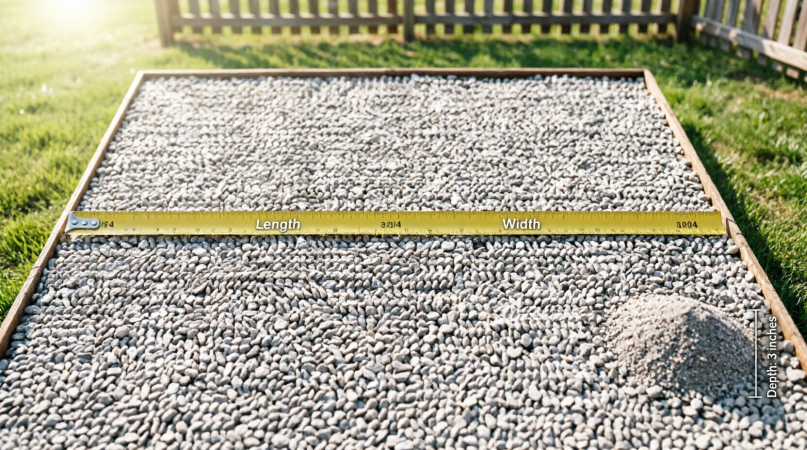
Planning a landscaping project, a new driveway, or a drainage bed? Getting your gravel quantities right is the difference between a smooth, finished job and a frustrating mid-project supply run.
At its core, calculating gravel is about finding volume. You multiply length by width by depth to get your total volume, then convert that to cubic yards. If your depth is measured in inches (which is standard), the quickest shortcut is:
Cubic yards = Length (ft) × Width (ft) × Depth (in) ÷ 324
For example, a 10 ft × 10 ft area covered 3 inches deep requires about 0.93 cubic yards of gravel. Assuming a standard bulk density of 2,700 lbs per cubic yard, that translates to roughly 1.25 tons.
You can use the interactive gravel calculator on this page to run your specific numbers. Below, we break down the math behind the tool, how to convert yards to tons, how far a single ton will actually spread, and how much extra material you should order to be safe.
How to Use a Gravel Calculator (or Do It Yourself)
You only need three basic measurements:
- Length of the area, in feet.
- Width of the area, in feet.
- Depth of the gravel layer, in inches.
Pro Tip: Keep your units consistent. Mixing feet and inches without converting is the number one reason people end up off by a factor of 12.
The result gives you a theoretical volume, usually in cubic yards, since that’s how bulk gravel is measured and sold across the US. However, many suppliers sell by the ton. This means you’ll often need a second step: converting that volume into weight using the specific density of your chosen material (more on that below).
Remember, this output is a theoretical volume for a perfectly flat, even layer. It doesn’t account for uneven ground, natural settling, or spillage. You’ll want to add a buffer for that.
How to Calculate Gravel by Hand
The Volume Formula (Rectangles)
- Cubic feet = Length (ft) × Width (ft) × Depth (ft)
- Cubic yards = Cubic feet ÷ 27
Since depth is usually measured in inches, you convert it to feet by dividing by 12. Combining both conversions gives us that handy shortcut: Cubic yards = Length (ft) × Width (ft) × Depth (in) ÷ 324
Why 324? It’s simple math: 12 (inches in a foot) multiplied by 27 (cubic feet in a cubic yard, since 3 ft × 3 ft × 3 ft = 27).
If you already know your total area in square feet, the formula simplifies to: Cubic yards = Area (sq ft) × Depth (in) ÷ 324
The Metric Formula
- Cubic meters = Area (m²) × Depth (m)
(If your depth is in centimeters, divide by 100 first).
For quick reference: 1 cubic meter ≈ 1.308 cubic yards, and 1 inch = 25.4 mm.
Circles and Irregular Shapes For a circular area, find the area first (Area = π × Radius²). A circular fire pit area 12 ft across has a 6 ft radius, making the area roughly 113.1 sq ft. At 3 inches deep: 113.1 × 3 ÷ 324 ≈ 1.05 cubic yards.
For irregular shapes, just divide the space into smaller rectangles or circles, calculate each volume, and add them together. If the ground slopes, use an average depth for that section.
Real-World Gravel Calculator Examples
These are practical calculations using the formulas above. Keep in mind, these are theoretical volumes before adding any safety buffer.
How much gravel for a 10×10 area?
Total area is 100 sq ft.
- At 2 inches deep: 100 × 2 ÷ 324 = 0.62 cubic yards
- At 3 inches deep: 100 × 3 ÷ 324 = 0.93 cubic yards
- At 4 inches deep: 100 × 4 ÷ 324 = 1.23 cubic yards
How much gravel for a 10×12 area?
Total area is 120 sq ft. At 4 inches deep: 10 × 12 × 4 ÷ 324 = 480 ÷ 324 = 1.48 cubic yards. Every extra inch of depth adds about 0.37 cubic yards to this specific footprint.
How much gravel do I need for 120 sq ft?
Area alone isn’t enough; depth dictates the answer.
| Depth | Calculation | Cubic Yards |
|---|---|---|
| 2 inches | 120 × 2 ÷ 324 | 0.74 yd³ |
| 3 inches | 120 × 3 ÷ 324 | 1.11 yd³ |
| 4 inches | 120 × 4 ÷ 324 | 1.48 yd³ |
How much gravel do I need for 100 square meters?
Let’s assume a 5 cm (0.05 m) layer.
100 m² × 0.05 m = 5 cubic meters (about 6.5 cubic yards).
If you need 10 cm depth, that same area requires 10 cubic meters. To convert this to weight, we apply density. Assuming 1,600 kg per cubic meter, 5 cubic meters weighs about 8,000 kg, or 8 metric tonnes.
Quick Reference for Common Sizes
| Area | 2 in Depth | 3 in Depth | 4 in Depth |
|---|---|---|---|
| 100 sq ft | 0.62 yd³ | 0.93 yd³ | 1.23 yd³ |
| 120 sq ft | 0.74 yd³ | 1.11 yd³ | 1.48 yd³ |
| 240 sq ft | 1.48 yd³ | 2.22 yd³ | 2.96 yd³ |
How Much Area Does a Cubic Yard of Gravel Cover?
Coverage is just the volume formula in reverse. One cubic yard contains 324 “square-foot-inches.” Therefore:
Coverage (sq ft) = 324 ÷ Depth (in)
| Depth | Coverage per Cubic Yard |
|---|---|
| 1 inch | 324 sq ft |
| 2 inches | 162 sq ft |
| 3 inches | 108 sq ft |
| 4 inches | 81 sq ft |
| 5 inches | 64.8 sq ft |
| 6 inches | 54 sq ft |
| 8 inches | 40.5 sq ft |
| 12 inches | 27 sq ft |
Note: These figures assume a perfectly uniform layer with zero waste. Also, coverage per cubic yard is not the same as coverage per ton, which brings us to density.
Gravel Calculator in Tons: Volume vs. Weight
Square feet measure surface area. Cubic yards measure volume. Tons measure weight. You can calculate volume from dimensions alone, but converting to weight requires bulk density. Different materials, stone gradations, and moisture levels all change how much a cubic yard weighs.
Weight = Volume × Bulk Density
- US Customary: Short tons = Cubic yards × Density (lb/yd³) ÷ 2,000
- Metric: Metric tonnes = Cubic meters × Density (kg/m³) ÷ 1,000
(A US short ton is 2,000 lbs. A metric tonne is 1,000 kg. They are not interchangeable).
What density should you use?
When inputting your measurements into the gravel calculator, keep in mind that supplier references for loose crushed stone typically put bulk density around 2,700 to 2,800 lbs per cubic yard (about 1.35 to 1.4 tons). If your gravel calculator is estimating a blended road base or crusher run, expect it to run heavier, up to 3,000 lbs per cubic yard. Furthermore, if you are using the gravel calculator for pea gravel or river rock, the final weight will differ, because moisture and higher fines content also add significant weight.”
Treat these as planning estimates. If your local supplier quotes a specific tons-per-yard figure for the exact product you’re buying, use that number.
Worked Example:
A 10 ft × 10 ft area, 3 inches deep, using an assumed density of 2,700 lbs/yd³:
- Volume: 100 × 3 ÷ 324 = 0.926 cubic yards
- Weight: 0.926 × 2,700 ÷ 2,000 = ~1.25 short tons
How much area will 1 ton of gravel cover?
First, convert the ton to volume. At 2,700 lbs/yd³, one short ton is 2,000 ÷ 2,700 = 0.74 cubic yards (or 20 cubic feet). Then, divide by your depth in feet.
| Depth | Coverage per Short Ton (at 2,700 lb/yd³) |
|---|---|
| 2 inches | 120 sq ft |
| 3 inches | 80 sq ft |
| 4 inches | 60 sq ft |
| 6 inches | 40 sq ft |
This is an illustration, not a hard rule. At 3,000 lbs/yd³, a ton covers about 72 sq ft at 3 inches deep. At 2,800 lbs/yd³, it covers roughly 77 sq ft.
What do 2 tonnes of gravel look like?
Two metric tonnes is 2,000 kg. Two US short tons is 4,000 lbs (about 1,814 kg). The physical pile size depends entirely on density.
- 2 metric tonnes (at 1,600 kg/m³) ≈ 1.25 cubic meters, or 1.6 cubic yards.
- 2 short tons (at 2,700 lbs/yd³) ≈ 1.5 cubic yards, or 40 cubic feet.
For scale, 40 cubic feet is the volume of a cube roughly 3.4 ft on each side. A loose delivery pile will naturally spread out wider and sit lower than a perfect cube.
3/4-Inch Gravel and the “Gravel Calculator Tons” Question
When using a gravel calculator, the volume formula doesn’t change based on stone size. Only the weight estimate generated by your gravel calculator changes, because the density of 3/4-inch crushed stone differs from pea gravel or crusher run. Always calculate your volume first with the gravel calculator, then apply the specific density provided by your supplier to get the most accurate tonnage.
How Much Gravel Do You Need for a Driveway?
Start by defining the gravel’s purpose. A simple surface refresh on an existing, stable base requires far less material than a full driveway build featuring a compacted base and a finish layer.
Example Scenario: A driveway 12 ft wide and 50 ft long equals 600 sq ft.
- At a 4-inch compacted depth: 600 × 4 ÷ 324 = 7.41 cubic yards
- Add a 10% buffer for settling and uneven ground: 7.41 × 1.10 = 8.15 cubic yards
- Converted at 1.35 tons per cubic yard: 7.41 × 1.35 ≈ 10.0 tons (or 11.0 tons with the buffer).
If your driveway requires a 4-inch base layer plus a 2-inch top layer, calculate each layer separately. Together, they equal 600 × 6 ÷ 324 = 11.11 cubic yards. This separation matters when the layers use different products with different densities. Always keep your base calculated volume separate from your buffer so you know exactly what you adjusted and why.
Is 2 inches of gravel enough?
When using a gravel calculator, the ideal depth depends entirely on the job. Two inches can work perfectly as a decorative top layer over a weed barrier, which your gravel calculator can easily estimate for a simple garden path. However, if your gravel calculator is being used for a functional driveway, a drainage bed, or any layer expected to carry heavy vehicles, 2 inches is generally too thin. A good rule of thumb to input into any gravel calculator is to keep the gravel layer at least twice as deep as the largest stone in it. Therefore, if your gravel calculator shows a 2-inch depth, it is already pushing the limits for standard 3/4-inch stone. Always verify these depth requirements with local codes or an engineer, rather than relying solely on a basic gravel calculator output.
Gravel Size and Material Selection
“Gravel” is a broad term covering several distinct products. Your choice directly impacts weight, drainage, and how the surface feels underfoot or under tires.
- Pea Gravel: Small, smooth, rounded stones. Common for garden paths, play areas, and decorative beds. Be aware that it shifts underfoot because the stones don’t lock together.
- Crushed Stone: Angular pieces that interlock and compact well. A standard grading is #57 stone (defined in ASTM D448 and AASHTO M43), which is roughly 1 inch down to 1/4 inch. It’s often casually called “3/4-inch stone.” This clean, open-graded product is a go-to for drainage and driveways.
- #67 Stone: Slightly smaller than #57, ranging from about 3/4 inch down to 1/4 inch, often used for slab bedding.
- Crusher Run / Dense-Grade Blends (e.g., #411): Crushed stone mixed with stone dust (fines). This allows it to pack down tightly into a solid, stable surface, making it ideal for a compacted driveway base rather than a loose top layer.
- Drainage Stone: Clean, washed stone with very few fines (like #57 or #8), specifically chosen for French drains and pipe bedding so water can flow freely.
What is 2-inch gravel called?
“2-inch gravel” usually refers to the nominal stone size, not the depth of the layer. In US aggregate grading, this often corresponds to products like #3 stone (roughly 2 inches down to 1 inch). You might also hear “2-inch minus,” which means the material includes everything smaller than 2 inches, fines included. Naming conventions vary by region, so always confirm the exact grading with your supplier.
Is 20 mm gravel the same as 3/4-inch gravel?
Not exactly, though they are close. 3/4 inch equals 19.05 mm, while 20 mm is about 0.79 inch. The same volume formula applies to both, but they aren’t identical specifications. US suppliers typically sell by ASTM and AASHTO size numbers, whereas 20 mm is the standard designation in metric markets
Gravel Bags, Bulk Delivery, and Ordering
How many bags of gravel is 1 cubic meter?
You simply divide 1 cubic meter (1,000 liters) by the volume printed on each bag:
- 20-liter bags: 50 bags
- 25-liter bags: 40 bags
- 40-liter bags: 25 bags
In US units, a bag labeled 0.5 cubic feet yields 27 ÷ 0.5 = 54 bags per cubic yard. These counts assume the label shows the actual volume of the contents. If bags are sold by weight, you’ll need the bag weight and the product’s density to estimate volume accurately. Always check the label, as bag sizes differ by retailer.
Allowances, Delivery, and Cost
Reasons to order more than your calculated volume include uneven subgrades, minor measurement errors, compaction, settling, and spillage. The exact amount is project-specific, but a 5% to 10% buffer is a common, safe illustration.
Suppliers often have minimum load requirements or set delivery increments (like full truckloads vs. partial loads), so ask before finalizing your quantity.
To estimate cost, multiply your final quantity by the supplier’s actual price:
- By the ton: tons × price per ton
- By the cubic yard: cubic yards × price per cubic yard
- By the bag: bags × price per bag
Don’t forget to add delivery fees. Prices fluctuate significantly by region, material type, and season. Always use a current quote from a local supplier rather than relying on outdated national averages.
Frequently Asked Questions
How do I calculate gravel?
Multiply your length (ft) × width (ft) × depth (in), then divide by 324 to get cubic yards. If you need the weight in tons, multiply that cubic yard total by your specific product’s tons-per-cubic-yard density.
How much will 1 ton of gravel cover?
Assuming a standard density of 2,700 lbs per cubic yard, one short ton will cover about 80 sq ft at a 3-inch depth. The exact figure shifts based on the material’s specific density and your target depth.
What size gravel should I use?
For driveways and drainage, #57 crushed stone (about 3/4-inch) is the industry standard, often laid over a compacted base. For walking paths and decorative beds, pea gravel or smaller crushed stone is more common. The right choice depends on your drainage needs, expected traffic, and desired aesthetic.
How many bags of gravel is 1 cubic meter?
It depends entirely on the bag volume. Typically, it’s 50 bags of 20 L, 40 bags of 25 L, or 25 bags of 40 L.
Conclusion
Always start with volume: length × width × depth, converted to cubic yards. Only convert to tons once you have the specific density for the actual product you’re buying, and always add a site-specific allowance for settling and uneven ground. Ask your supplier for the exact tons-per-yard figure for your chosen material, then run those numbers through the gravel calculator above to ensure you order exactly what you need.
1 thought on “Gravel Calculator: Estimate Cubic Yards, Tons, and Coverage”