
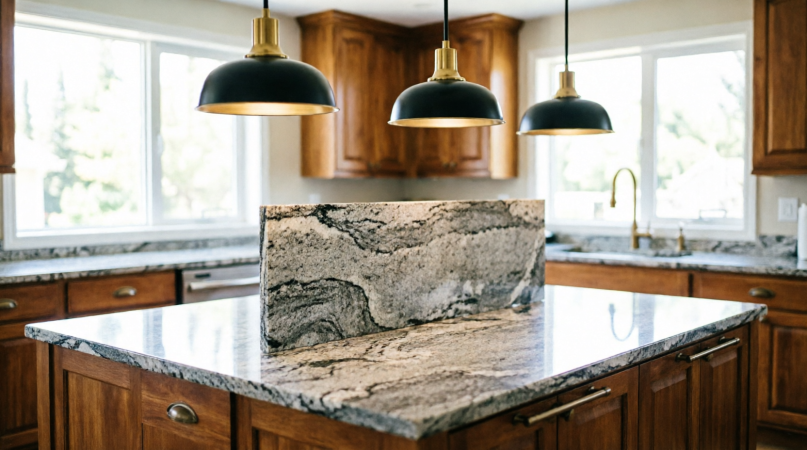
Granite countertops are essentially thick slices of natural stone, cut to size and polished for your kitchen. Homeowners have loved them for years because they’re tough, handle hot pans without flinching, and every single slab looks a little different from the next. That said, they’re not perfect — they’re heavy, they cost a fair amount, and some varieties need a bit of maintenance. You’ll need a professional crew to install them, and depending on the stone, you may need to seal it every now and then. Sharp knocks on the edges can chip them too.
If you’re weighing granite countertops against engineered quartz, you should know that quartz tends to resist stains a touch better and never needs sealing. The price ranges for both materials actually overlap quite a bit, so the decision usually comes down to whether you prefer natural variation or a more uniform look.
Opting for granite countertops works well if you want a surface that feels unique and you’re okay with a little upkeep. If you’d rather have matching slabs and almost zero maintenance, quartz might be the way to go. The sections below walk through everything — pricing, comparisons, cleaning methods, design ideas, and how to get quotes that actually mean something.
What Are Granite Countertops?
Granite is a hard, coarse-grained natural stone composed mostly of quartz and feldspar. Here’s something that trips people up: countertop suppliers sometimes label stones as “granite” that aren’t technically granite in the geological sense. So the term covers a broader range of materials than you might expect. Each slab is cut from a quarried block, which is exactly why no two slabs look identical. The color, speckling, and veining shift from quarry to quarry — and even from one slab to the next within the same batch.
There are three stages in the process that people often mix up:
- Slab selection: You pick the actual stone, ideally by visiting the yard in person.
- Fabrication: A shop templates your kitchen layout, cuts the slab to fit, and shapes the edges and cutouts.
- Installation: A crew sets the pieces on your cabinets, joins the seams, and hooks up the sink and fixtures.
Granite shows up in kitchen perimeters and islands, bathroom vanities, bar areas, and laundry rooms. The most common finishes are polished (glossy and reflective), honed (smooth with a matte look), and leathered (a softly textured surface with some grip).
Pros and Cons of Granite Countertops
What is the downside of granite countertops? The biggest drawbacks are the upfront cost (which can be steep for premium stones), the sheer weight of the slabs (which demands sturdy cabinets and trained installers), visible seams and natural color variation, and the fact that some stones need periodic sealing. Edges and corners are also vulnerable to chipping if something heavy hits them.
Advantages
- You get a genuinely natural look with patterns no factory can replicate.
- It performs well under pressure. Consumer Reports rated granite excellent for cutting resistance, abrasion resistance, and heat resistance — though they also pointed out that neither granite nor quartz is truly indestructible.
- The color range is broad, running from near-white all the way to deep black.
- When you pick the right stone, install it properly, and take care of it, granite lasts a very long time.
Drawbacks
- Cost: Most installed projects land in the thousands, and exotic stones push that number much higher.
- Weight: A 3 cm slab weighs roughly 16 to 17 pounds per square foot (based on typical granite density). A 34-square-foot kitchen therefore carries well over 500 pounds of stone, so your cabinets need to be solid and level.
- Variation: Slabs from the same stone name can differ noticeably, so planning seam placement takes thought.
- Staining: Granite is somewhat porous, though it varies by stone. Dense dark granites absorb very little, while lighter or more open stones can soak up oil and liquids.
- Chipping: Hard impacts along edges and around sink cutouts can chip or crack the stone.
- Sealing: Some granite benefits from periodic sealing, which I’ll cover in detail below.
No granite is stainproof, scratchproof, or immune to damage. If a seller tells you otherwise, walk away.
How Much Do Granite Countertops Cost in 2026?
Is granite countertop expensive? It sits in the mid-to-high price range, and the final number depends heavily on which stone you choose. Published figures often disagree because different sources define “installed” in different ways. The table below shows what major sources reported when I reviewed them in October 2026. Treat these ranges as a planning bracket, not a firm quote. All figures are in US dollars.
| Pricing item | What it includes | Reported figure and source | How it affects the budget |
|---|---|---|---|
| Material only | The slab or stone, without fabrication or installation | About $40 to $60 per sq ft for basic slabs (HomeAdvisor) | Depends on the stone and supplier. Not a full budget. |
| Typical installed project | Material, fabrication, and installation | $2,000 to $4,500 total, average $3,250 (HomeAdvisor and Angi) | The most useful number for a standard kitchen, but it hides size and stone differences. |
| Installed, per sq ft | Material, fabrication, and installation, defined differently by each source | About $40 to $100 (Consumer Reports, for granite and quartz); about $97 to $141 for mid-range work including removal and supplies (Homewyse, May 2026) | The spread is wide. Ask each supplier exactly what their per-foot price covers. |
| Old counter removal | Tear-out and disposal | About $4 to $7 per sq ft (Angi) | May be included in some quotes and extra in others. |
| Extras | Edge upgrades, cutouts, backsplash | Sink cutout about $100; ogee edge about $20 to $25 per linear ft; 4-inch backsplash about $10 to $15 per linear ft (HomeAdvisor) | Can add several hundred dollars on a typical kitchen. |
I didn’t average these into one national number because a material-only price and an all-in installed price describe completely different things.
What drives the final price
- Stone grade, rarity, color, and pattern. Common stones sit at the low end, while rare imports can cost much more.
- Slab thickness (2 cm or 3 cm) and finish. Honed and leathered finishes often carry a premium over polished.
- Total square footage and layout, including seams and waste factor.
- Edge profile, sink and cooktop cutouts, and backsplash height.
- Delivery, fabrication, and installation labor, which vary by region.
- Removal and disposal of the old countertop.
Worked budgeting example
This is an illustration, not a real quote. Suppose your kitchen has two straight runs — one 10 feet long and one 6 feet long, each 25.5 inches deep.
- Run A: 10 ft × 25.5 in ÷ 12 = 21.25 sq ft
- Run B: 6 ft × 25.5 in ÷ 12 = 12.75 sq ft
- Total area: 21.25 + 12.75 = 34 sq ft
Now assume an installed price of $70 per sq ft (picked from within the published ranges above), and add extras that may not be included in your quote:
| Line item | Assumption | Low | High |
|---|---|---|---|
| Installed granite | 34 sq ft × $70 | $2,380 | $2,380 |
| Old counter removal | 34 sq ft × $4 to $7 | $136 | $238 |
| Edge upgrade | 16 linear ft × $20 to $25 | $320 | $400 |
| 4-inch backsplash | 16 linear ft × $10 to $15 | $160 | $240 |
| Sink cutout | One cutout | $100 | $100 |
| Estimated total | $3,096 | $3,358 |
The general formula is: estimated total = measured area × installed price per sq ft + extras not included in the quote. If your quote already bundles removal or an edge upgrade, don’t count them twice.
Granite vs. Quartz Countertops: Which Is Better?
Neither material wins for every homeowner. Granite is natural stone. Conventional engineered quartz is manufactured from ground quartz, resin binders, and pigments. And just to clear up a common confusion — engineered quartz is not the same thing as natural quartzite, which is an entirely different natural stone.
| Factor | Granite | Engineered quartz |
|---|---|---|
| Composition | Natural stone | Ground quartz, resin, and pigments |
| Pattern consistency | Varies by slab | Consistent and predictable |
| Color range | Wide, but natural tones dominate | Very wide, including marble-look patterns |
| Scratch resistance | Excellent in Consumer Reports testing | Excellent in Consumer Reports testing |
| Heat resistance | Excellent in testing; use trivets as a precaution | Excellent in testing; manufacturers generally advise trivets |
| Stain resistance | Good, varies by stone and sealer | Scored higher with some staining substances in Consumer Reports testing |
| Sealing | Some stones benefit; others don’t need it | Not required |
| Chip risk | Possible at edges | Possible at edges |
| Cost | Overlaps with quartz | Overlaps with granite |
Which is better, quartz or granite? Consumer Reports describes both as top-tier materials that perform equally well across many tests. Quartz has a slight advantage on stain resistance and doesn’t need sealing. Granite appeals to buyers who want natural, one-of-a-kind variation.
Why are people using quartz instead of granite? Quartz gives you consistent slabs, a broader color palette (including convincing marble-like patterns), and less day-to-day upkeep. Consumer Reports also noted that quartz’s uniform manufacturing process makes seams easier to match up.
What is cheaper, granite or quartz? It depends. Consumer Reports and other sources put both in overlapping price ranges, so the cheaper option comes down to the specific product, your region, and the fabricator you choose. The smart move is to compare itemized quotes for the exact stones you like.
Granite Countertop Colors and Design Ideas
Granite countertops ideas generally fall into four families:
- White and light granite: Brightens a kitchen and pairs beautifully with dark or wood cabinets. Stones with gray or gold veining read as more dramatic.
- Black and dark granite: Delivers strong contrast and often has very low porosity. Honed finishes hide fingerprints better than polished ones.
- Gray granite: A flexible neutral that works with white, navy, or natural wood cabinets.
- Beige and brown granite: Adds warmth and suits traditional or earthy kitchen designs.
Choose the finish alongside the color. Polished brings out the deepest color and the most shine. Honed and leathered finishes look softer and more textured.
Should a countertop be lighter or darker than the floor? There’s no hard-and-fast rule. Contrast matters more than any specific direction. A countertop that differs from the floor and cabinets in tone tends to stand out, while a close match creates a calmer, more uniform feel. Cabinet color, lighting, and room size all play into the result.
Some practical tips:
- Islands: A bolder stone on the island can anchor the room while the perimeter stays calmer.
- Backsplash: Keep it simple if the granite has strong movement. A busy stone and a busy tile fight for attention.
- Samples: Small samples can mislead you. See the actual slab, or at least a large piece of the same stone, under your own kitchen lighting before committing.
Kitchen Countertop Trends in 2026
What is the 2026 trend for kitchen countertops? Designers and industry reports point toward natural-looking stone with visible movement, warm earthy colors, and softer finishes. These are observations, not guarantees.
- Natural stone: Design coverage citing the NKBA 2026 kitchen trends report says more homeowners are choosing natural stone. The report also noted a shift from white and gray toward browns and off-whites.
- Honed and leathered finishes: Several designers and manufacturers describe matte or softly textured finishes replacing high gloss. Much of that coverage focuses on quartzite and quartz, but honed and leathered finishes are available on granite too.
- Stone brought up the wall: Designers describe running the countertop material into the backsplash for a cohesive, seamless look.
- Waterfall edges: Opinions conflict. One designer roundup calls them over, while others still show them on islands. Treat this as a personal style choice.
Trends change faster than countertops do. Pick a color and finish you’ll still love in ten years, and let trends influence smaller, easier-to-swap elements like hardware and lighting.
How to Clean and Maintain Granite Countertops
How to clean granite countertops:
- Clear crumbs and loose debris with a soft cloth.
- Wipe with a soft cloth and warm water mixed with a few drops of mild dish soap, or a pH-neutral stone cleaner.
- Rinse by wiping again with a cloth dampened with clean water to remove soap residue.
- Dry with a clean, dry microfiber cloth to prevent streaks and water spots.
- Wipe up spills promptly, especially oil, wine, coffee, and acidic liquids like lemon juice.
Avoid:
- Abrasive scrub pads and powders.
- Vinegar, lemon, or other acidic cleaners unless the stone-care manufacturer confirms they’re safe for your stone.
- Assuming every household spray is safe for natural stone.
- Cutting directly on the surface, which dulls knives and can mark the finish.
- Setting very hot cookware down without a trivet, because rapid temperature changes can stress stone.
Does granite need to be sealed?
It depends on the stone. The Natural Stone Institute’s position, as summarized by Hunker, is that granite can benefit from a quality sealer, but dark granite usually doesn’t need one — especially if it was resin-treated at the factory. Some experts actually advise against sealing very dense stones because it can leave a streaky residue. There’s no single schedule that suits every kitchen.
A simple check is the water test: put a few drops of water on the stone and wait about 30 minutes. If the stone darkens, water is soaking in and sealing may help. If the water beads up and the stone stays light, you likely don’t need to seal yet. Follow your fabricator’s or the sealer maker’s instructions, and always test any new product on a hidden spot first.
Is Granite the Best Countertop Material?
What is the best material for a countertop? There’s no single answer. It depends on your budget, the look you want, how much maintenance you’ll tolerate, and how you cook.
| Material | Main advantage | Main limitation | Best for |
|---|---|---|---|
| Granite | Natural look, strong heat and scratch resistance | Heavy; some stones need sealing | Buyers who like natural variation |
| Engineered quartz | Consistent patterns, no sealing | Resin can be sensitive to excessive heat | Low-maintenance family kitchens |
| Laminate | Lowest cost | Less heat and impact resistant | Tight budgets and rentals |
| Butcher block | Warm look, easy to refinish | Needs oiling and can scratch or stain | Islands and warm designs |
| Marble | Classic veining | Soft, porous, and prone to etching | Bakers and low-traffic areas |
| Porcelain or sintered surface | Very hard and heat tolerant | Edges can chip; specialist fabrication | Modern designs |
| Solid surface | Seamless and repairable | Softer; can scratch and scorch | Seamless sink runs |
What is the newest material for kitchen countertops? Porcelain and sintered (ultra-compact) surfaces are among the newer options, along with quartz in new matte and veined styles. Newer isn’t always better, though — Consumer Reports testing found one ultra-compact product cracked in its drop test, although the manufacturer disputed those conditions.
What Is Fake Granite Called?
“Fake granite” is an informal phrase, not a single material name. Products that imitate granite include:
- Granite-pattern laminate.
- Engineered quartz in speckled, granite-like patterns.
- Solid-surface products with a printed or flecked look.
- Other manufactured surfaces with stone-inspired patterns.
A granite look doesn’t tell you what a surface is actually made of. Check the product specification, the manufacturer, and the warranty before you buy.
Cheaper Alternatives to Granite Countertops
What is a cheaper alternative to granite countertops? Laminate is typically the lowest-cost option, and solid surface and butcher block often cost less than granite as well, depending on the product. Granite tile is also much cheaper than a slab — HomeAdvisor lists it at roughly $5 to $15 per square foot, though it does have grout lines.
When comparing, look at:
- Appearance: Laminate patterns have improved over the years but don’t have the real depth of natural stone.
- Durability: Laminate scratches and scorches more easily than granite.
- Repairability: Solid surface and butcher block can often be sanded or refinished. Granite chips are harder to repair.
- Maintenance: Laminate is simple to wipe clean but can’t be repaired once damaged.
No single material is cheapest everywhere. Compare quotes for your exact kitchen.
How to Find Granite Countertops Near You
Search with your city or ZIP code for local stone yards and fabricators. Then:
- Request itemized quotes from at least three suppliers.
- Confirm what each quote includes: material, templating, fabrication, installation, cutouts, edges, and removal.
- Pick your own slab, or see a large sample of the exact stone.
- Ask about seam placement, edge options, sealing, care instructions, and warranty.
- Confirm who handles installation and any follow-up repairs.
- Check reviews and ask for photos of similar projects.
If you’re also weighing natural stone alternatives, TheCalcYard’s guide to Taj Mahal quartzite covers a marble-look natural stone with its own costs and trade-offs.
Frequently Asked Questions
Do granite countertops add resale value? Some sources say they can, but results vary by market and buyer preferences, so don’t count on a specific return.
Is granite a good choice for a busy family kitchen? Yes, if you’re comfortable with occasional sealing checks and promptly wiping spills. If you want zero sealing, quartz may be easier.
Can granite crack? It can, especially around sink cutouts, narrow sections, and edges. Good cabinet support and proper installation reduce the risk.
Should I choose 2 cm or 3 cm granite? Thicker slabs are generally stronger and may cost more. Ask your fabricator what thickness and support they recommend for your layout.
Conclusion
Granite countertops suit homeowners who value natural variation, strong heat and scratch performance, and a long service life — and who accept a bit of occasional care. Before you buy, measure your square footage, decide what an “installed” price must include, view the actual slabs, and compare itemized quotes. If low maintenance and uniform patterns matter most, price quartz alongside granite, since the two overlap in cost.
Sources referenced: Consumer Reports countertop testing and comparisons (as reported by news outlets and trade coverage); HomeAdvisor and Angi granite cost data; Homewyse granite installation estimate (May 2026); Natural Stone Institute sealing position (as summarized by Hunker); NKBA 2026 kitchen trends coverage and designer roundups from AOL and Martha Stewart Living. Prices and trends change, so confirm current figures with local suppliers.
1 thought on “Granite Countertops: Cost, Pros and Cons, Cleaning, and Design Ideas”