
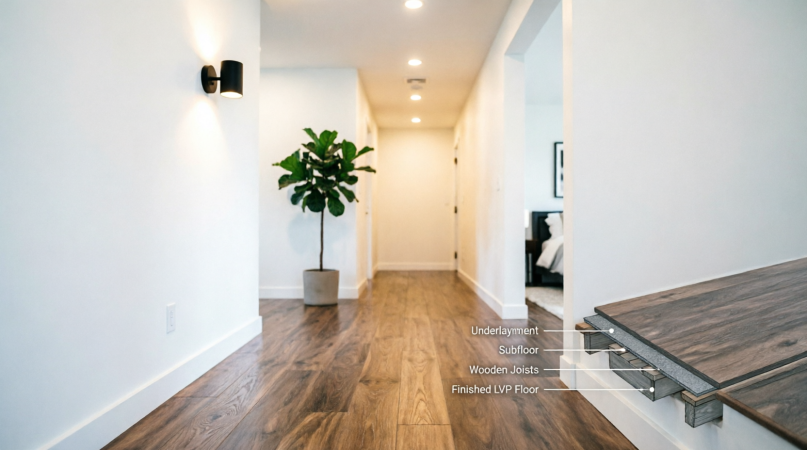
Let’s get one thing straight right out of the gate: there is no single “best” flooring material for every second floor. If you want soft footing and deadened footstep noise in dry bedrooms, carpet with a solid pad is your strongest choice. For hallways, kids’ rooms, or anywhere you need easy cleanup, Luxury Vinyl Plank (LVP) is the most practical route. Laminate gives you that wood aesthetic on a budget for dry spaces, while engineered hardwood is for those who insist on a genuine wood surface. Tile works beautifully in upstairs bathrooms, but only if your floor joists are stiff enough to handle it.
Your final decision really comes down to five things: how the room gets used, your personal tolerance for noise, moisture levels, your budget, and what the manufacturer’s installation instructions actually allow.
A quick note on terms: “2nd flooring” isn’t a standard industry phrase. When people search for it, they’re usually looking for guidance on picking the right floor covering for the upper level of a home or apartment. If you are dealing with the New York City housing market—perhaps securing a city FHEPS 2nd-floor apartment, or evaluating multi-family properties like the unit at 168 46 91st Avenue, 2nd Floor, Jamaica, NY 11432, or a modern condo at 625 Atlantic Avenue 2nd Floor, Brooklyn, NY 11217—the flooring you choose (or inherit) directly dictates your daily comfort and your relationship with the neighbors below.
Why upstairs flooring is a completely different decision
Think about the physical structure. A ground-floor room typically rests on a concrete slab or hangs over a crawl space. A second floor? It’s a framed wooden structure with someone else’s living space directly underneath. That physical reality changes the game in four major ways.
1. Footstep noise travels down. Walking, dropping objects, and dragging furniture create impact noise. That energy punches right through the floor and into the ceiling below. Hard surfaces like tile, hardwood, and thin vinyl or laminate reflect more of that acoustic energy into the structure than carpet does.
2. Sound is a whole-assembly result. How loud footsteps seem to the person downstairs depends on the flooring, the underlayment or pad, the subfloor, the joists, any insulation in the cavity, and the ceiling drywall. A flooring product’s sound rating describes a specific tested assembly, not your unique floor.
3. Subfloor stiffness matters. Wood-framed floors naturally flex. Some flooring types tolerate this flex just fine (carpet, most floating floors), while others absolutely hate it (tile and grout, and to a lesser degree, rigid planks with open seams). No floor covering or underlayment can fix a bouncy or damaged structural frame.
4. Moisture leaks reach the room below. An overflowing tub or a leaking washing machine upstairs will ruin the ceiling downstairs. This makes moisture behavior a massive deal in upstairs bathrooms and laundry rooms.
Impact noise and what IIC and STC actually mean
IIC (Impact Insulation Class) rates how well a floor-ceiling assembly reduces impact sound, like footsteps or dropped items. A higher number means better isolation. STC (Sound Transmission Class) rates how well the assembly blocks airborne sound, like voices or the TV.
Both ratings come from strict laboratory or field tests of a complete assembly under defined conditions (ASTM E492 and E492 for impact, ASTM E90 and E413 for airborne). If you see a rating printed on an underlayment box, it usually reflects a specific test setup, often over a concrete slab. Don’t assume that exact number applies to your wood-framed floor with a different ceiling below.
Sound requirements are also a legal issue in some cases. Model codes like the International Building Code set sound requirements for separations between dwelling units (apartments and condos). Many condo boards and HOAs add their own minimum IIC numbers for flooring replacements. Single-family homes usually don’t have these rules for internal floors. If you live in a multi-unit building, check your building’s bylaws and local code before buying anything.
Second-floor flooring options compared
Carpet with pad Carpet is the most reliable choice for killing footstep noise and adding warmth in a dry room. The carpet and pad work together to cushion impact before it hits the structure. The quality of the pad matters just as much as the carpet itself. The drawbacks? Stain management, allergen trapping, wear in high-traffic paths, and a shorter lifespan than hard surfaces. Never use carpet in a bathroom.
Luxury vinyl plank (LVP) is a resilient vinyl floor, usually installed as a floating click-lock plank or glued down. It handles spills beautifully, feels softer underfoot than tile, and comes in incredibly convincing wood looks. Products vary wildly in core type (flexible, stone-plastic composite, wood-plastic composite), thickness, wear layer, and whether a pad is pre-attached. Rigid-core products demand a flat subfloor because dips and ridges can stress the locking joints. “Water resistance” usually applies only to the plank itself. Water sneaking through seams, edges, or the perimeter is still a risk, so read the manufacturer’s waterproof claims and warranty terms carefully.
Laminate features a printed decorative layer and a protective wear layer over a wood-based core. It’s often the most budget-friendly way to get a wood look in a bedroom, office, or hallway. Its biggest weakness is moisture. Standing water and repeated wetting will swell the core, so check each product’s stated limits. Some newer laminates carry water-resistant claims under specific conditions. It’s usually installed as a floating floor over an underlayment, and it can sound hollow or clicky if you skimp on the pad.
Engineered hardwood: This has a real wood top layer bonded to a layered core. That construction is much more dimensionally stable than solid wood when humidity changes. You can nail, glue, or float it depending on the product and subfloor. It gives you a real-wood look and, in many products, the option to refinish the surface (though how many times depends on the wear layer thickness). It’s still a hard surface, so it won’t reduce footstep noise on its own. Keep it out of wet areas.
Solid hardwood A classic, long-lived choice. It’s usually nailed to a wood subfloor, making it a natural fit for upstairs rooms in a framed house. You can refinish it multiple times. However, it responds to seasonal humidity changes, meaning gaps and cupping can happen if indoor humidity swings wildly. It’s a terrible choice for bathrooms or laundry rooms. Like all hard surfaces, it transmits more footstep noise than carpet.
Ceramic or porcelain tile is highly durable and water-resistant, making it a prime candidate for an upstairs bathroom. But it’s hard, cold underfoot, and loud. Its main risk upstairs is deflection. Tile and grout will crack if the floor flexes. Industry guidance (like the Tile Council of North America) sets strict stiffness limits for tile over wood framing. Your floor structure must meet the installation method’s requirements, which often include an approved underlayment or uncoupling membrane. If you suspect a springy floor, get a professional to assess it before the tile goes in.
Cork (Optional): Cork is soft, warm, and quiet underfoot, which is perfect for bedrooms and home offices. It needs a suitable finish, careful maintenance around moisture, and protection from heavy furniture. Product selection is key for long-term durability.
Comparison table
Note: Ratings below are general qualitative guidance. Real performance varies by product, underlayment, and the specific floor assembly.
| Flooring type | Comfort | Noise considerations | Moisture considerations | Maintenance | Best use |
|---|---|---|---|---|---|
| Carpet with pad | Soft and warm | Best common option for reducing footstep noise | Not for wet areas; holds spills | Regular vacuuming; periodic deep cleaning | Bedrooms, playrooms |
| LVP | Moderate, softer than tile/wood | Can sound hollow without good underlayment; depends on core/pad | Plank is water resistant; seams/edges need attention | Easy sweeping and damp mopping | Hallways, kids’ rooms, laundry, some baths |
| Laminate | Firm | Can sound hollow/clicky; underlayment is critical | Limits vary; avoid standing water | Dry or lightly damp cleaning | Dry bedrooms, offices, hallways |
| Engineered hardwood | Firm, natural feel | Hard surface; noise depends on install method/pad | More stable than solid wood, but not for wet areas | Dry cleaning; occasional refinishing | Bedrooms, living areas |
| Solid hardwood | Firm, natural feel | Hard surface; transmits footsteps | Sensitive to humidity swings and wetting | Dry cleaning; refinishable | Bedrooms, hallways, family rooms |
| Tile (ceramic/porcelain) | Hard and cold | Hard and loud; impact noise carries easily | Highly water resistant when installed right | Easy surface; grout needs care | Baths, laundry (needs stiff floor) |
| Cork | Soft and warm | Quieter underfoot than most hard surfaces | Needs proper finish; avoid standing water | Moderate | Bedrooms, offices |
Which flooring for which upstairs room
Bedrooms. Choose carpet with a quality pad if quiet and warmth are your main goals. If you absolutely want a hard surface, pair it with a compatible acoustic underlayment and throw down a large area rug.
Hallways and landings. These are high-traffic zones that often connect to stairs. LVP is a go-to here because it cleans easily and resists scuffs. Laminate and engineered or solid hardwood work if the area stays dry. Plan your transitions and stair nosings right at the start, because the finished height of the new floor dictates how it meets the stairs.
Bathrooms. Moisture control is everything. Tile with a correct waterproofing system is the traditional answer, but it demands a suitably stiff, well-supported floor. Some LVP products are rated for bathroom use, but only when the manufacturer explicitly approves it and the installation follows their rules. Solid hardwood and most laminate are terrible choices here.
Home offices and family rooms. Think about rolling chairs, furniture feet, and noise. LVP, laminate, and engineered hardwood are all solid options. Toss a rug under the desk area to cut down on both noise and wear.
How to reduce noise from a second-floor floor
- Choose carpet and pad where possible. It addresses impact noise right at the source.
- Use a compatible acoustic underlayment under floating hard floors. It must be approved by the flooring manufacturer. Thicker isn’t automatically better; too much cushion can actually break click-lock joints.
- Don’t double-pad. Do not add an extra pad under a plank that already has one attached unless the manufacturer explicitly says it’s okay.
- Check the subfloor. Fix squeaks, loose panels, and damaged areas before you cover them up.
- Use dense rugs. Put rugs with a dense pad in bedrooms and living areas.
- Know your building’s rules. If you’re in an apartment or condo, some require minimum IIC values for replacement flooring, and these apply to the whole assembly.
- Be realistic. Flooring and underlayment reduce impact noise. They won’t eliminate it, because the joists, subfloor, and ceiling below also carry sound.
LVP, PVC, and laminate: clearing up the terms
LVP is luxury vinyl plank, a specific type of resilient vinyl flooring. PVC (polyvinyl chloride) is the actual polymer used in vinyl flooring. “PVC flooring” is a broad phrase that can include sheet vinyl, vinyl tile, and LVP. Laminate is a totally different product. It has a wood-fiber core with a printed layer and a clear wear layer, whereas vinyl is plastic all the way through.
The practical differences: Vinyl is generally much more tolerant of moisture. Laminate often looks and feels harder and more rigid. Both come in great wood looks. Neither category is automatically 100% waterproof. Always check the specific product’s moisture claims, installation limits, and warranty.
Is PVC flooring cheaper than tiles?
Often the material is cheaper, but not always, and it heavily depends on what you’re comparing. Vinyl and tile both span massive price ranges. Entry-level tile can cost less than premium LVP, and premium LVP can cost more than basic tile. Total project cost also depends on:
- Material price per square foot
- Underlayment, membranes, adhesives, grout, and trim
- Subfloor preparation and any leveling required
- Removal and disposal of the old floor
- Labor (tile installation generally takes way more skill and time than floating vinyl)
- Transitions, stair details, and door adjustments
To compare fairly, put material against material, or installed cost against installed cost. Get written quotes from local installers, because labor rates vary wildly by region. Keep long-term costs in mind, too: carpet wears out faster in busy areas, tile can last for decades, and some thin vinyl floors show scratches earlier.
Check these before you install
- Is the subfloor sound, dry, clean, and flat enough for the flooring you chose?
- Is the product approved for that specific room and subfloor type (including bathrooms and laundry rooms)?
- Does the product need to acclimate in the room before installation?
- Does the underlayment match the flooring and the installation method?
- How will the new floor height affect doors, thresholds, and stair nosings?
- Does a building association, HOA, or local code require specific sound performance?
- If the floor feels springy or has damage, has a qualified professional assessed it?
Pro tip: Do not rely on a floor covering to solve structural concerns. If a room has noticeable bounce, sagging, or water damage, have it looked at by a licensed contractor or structural engineer before you spend a dime on finishes.
Three decision scenarios (hypothetical)
1. A quiet bedroom above a living room. Priorities: Soft footing, noise reduction, warmth. The play: Carpet with a quality pad is the lowest-risk option. If the owner hates carpet, a floating LVP or engineered wood floor with a manufacturer-approved acoustic underlayment and a large rug can work. Just understand that footsteps will still be more audible than with carpet.
2. A hallway used by kids and pets. Priorities: Scratch and spill tolerance, easy cleaning, stable transitions. The play: LVP is a highly reasonable first choice, especially a product with a thick wear layer and a rigid core. Laminate can work if the area stays dry and the product has solid moisture protection. Carpet makes noise easier to manage, but it handles pet accidents poorly.
3. An upstairs bathroom renovation. Priorities: Moisture control, substrate suitability, correct installation. The play: Both vinyl and tile can work. Tile needs a stiff substrate and a proper waterproofing method. Vinyl needs a product approved for bathroom use, a flat clean subfloor, and careful sealing at edges and around fixtures. Installation quality is the main factor here, so choose an installer who strictly follows manufacturer or industry standards.
Estimating how much flooring to buy
Room area in square feet is simply length times width. You need to buy extra for cuts and mistakes using this formula: Purchase area = Floor area × (1 + waste percentage)
Example: A bedroom measures 12 ft × 14 ft, so the area is 12 × 14 = 168 sq ft. With an assumed 10% waste allowance, 168 × 1.10 = 184.8 sq ft. You’d buy about 185 sq ft before rounding up to full cartons. The right waste percentage depends on the room’s shape, plank layout, pattern, and the manufacturer’s guidance. Ten percent is just an assumption here, not a universal rule.
Design considerations
Using the same flooring through connected spaces can make an upstairs area feel larger and simplify transitions. Wood-look planks and neutral tones remain incredibly popular, but this guide doesn’t claim any one color or plank width is the “best” nationwide. Plank direction can change how a room reads: running planks along the longest wall often makes it feel longer. Matte or low-sheen finishes tend to hide scratches and dust much better than glossy ones. These are design preferences, not measurable performance differences.
Common mistakes to avoid
- Choosing by looks alone. Compare noise, moisture tolerance, and maintenance, too.
- Ignoring the room below. A bedroom under a play area deserves way more acoustic attention than a storage room.
- Assuming all LVP or laminate is equally waterproof. Verify product-specific claims.
- Using the wrong or excessive underlayment. Follow the flooring manufacturer’s instructions to the letter.
- Covering a damaged or damp subfloor. Repair and dry it first.
- Comparing material prices with installed prices. Keep the comparison consistent.
- Forgetting transitions and clearances. Check door swing, stair nosings, and neighboring floor heights.
- Assuming tile works over any upstairs floor. Deflection limits apply.
- Reading a product’s sound rating as your floor’s actual performance. The result depends on the whole assembly.
FAQ
Which flooring is best for a 2nd floor? It depends entirely on the room. Carpet is best for quiet and warmth, LVP for easy maintenance and moisture tolerance, laminate for budget wood looks in dry rooms, engineered hardwood for real wood, and tile for suitable bathrooms.
What is the quietest flooring for upstairs bedrooms? Carpet with a quality pad is generally the quietest common option. Cork is also soft underfoot. Hard floors can be improved with underlayment and rugs, but they usually remain louder.
Is LVP suitable for an upstairs bedroom? Yes, if the subfloor is flat and sound and the product is installed per the manufacturer’s instructions. Noise depends heavily on the product and the underlayment you choose.
Is laminate suitable for a second floor? Yes, in dry rooms. Avoid bathrooms and areas with standing water unless the specific product is explicitly approved for them.
Is engineered hardwood better than solid hardwood upstairs? Engineered wood is more dimensionally stable and offers more installation options. Solid wood can be refinished more times and is a classic choice over a wood subfloor. Neither is a good choice for wet areas.
Do I need acoustic underlayment for upstairs flooring? Not always. It is definitely worth considering under floating hard floors in rooms above living spaces, and it is sometimes legally required in condos and apartments. Only use underlayment the flooring manufacturer allows.
Can tile be installed on a second floor? Yes, when the floor structure is stiff enough, and the installation method is appropriate for the substrate. Have the floor assessed by a pro if it flexes.
What does “2nd floor” mean? In the United States, the second floor is the level above the ground (first) floor. In many other countries, the ground floor is labeled separately, and the first floor is the level above it, so numbering can differ.
Is it “2 floor” or “2 storey”? In American English, say “second floor” for a level and “two-story” for a building with two stories. “Storey” is the British spelling.
How do I add a second floor to a house? That is a massive structural construction project, not a flooring choice. It requires engineering, permits, and licensed professionals, and it is completely outside the scope of this flooring guide.
Conclusion
Start with the room, not the material. Pick carpet or cork for the quietest upstairs bedrooms, LVP or laminate for practical, wood-look hallways and offices (just check those moisture limits), engineered or solid hardwood for a real-wood surface, and tile for bathrooms when the structure supports it. Then, confirm the subfloor, underlayment, transitions, and any building rules before you swipe your credit card. A well-matched floor and a sound installation will matter way more than any single product label.
Sources
- American Society for Testing and Materials (ASTM), standards E492, E989, E90, and E413 for impact and airborne sound testing: astm.org
- International Code Council, International Building Code (sound transmission provisions for dwelling unit separations; confirm the version your jurisdiction has adopted): iccsafe.org
- Tile Council of North America, installation guidance on deflection and substrates: tcnatile.com
- National Wood Flooring Association, installation and moisture guidance for solid and engineered wood: nwfa.org
- Flooring manufacturers’ own installation instructions and warranties for your specific product
2 thoughts on “Best Flooring for a Second Floor: Options, Noise, and Cost Guide”