
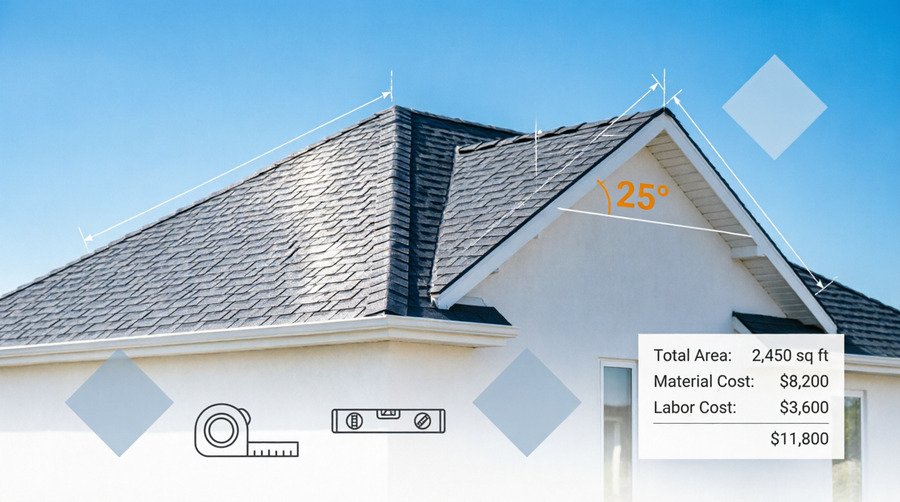
A reliable roof cost estimator starts with one fundamental rule: your house square footage is not your roof square footage.
In 2026, a full roof replacement typically costs between $8,000 and $25,000, with most homeowners spending around $10,000 to $16,000 for a standard 2,000 square foot home using architectural asphalt shingles. However, applying a generic “per square foot” number to your home’s floor plan will result in an inaccurate budget.
This guide provides the exact formulas, current material costs, and practical steps you need to estimate your roof replacement cost accurately, avoid common contractor pitfalls, and understand the hidden factors that drive pricing.
The Roof Cost Estimator Formula
To estimate your roof replacement cost yourself, you must calculate the actual sloped surface area, not the flat footprint of your house. Use this proven sequence:
- Calculate the building footprint: Length multiplied by width.
- Apply the roof pitch multiplier: Footprint area multiplied by the slope factor.
- Calculate roofing squares: Actual sloped roof area divided by 100.
- Estimate installed cost: Roof area multiplied by the installed cost per square foot for your chosen material.
- Add project specific costs: Tear off, disposal, decking repairs, flashing, ventilation, and permits.
Step 1 and 2: Account for Roof Pitch
Roof pitch describes how many inches the roof rises for every 12 inches of horizontal run. A steeper roof has more surface area and requires more labor and safety equipment.
Use this multiplier table to convert your flat footprint into actual sloped roof area:
| Roof Pitch | Slope Multiplier |
|---|---|
| 3/12 | 1.031 |
| 4/12 | 1.054 |
| 5/12 | 1.083 |
| 6/12 | 1.118 |
| 7/12 | 1.158 |
| 8/12 | 1.202 |
| 9/12 | 1.250 |
| 12/12 | 1.414 |
Example Calculation:
If your home has a 2,000 square foot footprint and a 6/12 roof pitch, the math is:
2,000 sq ft multiplied by 1.118 equals 2,236 square feet of actual roof surface.
Step 3: Understand Roofing Squares
Contractors and suppliers measure roofing in “squares.” One roofing square equals 100 square feet of roof area.
2,236 square feet divided by 100 equals 22.36 roofing squares.
Contractors will round this up and add a waste factor, typically ordering 24 to 25 squares for this project to account for cutting and overlaps.
Roof Replacement Cost by Material (2026)
Material selection is the largest variable in your estimate. The prices below represent installed costs, which include both materials and professional labor.
| Roofing Material | Installed Cost per Sq. Ft. | Estimated Total for 2,236 Sq. Ft. Roof | Expected Lifespan |
|---|---|---|---|
| Asphalt Shingles (3 tab) | $3.40 to $4.65 | $7,600 to $10,400 | 15 to 20 years |
| Asphalt Shingles (Architectural) | $4.50 to $6.50 | $10,000 to $14,500 | 25 to 30 years |
| Metal Roofing (Corrugated) | $6.00 to $9.00 | $13,400 to $20,100 | 40 to 50 years |
| Metal Roofing (Standing Seam) | $12.00 to $18.00 | $26,800 to $40,200 | 50 to 70 years |
| Wood Shakes or Shingles | $6.50 to $9.50 | $14,500 to $21,200 | 30 to 40 years |
| Concrete or Clay Tile | $8.00 to $14.00 | $17,800 to $31,300 | 50 to 100 years |
| Slate Roofing | $20.00 to $30.00+ | $44,700 to $67,000+ | 75 to 150 years |
Note: These are national planning ranges. Local labor rates, material availability, and roof complexity will cause final quotes to vary.
Roof Cost Estimates by House Size
The following table answers common search queries by applying a realistic 6/12 pitch multiplier to standard house footprints, using architectural asphalt shingles at $4.50 to $6.50 per square foot installed.
| House Footprint | Estimated Roof Area (6/12 Pitch) | Roofing Squares | Estimated Installed Cost |
|---|---|---|---|
| 1,200 sq. ft. | 1,342 sq. ft. | 13.4 | $6,039 to $8,723 |
| 1,500 sq. ft. | 1,677 sq. ft. | 16.8 | $7,547 to $10,901 |
| 1,600 sq. ft. | 1,789 sq. ft. | 17.9 | $8,051 to $11,629 |
| 2,000 sq. ft. | 2,236 sq. ft. | 22.4 | $10,062 to $14,534 |
| 2,200 sq. ft. | 2,460 sq. ft. | 24.6 | $11,070 to $15,990 |
| 3,000 sq. ft. | 3,354 sq. ft. | 33.5 | $15,093 to $21,801 |
Important Limitation: These are mathematical planning examples for a simple gable roof. A home with multiple dormers, valleys, a steep pitch, or a complex layout will have a larger surface area and higher labor costs than these baseline estimates.
How Much Does a 20×20 or 12×12 Roof Cost?
A 20 by 20 footprint equals 400 square feet. At a 6/12 pitch, the roof area is 447 square feet. At $4.50 to $6.50 per square foot, the mathematical cost is $2,012 to $2,906.
However, small roofs like this, or a 12 by 12 roof (161 square feet of surface area), often trigger minimum project charges. Contractors have fixed costs for mobilization, dumpster delivery, and crew deployment. A small repair or replacement may cost $1,500 to $3,500 flat, regardless of the low square footage.
Hidden Costs and Additional Components
A complete roof replacement involves more than just shingles. Ensure your estimator or contractor quote explicitly includes the following:
- Tear off and Disposal: Removing old shingles costs $0.40 to $2.00 per square foot. Disposing of the debris typically requires a dedicated dumpster, adding $400 to $600.
- Roof Decking Repair: If water has rotted the plywood beneath the shingles, replacement costs $2.20 to $3.00 per square foot. This is often discovered only after tear off begins.
- Underlayment and Ice/Water Shield: Synthetic underlayment costs $1.50 to $2.10 per square foot. Ice and water barriers are mandatory in cold climates along eaves and valleys, costing $1.87 to $2.53 per square foot.
- Flashing and Pipe Boots: Metal flashing around chimneys and vents costs $9.00 to $11.00 per linear foot. Rubber pipe boots cost $60 to $85 each and should always be replaced during a reroof.
- Ventilation: Ridge vents and soffit vents are critical for roof longevity. Upgrading ventilation adds $300 to $800 but prevents premature shingle failure.
- Permits: Local building departments typically charge $150 to $500 for a roofing permit.
Metal Roof vs. Asphalt Shingles: Which is Cheaper?
Asphalt shingles are almost always cheaper upfront. However, the decision should be based on your long term plans.
- Choose Asphalt Shingles if: You have a strict initial budget, plan to sell the home within 10 years, or live in an area with abundant, experienced asphalt roofing contractors.
- Choose Metal Roofing if: You plan to stay in the home for decades, live in an area prone to heavy snow, wildfires, or high winds, and want to minimize long term maintenance. Metal roofs also reflect solar heat, which can lower cooling costs in warm climates.
Roof Repair Cost Estimator
Roof repair pricing is driven by the location and nature of the damage, not total roof area. National averages for common repairs include:
- Minor shingle replacement: $150 to $400
- Flashing repair around a chimney or vent: $200 to $500
- Valley repair: $300 to $800
- Fixing a localized leak: $400 to $1,000
If repair costs approach 30 percent of the cost of a full replacement, or if the roof is near the end of its expected lifespan, replacement is the more financially sound decision.
Roof Inspection Costs
A professional roof inspection typically costs between $150 and $400, with a national average around $250. This fee covers a visual assessment of shingles, flashing, gutters, and attic ventilation.
Be aware that a routine maintenance inspection is different from a formal roof certification required by some homebuyers or insurance companies, which may cost $500 or more and include a detailed written report guaranteeing the roof’s condition for a specific period.
Crucial Roofing Rules, Myths, and Red Flags
What is the 25 Percent Rule in Roofing?
The 25 percent rule is not a universal insurance mandate. It is a building code provision, most notably enforced in the Florida Building Code, which states that if more than 25 percent of a roof section is repaired or replaced within a 12 month period, the entire roof section must be brought up to current building code standards. Do not assume this rule applies to your insurance claim in other states. Always check your local municipal codes.
Are There Tax Credits for New Roofs?
Generally, no. The IRS Residential Clean Energy Credit and the Energy Efficient Home Improvement Credit do not apply to standard asphalt or metal roof replacements. Tax credits are typically reserved for solar roofing tiles that generate electricity or specific ENERGY STAR certified “cool roofs” that meet strict reflectivity standards. Consult a tax professional for your specific situation.
Does a 30 Year Roof Really Last 30 Years?
Not always. A “30 year” rating is a manufacturer warranty based on ideal conditions, perfect ventilation, and moderate climates. In reality, severe weather, poor attic ventilation, and installation errors often reduce the actual lifespan of architectural shingles to 20 to 25 years.
Should You Ever Pay a Roofer Up Front?
Never pay 100 percent upfront. A standard and acceptable practice is a 10 percent to 30 percent deposit to cover material delivery, with the remaining balance paid in milestones or upon satisfactory completion and final municipal inspection.
How to Spot a Bad Roofing Company
Avoid contractors who exhibit these red flags:
- They demand full payment in cash before work begins.
- They use high pressure tactics or claim they “just happened to be in the neighborhood” after a storm.
- They cannot provide proof of general liability insurance and workers’ compensation.
- Their quote lacks an itemized breakdown of materials, tear off, and warranty terms.
- They ask you to sign a document giving them the right to speak with your insurance company on your behalf before you have filed a claim.
How to Afford a New Roof
If the estimate exceeds your immediate cash reserves, consider these options:
- Homeowner’s Insurance: If the damage was caused by a covered peril like hail, wind, or a fallen tree, your policy may cover the replacement, minus your deductible. Insurance does not cover wear and tear or old age.
- Contractor Financing: Many reputable roofing companies partner with lenders to offer 0 percent interest promotional periods or fixed rate home improvement loans.
- Home Equity: A Home Equity Line of Credit (HELOC) or cash out refinance often offers lower interest rates than unsecured personal loans or credit cards.
Frequently Asked Questions
What time of year is the cheapest to replace a roof?
Late fall and winter are typically the slowest seasons for roofing in most of the United States. Contractors may offer slight discounts to keep their crews working. However, asphalt shingles become brittle in freezing temperatures, and ice or snow can delay the project. The best value is often found in the shoulder seasons, like late spring or early fall, when weather is stable but demand has not peaked.
What is the most expensive part of replacing a roof?
Labor accounts for roughly 60 percent of the total project cost. The complexity of the roof, including steep pitch, multiple stories, and numerous penetrations like chimneys and skylights, drives labor hours up significantly.
How long does it take to replace a 1,200 sq. ft. roof?
A professional crew can typically tear off and replace a simple 1,200 square foot roof in one to two days, weather permitting. Complex roofs or those requiring extensive decking repairs may take three to four days.
What color roof increases home value?
Neutral colors like black, charcoal gray, and earthy brown provide the highest resale value. They complement most exterior siding colors and appeal to the broadest range of potential buyers. In hot, sunny climates, lighter colors or “cool roof” shingles can also be a selling point due to improved energy efficiency.
What are five signs that my roof needs to be replaced?
- Widespread curling, cracking, or missing shingles.
- Significant granule loss found in gutters or downspouts.
- Sagging areas in the roof deck, indicating structural or moisture damage.
- Daylight visible through the roof boards from inside the attic.
- Multiple active leaks or water stains on interior ceilings.
Final Takeaway
A precise roof cost estimator requires accurate measurements, an understanding of roof pitch, and a clear breakdown of installed material costs. Do not rely on your home’s floor square footage alone.
Calculate your actual roof area, convert it to roofing squares, and use the resulting number to evaluate contractor quotes. Always demand itemized proposals that specify the exact shingle brand, underlayment type, tear off procedures, and warranty terms. This due diligence ensures you pay a fair price for a roof that will protect your home for decades.