
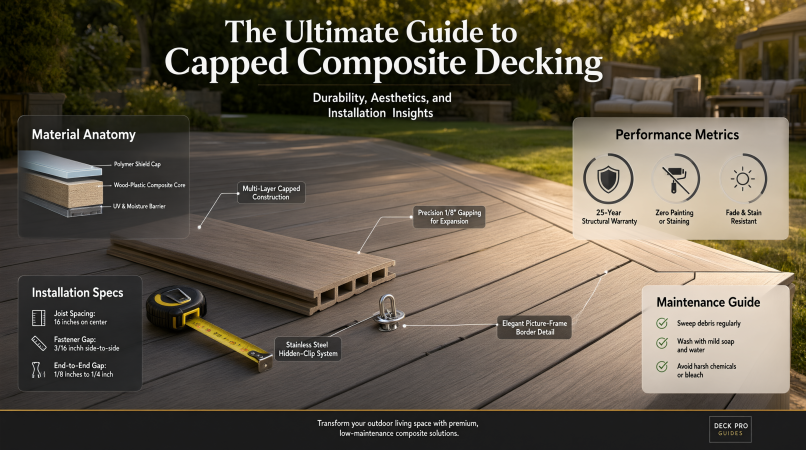
Composite decking is an outdoor flooring material made from wood fiber and plastic, or in some products from plastic alone. It’s sold as boards that install over a deck frame like lumber. You’ll pay more than pressure-treated wood up front, but you won’t need to stain or seal it. Performance depends on the product, the framing beneath it, and following the manufacturer’s installation rules.
This guide covers how composite boards are made, how they stack up against wood and PVC, what they cost in the US, how to install and clean them, and what problems you might run into. Technical numbers like gaps and joist spacing come straight from manufacturer documents. They vary by product, so check the guide for the exact boards you buy.
What Is Composite Decking?
Composite decking means deck boards made from a blend of wood fibers and plastic polymers, usually with a protective surface layer and pigments. The term most often refers to wood-plastic composite (WPC), though formulations vary. Because it resists rot and insects and has no grain to splinter, it’s become a go-to low-maintenance alternative to natural wood.
“Composite lumber for decks” and “composite deck boards” describe the same category. Boards are usually 12, 16 or 20 feet long, and most are about 5.4 to 5.5 inches wide and just under 1 inch thick.
What Is Composite Decking Made Of?
A typical board combines wood flour or fibers, polyethylene or other plastic (recycled or virgin), and additives. The additives include colorants, UV stabilizers and bonding agents. The mixture is heated and extruded into board profiles. Many brands add a protective polymer shell, called a cap, to the outer surface.
Recycled content varies. Fiberon states that its composite decking contains up to 94% recycled content. MoistureShield says its decking is made with 95% recycled materials, of which 38% are post-consumer. fiberondeckingmoistureshield
Capped vs. Uncapped Composite Decking
An uncapped board is a bare wood-plastic mix. A capped board has a polymer shell over the core, and that shell is your main defense against stains, fading and moisture. Capped boards cost more. Uncapped boards can weather, fade and stain more readily, so they typically need more attention.
Capping isn’t the same on every board. Trex boards are capped on three sides with the bottom left uncapped to allow drainage, while TimberTech’s PRO collections are capped on four sides. Check which sides are capped, because the exposed core is where moisture can enter. bobvilawood-source
Hollow vs. Solid Composite Decking
Hollow-core boards have channels along their length. They’re lighter and often cheaper, but may be less rigid and can have exposed ends that need end caps or trim. Solid boards weigh more and often feel more substantial underfoot. Neither design is universally better. Suitability depends on the tested span rating, the fastening system and how you’ll use the deck.
| Type | Construction | Main advantage | Main limitation |
|---|---|---|---|
| Uncapped WPC | Wood-plastic core, no shell | Lower price | More exposed to staining and fading |
| Capped composite | Core plus polymer shell | Better stain and fade resistance | Costs more; cap damage is hard to repair |
| Solid board | Fully solid profile | Rigid, substantial feel | Heavier |
| Hollow or scalloped board | Channels or grooved underside | Lighter, easier to handle | Check span rating and end finishing |
| Advanced PVC | Plastic, no wood fiber | Strong moisture resistance | Typically higher price |
Composite Decking Pros and Cons
| Topic | Advantage | Disadvantage |
|---|---|---|
| Maintenance | No staining or sealing for most products | Still needs periodic washing; not maintenance-free |
| Durability | Resists rot and insect damage | Can scratch, fade or stain if neglected |
| Surface | Low splinter risk; consistent look | Can feel hot in direct sun, especially dark colors |
| Cost | Long-term upkeep is low | Higher purchase price than pressure-treated wood |
| Movement | Stable against moisture swelling | Expands and contracts with temperature, so gapping is critical |
| Repairs | Individual boards can be replaced | Matching weathered color can be difficult |
| Warranty | Long limited warranties are common | Exclusions apply, especially for improper installation or cleaning |
Composite Decking vs. Wood, PVC and UPVC
| Feature | Composite (WPC) | Pressure-treated wood | PVC | UPVC |
|---|---|---|---|---|
| Material | Wood fiber plus plastic | Treated softwood | Plastic, no wood fiber | Rigid unplasticized PVC |
| Upfront cost | Mid to high | Lowest | Often highest | Varies by market |
| Maintenance | Washing | Staining, sealing, repairs | Washing | Washing |
| Moisture | Good to very good | Prone to rot without care | Best | Very good |
| Heat | Can run hot, especially dark colors | Cooler in light tones | Varies; cooler options exist | Varies |
| Look | Wide wood-look range | Natural wood | Wide range; some look more uniform | Varies |
Composite vs. wood: Wood costs less to buy, but staining, sealing and board replacement add ongoing cost and labor. Composite shifts that cost to the front.
Is PVC better than composite decking? Not universally. PVC decking is made from plastic rather than the wood-and-plastic mix in conventional WPC. TimberTech rates its Advanced PVC moisture resistance as “best,” against “better” or “good” for its composite collections. It also lists PVC at a higher price tier than composite. PVC may suit wet or marine settings, while composite offers a wider budget range. timbertech
UPVC vs. composite: UPVC (unplasticized PVC) is a term more common outside the US. In US catalogs the product is usually just called PVC. Treat the terms with care and compare the actual product specifications rather than the labels.
What’s better than composite decking? It depends on the goal. PVC suits constant moisture, tropical hardwoods suit people who want natural timber without plastic, and pressure-treated lumber suits the tightest budgets.
Composite Decking Colors and Board Styles
Common looks include gray, brown, light oak or tan, dark walnut-style tones, and multi-tone boards with streaked grain. Surfaces range from smooth to deeply embossed. Brand catalogs change, so use these as examples and confirm current offerings. Recent examples include TimberTech Pro Terrain in Brown Oak, Rustic Elm, Silver Maple and Stone Ash. Trex Select comes in Pebble Grey and Saddle. deckstorontodecks
Black composite decking: Very dark boards look striking but absorb more sunlight. Many “black” options are really deep charcoal or dark brown, so confirm the exact shade in a sample. If you want dark boards, ask whether the brand offers a heat-mitigating version.
Color and heat: Darker boards absorb more solar energy and lighter boards reflect more. UV exposure can also fade pigments over time, so view samples outdoors in natural light, and ideally leave one in the sun for an afternoon before buying.
Widths and profiles: The common standard is about 5.5 inches wide. TimberTech Pro boards measure 5.36 inches wide by 0.94 inches thick (actual dimensions), and Trex’s main boards are 0.94 inches thick and 5.5 inches wide. Trex also offers 2-inch-thick boards at 1.33 inches in 3.4 and 5.5 inch widths. TimberTech lists some PVC lines in narrow, standard and wide widths. Edges come either grooved (for hidden clips) or square-shouldered (for face screws). Timbertech Pro Terrain – Stone Ash +2
Best Composite Decking Brands
No brand is the best for everyone. Compare the specific collection’s warranty, specifications, local availability and price.
| Brand | Example lines | Notes | Price position |
|---|---|---|---|
| Trex | Enhance, Select, Transcend, Transcend Lineage, Signature | Largest tier range; Select is thinner at 0.82 in | Entry to premium |
| TimberTech | PRO (Legacy, Reserve, Terrain); EDGE (Prime+, Prime, Premier); AZEK PVC (Vintage, Landmark, Harvest) | Composite and PVC under one brand | Entry to premium |
| Fiberon | Multiple capped composite collections | High recycled content | Generally entry to mid |
| Deckorators | Solid and slotted composite lines | Solid decking installs per its own gap rules | Varies by line |
| MoistureShield | Elevate, Vision, Vantage | Solid core, high recycled content | Mid to upper-mid |
Trex: Select is the thinner board in the lineup at 0.82 inches, while Transcend and Enhance are both 0.94 inches. Don’t mix Select with the thicker lines on one deck surface. Residential warranties are generally 25 years for Enhance, 35 years for Select, and 50 years for Transcend, Lineage and Signature. Confirm the warranty for your region and collection. trexadvantagelumber
TimberTech: Composite collections carry 30-year warranties on Legacy, Reserve and Terrain, and 25 years on Prime+, Prime and Premier. TimberTech’s PVC line carries a limited lifetime product warranty and a 50-year fade and stain warranty. Its sell sheet notes that the Prime+, Prime and Premier collections do not feature Mold Guard Technology. timbertechdomanbm
Fiberon: The brand says it was first to introduce a 25-year stain and fade warranty, and its warranties run 25, 40 or 50 years depending on the collection. bobvilafiberondecking
MoistureShield: Its Elevate line lists a transferable 50-year residential structural warranty. The brand also markets CoolDeck technology with up to 35% less heat absorption than standard composites in similar colors. That’s a manufacturer claim, not independent testing. issuumoistureshield
Deckorators: Check the specific line’s warranty document, because terms differ by product.
How Much Does Composite Decking Cost?
Pricing below is for the United States, in USD, based on research in November 2026. These are third-party contractor and retailer estimates, not official data, and quotes vary widely by region.
Keep four numbers separate: board price, total material cost, installation labor, and the finished deck. A board-only price isn’t a deck price, because the frame, fasteners, trim, stairs and railings all add cost.
| Item | Typical US range, per sq ft unless noted | What it covers |
|---|---|---|
| Entry capped composite boards | About $4 to $8 | Boards only |
| Mid-tier capped composite boards | About $7 to $12 | Boards only |
| Premium composite or PVC boards | About $10 to $18 | Boards only |
| New ground-level deck, installed | About $25 to $55 | Frame, boards, labor |
| New raised deck, installed | About $45 to $75 or more | Frame, boards, labor |
| Resurfacing a sound existing frame | About $15 to $30 | Boards and labor |
| Old deck removal | About $5 to $15 | Demolition and haul-away |
| Railing, installed | Roughly $20 to $150 per linear foot | Varies by material |
These ranges draw on 2026 guides that put board-only costs at $4 to $16 and installed composite at $25 to $50 per square foot, and on a broader breakdown that lists raised or second-story installed decks at $45 to $75 or more. compositedeckdirectinspectandtest
Worked example (illustrative): A 12 by 16 foot deck is 192 square feet. At $4 to $18 per square foot for boards only, the boards cost about $768 to $3,456. At $25 to $55 installed, a ground-level deck lands around $4,800 to $10,560.
What moves the price: Brand and collection, board thickness and profile, capped or uncapped construction, deck size, frame condition, fasteners, fascia, railings, stairs, labor rates and local availability.
Clearance and discounted decking can cut costs. Before buying, check whether the product is discontinued, whether you can get enough boards from one production run, whether matching fasteners and trim are still available, and whether the warranty still applies.
How to Install Composite Decking
Always follow the installation guide for your exact collection. Rules differ by manufacturer, product line and region, so don’t rely on one number from any article. Check local permit and code requirements before you start.
Step 1: Plan and Measure
Measure the deck area and decide the board direction. Then calculate the number of board rows:
Rows = deck width ÷ (board width + gap), in feet
Example: a deck 12 feet wide with 5.5 inch boards and 1/8 inch gaps uses 5.625 inches (0.46875 feet) per board. 12 ÷ 0.46875 = 25.6, so you need 26 rows. With 16-foot boards over a 16-foot-long deck, that’s 26 boards. Adding 10% for cutting waste gives 28.6, so order 29 boards. Add more for diagonal layouts or picture-frame borders. Use your product’s real width in the formula.
Step 2: Prepare the Substructure
Composite boards follow the contour of the frame, so it must be level and flat. Joists, blocking and any added framing should sit in the same plane. TimberTech’s guidance for crowned or misaligned joists includes replacing them or planing or sanding them level. timbertech
Joist spacing is the critical number. For Trex, spacing must not exceed 16 inches on center for residential applications. TimberTech sets 16 inches on center as a maximum for standard installation, and 12 inches on center for diagonal layouts. Deckorators solid decking uses 16 inches for perpendicular installs and 12 inches for diagonal. Trex also reduces allowed spans for angled boards in its span chart, so check it for your angle. How To Install Trex Decking Boards +2
Make sure the frame has airflow and drainage, and add blocking where required. Joist tape can protect framing from moisture.
Step 3: Gather Tools and Materials
You’ll need boards, manufacturer-approved fasteners, a circular saw with a suitable blade, drill/driver, chalk line, level, tape measure, spacers, safety glasses and gloves. Use the fastening system the manufacturer approves. TimberTech doesn’t recommend any fastener not listed in its installation guide, and using an alternative doesn’t void the warranty, but any claim caused by that fastener will be denied. timbertechtimbertech
Step 4: Install the Starter Board
Snap a chalk line, set the first board with the required clearance from the house, and secure it with starter clips or the approved screw method. Check that it’s straight before continuing, because every other board follows it.
Step 5: Install the Remaining Boards
Work across the frame and use spacers even with self-gapping clips. TimberTech notes that hidden clips offer self-gapping, but spacers ensure consistent gaps, and end gapping must be followed for composite and PVC. Support every board end on a joist, and depending on the fastener, TimberTech says you may need blocking at butt joints. timbertechtimbertech
Step 6: Cut and Finish
Cut with a sharp carbide blade. Install fascia, corners and trim as specified. Don’t use the boards as a work surface, since debris and tools can damage the surface finish. lowes
Step 7: Inspect
Check alignment, fastener seating, gaps, drainage, edge finish and surface stability before adding furniture.
Gap Requirements Vary by Product
| Manufacturer example | Side-to-side gap | End-to-end gap | Other limits |
|---|---|---|---|
| Trex Signature guide | 1/8 to 3/16 in | 1/8 in above 40°F; 3/16 in below 40°F | Abutting gap 1/4 in warm, 1/2 in cold; overhang max 3/4 in |
| Trex Refuge guide | 3/16 in minimum | 3/16 in above 40°F; 5/16 in below | Abutting gap 5/16 in warm, 9/16 in cold; no gap over 1/2 in |
| TimberTech CONCEALoc | 1/8 in minimum, 3/16 in maximum | Follow the temperature table | 3/16 in minimum at posts or structures |
| Deckorators solid | 1/4 in | 1/16 in per 20°F difference between install and peak temperature | Verify per product |
Trex’s end-to-end gaps depend on the temperature at installation, and its Refuge guide sets a 3/16 inch minimum width-to-width gap. TimberTech’s CONCEALoc guidance calls for side-to-side gaps of at least 1/8 inch and no more than 3/16 inch, with a 3/16 inch minimum where boards meet a structure. Deckorators states that 1/4 inch should be used for side gapping and at least 1/16 inch per 20°F between install and hottest expected temperature at board ends. Trex suggests installing near the average yearly outdoor temperature when possible. Trex Signature® Decking Install Guide +4
| Stage | Action | Key consideration |
|---|---|---|
| Plan | Calculate rows and waste | Use actual board width plus gap |
| Frame | Level joists and add blocking | Max joist spacing by product |
| Start | Set straight starter board | Clearance from house |
| Field | Fasten and gap every board | Approved fasteners and temperature-based gaps |
| Finish | Cut, trim, fascia | Support ends; limit overhang |
| Inspect | Check gaps and drainage | Airflow under deck |
How to Clean Composite Decking
Most manufacturers start with soap and water, but details differ, and using the wrong method can void a warranty.
- Sweep off loose debris, and clear leaves from gaps.
- Rinse with a hose.
- Scrub with warm soapy water and a soft-bristle brush, following the board texture. Don’t use a wire brush; Trex warns against it on Signature decking. cloudinary
- Rinse thoroughly. Trex notes that dirty water left to dry leaves a film on the surface. cloudinary
- Repeat seasonally. Trex recommends semi-annual cleaning in spring and fall to remove pollen and debris that mold can feed on. trex
Pressure washing differs by brand. Trex allows a washer no greater than 3,100 psi with a fan tip held no closer than 8 inches. TimberTech says a power washer may be used for rinsing only, at a maximum of 1,500 psi with a fan tip. Always do a test patch. cloudinarytimbertech
Stains and mold: Treat food and grease promptly. For tannin or hard-water stains, some Trex guides call for a deck brightener containing oxalic acid. For other cleaners, TimberTech advises contacting the manufacturer first. Never let cleaner dry on the surface. flippingbook
Common Composite Decking Problems
| Problem | Possible cause | Prevention or response |
|---|---|---|
| Cracking or splitting | Missed gaps, poor support, wrong fasteners, impact | Follow gap and span rules; replace damaged boards |
| Buckling or warping | Tight end gaps, heat, bad framing | Use temperature-based gaps; fix framing |
| Fading | UV, harsh cleaners, normal weathering | Choose capped boards; avoid abrasives |
| Scratches | Furniture dragging, grills, pets | Use pads; test a sample |
| Mold and mildew | Debris and moisture | Clean seasonally; keep airflow |
| Slipperiness | Algae, pollen, wet smooth surface | Clean regularly; choose textured boards |
| Uneven surface | Warped or misaligned joists | Correct framing before install |
Why does composite decking crack? Usually because installation or support wasn’t what the manufacturer specified: insufficient gaps, bad fastening, wide joist spacing, damaged boards or heavy point loads. The type and location of the crack tell you the likely cause. Not every crack is a manufacturing defect.
What ruins composite decking? Incorrect cleaners or pressure settings, incompatible fasteners, open flame or extreme heat from grills, deep scratches, standing debris and ignoring the care guide.
Composite Decking Performance and Specifications
Is Composite Decking Strong?
Strength has several parts: material strength, board stiffness, span capability, load rating and the frame beneath it. A board that’s strong can still feel bouncy if joists are too far apart, which is why manufacturers cap spacing at 12 to 16 inches.
How Much Weight Can Composite Decking Hold?
There’s no universal figure. Capacity depends on the product, joist spacing, frame, fasteners and code. Residential decks are generally designed for a live load of about 40 pounds per square foot under the International Residential Code, but local rules govern. Look at the manufacturer’s span chart and any ICC-ES evaluation report, such as the ESR-1573 reference in Deckorators’ guide. shopify
Is Composite Decking Waterproof?
It’s water resistant, not waterproof. Capped boards resist moisture better than uncapped ones, but standing water, debris and poor drainage still cause problems. Composite is more stable against moisture swelling than wood, while temperature drives movement. Trex says boards won’t noticeably swell or shrink from moisture, but temperature changes cause slight expansion and contraction. webflow
Is Composite Decking Slippery?
It can be when wet, especially with algae, pollen or sunscreen buildup. Texture helps. TimberTech claims its Advanced PVC offers up to 40% better slip resistance, wet or dry, than a leading competitor. That’s a manufacturer claim, so ask for the test data on any board you plan to use around a pool. timbertech
Is Composite Decking Hot in the Sun?
It can be. Color is the biggest factor, followed by sun exposure, airflow and formulation. One study cited by MoistureShield found standard composite can reach 34 to 76°F above the surrounding air. Light colors, shade and heat-mitigating lines help. Trex says its Transcend Lineage line uses heat-mitigating technology, but compare claims against actual samples. moistureshieldtrex
Thickness, Width and Weight
Most composite boards are just under 1 inch thick (0.94 in) and about 5.4 to 5.5 inches wide, with 12, 16 and 20 foot lengths. Wider specialty boards exist; TimberTech sells wide widths in select PVC lines. Wood versus composite weight depends on species, moisture content, profile and formulation, so compare specific products rather than categories.
| Specification | What it means | What to verify |
|---|---|---|
| Actual thickness | Real board depth | 0.94 in is common; Trex Select is 0.82 in |
| Actual width | Face width | 5.36 in vs 5.5 in affects board count |
| Joist spacing | Max frame spacing | 16 in typical; 12 in diagonal |
| Side gap | Drainage and movement | Product-specific |
| End gap | Thermal expansion | Depends on install temperature |
| Fire rating | Wildfire suitability | WUI compliance where required |
| Warranty | Coverage terms | Residential vs commercial; fade, stain, structural |
How to Choose the Best Composite Decking
Start with budget and how much heat, wetness and traffic the deck will see. Then compare:
- Capped versus uncapped, and which sides are capped
- Warranty terms, exclusions and transferability
- Color in real sunlight, plus heat claims
- Board profile and fastening system
- Joist spacing and frame requirements
- Local availability of matching boards and trim
- Fire requirements if you live in a wildfire zone
Which type is best depends on these factors. Capped composite suits most homeowners, PVC suits constant moisture, and uncapped boards suit tighter budgets.
Frequently Asked Questions About Composite Decking
Is composite decking good? For many homeowners, yes, if they accept a higher upfront cost and some seasonal cleaning in exchange for no staining or sealing.
Why not use composite decking? Reasons include higher cost, heat in direct sun, scratches, limited repair options and the need for strict installation.
Which type of composite decking is best? Capped, solid or well-rated hollow boards from a brand with clear specs and warranty terms. No single type wins for every deck.
What is the best-priced composite decking? Entry-level capped lines are usually cheapest, but compare per-square-foot cost including trim and fasteners, and factor in warranty.
What is the gap for composite decking? It depends on the product. Typical side gaps are 1/8 to 1/4 inch, and end gaps depend on temperature.
Which is heavier, wood or composite? It varies by wood species, moisture and board design, so check the specs.
Conclusion
Composite decking trades a higher purchase price for lower upkeep, but it’s not maintenance-free. The three things that matter most are choosing a capped or PVC product that suits your climate, building a flat frame with the correct joist spacing, and following your manufacturer’s gap and cleaning instructions exactly. Before you buy, request samples, test them in the sun, and read the installation guide for the specific collection.