
Table of Contents
- What Is Home Restoration?
- What Does Home Restoration Include?
- Types of Home Restoration
- Home Restoration vs. Renovation vs. Remodeling
- Check for Lead, Asbestos, and Mold First
- Step-by-Step Home Restoration Process
- How Much Does Home Restoration Cost?
- Is It Worth Restoring an Old House?
- Financing and Incentives
- How to Choose Home Restoration Specialists
- Affordable Home Restoration Tips
- FAQ
- Conclusion
- Internal Links and Sources
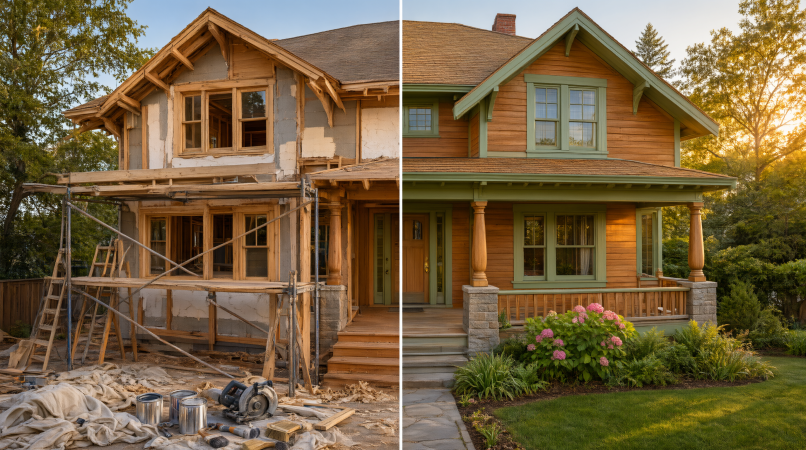
When my neighbor bought her 1923 Craftsman bungalow last spring, she thought she was signing up for a few weekends of painting and maybe some new light fixtures. Six months later, she was knee-deep in a full-scale home restoration that touched everything from the foundation to the roofline. She’s not alone. Across the country, homeowners are discovering that bringing an older house back to life is far more involved—and far more rewarding—than they first imagined.
Home restoration is the process of repairing a house, or returning damaged or worn parts of it, to a sound and earlier condition. In practice, the term covers two different kinds of projects. One is old-house or historic restoration, where the goal is to keep or recover original materials and character. The other is damage restoration after water, fire, smoke, storm, or mold, where the goal is to dry, clean, and rebuild what was lost. Both can involve structure, roofing, systems, and finishes, but they use different specialists, different timelines, and different budgets.
This guide explains what home restoration includes, how it differs from renovation and remodeling, the order the work should follow, what it typically costs in the United States, and how to hire qualified people. Cost figures are estimates drawn from published US cost guides and are labeled as such. Your own price depends on your location and your house.
What Is Home Restoration?
Home restoration is the repair or recovery of a house’s original or pre-damage condition, using methods and materials that match what was there. A restored house should look and function as it did before time or damage changed it.
Homeowners usually start a restoration for one of three reasons:
Age and deterioration. Rotted sills, failing plaster, worn-out wiring, and tired roofs in a house that is decades or a century old.
Sudden damage. A burst pipe, storm, flood, or fire that has affected structure, finishes, or air quality.
Character. The owner wants to keep original features such as wood windows, plaster walls, built-ins, or period trim rather than replace them.
Restoration differs from an ordinary repair in scope and intent. Patching a leaking faucet is a repair. Replacing a rotted sill plate, dry-rotted siding, and the wet insulation behind it, then matching the original profile, is restoration work. A rough test is this: if the goal is to bring a house or its features back to a sound original or pre-damage state, rather than to change them, it is restoration.
What Does Home Restoration Include?
No project includes everything. The scope depends on the property’s condition and the type of restoration. These are the areas most often involved.
Structural repairs. Sagging or rotted framing, damaged joists, failing sills, and settlement-related cracks. A structural engineer should assess anything beyond cosmetic cracking.
Roofing and exterior. Roof repair or replacement, flashing, gutters, siding, trim, and chimney repair. Roof geometry affects materials and cost, and the Roof Pitch Calculator converts rise and run into pitch, angle, rafter length, and roof area.
Foundation and masonry. Repointing brick, repairing cracked or spalled concrete, drainage correction, and waterproofing.
Walls, ceilings, and floors. Plaster repair, drywall replacement, refinishing original hardwood, or replacing damaged subfloor.
Windows and doors. Repairing original wood windows, replacing sash cords and glazing, and fixing rotted frames and thresholds.
Plumbing and electrical. Replacing failed supply lines, damaged drains, and outdated or unsafe wiring. These upgrades are often required for safety or code.
Water, fire, and smoke damage. Water extraction, drying, cleaning, deodorizing, and rebuilding.
Mold remediation. Containment, removal of contaminated materials, and fixing the moisture source.
Painting and finishing. Paint, stain, and trim work, done last.
A house with a solid frame and a failed roof does not need foundation work. A flooded basement may need drying, drywall replacement, and a drainage fix, but no new windows. Scope each house on its own facts.
Types of Home Restoration
Historic home restoration. The goal is to accurately depict a house as it appeared in a chosen period, which means removing later additions and rebuilding missing original features. It relies on documentation such as photographs, drawings, and physical evidence in the building.
Old house restoration. This is the more common homeowner project. The house may not be officially historic, but the owner repairs rather than replaces original materials, such as plaster walls, wood floors, and wood windows, while updating systems for safety.
Structural restoration. Repair of framing, foundations, and load-bearing elements so the building is safe and stable.
Water damage restoration. Extracting water, drying the structure, and rebuilding. Speed matters. Federal EPA guidance says mold generally does not grow if wet materials are dried within 24 to 48 hours.
Fire and smoke damage restoration. Structural assessment, soot and smoke cleanup, odor removal, and rebuilding. This almost always involves insurance.
Interior and exterior restoration. Work focused on finishes and envelope, such as restoring siding, porches, trim, floors, and plaster.
Keep damage restoration and historic restoration separate in your planning. A water mitigation company and a preservation carpenter have different training, and one is rarely a substitute for the other.
Home Restoration vs. Renovation vs. Remodeling
People use these words interchangeably, and many contractors do too. They mean different things.
- Restoration returns a property or feature to an earlier or pre-damage condition.
- Renovation repairs, updates, or improves an existing property. A common house renovation definition is making an existing building “new again” through repair, replacement, or updating, usually without changing its basic layout.
- Remodeling changes the design, layout, or function of a space.
| Factor | Restoration | Renovation | Remodeling |
|---|---|---|---|
| Main purpose | Return to original or pre-damage condition | Improve or update existing condition | Change design or function |
| Structural changes | Repair only, unless needed for safety | Sometimes | Often |
| Original features | Preserved or recreated | May be updated or replaced | May be removed |
| Example | Refinishing original oak floors | Replacing old kitchen cabinets and counters | Moving a kitchen wall to open the layout |
The terms overlap. A kitchen can be restored (original cabinets repaired), renovated (new appliances added), and partly remodeled (a doorway widened) in one project.
For historic properties, the National Park Service uses four precise terms. The Secretary of the Interior’s Standards define preservation, rehabilitation, restoration, and reconstruction as separate treatments. In that vocabulary, restoration means depicting a property as it appeared at a particular period by removing features from other periods and rebuilding missing ones. Rehabilitation allows alterations to meet new uses while keeping historic character. Most owners of older homes actually do rehabilitation, even when they call it restoration. The Standards are regulatory mainly for projects using certain federal funding or incentives, though many local historic commissions apply them.
Check for Lead, Asbestos, and Mold First
Older houses can contain hazardous materials, and the work you plan can release them. Test before you disturb anything.
Lead paint. The federal government banned lead-based paint in homes in 1978. EPA estimates that about three-quarters of US homes built before 1978 still contain some. Its guidance puts the likelihood near two in three for homes built from 1940 to 1960 and nine in ten for homes built before 1940. Under EPA’s Renovation, Repair and Painting (RRP) Rule, anyone paid to disturb paint in a pre-1978 home must be a lead-safe certified firm using trained workers. The rule generally does not cover homeowners working on their own homes, but EPA recommends hiring a certified contractor. Sanding, scraping, and demolition create the most dangerous dust.
Asbestos. Some pre-1980s materials may contain asbestos, including certain insulation, flooring, plaster, and roofing products. Material in good condition is usually safest left undisturbed. Have suspect material tested by an accredited professional before demolition or sanding.
Mold. EPA’s mold guidance divides cleanup into small (under about 10 square feet), medium (10 to 100 square feet), and large (over 100 square feet) jobs, and recommends professional help for larger areas, sewage-contaminated water, or HVAC involvement.
This is general safety information, not a substitute for testing or a licensed professional. Do not DIY work involving suspected asbestos, extensive mold, structural failure, or live electrical systems.
Step-by-Step Home Restoration Process
The correct order of renovation and restoration is: assess, make safe, fix structure and water, close up the building, update systems, then finish. Structural and safety work comes before cosmetic work because finishes installed first are usually torn out later.
| Stage | Typical work | Why it matters |
|---|---|---|
| 1. Inspect | Home inspection; structural engineer, roofer, and hazard testing as needed | Defines the real scope before money is committed |
| 2. Set goals | Decide what to restore, update, or leave alone | Prevents scope drift and mismatched specialists |
| 3. Budget and permits | Written estimates, contingency, permit check | Avoids stop-work orders and surprises |
| 4. Stabilize and dry | Shoring, water extraction, drying, hazard abatement | Stops damage from spreading |
| 5. Structure and envelope | Framing, foundation, roof, flashing, windows, exterior walls | Makes the building weathertight |
| 6. Rough-in systems | Plumbing, electrical, HVAC, insulation | Done while walls are open; cheaper than later access |
| 7. Walls, ceilings, floors | Plaster or drywall, subfloor, floor refinishing | Prepares surfaces for finishes |
| 8. Finishes | Priming, painting, trim, fixtures | Last, to avoid damage from other trades |
| 9. Final inspection | Code inspections, punch list, warranties | Closes permits and documents the work |
Inspect first. Hire a licensed home inspector, and add specialists where signs warrant: a structural engineer for sagging floors or cracks wider than hairline, a roofer for leaks, and testing for lead, asbestos, or mold.
Check permits. Structural, electrical, plumbing, and roofing work usually require permits, and historic districts may require design review before exterior changes. Rules vary by city, county, and state, so contact your local building department. Do not assume a contractor’s state license replaces a local permit.
Fix water first. A house that is still taking on water will damage every repair that follows. Gutters, grading, flashing, and drainage come before interior finishes. If you need fill or drainage stone, the Cubic Yard Calculator and Gravel Calculator help you order the right volume. Masonry or slab repairs can be sized with the Concrete Calculator.
Order lumber with a margin. Replacement joists, sills, and trim are priced by the board foot. Using the nominal formula (thickness in inches x width in inches x length in feet, divided by 12), one 2×8 that is 12 feet long is 2 x 8 x 12 / 12 = 16 board feet. Four of them are 64 board feet, and adding 10 percent for cuts and waste gives about 70 board feet. The Board Foot Calculator handles nominal or custom sizes and lumber cost. This is an example, not a quote.
This sequence is a general guide, not a fixed schedule. Fire damage, a roof emergency, or a phased budget can change the order.
How Much Does Home Restoration Cost?
There is no single price for home restoration. Published US cost guides for whole-house renovation, the closest widely reported benchmark, commonly cite about $15 to $60 per square foot for typical projects, with premium work reaching about $150 per square foot or more.
HomeAdvisor figures reported by Rocket Mortgage for 2025 put renovation at $18,750 to $75,000 for a 1,250 square foot home, $37,500 to $150,000 for 2,500 square feet, and $52,500 to $210,000 for 3,500 square feet. Each of those equals roughly $15 to $60 per square foot. This Old House cites about $150 per square foot for premium renovation with top-tier finishes and possible structural changes.
Assumptions for the example below: these are renovation benchmarks, not restoration quotes; they apply to US averages; they reflect the full project, not labor or materials alone; and they exclude land, furniture, and most specialty historic work. Restoration of historic or heavily damaged houses often lands toward the upper end because specialty labor and matching materials cost more. That is a reasoned caution, not a measured figure.
Example for a 2,000 square foot house (illustrative):
- Low end: 2,000 x $15 = $30,000
- High standard end: 2,000 x $60 = $120,000
- Premium: 2,000 x $150 = $300,000
A common planning rule is to hold a contingency of 10 to 20 percent for older homes, because hidden problems are likely behind walls. On a $120,000 budget, 15 percent is $18,000. Treat this as a rule of thumb, not a published standard.
| Cost factor | How it changes the price |
|---|---|
| House size | More area means more materials and labor |
| Age and condition | Older, more deteriorated houses reveal more hidden repairs |
| Structure, foundation, roof | Largest and most variable line items |
| Plumbing and electrical | Full replacement costs far more than spot repairs |
| Material quality | Salvaged or matched historic materials cost more than stock |
| Labor market and location | Metro areas and skilled trades cost more |
| Access | Tight sites and multi-story work add labor time |
| Historic requirements | Design review and approved materials add cost and time |
| Permits and inspections | Fees vary by jurisdiction |
| Unexpected repairs | Rot, hazardous material, and code upgrades |
Which part is most expensive? Kitchens and bathrooms usually cost the most per square foot because of plumbing, electrical, and cabinetry. In restoration, however, structure, foundation, roofing, and system replacement are what most often drive budgets up.
Is It Worth Restoring an Old House?
Often yes, if the structure is sound and the character is real. Often no, if the frame is failing and the features are gone. The decision depends on facts, not sentiment alone.
Reasons it can make sense: original materials such as old-growth lumber, plaster, and quality millwork are hard to match; the location may be hard to replicate; and a sound frame can be cheaper to repair than to rebuild.
Reasons to be cautious: hidden structural, moisture, or hazardous-material problems; energy performance that needs upgrading; ongoing maintenance of old materials; and costs that can exceed local property values.
| Situation | Usually best approach |
|---|---|
| Sound structure, intact original features, historic value | Restore |
| Sound structure, dated finishes, no historic value | Renovate |
| Sound structure, wrong layout | Remodel |
| Failing foundation or frame, few original features | Compare against rebuilding |
| Hazardous materials throughout, low property value | Get quotes for both repair and rebuild |
Restore or rebuild: which is cheaper? Renovation is usually cheaper than building new when the structure is sound. One 2026 cost guide puts typical new construction at $150 to $300 per square foot, which is $300,000 to $600,000 for 2,000 square feet before land, while renovation of the same area at $15 to $150 per square foot is $30,000 to $300,000. A gut renovation with new systems and structural work narrows that gap. Get itemized quotes for both before deciding.
No contractor can guarantee that restoration will raise your home’s value. Value depends on your market, the quality of the work, and what buyers there prefer.
Financing and Incentives
FHA 203(k) loans. HUD’s 203(k) program lets buyers and homeowners finance a purchase or refinance together with rehabilitation costs in one mortgage. The Limited version covers non-structural work up to $75,000 under HUD’s current program page. The Standard version covers major repairs and structural work, requires at least $5,000 in eligible repairs, and requires a HUD-approved consultant. Repair funds go into escrow and are released as work is completed. Lenders may add requirements, so confirm limits with an FHA-approved lender.
Historic tax credits. The 20 percent federal historic rehabilitation tax credit applies to income-producing historic buildings. Owner-occupied residences do not qualify. Many states offer their own credits for owner-occupied historic homes, and rules vary. Check your State Historic Preservation Office.
How to Choose Home Restoration Specialists
Searches for home restoration near me or a building restoration company near me tend to return damage-restoration firms that handle water, fire, and mold. If you are restoring an older house, you may need a different kind of specialist, such as a preservation carpenter or architect, so match the provider to the job.
When comparing home restoration services and specialists, check:
- Relevant experience. Ask for similar completed projects, such as the same house age or damage type, and recent references.
- License and insurance. Requirements vary by state and city. Confirm the license with your state board and ask for proof of general liability and workers’ compensation coverage.
- Lead-safe certification. For pre-1978 homes, paid contractors disturbing paint must be EPA lead-safe certified. EPA lists certified firms on its website.
- Relevant certifications. For water and mold work, ask about industry training such as IICRC certification, and about which standards the firm follows.
- Written estimate and contract. It should itemize scope, materials, timeline, payment schedule, permit responsibility, and change-order process.
- Warranty. Know what is covered and for how long.
- Communication. Who is your point of contact, and how often will you get updates?
Get at least three written estimates and compare scope, not just price. Be wary of very large upfront deposits, pressure to sign immediately after a disaster, and anyone who offers to skip permits. State consumer protection offices, such as the Maryland Attorney General and California’s Bureau of Household Goods and Services, publish guidance on hiring restoration companies, and many restoration firms work directly with insurers, so read any insurance-related paperwork before you sign.
The Roof Pitch Calculator can help you check a roofer’s measurements. For example, a rise of 6 inches over a run of 12 inches is a 6/12 pitch, which is about 26.6 degrees. Confirm that the estimate uses the correct roof area before comparing bids.
Affordable Home Restoration Tips
The most affordable way to restore a house is to fix what is failing, keep what is sound, and avoid changes you do not need.
- Prioritize safety and structure. Water intrusion, structural problems, electrical hazards, and hazardous materials come first.
- Repair, don’t replace, salvageable features. Original wood windows and plaster can often be repaired for less than premium replacements, and restored windows can be made more efficient with weatherstripping or storm windows.
- Compare written bids. Make sure each includes the same scope.
- Choose appropriate materials. Match the house’s character and exposure rather than the most expensive option.
- Plan before buying. Order materials after the scope is final to avoid returns and waste.
- Avoid layout changes. Moving walls, plumbing, or kitchens costs far more than repairing in place.
- Hold a contingency. Ten to 20 percent is a common rule of thumb for older houses.
- Separate essentials from cosmetics. Phase finishes over time if the budget is tight.
FAQ
What is a house restoration? It is the repair of a house to return it to a sound original or pre-damage condition, whether after age-related decline, historic alterations, or damage from water, fire, or storm.
What’s the difference between restoration and renovation? Restoration brings a property back to an earlier state. Renovation improves or updates what exists. Many projects mix both.
What does restoration include? Possible work includes structure, roofing, foundation, walls, floors, windows, plumbing, electrical, damage cleanup, and finishes. Each project uses only the parts it needs.
What is the correct order of renovation? Assess, make safe, repair structure and water problems, enclose the building, rough in systems, finish walls and floors, then paint and install fixtures.
How much will my renovation cost? Typical US ranges run about $15 to $60 per square foot, with premium work around $150 or more. Location, scope, and condition can move it significantly.
What is a good renovation budget? A budget based on itemized written bids plus a contingency of 10 to 20 percent for older homes.
How much does a 4 room renovation cost? That depends on what “room” means in your market. As a rough US illustration, four rooms totaling 800 square feet at $15 to $60 per square foot is $12,000 to $48,000. Kitchens and baths cost more per square foot than bedrooms.
What are renovation charges? The fees on a project: labor, materials, permits, inspections, design fees, disposal, and contractor overhead and profit. Ask for them itemized.
Which is cheaper, renovating or building? Renovating is usually cheaper if the structure is sound. If it needs major structural and systems replacement, the gap narrows.
What is included in a full renovation? Usually all interior surfaces, fixtures, and many systems, and sometimes the kitchens, baths, and exterior envelope. Confirm the written scope.
How do I modernize or refurbish a house? Start with systems, insulation, and windows, then update kitchens, baths, and finishes. Refurbishing usually means cleaning, repairing, and redecorating rather than structural change.
What are creative renovation ideas for old homes? Restore original wood floors, expose brick, refinish built-ins, keep period tile, and add modern lighting and storage that does not damage original features.
Conclusion
Home restoration works best when you decide the goal first, assess the house honestly, and fix problems in the right order: hazards, water, structure, systems, then finishes. Budget with a contingency, verify licenses and insurance, and match the specialist to the kind of work, whether that is damage recovery or old-house preservation. Your next step is a professional inspection and two or three itemized written estimates. Then use the calculators above to check quantities before ordering materials.