
If you have been shopping for flooring lately, chances are you have come across LVP flooring more than once. It is everywhere right now — in showrooms, on home renovation shows, and all over online forums. But here is the thing: not every plank sold under the “LVP” label performs the same way. The core material, the thickness, the wear layer, the water rating, and even the installation method can change completely from one brand to the next.
So before you hand over your money, it helps to know exactly what you are buying. This guide breaks down how LVP is actually built, whether it really lives up to its waterproof claims, how to read thickness and wear layer specs, what you can expect to pay, and how it stacks up against laminate, hardwood, and tile.
Table of Contents
- What LVP Flooring Is Made Of
- Pros and Cons
- Is LVP Flooring Waterproof?
- LVP Thickness Guide
- LVP vs. Laminate, Vinyl Plank, LVT, Hardwood and Tile
- Is LVP Flooring Expensive?
- Does LVP Look Cheap?
- COREtec LVP Flooring
- LVP Flooring at Costco
- Installation Tools
- Can You Put a Refrigerator on LVP?
- How Long Does LVP Last?
- Are LVP Floors Slippery, and Why Do Some People Avoid Vinyl?
- FAQ
- Conclusion
What LVP Flooring Is Made Of
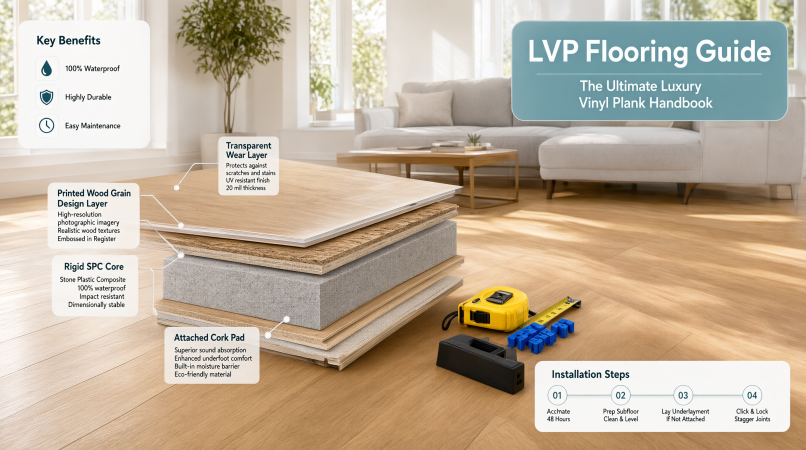
LVP stands for luxury vinyl plank. At its core (pun intended), it is a layered product built from several components bonded together. Here is what is inside a typical plank:
Wear layer — This is the clear protective top coat. It is what takes the daily beating from shoes, pet claws, and dropped objects. A thicker wear layer generally means better scratch resistance.
Design layer — This is the printed film that gives the plank its wood grain look. Higher-end products go a step further and add embossing that lines up with the printed grain, which makes the texture feel a lot more realistic underfoot.
Core — This is the structural backbone of the plank. You will usually see two types:
- SPC (stone plastic composite) — A dense, mineral-filled core that is rigid and very stable.
- WPC (wood plastic composite) — A slightly softer, thicker core that often includes foaming agents for a more cushioned feel.
Some budget products still use a flexible vinyl core, which is thinner and bendable.
Backing or attached pad — Many planks come with a foam or cork underlayment already glued to the bottom. Others require you to buy a separate underlayment, and a few actually prohibit using one at all.
As for installation, you will typically find three formats: click-lock floating (planks snap together and rest on the subfloor), glue-down (planks are adhered directly), and loose-lay or peel-and-stick styles. The installation guide that comes with your product will tell you which methods are approved.
LVP vs. LVT — What is the difference?
The construction is often nearly identical. The main difference is the shape and the look. LVP comes in long, narrow planks that mimic wood. LVT (luxury vinyl tile) comes in square or tile-shaped pieces that imitate stone or ceramic. When people search for “LVP flooring tile,” they are usually referring to LVT or a tile-look vinyl product — which is still vinyl, not actual ceramic or porcelain.
LVP vs. “vinyl plank”
“Vinyl plank” is a broad umbrella term. Some retailers use it for basic, thin, flexible planks, while “luxury” usually signals a thicker, more detailed, and often more durable product. Because the term is not tightly regulated, it is always smarter to compare actual specifications rather than relying on the label.
Pros and Cons of LVP Flooring
Advantages
Wood look without solid hardwood. Quality printing and texture technology have come a long way. Many LVP products are genuinely convincing to the eye and to the touch.
Good everyday moisture tolerance. Most LVP products handle spills and humidity far better than hardwood or standard laminate — as long as the specific product is rated for the room you are installing it in.
Easy routine cleaning. A quick sweep and a damp mop with an approved cleaner is usually all you need. No waxing, no refinishing.
Simpler installation for many homeowners. Click-lock planks have made LVP one of the more DIY-friendly flooring options out there. A careful homeowner with the right tools can absolutely handle it.
Wide range of looks and prices. From light Scandinavian oak to dark walnut, narrow strips to wide planks — the variety is huge, and so is the price range.
Comfort underfoot. Many LVP floors feel noticeably warmer and softer than tile, especially when they come with an attached pad.
That said, every benefit has a limit. “Scratch resistant” does not mean scratch-proof, and a waterproof plank does not automatically mean a waterproof floor assembly.
Disadvantages
Cuts, gouges, and dents. Sharp objects and heavy point loads can mark vinyl, especially in lower-grade products.
Furniture and appliance damage. Dragging something heavy across the surface can tear or dent it.
Heat and sunlight sensitivity. Some products can soften, fade, or expand in strong direct sunlight or high temperatures. Manufacturers publish specific limits for a reason.
Subfloor sensitivity. Vinyl tends to telegraph bumps, ridges, and dips from the subfloor below. A flat, clean, stable subfloor is not optional — it is a requirement.
Repair difficulty. Replacing a single plank is easier on some installations than others, and it requires spare planks from the same production lot.
Resale perception. Many homebuyers still rate hardwood or stone higher. Do not assume LVP adds a specific dollar amount to your resale value.
Product-specific emissions concerns. Some vinyl products can emit VOCs. More on this in the vinyl safety section below.
Who it suits: Households that want a wood look with good moisture tolerance and a moderate budget.
Who may prefer something else: Owners who want a refinishable floor (solid hardwood), the hardest-wearing surface in a very wet room (tile), or a natural-material floor.
Is LVP Flooring Waterproof?
This is where marketing language gets tricky. Sometimes the plank itself is waterproof, but the whole floor system rarely is. That distinction matters more than any label on the box.
| Term | What it means in practice |
|---|---|
| Waterproof plank | The plank material does not absorb water or swell. |
| Water-resistant | The product tolerates spills for a limited time. |
| Seam and edge exposure | Water can pass through joints and reach the subfloor even if the plank itself is unharmed. |
| Subfloor moisture | Wood subfloors can swell or grow mold if water gets underneath. |
| Concrete slab vapor | Moisture vapor rising through a slab can damage adhesives. Testing and vapor control follow manufacturer rules. |
| Flooding | Prolonged standing water is not covered by “waterproof” claims. |
How long can water sit on LVP flooring?
There is no universal number. The allowed time depends on the product, how it was installed, and the warranty. Most manufacturers require prompt cleanup, especially near seams, walls, transitions, dishwashers, refrigerators with water lines, and laundry connections. Always check the installation guide and warranty for your exact product.
For bathrooms, kitchens, laundry rooms, and basements, confirm that your specific product is approved for that use. For concrete subfloors, follow the manufacturer’s moisture testing and vapor-barrier requirements. Trade groups like the Resilient Floor Covering Institute publish technical resources on resilient flooring and moisture if you want to dig deeper.
LVP Flooring Thickness Guide
Two numbers matter here, and they are not interchangeable.
Total thickness is measured in millimeters (mm). It includes the wear layer, design layer, core, and sometimes the attached pad (check whether the listed figure includes it). Total thickness affects transitions, door clearance, and underfoot feel.
Wear layer is measured in mils. One mil is 0.001 inch, not a millimeter. So a 20 mil wear layer is 0.020 inch, or about 0.5 mm. A 12 mil layer is about 0.3 mm. A 6 mil layer is about 0.15 mm.
The wear layer is your main measure of surface-wear protection. Total thickness is mostly about rigidity, feel, and installation compatibility. A thicker plank is not automatically more durable, and a high mil number does not make the floor scratch-proof.
| Specification | What it tells you | Common mistake |
|---|---|---|
| Total thickness (mm) | Overall plank build, fit with transitions | Assuming thicker means tougher |
| Wear layer (mil) | Surface wear protection | Confusing mil with mm |
| Core type (flexible, SPC, WPC) | Rigidity, dent resistance, feel | Assuming all rigid cores behave alike |
| Attached pad | Sound and comfort | Adding a second underlayment when the manufacturer prohibits it |
Example of real specifications: Retailer listings for COREtec Pro Plus show an SPC core, a 20 mil wear layer, and an attached cork underlayment, with one listed style at 5.0 mm total thickness and 7 inch by 48 inch planks. Other products have different values, so always use the spec sheet for the exact style you are buying.
Common wear layer tiers sold for homes are around 6, 12, and 20 mil. Lower values can be reasonable for low-traffic bedrooms, and higher values are often chosen for busy kitchens and entries. Treat that as a general guide, not a hard rule.
LVP vs. Laminate, Vinyl Plank, LVT, Hardwood and Tile
Here is a quick comparison to help you see how LVP fits into the bigger picture:
| Floor type | Look | Moisture behavior | Scratch and dent | Underfoot | Typical cost position | Best for |
|---|---|---|---|---|---|---|
| LVP | Wood-look print | Many products tolerate spills; seams and subfloor still matter | Can cut, gouge or dent; varies | Slightly soft, quieter with a pad | Mid range | Most living areas, many wet-adjacent rooms if rated |
| Laminate | Wood-look print | Standard types swell if soaked; water-resistant types exist | Often scratch resistant, edges can chip | Firm | Often lower to mid | Dry areas, budget projects |
| Solid or engineered hardwood | Real wood | Sensitive to water | Dents and scratches; most types can be refinished | Firm, warm | Higher | Living rooms and bedrooms where authenticity matters |
| Ceramic or porcelain tile | Tile, stone, wood-look | Very good when properly installed | Very hard wearing, can crack | Hard and cold | Varies, often higher installed | Bathrooms, entries, wet areas |
Performance varies by product in every category, so these are descriptive, not ratings.
LVP vs. Laminate
Laminate has a fiberboard-type core with a printed surface and hard coating. LVP has a vinyl-based core with a vinyl surface. Standard laminate is more vulnerable to prolonged water, but water-resistant laminate products exist, so do not treat all laminate as equally weak.
Which lasts longer? It depends on the product, moisture exposure, and installation. Neither wins automatically. Compare warranties and wear specifications for the exact products you are considering.
Is LVP cheaper than laminate? Not always. Laminate often prices lower, but premium laminate can cost more than basic LVP. Compare equal quality and equal project scope, including underlayment and subfloor prep.
Which is better, laminate or LVT? LVT usually suits moisture-prone rooms better, while laminate may suit dry rooms and hard-wearing, scratch-resistant needs. Which is more expensive? Neither, consistently. Price depends on the product line.
LVP vs. Standard Vinyl Plank
LVP is a type of vinyl plank, so “Is LVP better than vinyl plank?” depends on the exact products. Luxury products tend to be thicker, more realistic, and often more durable, but a thin LVP can underperform a good standard vinyl plank. Compare thickness, wear layer, core, and warranty instead of the label.
LVP vs. LVT
Same family. LVP is plank-shaped and wood-look. LVT is tile-shaped and stone or ceramic-look. Performance, installation, and maintenance are similar when the construction is similar. Price depends on the product, not the shape.
LVP vs. Hardwood
Hardwood offers authentic grain, and solid hardwood can be sanded and refinished multiple times. Most LVP cannot be refinished. LVP is generally more tolerant of moisture. Hardwood can scratch and dent, and vinyl can scratch and gouge. Hardwood often costs more installed. Do not assume either affects resale value by a specific amount.
LVP vs. Tile
Tile is the better choice for constant standing water and the hardest wear, but it is cold, hard, and more demanding to install. It needs a stiff, flat substrate and grout maintenance. LVP is warmer, quieter, and easier to install. Is it better to have tile or vinyl flooring? For showers, wet rooms, and heavy water exposure, tile is typically the safer choice. For living areas, bedrooms, and many kitchens, LVP can be a comfortable, lower-effort option.
Is LVP Flooring Expensive?
LVP is usually mid-priced — cheaper than most hardwood and many tile installations — but the range is wide. The costs below come from cost guides published in recent years and viewed in October 2026. They are national figures and vary by region, product, labor market, and project.
| Cost item | Reported range | Notes |
|---|---|---|
| LVP material | About $3 to $10 per sq ft | Angi data cited by This Old House |
| Professional installation | About $1 to $5 per sq ft | MSI, a manufacturer; other guides report higher labor |
| Total installed | About $3 to $16 per sq ft; most projects $5 to $12 | Fixr |
| Old flooring removal | About $1 to $2 per sq ft | This Old House |
| Underlayment (when needed) | About $0.50 per sq ft | This Old House |
Sources disagree because they describe different products, labor scopes, and markets, so these figures should not be averaged. For comparison, This Old House (citing Angi) lists laminate at about $1 to $4 per sq ft and hardwood installation at about $6 to $18 per sq ft.
Material price is not the total price. Budget for subfloor repair, removal, underlayment, transitions, trim, and waste.
Budget Example (Illustrative, Not a Quote)
Assume a 200 sq ft room, 10% waste, and these assumptions: $4.00 per sq ft for material, $3.00 per sq ft labor, $1.50 per sq ft removal, $0.50 per sq ft underlayment, and $150 for trim and transitions.
| Item | Calculation | Cost |
|---|---|---|
| Material with waste | 200 × 1.10 = 220 sq ft; 220 × $4.00 | $880 |
| Installation labor | 200 × $3.00 | $600 |
| Old floor removal | 200 × $1.50 | $300 |
| Underlayment | 200 × $0.50 | $100 |
| Trim and transitions | Allowance | $150 |
| Estimated total | $2,030 |
That equals about $10.15 per installed sq ft. In practice you buy whole cartons, so material may round up. For example, at 28.84 sq ft per carton, 220 sq ft needs 8 cartons (230.72 sq ft). Complex layouts or subfloor work can raise the total.
Is LVP considered high end? Premium LVP can be refined, but it is not generally ranked with natural stone or solid hardwood. Price alone does not prove performance, so judge by wear layer, core, texture quality, and warranty.
Does LVP Flooring Look Cheap?
It can, but it does not have to. Looks depend on several factors:
- Print and texture quality. Embossing that matches the printed grain looks far more realistic than flat surfaces.
- Pattern repetition. Fewer repeats across boxes looks more natural.
- Plank size. Wider, longer planks often look more premium, but not always.
- Surface finish. Low, matte sheen usually looks more natural than a high gloss.
- Installation. Staggered joints, consistent gaps, and good transitions matter a lot.
- Lighting. Strong side light can reveal flat texture.
Tip: View large samples in your own lighting, and lay several planks from different cartons together before committing.
COREtec LVP Flooring
COREtec is a well-known branded range of rigid-core luxury vinyl. Specifications differ across collections, so confirm each style on the official COREtec site. For example, retailer listings for COREtec Pro Plus describe an SPC core, a 20 mil wear layer, and an attached cork pad. Other collections can differ in thickness, core, and finish.
Before choosing a COREtec product, compare:
- Total thickness and wear layer for your exact style
- Core type and attached pad
- Installation method and whether a separate underlayment is allowed
- Room approvals (kitchen, bath, basement)
- Residential and commercial warranty terms and limits
- Price per carton and sq ft per carton
COREtec is one option among many, not automatically the best or most durable brand.
LVP Flooring at Costco
Costco and other big retailers can offer competitive pricing, but listings and stock change, so verify details at the time of purchase. Check:
- Exact brand and model
- Price per sq ft and sq ft per box
- Total quantity needed, including waste
- Wear layer and total thickness
- Core type and attached pad
- Installation instructions and permitted methods
- Warranty terms and what voids them
- Shipping, returns, and availability
Do not assume a retailer’s product matches a brand-name collection’s specifications.
Tools for Installing LVP Flooring
Tools depend on the product, installation method, and subfloor. Always follow the manufacturer’s instructions.
| Tool | Purpose | When needed | Precautions |
|---|---|---|---|
| Tape measure and pencil | Measuring and marking | Always | Measure more than once |
| Carpenter’s square | Square cuts | Always | Check wall squareness |
| Utility knife and straightedge | Score-and-snap cuts | Most thin planks | Use sharp blades, cut away from your body |
| Spacers | Maintain expansion gap | Floating floors | Gap size follows the manufacturer |
| Tapping block and pull bar | Close joints at walls and ends | Click-lock floors | Use only tools the manufacturer approves; some prohibit specific tools or techniques |
| Rubber mallet | Seat planks | If permitted | Never strike the locking edge directly |
| Saw (such as a fine-tooth or power saw) | Cuts that cannot be scored | Thicker or rigid planks | Use dust control and eye and respiratory protection |
| Trowel | Spread adhesive | Glue-down installs | Use the specified trowel and adhesive |
| Floor roller | Bond planks | Glue-down installs | Follow roller weight guidance |
| Vacuum or broom | Clean subfloor | Always | Debris causes bumps and gaps |
| Moisture testing equipment | Check concrete or wood moisture | Many slab installs | Follow test method and limits |
| PPE | Safety | Cutting and adhesive work | Eye protection, gloves, mask where needed |
Click-lock floors rely on spacers, tapping tools, and a clean flat subfloor. Glue-down floors add adhesive, trowels, and rollers and need stricter surface prep.
Can You Put a Refrigerator on LVP Flooring?
It depends on the flooring manufacturer’s load and installation requirements, the refrigerator’s weight, and whether the floor needs to move. There is no universal weight limit.
Weight and point loads: Weight concentrates at feet or wheels, which can dent or mark softer vinyl.
Floating floor movement: A floating floor needs to expand and contract. Heavy fixed items, such as built-in cabinetry, can pin a floating floor and cause gaps or buckling. Some manufacturers specify not to install floating floors under fixed objects.
Moving the appliance: Do not drag it. Use appliance dollies and protective hardboard or similar protection under wheels and feet, and lift or roll carefully.
Check both the flooring and appliance manufacturers’ guidance. Use protective pads or leveling feet recommended for resilient floors.
How Long Does LVP Flooring Last?
There is no single lifespan. Manufacturers publish warranties, not guaranteed service lives. A warranty is a legal promise with conditions, and it is not a prediction. Many cost guides quote roughly a decade or two for residential use, but treat that as an estimate that depends on:
- Product quality and wear layer
- Traffic, pets, and furniture
- Sunlight and temperature
- Installation quality and subfloor prep
- Moisture exposure
- Maintenance
Note the difference between residential and commercial warranty terms and what causes exclusions (water intrusion, improper installation, using unapproved cleaners).
Maintenance Basics
- Sweep or vacuum regularly (use a hard floor setting; avoid beater bars).
- Clean with a manufacturer-approved cleaner.
- Wipe spills promptly, especially near seams.
- Use felt pads under furniture and mats at entries (check which backings are safe for vinyl).
- Avoid harsh chemicals, abrasive pads, and steam cleaning unless the manufacturer allows it.
Are LVP Floors Slippery, and Why Do Some People Avoid Vinyl?
Are LVP floors slippery? Not inherently. Traction depends on surface texture, footwear, spills or residue, and the product. Embossed textures often grip better than smooth gloss, and any wet floor can be slippery. If traction matters, such as for mobility concerns or wet areas, check manufacturer slip data and choose a textured finish.
Why avoid vinyl flooring? Reasons are real but should be weighed fairly:
- Emissions: Some products can emit volatile organic compounds (VOCs). Certification programs such as FloorScore test emissions against indoor air standards. Certification addresses emissions, not health outcomes, so look for certified products if this concerns you. The US EPA offers general guidance on indoor air quality.
- Environmental trade-offs: Vinyl is plastic-based and hard to recycle in many areas.
- Repair limits: It cannot be refinished like hardwood.
- Heat and sun sensitivity in some products.
- Quality variability between products.
This does not mean all vinyl is toxic or that you should remove a properly installed floor without a credible reason.
Frequently Asked Questions
What is LVP flooring? Luxury vinyl plank: layered, wood-look vinyl flooring sold in planks, with a wear layer, printed design layer, core, and sometimes an attached pad.
Is LVP better than vinyl plank? LVP is a type of vinyl plank. Premium versions are often thicker and more realistic, but compare specifications, not names.
What are the disadvantages of LVP flooring? It can cut, gouge, or dent, can be sensitive to heat and sun, needs a good subfloor, and may be harder to repair than some floors.
Which is better, laminate or LVT? LVT usually suits moisture-prone rooms better. Laminate can suit dry rooms and hard-wearing, scratch-resistant needs. Water-resistant laminate exists.
Is LVP considered high end? Premium LVP can look refined, but it is generally not classed with solid hardwood or natural stone.
How long can water sit on LVP? It depends on the product and warranty. Clean spills promptly, especially near seams.
Which lasts longer, laminate or LVP? It depends on the products, moisture exposure, and installation.
Is LVP cheaper than laminate? Not always. Compare equal quality and project scope.
Can you put a refrigerator on top of LVP? Often yes, but follow the flooring and appliance manufacturers’ guidance and avoid pinning a floating floor.
Why avoid vinyl flooring? Concerns include product-specific emissions, environmental trade-offs, and repair limits. They vary by product.
Is it better to have tile or vinyl flooring? Tile for constant wet exposure and heavy wear. LVP for comfort, easier installation, and general living areas.
Does LVP look cheap? It can if the print, texture, or installation is poor. Quality products can look realistic.
Are LVP floors slippery? Not inherently. Texture, footwear, and spills matter.
Which is more expensive, laminate or LVT? It depends on the specific products.
How long does LVP flooring last? No guaranteed lifespan exists. Warranties and real-world performance differ.
Conclusion: Is LVP Flooring Right for Your Home?
LVP is a strong fit when you want a wood look, good everyday moisture tolerance, and a moderate budget. Choose it by specifications: wear layer in mils, total thickness in millimeters, core type, attached pad, installation method, and warranty. Consider laminate for dry, budget-focused rooms, hardwood if you want a refinishable natural floor, and tile for constant water exposure. Before buying, get large samples, read the installation guide, and budget for the whole project, not just planks.