
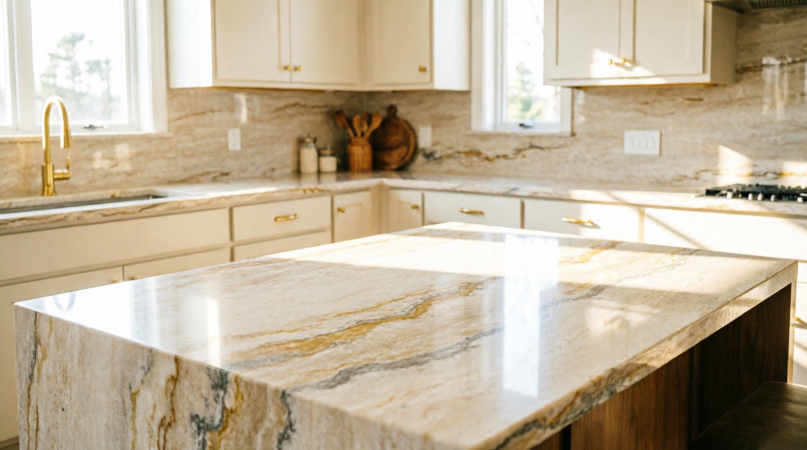
Taj Mahal quartzite pulls from quarries in Ceará, Brazil, bringing a creamy white to soft beige backdrop streaked with gold, tan, or gray veining. It’s a natural metamorphic stone—not engineered quartz, not marble. Suppliers market it as a marble-look option with better hardness and acid resistance. In the US market, most projects land somewhere between $100 and $200 per square foot fully installed, though you’ll see plenty of variation depending on where you look.
That reputation for performance hinges on one thing: the slab you’re buying actually being genuine quartzite. Not every slab carrying the Taj Mahal name is the same rock underneath, so verification matters before you commit.
What Is Taj Mahal Quartzite?
“Taj Mahal” functions as a trade name rather than a specific quarry designation or precise geological classification. A Brazilian stone-industry publication describes it as a family of visually similar crystalline quartzites from Ceará, not one single stone. You’ll also see it sold under names like Perla Venata and Madreperola.
Quartzite forms when quartz-rich sandstone gets transformed by heat and pressure deep underground. Marble comes from limestone under similar processes. Engineered quartz is manufactured from crushed quartz mixed with resin. Three completely different materials.
Brachot, a European stone supplier, lists Taj Mahal as a fine-grained white-beige quartzite from Brazil and points out that not every stone sold under that name meets the same geological or technical standard. That caution matters. A trade name doesn’t prove what’s actually in the slab.
Is Taj Mahal Quartzite Marble?
No. Documented quartzite isn’t marble. The name references the monument’s pale appearance, and yes, the monument itself is built from marble. The countertop stone is a different rock entirely, quarried in Brazil.
Is Taj Mahal Quartzite Limestone?
No. Limestone is sedimentary rock made mostly of calcium carbonate. Quartzite is made mostly of quartz. Similar coloring doesn’t mean similar geology.
Where Does Taj Mahal Quartzite Come From?
Documented Taj Mahal quartzite comes from Ceará in northeastern Brazil. Supplier and trade sources place quarrying near Uruoca. Multiple operators work that area, so pointing to one exact quarry for every slab you’ll see in a showroom isn’t realistic.
The stone’s geological age isn’t something a trade name reveals, and reliable slab-level age documentation is hard to come by. Treat any specific age claim for a retail slab with healthy skepticism.
Is Taj Mahal Quartzite Available in India?
The stone gets quarried in Brazil and exported internationally. Whether a specific slab is available in India depends on local importers and distributors, so you’ll need to ask them directly about current stock and documentation.
What Color Is Taj Mahal Quartzite?
The base color runs from creamy white to soft beige or champagne. Veining stays usually subtle and may run gold, amber, taupe, brown, or gray. Some slabs show a layered or crystalline look, others have more movement.
Several factors change how it looks once it’s in your kitchen:
Slab variation. Color intensity, vein density, and pattern differ between slabs and between bundles. A small sample or showroom photo won’t show you the full picture.
Finish. Brachot lists polished and a matte “leather touch” finish. Other suppliers offer honed, leathered, or flamed finishes. Polished shows color and veining most vividly. Leathered and honed finishes read softer and cut down on glare.
Lighting. Warm bulbs push the stone toward yellow. Cool daylight makes it look whiter or grayer.
Taj Mahal Quartzite Countertops: Advantages
Marble-like appearance. Warm, soft color with natural movement you won’t get from engineered materials.
Hardness. Quartz sits at about 7 on the Mohs scale. Supplier sources describe Taj Mahal at roughly 7 to 7.5, compared with about 3 to 3.5 for softer stones it’s often compared to. That helps with scratch resistance, though hardness alone doesn’t determine staining or maintenance needs.
Low absorption, per supplier documentation. Brachot describes very low water absorption and strong acid resistance for its verified material. Check the data for the specific slab you’re buying.
Natural stone character. No two slabs match.
What Are the Disadvantages of Taj Mahal Quartzite?
The main drawbacks come down to cost, slab variation, and the need to verify what you’re buying. None of these make it a bad choice—they’re trade-offs to weigh.
Premium cost. It generally prices above many granites and most mid-range engineered quartz.
Slab and bundle variation. What you see in a photo may not match your slab. Finding matching material later for a repair or addition can be difficult.
Composition uncertainty. Some stones sold as quartzite behave differently from true quartz-rich quartzite, including with acids and stains. Documentation matters here.
Possible staining. Low absorption lowers the risk but doesn’t remove it. Absorption varies by slab, finish, and treatment, and some finishes (honed or leathered) can show marks differently than polished.
Sealing questions. Whether you need a sealer depends on the slab’s absorption and the supplier’s guidance. There’s no universal schedule that works for everything.
Chips at edges and cutouts. Hard stones can still chip at sharp edges, sink and cooktop cutouts, or from impact. Edge profile and fabrication quality matter.
Heat precautions. Natural stone tolerates heat better than many surfaces, but sudden extreme temperature changes can stress any stone. Trivets are a reasonable habit.
Fabrication complexity. Hard stone needs experienced fabricators and suitable tooling, and that shows up in the quote.
Some problems are inherent to the stone itself (variation, cost, chip risk at edges). Others depend on the supplier, the fabricator, or your habits (documentation, seam placement, sealing, cleaning products).
How Much Does Taj Mahal Quartzite Cost?
Taj Mahal quartzite commonly costs about $100 to $200 per square foot installed in the US, based on one contractor guide for this specific stone. Broader quartzite pricing runs wider, so use any single number as a starting point for comparing real quotes.
These figures were checked on October 14, 2026, for the US market, in USD. Published pricing for this specific stone is inconsistent, and many pages that rank for these searches are thin or contradict each other, so I excluded pages that didn’t read as credible. Treat everything below as a planning range, not a quote.
| Cost type | Range found (USD, per sq ft) | What it covers | Source type |
|---|---|---|---|
| Taj Mahal, installed | $100 to $200 | Slab, fabrication, installation | Contractor guide for this stone |
| Taj Mahal, slab only | About $60 to $100+ | Material only | Same guide |
| Quartzite in general, installed | $60 to $200+ (most $80 to $140) | All-in | Countertop cost guide (2026) |
| Quartzite in general, slab only | $50 to $120 | Material only | Cost guide (Fixr) |
| Quartzite in general, fabrication | $30 to $90 | Cutting, edges, finishing | Cost guide (Fixr) |
Slab-only and installed prices aren’t interchangeable. A low slab price doesn’t mean a low project cost, because fabrication and installation often cost as much as the stone itself.
What Affects the Price?
- Slab grade, appearance, and current availability
- Slab size and thickness (2 cm versus 3 cm)
- Finish (polished, honed, leathered)
- Edge profile (an upgraded edge is often priced per linear foot)
- Sink, faucet, and cooktop cutouts
- Backsplashes, especially full-height, and waterfall island sides
- Seams and slab yield (waste from layout and cuts)
- Delivery and handling
- Demolition and disposal of old countertops
- Regional labor rates and project complexity
Example: Comparing Quotes on a 40 Square Foot Kitchen
This is an illustrative calculation, not a real project or a market average. Assume 40 square feet of finished countertop.
Formula: area × price per square foot.
- Slab only at $50 per sq ft: 40 × $50 = $2,000
- Slab only at $120 per sq ft: 40 × $120 = $4,800
- Installed at $100 per sq ft: 40 × $100 = $4,000
- Installed at $200 per sq ft: 40 × $200 = $8,000
Those four numbers show how much the answer depends on what the quote includes. Stone is often sold by the slab, so you may pay for more material than the finished area. Seams, cutouts, and layout waste can push the billed amount above 40 square feet. If you need help with the area itself, a countertop square footage calculator can handle L-shapes and islands.
Is Taj Mahal Quartzite Expensive?
Yes, relative to most granite and mid-range engineered quartz. It sits in the premium natural-stone tier, and supplier sources describe supply as constrained. Brazilian industry sources also report strong export growth for Ceará quartzite in 2025, which is consistent with rising demand, though how that translates into your local price depends on your market.
Why Is “Taj Mahal Quartz” So Expensive?
Check which material the question refers to. Natural Taj Mahal quartzite is expensive because of quarrying, limited high-quality yield, transport from Brazil, and difficult fabrication. Engineered quartz sold in a similar pattern is manufactured, and its price depends on the brand and line. Don’t assume the two cost the same.
What Color Cabinets Go With Taj Mahal Quartzite?
Warm white, natural wood, and greige or taupe cabinets are the safest pairings, because they share the stone’s warm undertones. Match undertones rather than color names, since “white” and “gray” paints vary a lot.
Warm white and off-white. Cohesive and bright. Avoid stark or blue-based whites, which can make the stone look yellow or dingy by comparison.
Natural wood (oak and similar). Reinforces the beige and gold in the veining. Works well in organic-modern kitchens.
Greige, taupe, and beige. A low-contrast, layered look. Check that the cabinet undertone is warm, not pink or cool gray.
Muted green (sage or olive). Contrasts with the cream stone while staying natural.
Navy, charcoal, or dark brown. Higher contrast. These often work best on an island or lower cabinets, with lighter perimeter cabinetry.
No pairing is universally best. The slab’s actual veining and the kitchen’s light decide.
Other Design Decisions
Backsplash. Matching stone creates a continuous look. A simple warm tile contrasts without competing with the veining.
Flooring. Keep undertones warm and avoid heavy pattern near a busy slab.
Hardware, faucet, and sink. Brass and bronze finishes echo gold veining. Black or nickel finishes shift the look cooler and more modern.
Lighting. Test samples under your actual daylight and your kitchen bulbs.
Slab layout. Plan vein direction before fabrication, especially on islands, waterfall panels, and across seams.
Always hold cabinet door and backsplash samples against the actual slab before committing.
Taj Mahal Quartzite Kitchen Ideas
Warm minimalist. Flat-panel warm white cabinets, honed or leathered stone, minimal hardware.
Organic-modern. Natural oak cabinets, textured tile, matte black or aged brass accents.
Transitional. Warm white shaker cabinets, a full-height stone backsplash, and traditional hardware.
Contrasting island. Muted green or navy island with neutral perimeter cabinets and the stone on both.
Continuous stone. Same slab for countertop and backsplash, with simple cabinets to let the veining lead.
Adapt each idea to your actual slab. A heavily veined slab needs quieter surroundings than a clean, pale one.
Taj Mahal Quartzite vs. Quartz, Granite, and Marble
| Factor | Taj Mahal quartzite | Engineered quartz | Granite | Marble |
|---|---|---|---|---|
| Material type | Natural metamorphic stone | Manufactured (crushed quartz and resin) | Natural igneous stone | Natural metamorphic stone (from limestone) |
| Appearance | Natural variation, no two alike | Consistent, depends on product line | Varies widely by variety | Soft veining, varies by variety |
| Acid sensitivity | Generally resistant if true quartzite; verify the slab | Resin surface; check the manufacturer | Generally resistant | Etches easily |
| Stain resistance | Low absorption per supplier data; verify the slab | Generally low porosity; check the product | Varies by stone | More prone to staining |
| Sealing | Depends on slab and supplier guidance | Typically not required; check the manufacturer | Often recommended; varies | Commonly recommended |
| Heat | Tolerant, but avoid thermal shock | Resin can be heat-sensitive; follow manufacturer guidance | Tolerant, avoid thermal shock | Tolerant, avoid thermal shock |
| Relative cost | Premium natural stone | Wide range by brand and design | Wide range; many varieties cost less | Wide range; some very expensive |
| Maintenance | Moderate; depends on slab | Typically low | Moderate | Highest |
These are general patterns, not guarantees. Individual products, finishes, and installation specs change the result.
Which Is Better, Taj Mahal Quartzite or Quartz?
It depends on your priorities. Choose Taj Mahal quartzite if you want natural variation and a stone with marble-like character. Choose engineered quartz if you want predictable color, consistent patterns, and typically lower maintenance. Neither is better for every kitchen.
Which Is Cheaper, Quartzite or Granite?
Granite is often cheaper, but pricing varies by variety, grade, location, and installation. Some exotic granites cost as much as quartzite, and some quartzites cost less than premium granite.
How to Clean and Maintain Taj Mahal Quartzite
Daily: Use warm water and a soft cloth, plus a mild pH-neutral stone cleaner if needed.
Spills: Wipe promptly, especially oils, wine, and coffee.
Products to avoid: Do not automatically use vinegar, acidic cleaners, or abrasive pads. Even if the stone is acid-resistant, sealers and finishes may not be.
Sealing: Ask the supplier whether this slab needs it, and what product they recommend. Some buyers do a simple water-absorption check on a hidden area, which tells you about absorption but not about geology or identity.
Heat and cutting: Use trivets and cutting boards.
Repairs: Chips and cracks should go to a professional stone repair service.
The Natural Stone Institute is a good reference for general natural stone care and terminology. For product-specific guidance, rely on the supplier’s documentation.
How to Choose a Taj Mahal Quartzite Slab
Take this checklist to the stone yard:
- Inspect the actual slab, not just photos
- Ask for identity and origin documentation
- Look for color variation, veining, fissures, repairs, and filled areas
- Confirm thickness and available finishes
- Ask whether the slab needs sealing or special care
- Ask how visible fissures and repairs will be handled during fabrication
- Plan seams, sink cutouts, edge profiles, and island layout in advance
- Confirm whether matching slabs are available for the whole project
- Get a written quote that itemizes material, fabrication, transport, and installation
- Collect care instructions and warranty details
A buyer’s scratch or acid test cannot reliably establish a stone’s geological identity. If identity matters to you, rely on supplier documentation or a qualified materials professional.
Is Taj Mahal Quartzite Outdated?
Not inherently. I didn’t find reliable, current trend data that rates it in or out of fashion, so I wouldn’t claim either way. What is true is that a warm cream stone suits traditional, transitional, contemporary, and organic-modern kitchens. Whether a kitchen feels current depends more on cabinet color, hardware, backsplash, and lighting than on the countertop alone. A well-coordinated kitchen tends to age better than one built around a passing trend. Taste is personal, so the best test is whether you’ll still like it in ten years.
Cheaper Alternatives to Taj Mahal Quartzite
There’s no single cheaper version, so compare actual specifications and quotes.
Engineered quartz in warm cream or soft-veined designs. Often easier to maintain, but ask about heat limits.
Porcelain slabs with a quartzite look. Some manufacturers sell Taj Mahal-effect porcelain, for example in 12 mm thickness aimed at floors and walls. Check that a specific product is rated for countertops.
Other natural quartzites. Super White, Shadow Storm, and Perla Venata are among those sold in the US; one cost guide lists them at roughly $50 to $80 per sq ft for slabs. Perla Venata is also an alternative name for Taj Mahal-type material, so confirm what you’re looking at.
Granite in a cream or beige variety.
I can’t give a defensible “top five quartzites” or “most expensive quartzite” ranking. Pricing depends on rarity, availability, region, and project details. The same is true of the most expensive countertop stone and the best luxury kitchen countertop. Treat these as preference and budget questions, not universal rankings.
Frequently Asked Questions
How old is Taj Mahal quartzite? The name is a recent commercial label. The rock itself is geologically much older, but a reliable age for a particular slab can’t be read from the trade name.
What is the most expensive countertop stone? It depends on rarity and market. No single stone is reliably the most expensive everywhere, and I didn’t find evidence to name one.
What is the best countertop for a luxury kitchen? Pick based on look, maintenance tolerance, and budget. Natural stone, engineered quartz, and large-format porcelain all appear in high-end kitchens.
Conclusion
Taj Mahal quartzite offers a warm, marble-like look with the hardness of quartz, at a premium price. Before you buy, inspect the actual slab, ask for documentation, compare itemized quotes, and test cabinet and backsplash samples against the stone in your own lighting.
2 thoughts on “Taj Mahal Quartzite: Color, Cost, Pros and Cons, and Kitchen Ideas”