
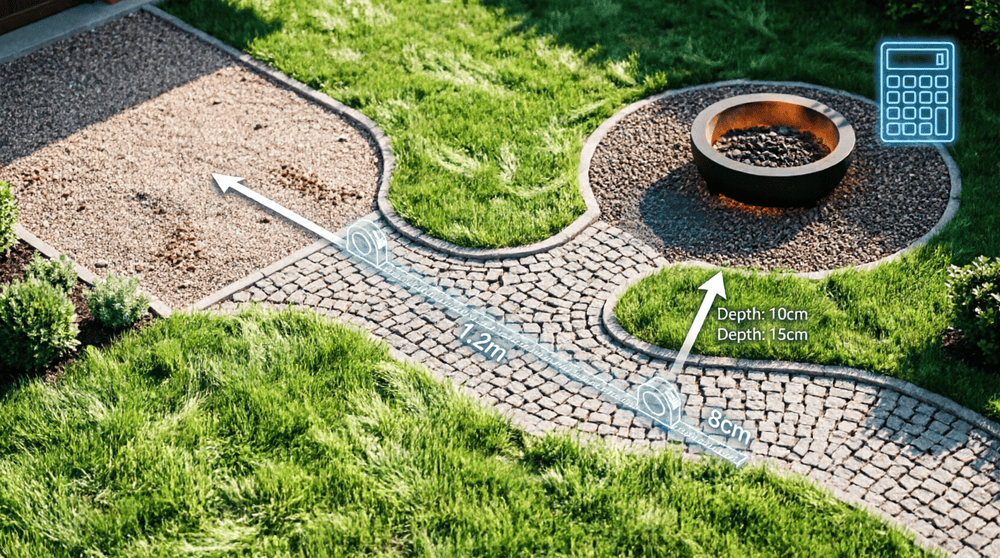
Gravel is one of the easiest landscaping materials to work with and one of the easiest to order wrong. Order too little and you’re paying for a second delivery fee; order too much and you’re shoveling the surplus into a corner of the yard.
How much gravel you need comes down to one simple calculation: area × depth, converted to cubic yards or tons. Below you’ll find the formula, depth guidelines for every common project, and worked examples you can copy. If you’d rather skip the math, our gravel calculator handles the conversions for you.
The Quick Answer: The Gravel Calculation Formula
Calculating gravel takes three steps:
- Measure the area in feet (length × width for rectangles).
- Multiply by depth in feet — divide your depth in inches by 12 first.
- Convert to cubic yards by dividing cubic feet by 27 (one cubic yard = 27 cubic feet).
The formulas:
- Volume (cubic feet) = Length × Width × Depth (all in feet)
- Cubic yards = cubic feet ÷ 27
- Tons ≈ cubic yards × 1.4 (a typical planning figure for gravel — more on weight below)
Worked example — a garden path 50 ft long, 3 ft wide, 3 inches deep:
- Area: 50 × 3 = 150 square feet
- Depth: 3 ÷ 12 = 0.25 ft
- Volume: 150 × 0.25 = 37.5 cubic feet
- Cubic yards: 37.5 ÷ 27 = 1.39 cubic yards
- Weight: 1.39 × 1.4 ≈ 2 tons
For this path you’d order about 1.5 cubic yards (roughly 2 tons), leaving a small margin for waste — which we’ll cover later.
Irregular Shapes: Circles and L-Shapes
Circles (fire pit areas, tree rings): area = 3.14 × radius².
Example: a 12-ft-diameter fire pit area, 2 inches deep.
- Area: 3.14 × 6² = 113 sq ft
- Volume: 113 × 0.167 = 18.9 cu ft ÷ 27 = 0.7 cubic yards (≈ 1 ton)
L-shapes and odd layouts: split the space into rectangles, calculate each one, then add the volumes together. This takes an extra two minutes and prevents the most common measuring error.
Gravel Depth Guide by Project
The volume formula only works if your depth is right. These depths are compacted depths — what you want after the stone has settled and been firmed up:
| Project | Recommended compacted depth |
|---|---|
| Decorative border or top dressing | 1–2 in |
| Garden path (pea gravel or crushed stone) | 2–3 in |
| Walkway with regular foot traffic | 3–4 in |
| Patio base or shed pad | 4–6 in |
| Residential driveway (cars, light trucks) | 4–6 in, installed in layers |
| Driveway on soft or clay soil | 6–8 in, over geotextile fabric |
| Playground surfacing (fall protection) | Depends on fall height — see note below |
Playground note: required loose-fill depth is tied to the equipment’s fall height. In the U.S., the Consumer Product Safety Commission’s Public Playground Safety Handbook is the standard reference; requirements differ elsewhere, so check the guidance that applies to you.
If your ground is soft or you’re parking heavier vehicles, err toward the deeper end. Thin gravel on soft soil disappears into the mud within a season or two.
Figuring Gravel for a Driveway
Figuring gravel for a driveway deserves its own section, because driveways are where most people under-order. Two things make driveways different:
- Depth comes in layers, not one pour. A typical residential driveway uses 3–4 inches of larger base stone (roughly 1½–2½-inch rock, or crusher run) topped with about 2 inches of a finer surface stone such as ¾-inch crushed stone or pea gravel. Two layers lock together and hold up under tires; a single thick layer of round stone won’t.
- Soft ground needs fabric. On clay or soft soil, a geotextile fabric under the gravel keeps the stone from punching into the ground — it protects your whole investment for a modest cost.
Driveways should also be crowned or sloped slightly (a common practice is about 2%, or a quarter inch per foot) so water drains off instead of carving ruts, and held in place with edging or a shoulder of larger stone.
Driveway Example: 20 ft × 12 ft, 6 Inches Total
- Area: 20 × 12 = 240 sq ft
- Base layer, 4 inches: 240 × (4 ÷ 12) = 80 cu ft ÷ 27 = 3.0 cubic yards (≈ 4.2 tons)
- Finish layer, 2 inches: 240 × (2 ÷ 12) = 40 cu ft ÷ 27 = 1.5 cubic yards (≈ 2.1 tons)
- Total: about 4.5 cubic yards, or roughly 6.3 tons (4.2 + 2.1) — order 5 yards to include a waste margin
If the soil is firm and you only need 4 inches total, the same driveway takes 80 cu ft ≈ 3 cubic yards, or roughly 4.2 tons.
Estimating Gravel Driveway Cost
Bulk gravel is sold by the cubic yard or by the ton, and prices vary widely by region, stone type, and delivery distance — so any gravel driveway cost calculation comes down to your tonnage × your local quoted price. Once you’ve calculated tons (cubic yards × 1.4), get quotes from two or three local suppliers and multiply. A few phone calls usually reveal a meaningful price spread, especially on delivery fees.
How Much Does a Cubic Yard of Gravel Weigh?
Gravel suppliers often sell by weight, so the volume-to-weight conversion matters. The honest answer is that it varies with stone type and moisture — but these ranges cover most common materials:
| Material | Approx. weight per cubic yard |
|---|---|
| Sand/gravel mix, dry | 1.3–1.4 tons |
| Pea gravel | ~1.4 tons |
| Crushed stone ¾ in (#57) | 1.35–1.45 tons |
| Wet gravel or fines-rich material | 1.5–1.6 tons |
Two things worth knowing: bigger stone isn’t heavier; large rock carries more air voids and can weigh slightly less per yard than finer mixes—and moisture is what pushes weight up, sometimes by a meaningful amount. A practical planning figure is 1.4 tons (about 2,800 lb) per cubic yard, or roughly 100 pounds per cubic foot. When ordering by the ton, confirm the conversion factor with your supplier; they know their material.
How Much Area Does a Cubic Yard of Gravel Cover?
Use this table as a quick gravel estimator before you do any measuring:
| Depth | Area covered by 1 cubic yard |
|---|---|
| 1 in | 324 sq ft |
| 2 in | 162 sq ft |
| 3 in | 108 sq ft |
| 4 in | 81 sq ft |
| 6 in | 54 sq ft |
| 12 in | 27 sq ft |
Working in tons? One ton covers roughly 100–120 sq ft at 2 inches deep, or about 80 sq ft at 3 inches, depending on the stone. Quick check: a 200 sq ft path at 2 inches works out to about 1.7 tons — so you’d order 2.
Choosing a Gravel Type (and Why It Changes the Numbers Slightly)
Gravel types differ in size, shape, and how they behave underfoot — which affects both the depth you need and how the stone performs:
| Gravel type | Typical size | Best for | Behavior |
|---|---|---|---|
| Pea gravel | ~⅜ in (10 mm), rounded | Paths, borders, play areas | Rolls underfoot; needs firm edging |
| Crushed stone (#57) | ¾ in, angular | Driveway finish, drainage | Compacts well, locks together |
| Base stone (#3 or similar) | 1½–2½ in | Driveway base layer | Forms a stable, load-bearing base |
| Crusher run / “minus” / DGA | Fines + stone | Bases, shed pads | Compacts nearly solid |
| River rock | 1–2 in, rounded | Decorative beds, dry creek beds | Decorative; not for driving on |
| Decomposed granite | Fine, with fines | Firm paths, patios | Compacts to a near-solid surface |
Angular crushed stone interlocks and compacts; rounded stone looks great but migrates. Choosing based on looks alone is how gravel ends up tracked across the lawn.
Pea Gravel Calculator Tips
The formula is identical — but when figuring pea gravel, keep two things in mind:
- Depth: 2–3 inches covers most paths comfortably. Deeper isn’t better; round stone just shifts more underfoot.
- Edging is mandatory. Pea gravel migrates, so budget for steel, stone, or plastic edging, and keep the gravel below the level of surrounding surfaces so it stays put.
- On driveways, pea gravel needs help. On its own it ruts and rolls, but over a compacted base — or held in a stabilizer grid — it works fine and is a popular finish layer.
Gravel Grids: How the Stone Spec Changes the Math
Cellular gravel grids (plastic stabilizer systems used for driveways, parking areas, and gravel decks) simplify the calculation in one way: the grid sets your depth. Volume = grid area × cell depth.
The stone itself must match the product’s specification. Most systems call for washed stone somewhere in the 8–25 mm (⅜–1 in) range, and the details vary by product — some specify rounded stone, others angular chip, and the maximum stone size is set by the cell design. Oversize stone won’t seat properly and can keep the surface from locking up. Manufacturers usually publish coverage figures per bag or per tonne; use those, or order the cell volume plus a small margin for leveling and spillage.
Working in Metric?
The formula is the same; only the units change.
- Volume (m³) = length (m) × width (m) × depth (m)
- Weight ≈ volume × 1,500–1,700 kg/m³ (planning figure: 1,600 kg/m³ for loose gravel)
Example: a path 10 m × 1 m at 50 mm deep: 10 × 1 × 0.05 = 0.5 m³ → 0.5 × 1,600 = 800 kg — order about 0.9 tonnes with a waste margin.
(Handy conversions: 1 inch = 25.4 mm, and 1 cubic yard ≈ 0.765 m³.)
Bags vs. Bulk: Practical Ordering Tips
- Bagged gravel typically comes in 0.5 cubic-foot bags (about 50 lb each). That works out to 54 bags per cubic yard, or roughly 40 bags per ton. Bags make sense for small jobs — under about a cubic yard — or where a truck can’t reach.
- Bulk delivery is far cheaper beyond that, but trucks deliver in whole yards or tons. Round up to the next increment.
- Add 5–10% extra for spillage, uneven subgrade, and rounding. Gravel also settles when compacted — often on the order of 10% — which is another reason the margin matters. Leftover gravel is never wasted; a shortfall means a second delivery fee.
Common Mistakes When Calculating Gravel
- Forgetting to convert inches to feet before multiplying (the #1 error — 4 inches is 0.33 ft, not 4 ft)
- Confusing loose and compacted depth — plan for the compacted depth you want
- Skipping the weight conversion when the supplier sells by the ton
- Measuring a driveway flat instead of accounting for crowning and sloped edges
- Skipping geotextile fabric on soft soil — then wondering where the gravel went
- Ordering the exact calculated amount instead of rounding up with a waste margin
FAQs
How much gravel do I need for a 20 × 10 ft driveway? At 4 inches deep: 200 sq ft × 0.33 ft = 66.7 cu ft ÷ 27 = 2.5 cubic yards (about 3.5 tons). At 6 inches: 3.7 cubic yards (about 5.2 tons). Add 5–10% for waste.
How much area does a ton of gravel cover? Roughly 100–120 sq ft at 2 inches deep, or about 80 sq ft at 3 inches, depending on the stone.
How deep should pea gravel be? 2–3 inches for paths and decorative areas. Under play equipment, the required depth for fall protection depends on the equipment’s fall height — follow current playground safety guidance rather than guessing.
How much gravel do I need for a French drain? Use the same volume formula on the trench: length × width × depth, converted to yards or tons. The perforated pipe displaces only a small share of the volume, so the trench volume is a sound estimate. Most designs fill the drainage zone with clean, washed stone so water can move freely.
Do I need landscape fabric under gravel? Yes, in most cases. A geotextile fabric separates stone from soil, stops weeds, and prevents gravel from sinking into soft ground — especially important on driveways and clay soils.
How do I calculate gravel in cubic yards? Multiply length × width × depth (in feet) to get cubic feet, then divide by 27. Or enter your measurements into the gravel calculator and let it handle the conversions.
Is pea gravel good for driveways? Only over a compacted base layer, ideally held in a stabilizer grid. Loose pea gravel on bare soil ruts and rolls under tires.
How much extra gravel should I order? 5–10% beyond your calculated amount, then round up to your supplier’s delivery increment.
The Bottom Line
How much gravel you need is a three-line calculation: area × depth in feet = cubic feet; cubic feet ÷ 27 = cubic yards; cubic yards × 1.4 ≈ tons. Pick the right depth for your project from the table above, add a small waste margin, and round up to your delivery increment. For a fast answer with no manual math — including circles, L-shapes, and metric units — use the gravel calculator, then take your tonnage straight to a local supplier for pricing.