
If your glasses are coming out with a gritty film or your kitchen has developed a sour, musty smell, the culprit is likely hiding at the bottom of your dishwasher. Most homeowners never check this part, but a clogged filter is the leading cause of poor wash performance, standing water, and lingering odors.
The good news? The fix takes about ten minutes, costs nothing, and requdifferent applianceires no special tools. This guide walks you through the universal process of how to clean a dishwasher filter, provides brand-specific instructions for Whirlpool, Samsung, Bosch, LG, and Frigidaire, and answers the most common maintenance questions.
What Does a Dishwasher Filter Actually Do?
Unlike your washing machine, a dishwasher recirculates the same water throughout the entire cycle. Water is pulled from the bottom of the tub, pushed through the spray arms, and drained at the end.
The filter acts as a gatekeeper. It catches food particles before they can reach the drain pump or get sprayed back onto your clean dishes. A dirty filter compromises both of these jobs, which is why a quick cleaning often resolves cleaning issues without the need for costly repairs.
Note: Not all dishwashers have a removable filter. Some older models (and a few modern ones) use a self-cleaning design with a built-in food grinder. These are typically noisier and lack a removable screen. Check your owner’s manual to confirm your model type.
Where Is the Dishwasher Filter and What Does It Look Like?
You will find the filter at the bottom of the tub, usually near the center or toward the back, tucked under the lower spray arm and beneath the lower rack. Pull the rack out and look at the tub floor. You are looking for a round or cylindrical plastic piece, often featuring a small handle, arrow markings, or a lock icon, set into a recessed area called the sump.
How many filters does a dishwasher have?
It depends on the model, but most manual-clean dishwashers feature a single filter assembly made of two or three nesting components:
- Coarse filter (or large object trap): Catches big items like bones, fruit pits, and broken glass.
- Fine filter (or cylinder filter): A mesh screen that traps smaller soil so it doesn’t redeposit on your dishes.
- Microfilter (or flat filter plate): A flat mesh screen found under the cylinder on some models, particularly in Bosch-style designs.
Is there a filter to clean on every dishwasher?
No. If you see no removable part on the tub floor, or you hear a distinct grinding sound during the cycle, your machine likely has a self-cleaning filtration system. Do not try to pry apart a sealed assembly.
Signs Your Dishwasher Filter Is Dirty
A dirty filter rarely triggers an error code. Instead, it shows up as everyday annoyances that are easy to blame on your detergent.
| Warning Sign | Possible Explanation | Recommended Action |
|---|---|---|
| Gritty film or specks on clean dishes | Food particles recirculating through the wash water. | Remove and clean the filter, then run a normal cycle. |
| Musty or sour odor | Food and grease trapped in the filter or sump. | Clean the filter and sump area; wipe the tub floor. |
| Visible debris or slime on the filter | Skipped cleaning or heavy food residue on dishes. | Clean immediately and scrape plates before loading. |
| Dishes not as clean as they used to be | Reduced water flow through a clogged screen. | Clean the filter first, then check spray arm holes. |
| Standing water after the cycle | Partial blockage at the filter or sump. | Clean filter and sump; if water remains, check drain hose. |
| Unusual noise during washing | Debris near the pump or a misaligned filter. | Remove and reseat the filter; look for stray objects. |
Pro Tip: These symptoms can also be caused by a clogged spray arm, a kinked drain hose, or poor loading. The filter is the cheapest and fastest thing to rule out, so check it first.
What You Need to Clean a Dishwasher Filter
You don’t need expensive specialty products. Everything on this list is already in most kitchens.
| Supply | Purpose | Important Precautions |
|---|---|---|
| Mild dish soap | Cuts grease on the filter mesh. | Avoid harsh or abrasive cleaners that can wear the mesh. |
| Soft brush or old toothbrush | Loosens residue stuck in the screen. | Never use wire brushes or scouring pads; they tear fine screens. |
| Warm running water | Flushes loose debris. | Let the dishwasher cool first so parts are not scalding hot. |
| Soft cloth | Wipes the sump and tub floor. | Check for broken glass before wiping with your bare hand. |
| Towel | Dries hands and catches drips. | Place it under the work area if the tub is wet. |
| Gloves (optional) | Protects against sharp debris. | Highly recommended if you recently broke glassware in the machine. |
How to Clean a Dishwasher Filter: 10 Step-by-Step Instructions
These steps describe the common process for removable filters. Where your manual disagrees, always follow the manual.
Step 1: Power Down and Cool Off
Ensure the cycle is finished and the dishwasher is off. Let the tub cool if you just ran a hot cycle. If your manual calls for disconnecting power before maintenance, do so. Never reach into the tub while a cycle is running.
Step 2: Remove the Lower Dish Rack
Pull the lower rack all the way out and set it aside. This clears direct access to the tub floor and the filter assembly.
Step 3: Locate the Filter
Look at the bottom of the tub, usually near the center. You should see a cylindrical or round filter assembly set into a recess, often with a handle, arrows, or lock icons printed on it.
Step 4: Remove the Filter Assembly
Most removable filters release with a quarter turn followed by a lift. The direction varies by model, so look for the unlock arrow. Some assemblies come out as one piece; others separate into a cylinder and a flat plate underneath. If it does not turn easily, stop. Forcing it can crack the plastic or damage the locking tabs.
Step 5: Remove Food Debris
Lift out loose scraps by hand or tap the parts over the trash. Look into the opening where the filter sat. Bones, fruit pits, toothpicks, and broken glass often collect there. Wear gloves if you suspect glass.
Step 6: Rinse the Filter
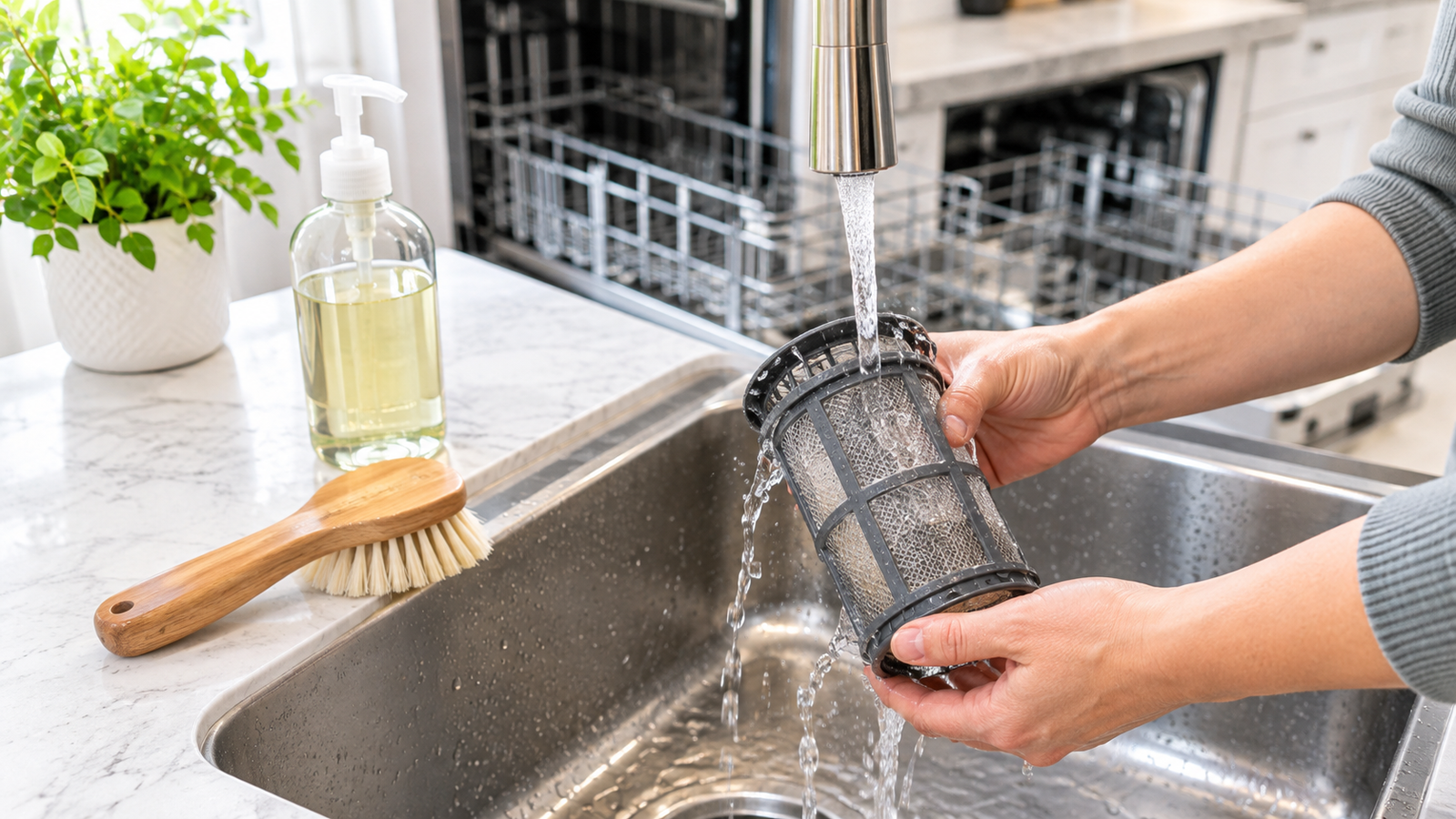
Hold each component under warm running water and flush from both sides. Separate the parts if they come apart, because debris hides at the joints. Rinse until the water runs completely clear through the mesh.
Step 7: Scrub Gently
For grease film or stubborn bits, use a soft brush or old toothbrush with a little mild dish soap. Work along the mesh lightly. A torn screen lets particles slip through, so avoid abrasive pads. Rinse off all soap afterward.
Step 8: Inspect for Damage
Hold the mesh up to a light. Check for leftover food, white chalky mineral deposits, tears, holes, warped mesh, or cracked locking tabs. If the filter is damaged, order a replacement for your exact model number.
Step 9: Reinstall the Filter
Wipe the sump area with a cloth first to ensure no debris remains. Reassemble the parts in the correct order, set the filter into its seat, and turn it to lock using the arrows on the part. A properly locked filter will sit flush and should not wobble.
Step 10: Test the Dishwasher
Put the lower rack back and run a short or normal cycle. Listen for rattling, check that water drains fully, and open the door afterward to confirm there is no odor or standing water.
How to Clean Different Dishwasher Brand Filters
The core steps remain the same, but the hardware changes. Use this guide to know what to expect, then confirm with your specific model’s manual.
How to Clean a Whirlpool Dishwasher Filter
If you are searching for how to clean a Whirlpool dishwasher filter, start by confirming you have a removable one. Whirlpool’s product help describes a triple filter system at the bottom center of the tub, made of an upper filter assembly and a lower filter.
- Removal: Grasp the lower filter, lift slightly, and pull it forward. For the upper assembly, give it a quarter turn to unlock and lift. (Follow the specific arrows on your model, as turn direction varies).
- Cleaning: Separate the upper assembly from the lower plate. Rinse under running water. Whirlpool explicitly warns not to use wire brushes or scouring pads, as they damage the filters.
- Reinstallation: Lock the upper assembly securely. Whirlpool states the dishwasher should never run without the filters properly installed. (Note: Some older Whirlpool models use a self-cleaning grinder system with no removable filter).
How to Clean a Samsung Dishwasher Filter
Samsung’s support pages describe a filtering system with a main filter, a coarse filter, and a fine filter.
- Removal: Turn the filter assembly counterclockwise to unlock, lift it out, and detach the coarse and fine filters.
- Cleaning: Rinse both under running water or use a soft brush. Samsung suggests wearing protective gloves when checking the sump.
- Reinstallation: Put the fine filter back first, then the coarse and main parts. Press down and turn clockwise to lock. Samsung specifically warns that installing the fine filter upside down can cause drainage errors or overflow problems.
How to Clean a Bosch Dishwasher Filter
Bosch filters commonly sit under the lower rack.
- Removal: Unscrew the filter cylinder at the base of the tub (usually a quarter turn on the handle) and lift the unit out.
- Cleaning: Clean the pieces under running tap water, using a small brush gently on the inside. Avoid anything abrasive.
- Reinstallation: Put the flat microfilter plate back first so it sits in its guides. Then reassemble the cylinder and twist until the arrows line up and it locks. (Note: Some Bosch US manuals describe the system as largely self-cleaning, requiring only occasional inspection).
How to Clean an LG Dishwasher Filter
LG’s US help library advises pulling out the lower basket to access the filter.
- Removal: Turn the filter counterclockwise and lift it. On many models, the inner filter and the stainless steel mesh come out as one piece.
- Cleaning: Separate them, empty large debris, and wash under running water with a soft brush or sponge. LG warns against steel wool, noting the stainless filter has sharp edges.
- Reinstallation: Reassemble in reverse order, turning until it clicks. Improper installation prevents the filter from collecting debris and lowers wash performance.
How to Clean a Frigidaire Dishwasher Filter
Frigidaire’s owner support describes a glass trap and filter system with a cylinder fine filter and a coarse filter.
- Removal: Rotate the cylinder fine filter counterclockwise and lift it out. Then, take the coarse filter out of the bottom of the tub.
- Cleaning: Flush both under running water. Frigidaire notes that a sponge or bottle brush may help remove stuck residue.
- Reinstallation: Press the fine filter down and rotate it clockwise until the arrows align, listening for a click if your model has one.
Can You Clean a Dishwasher Filter With Vinegar and Baking Soda?
You can use vinegar and baking soda around a dishwasher, but neither replaces rinsing and brushing the removable filter by hand. Think of the filter and the tub as two separate jobs.
- Cleaning the filter itself is a mechanical job. Removing food from the mesh takes running water and a soft brush. If you want to loosen mineral scale on a stubborn filter, a short soak in diluted white vinegar is a common home approach (Samsung’s support pages even mention soaking removable parts in distilled white vinegar for a deep clean). However, keep soaks short, rinse well, and check your manual first, as prolonged acid exposure can harm rubber seals.
- Cleaning the tub is where vinegar earns its reputation. Both Samsung and LG describe placing distilled white vinegar in a dishwasher-safe cup on the lower rack and running a hot cycle. Do this after the filter is already cleaned and reinstalled.
- Baking soda can help freshen the tub and lift light film, but it will not dissolve a clogged filter or remove trapped food.
- Warning: Do not mix vinegar and baking soda as a filter cleaner. They react and neutralize each other, weakening both. Furthermore, never combine vinegar with bleach, as this releases toxic chlorine gas. Samsung also advises against using bleach in dishwashers with stainless steel interiors.
How to Clean a Dishwasher Filter Without Removing It
You can only clean part of a filter without removing it, and that is rarely enough. Reaching into the tub to scoop out visible food helps, but it does not clear the mesh pores or the sump beneath the filter.
If your dishwasher has a removable filter, take it out. The mesh and joints hide grease and fine particles that a wipe will not reach.
If your dishwasher has a non-removable or self-cleaning filter, do this instead:
- Remove loose debris you can see in the tub floor and around the drain opening by hand or with a cloth.
- Check the lower spray arm holes for clogs and clear them with a toothpick.
- Run a dishwasher cleaning cycle or a vinegar cycle if your manual allows it.
- Scrape plates thoroughly before loading to reduce what reaches the drain.
Do not pry open or force apart a sealed assembly. If the dishwasher still drains slowly or smells after this, a technician should access the parts.
How Often Should You Clean a Dishwasher Filter?
There is no single interval that fits every machine. Manufacturers tie it to how many loads you run and how clean your dishes are when loaded.
| Maintenance Task | When to Perform It | What to Check |
|---|---|---|
| Look at the filter | Every couple of weeks, or any time dishes come out gritty. | Visible food, grease film, blocked mesh. |
| Full filter cleaning | Monthly for most manual-clean models; more often with heavy use. | Both coarse and fine parts rinsed; sump area clear. |
| Inspect for damage | During each cleaning. | Tears, cracks, warped frames, worn locking tabs. |
| Check after broken glass | Immediately. | Filter, glass trap, and sump for fragments. |
| Tub cleaning cycle | As directed by the manufacturer (usually every 1-3 months). | Odor and film on the tub walls. |
How long do dishwasher filters last?
There is no set expiration date. Treat the filter as a part you inspect, not a part that expires. Replace it only when the mesh is torn, the frame is cracked, the locking parts are worn, or the manufacturer explicitly recommends it. Always buy a replacement matched to your exact model number.
Frequently Asked Questions (PAA)
What happens if you never clean your dishwasher filter?
Food builds up gradually. You will likely notice foul odors from decaying food, gritty or cloudy dishes as particles recirculate, reduced cleaning performance, slow draining, and potentially a louder machine if debris works its way toward the pump.
Can I run my dishwasher with no filter?
No. If your model has a removable filter, do not run it with the filter missing or loose. Whirlpool and other manufacturers explicitly state that operating without properly installed filters can cause severe damage to the drain pump.
How do you clean a dishwasher (overall)?
Start with the filter, since that is where most food collects. Then, clear the spray arm holes, wipe the door gasket and edges, and run a manufacturer-approved cleaning cycle or a vinegar cycle to refresh the tub.
What are 8 things you should avoid putting in the dishwasher?
To keep your filter clean and your machine running smoothly, never put these in the dishwasher: 1) Wooden cutting boards/utensils, 2) Cast iron cookware, 3) Delicate crystal or hand-painted ceramics, 4) Non-dishwasher-safe plastics, 5) Sharp chef’s knives (dulls the blade), 6) Aluminum foil, 7) Insulated travel mugs (ruins the vacuum seal), and 8) Items with adhesive labels.
Why should you run your dishwasher every night (or regularly)?
Running your dishwasher regularly prevents food from drying and hardening on the filter and interior walls. Letting dirty dishes sit for days makes the filter’s job much harder and invites odors. Most households only need to run it once a day to maximize water and energy efficiency.
What is the disadvantage of a dishwasher?
The main disadvantage is its reliance on proper user maintenance. Unlike handwashing, neglecting the filter, using the wrong detergents, or overloading the racks can lead to poor cleaning results, odors, and costly mechanical failures.
Can baking soda clean a dishwasher?
It can help freshen the tub and lift light residue when sprinkled on the bottom and run through a short cycle, but it will not clear a clogged filter. Rinse and brush the removable filter by hand.
Conclusion
A clean filter is one of the simplest, most effective ways to get better results from a dishwasher you already own. Remove it, rinse it, brush it gently, check it for damage, and lock it back in correctly. Do this on the schedule your manual recommends, and sooner if dishes come out gritty or the tub smells.
Because Whirlpool, Samsung, Bosch, LG, and Frigidaire each build their filters differently, keep your owner’s manual handy for the exact removal motion and cleaning interval. If you no longer have the manual, search the manufacturer’s support site using your model number, which is usually printed on the door edge or inside the tub.