
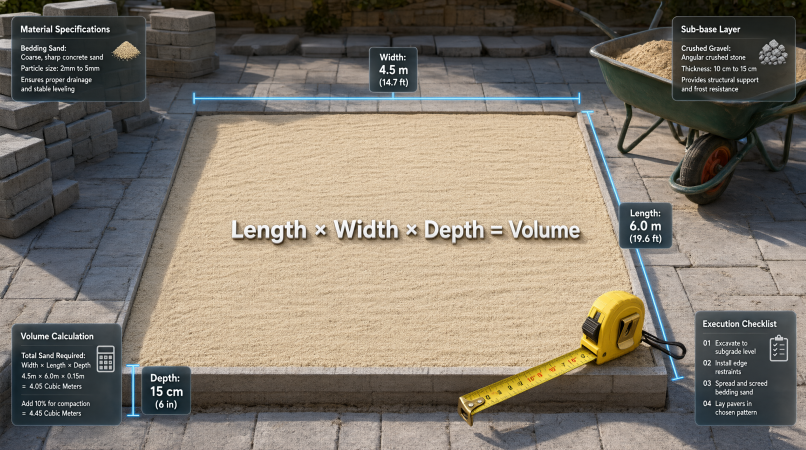
Figuring out how much sand you need for a project shouldn’t feel like solving a math puzzle. Whether you’re laying pavers for a new patio, filling a sandbox for the kids, or prepping a pool base, getting the sand quantity right saves you time, money, and a lot of headaches.
This guide walks you through everything you need to know about calculating sand — from the basic formula to handling circles, converting between cubic yards and tons, and figuring out how many bags to buy. We’ll also cover specific scenarios like paver sand, polymeric sand, and play sand so you can tackle your project with confidence.
What You Need to Know Before You Start
Every sand calculation boils down to three measurements and one choice:
- Length and width of your area (in feet)
- Depth of the sand layer (usually in inches)
- Output unit you want: cubic feet, cubic yards, cubic meters, tons, or bags
- Sand condition: dry, damp, or wet (this matters if you need weight)
The biggest mistake people make? Mixing units. If your depth is in inches and your length is in feet, you’ve got to convert before multiplying. Divide inches by 12 to get feet, or use the shortcut formula below that handles this for you.
Keep in mind: the number you get is the theoretical volume. It’s what fills the space perfectly. In the real world, you’ll likely need a bit more to account for uneven ground, settling, and handling loss. We’ll cover how much extra to add later.
The Sand Calculator Formula for Rectangular Areas
Here’s the straightforward math:
Variables:
- L = length in feet
- W = width in feet
- D = depth in inches
Cubic feet = L × W × (D 12)
Cubic yards = L × W × (D ÷ 12) ÷ 27
Shortcut: Cubic yards = (L × W) × D 324
Why does the shortcut work? Because 12 × 27 = 324. It’s a handy way to skip steps when you already know your square footage. Just make sure your area is in square feet and your depth is in inches.
Example: Rectangular Sand Bed
Let’s say you’re working on a 10 ft × 10 ft area and need 2 inches of sand.
- Area: 10 × 10 = 100 sq ft
- Cubic feet: 100 × 2 ÷ 12 = 16.67 cu ft
- Cubic yards: 16.67 ÷ 27 = 0.62 cu yd
- Shortcut check: 100 × 2 ÷ 324 = 0.617, which rounds to 0.62 cu yd
That’s your theoretical volume. Now let’s figure out what that means in tons and bags.
How to Calculate Sand for a Circular Area
Round sandboxes, circular garden beds, and pool bases need a different approach. You’ll use the area of a circle.
Area = π × r² (where π ≈ 3.1416 and radius r is half the diameter)
Cubic feet = π × r² × Depth in feet
Cubic yards = Cubic feet ÷ 27
Example: Circular Area
Say you’ve got a 20 ft diameter circle and need 2 inches of sand.
- Radius: 20 ÷ 2 = 10 ft
- Depth in feet: 2 ÷ 12 = 0.1667 ft
- Area: 3.1416 × 10² = 314.16 sq ft
- Cubic feet: 314.16 × 0.1667 = 52.36 cu ft
- Cubic yards: 52.36 ÷ 27 = 1.94 cu yd
- Shortcut check: 314.16 × 2 ÷ 324 = 1.94 cu yd
Heads up: A common mistake is using the diameter instead of the radius. That’ll give you an answer four times too large. Always halve the diameter first.
Also, remember that the right sand depth for a pool or any circular installation depends on the manufacturer’s instructions. Not every pool type needs a sand layer, so check your specific product guidelines.
Sand Volume in Cubic Feet, Cubic Yards, and Cubic Meters
Understanding these units helps you communicate with suppliers and compare prices.
A cubic yard is a cube 3 feet on each side, holding 27 cubic feet. A cubic meter is the metric equivalent, equal to about 1.308 cubic yards.
For metric measurements, convert everything to meters first:
Cubic meters = Length (m) × Width (m) × Depth (m)
Example: 3 m × 2 m × 0.05 m = 0.30 m³, which is about 0.39 cubic yards.
Quick Conversion Table
| Convert | Multiply by |
|---|---|
| Cubic feet to cubic yards | 0.037037 (divide by 27) |
| Cubic yards to cubic feet | 27 |
| Cubic yards to cubic meters | 0.7646 |
| Cubic meters to cubic yards | 1.308 |
| Cubic meters to cubic feet | 35.31 |
How Much Area Does One Cubic Yard of Sand Cover?
Here’s a handy formula: Coverage in square feet = 324 ÷ depth in inches
This assumes a flat surface with no waste, compaction, or uneven ground. In reality, you’ll probably need a bit more.
| Depth | Area covered by 1 cubic yard |
|---|---|
| 1 inch | 324 sq ft |
| 2 inches | 162 sq ft |
| 3 inches | 108 sq ft |
| 4 inches | 81 sq ft |
| 6 inches | 54 sq ft |
Example Sand Quantities for Common Projects
These are illustrative examples. Always use the depth your project or product instructions specify.
| Area | Depth | Cubic feet | Cubic yards |
|---|---|---|---|
| 8 ft × 10 ft (80 sq ft) | 1 in | 6.67 | 0.25 |
| 10 ft × 10 ft (100 sq ft) | 2 in | 16.67 | 0.62 |
| 12 ft × 12 ft (144 sq ft) | 1 in | 12.00 | 0.44 |
| 12 ft × 16 ft (192 sq ft) | 2 in | 32.00 | 1.19 |
| 20 ft × 30 ft (600 sq ft) | 4 in | 200.00 | 7.41 |
How Many Tons of Sand Do You Need?
Cubic yards measure volume. Tons measure weight. To convert between them, you need the sand’s bulk density.
Weight = Volume × Bulk density
US short tons = Cubic yards × Pounds per cubic yard ÷ 2,000
Metric tonnes = Cubic meters × Density in kg/m³ ÷ 1,000
A US short ton is 2,000 pounds. A metric tonne is 1,000 kilograms (about 2,205 pounds). They’re not interchangeable, so make sure you’re using the right one for your supplier.
Density Assumptions
Sand doesn’t have a single universal density. It changes with grain size, mineral content, moisture, and how tightly it’s packed. For this guide, we’re using typical figures from the Engineering ToolBox ditch-filling materials table:
- Dry sand: about 100 lb/ft³ (1,600 kg/m³)
- Damp sand: about 115 lb/ft³
- Wet sand: about 120 lb/ft³
These are assumptions. Your supplier’s stated weight per yard or per ton for your actual product is always better for ordering.
| Condition | Density | Pounds per cubic yard | Short tons per cubic yard | Cubic yards per short ton |
|---|---|---|---|---|
| Dry (assumed) | 100 lb/ft³ | 2,700 | 1.35 | 0.74 |
| Damp (assumed) | 115 lb/ft³ | 3,105 | 1.55 | 0.64 |
| Wet (assumed) | 120 lb/ft³ | 3,240 | 1.62 | 0.62 |
Using the dry assumption, our 10 ft × 10 ft example (16.67 cu ft) weighs about 16.67 × 100 = 1,667 lb, or roughly 0.83 short tons.
Common Questions About Tons and Yards
Is 1 yard of sand 1 ton?
No. Under the assumptions above, one cubic yard of sand weighs about 1.35 to 1.62 short tons, depending on moisture. A yard and a ton measure different things, so they’re never equal in general.
How many tons is 1 yard of sand?
About 1.35 short tons for dry sand at 100 lb/ft³, and more when the sand is damp or wet.
What is 5 tons in yards?
It depends on density. At the dry assumption of 2,700 lb per cubic yard, 5 short tons is 10,000 lb ÷ 2,700 = about 3.70 cubic yards. At the damp assumption it’s about 3.22 cubic yards, and at the wet assumption about 3.09 cubic yards.
What is 1 ton of sand?
One ton of sand is 2,000 pounds of sand (a US short ton). Under the dry assumption it fills about 0.74 cubic yards, or about 20 cubic feet. In metric terms, 1 tonne of dry sand at 1,600 kg/m³ fills about 0.625 cubic meters.
How many yards is 1 ton of soil?
Soil and sand have different densities, so you can’t use sand’s figure for soil. Soil type and moisture change the answer a lot, so ask the supplier for the weight per cubic yard of the soil you’re buying.
What Volume Is 20 kg of Sand?
Weight alone doesn’t give you volume. You need density:
Volume (m³) = Mass (kg) ÷ Density (kg/m³)
With the assumed dry density of 1,600 kg/m³: 20 ÷ 1,600 = 0.0125 m³, which is 12.5 liters, or about 0.44 cubic feet.
With an assumed damp density of 1,850 kg/m³: 20 ÷ 1,850 = 0.0108 m³, or about 10.8 liters.
A 20 kg bag doesn’t have a fixed volume because the volume changes with moisture and packing.
Sand Calculator for Bags
Bags required = Required volume ÷ Volume per bag, rounded up to a whole bag
The units must match. If the bag yield is in cubic feet, use project volume in cubic feet. If the bag yield is in liters, convert the project volume to liters first.
Example: Bags for the 10 ft × 10 ft Bed
- Required volume: 16.67 cu ft (from our earlier example)
- Assumed yield: 0.5 cu ft per bag
- Bags: 16.67 ÷ 0.5 = 33.33
- Round up: 34 bags
Important: A bag’s weight rating doesn’t guarantee its volume. A 50 lb bag is often sold as roughly 0.5 cubic feet, but yields differ by product and brand, so read the label. At 0.5 cu ft per bag, one cubic yard equals 54 bags.
Adding an Allowance
It makes sense to add extra when the ground is uneven or you’ll lose some material during handling. Apply the allowance once to the final volume:
Adjusted quantity = Theoretical quantity × (1 + Allowance % ÷ 100)
A 10% allowance means multiplying by 1.10, which turns 0.62 cubic yards into about 0.68. Choose an allowance that fits your application and supplier guidance. Don’t stack separate waste, settling, and moisture factors without a reason for each.
How to Calculate Paver Sand and Polymeric Sand
These are two different materials with two different calculations. Mixing them up is a common mistake that can cost you time and money.
Bedding Sand (Under the Pavers)
Bedding sand is the leveling layer between the compacted base and the pavers. Industry guidance often specifies washed, well-graded concrete sand meeting ASTM C33. The Interlocking Concrete Pavement Institute (ICPI) lists a bedding layer thickness of 1 inch in its construction tolerance guide, and project specifications or the paver manufacturer may call for something different. Pine Hall Brick’s technical bulletin notes that ASTM C144 mason sand is not suitable for bedding.
Calculate it as a flat layer using the rectangular formula.
Example: A 12 ft × 16 ft patio (192 sq ft) with a 1-inch bedding layer.
- Cubic feet: 192 × 1 ÷ 12 = 16.00 cu ft
- Cubic yards: 16 ÷ 27 = 0.59 cu yd
- Bags at 0.5 cu ft each: 16 ÷ 0.5 = 32 bags
Remember to include the full area under the pavers and edge restraints, and check the layer depth against your paver system’s instructions.
Polymeric Sand (Between the Pavers)
Polymeric sand fills the narrow joints between pavers and contains binders that harden when activated with water. Its quantity depends on paver size, joint width, joint depth, and the specific product’s formulation, so you can’t estimate it by multiplying patio area by a layer depth.
Use the coverage chart or calculator on the manufacturer’s bag or website. Because coverage figures are product-specific, borrowing numbers from a different brand can leave you short.
Quick distinction: Bedding sand goes under the pavers and is calculated as a layer. Polymeric sand goes between the pavers and is calculated from joint size and manufacturer coverage.
If you’re also estimating the crushed stone base under the sand, you’ll need to calculate that separately.
Play Sand and Pool Sand Calculations
Play Sand
For a sandbox, measure the inside length, width, and the depth you want, then use the rectangular formula.
Example: A 4 ft × 4 ft sandbox filled 6 inches deep.
- Cubic feet: 4 × 4 × 0.5 = 8 cu ft
- Cubic yards: 8 ÷ 27 = 0.30 cu yd
- Bags at 0.5 cu ft each: 8 ÷ 0.5 = 16 bags
Check the product label for suitability and the bag’s stated yield. Not all sand is safe for play areas, so look for sand specifically labeled as play sand.
Pool Bases
For a rectangular pool base, use length × width × depth. For a round one, use the circle formula above. The right depth, and whether sand belongs under the pool at all, depends on the pool type and manufacturer’s installation instructions, so follow those rather than a general rule.
Common Sand Calculation Mistakes
Here are the pitfalls to avoid:
- Not converting inches to feet. A 2-inch depth is 0.1667 ft, not 2.
- Skipping the divide-by-27 step when converting cubic feet to cubic yards.
- Treating 1 cubic yard as 1 ton. They measure different things.
- Using one density for every sand. Moisture and grain type change the weight.
- Counting bags by weight alone. Use the bag’s stated volume.
- Confusing bedding sand with polymeric sand. They’re different products with different estimating methods.
- Using the rectangle formula for a circle, or the diameter in place of the radius.
- Adding an arbitrary percentage without a reason tied to your project.
- Treating the theoretical volume as a guaranteed delivery quantity. Confirm the order with your supplier.
Frequently Asked Questions
How do you calculate sand?
Multiply length × width × depth (all in the same unit) to get volume. For feet and inches, use cubic yards = square feet × depth in inches ÷ 324.
How much sand is needed?
It depends on the area and depth. A 10 ft × 10 ft area at 2 inches deep needs about 0.62 cubic yards, before any allowance.
How many bags of sand do I need?
Divide the project volume by the volume printed on the bag, then round up. For 16.67 cubic feet and 0.5 cubic feet per bag, that’s 34 bags.
How do you calculate sand in cubic meters?
Multiply length, width, and depth in meters. For example, 3 m × 2 m × 0.05 m = 0.30 m³.
How do you calculate sand for a circle?
Use π × radius² × depth, with depth in feet. A 20 ft diameter circle at 2 inches deep needs about 1.94 cubic yards.
How do you calculate sand for pavers?
Treat bedding sand as a flat layer (area × layer depth) and use your paver system’s specified depth. Estimate polymeric sand separately from the manufacturer’s coverage chart.
How much play sand do I need?
Multiply the sandbox’s inside length, width, and fill depth. A 4 ft × 4 ft box filled 6 inches deep needs 8 cubic feet, or 16 half-cubic-foot bags.
How do you calculate polymeric sand?
Use the manufacturer’s coverage information, which accounts for paver size and joint width and depth. Don’t use a layer-depth formula.
Wrapping It Up
The core of any sand calculation is simple: area times depth gives you volume, and conversion factors turn that volume into cubic yards, cubic meters, tons, or bags. The step that most often goes wrong is the move from volume to weight or bag count, which depends on the density or bag yield of the actual product.
Measure carefully, state your assumptions, and confirm weight and yield with your supplier before ordering. A little extra planning upfront saves you from running short mid-project or paying for sand you don’t need.
Whether you’re tackling a small sandbox or a large patio, having the right amount of sand makes all the difference. Use this guide as your reference, and you’ll be ready to get started.