
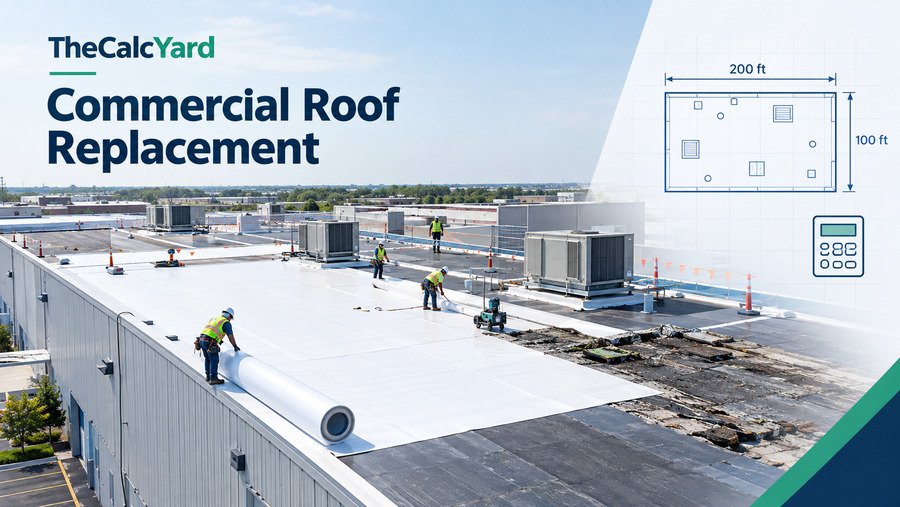
A full commercial roof replacement in the U.S. typically runs about $5 to $17 per square foot installed. Where a project lands depends mostly on the roofing system and whether new insulation is required. One consultant’s national estimates put commercial replacement from about $5 per square foot for ballasted EPDM with no insulation to about $17 for 2-ply modified bitumen with enough insulation for R-30. For a 10,000 sq ft roof, that is roughly $50,000 to $170,000. Treat this as a planning range, not a quote. An on-site inspection is the only way to price hidden moisture, deck damage, and code upgrades.
(Note: Costs in high-cost markets such as NYC, San Francisco, or Boston can be 20% to 40% higher than these national averages.)
How Much Does Commercial Roof Replacement Cost?
Published guides disagree on the range because they define scope differently. HomeGuide places commercial flat roofs at $4 to $11 per square foot including labor and materials, while Thumbtack points to $5 to $14 per square foot installed. The consultant data above reaches $17 because it includes code-level insulation. Always ask what a price includes.
| Roof area | At $5/sq ft | At $10/sq ft | At $15/sq ft |
|---|---|---|---|
| 5,000 sq ft | $25,000 | $50,000 | $75,000 |
| 10,000 sq ft | $50,000 | $100,000 | $150,000 |
| 20,000 sq ft | $100,000 | $200,000 | $300,000 |
| 50,000 sq ft | $250,000 | $500,000 | $750,000 |
Why insulation changes the price so much
Most commercial low-slope roofs include insulation above the deck, and energy codes set a minimum R-value for it. Most U.S. climate zones require R-25 or R-30, and above-deck insulation costs about $0.75 to $1.50 per inch per square foot, with polyiso giving roughly R-5 to R-5.7 per inch. That is why two bids for the same membrane can differ by a wide margin, according to commercial roofing cost guides.
Note on Pricing Data: The table below reflects one consultant’s 2026 national averages and is provided for illustrative planning purposes only. While these figures include an estimated $1.50 per sq ft for tear-off and disposal, they are not local quotes. Actual costs vary significantly based on regional labor rates, material availability, specific building codes, and site conditions. Always obtain multiple localized, written bids for your specific project.
| System (60-mil unless noted) | Without new insulation | With R-30 insulation |
|---|---|---|
| Ballasted TPO | $4.55 | $10.85 |
| Mechanically attached TPO | $5.10 | $14.00 |
| Fully adhered TPO | $5.35 | $14.30 |
| Fully adhered EPDM | $5.60 | $14.55 |
| Fully adhered PVC | $6.10 | $15.00 |
| 2-ply SBS modified bitumen | $9.65 | $17.25 |
| Standing seam steel (basic coating) | $12.75 | not split out |
In those tables, R-30 adds roughly $6 to $9 per sq ft. The same source adjusts by about $1.25 per sq ft for each R-5 step up or down.
Other cost drivers
- Tear-off and disposal: typically $1 to $3 per square foot, more with multiple layers or wet materials.
- Labor vs materials: each is usually 40% to 60% of the total.
- Access: limited access, no crane or lift room, and tall buildings raise cost. Industry sources note this can add up to 15%.
- Permits: fees vary by city. One consultant cites roughly 0.5% to 2% of project value.
- Roof complexity: curbs, parapets, HVAC units, and drains add flashing labor that roof area alone does not capture.
- Deck and insulation repairs: found after demolition. If your building has a concrete deck or requires new concrete curbs, use the Concrete Calculator to price the material for the repairs.
What a complete estimate should include
- Membrane or panels, insulation, and cover boards
- Tear-off and disposal (if included)
- Flashing, edge metal, and penetrations
- Drains, scuppers, and any slope or tapered insulation
- Safety, protection of occupied areas, and permits
- Manufacturer warranty requirements
Some contractors price a base system and quote deck repair or drainage separately. Do not compare totals until the scopes match.
How to Calculate Commercial Roof Replacement Cost
Estimated cost = roof area × installed cost per sq ft + items excluded from that rate
Do not add tear-off, disposal, or insulation again if the rate already includes them.
Step 1: Measure the roof area
For a simple rectangle, area = length × width. A 100 ft by 200 ft roof is 20,000 sq ft. Measure multiple sections separately. Do not subtract rooftop equipment footprints, because curbs and flashing still need waterproofing.
Step 2: Adjust for slope
Flat roofs are measured as plan area. On a sloped roof, surface area is larger than the footprint. Multiply footprint by √(1 + (rise ÷ 12)²):
| Pitch | Multiplier |
|---|---|
| 1:12 | 1.004 |
| 2:12 | 1.014 |
| 3:12 | 1.031 |
| 4:12 | 1.054 |
| 6:12 | 1.118 |
A 20,000 sq ft footprint at 4:12 is about 21,082 sq ft of roof surface. Online roof pitch calculators can work out pitch, angle, rafter length, and roof area from rise and run, though they do not estimate replacement cost.
Step 3: Convert to roofing squares (optional)
Roofing squares = area ÷ 100. A 20,000 sq ft roof is 200 squares. One square (100 sq ft) costs $500 to $1,700 at $5 to $17 per sq ft.
Worked example (illustrative)
Take a 100 ft by 200 ft warehouse roof, 20,000 sq ft. Compare two scopes using the consultant averages above for 60-mil TPO.
| Item | Option A: new R-30 insulation | Option B: reuse dry insulation |
|---|---|---|
| Fully adhered TPO, incl. tear-off | $14.30/sq ft | not applicable |
| Mechanically attached TPO, no new insulation | not applicable | $5.10/sq ft |
| Base cost (× 20,000) | $286,000 | $102,000 |
| Allowance for hidden damage (assumed 5%) | $14,300 | $5,100 |
| Estimated total | $300,300 | $107,100 |
The $193,200 gap comes mostly from the insulation scope, not the membrane. Option B only works if testing shows the existing insulation is dry and code allows it. The 5% allowance is an assumption for illustration. An inspection should replace it.
Commercial Roofing Systems Compared
| System | Typical lifespan | Good fit | Watch for |
|---|---|---|---|
| TPO | 20 to 30 years | Reflective low-slope roofs | Seam quality, thickness, attachment |
| PVC | 15 to 30 years | Grease or chemical exposure | Cost, spec compatibility |
| EPDM | 10 to 30 years (sources differ) | Low-slope, cold climates | Seam and flashing detailing |
| Modified bitumen | 10 to 30 years | Roofs with foot traffic | Installation method, labor |
| Built-up roofing | 15 to 20+ years | Multi-layer redundancy | Weight, fewer installers |
| Standing seam metal | 40 to 60+ years | Sloped or large-span buildings | Higher upfront price, thermal movement |
Lifespan figures here follow GAF’s published ranges, which put TPO at 20 to 30 years, PVC at 15 to 30, and EPDM at 10 to 15. HomeGuide lists EPDM at 15 to 25 years, and other sources go higher, so treat any single number as a rough guide. Climate, drainage, installation quality, and maintenance matter as much as the material.
Commercial Flat Roof Replacement
“Flat” commercial roofs are low-slope roofs designed to drain through drains, scuppers, or tapered insulation. Persistent ponding stresses seams and flashing, so drainage should be reviewed as part of any replacement.
Tear-off, recover, or restoration
| Option | What it is | Published cost | Main limits |
|---|---|---|---|
| Tear-off | Remove existing layers, inspect the deck, install new system | Full replacement range above | Highest cost, most inspection value |
| Recover | New membrane over an existing roof, often with cover board | One guide cites $3 to $7/sq ft | Needs dry insulation, sound deck, and code and warranty approval |
| Restoration | Coating over a sound membrane | One guide cites $2 to $4/sq ft | Cannot fix wet insulation or failed seams |
Recover and restoration costs come from Roofs Wiki’s cost guide. A recover can also avoid new insulation requirements, but it is not always permitted or advisable under local code, existing roof condition, or manufacturer rules. Many codes also restrict recovering a roof that already has two layers or wet insulation, so confirm with the local building department.
How roofers check whether a recover is possible
Roofing professionals use core cuts to see the roof layers, materials, vapor barrier, and any moisture, and infrared scans to find hidden moisture. Ask for those results before accepting a repair or restoration proposal.
How Long Does Commercial Roof Replacement Take?
Many projects take several weeks on site. Published guides estimate two to eight weeks depending on size, system, and weather, plus lead time for permits and materials. For occupied buildings, ask how the contractor will phase tear-off so the building is watertight each night, schedule noisy work, and protect HVAC intakes.
When to Replace a Commercial Roof
Book an inspection if you see repeated leaks, open seams, cracked or blistered membrane, loose flashing, persistent ponding, wet insulation, or a sagging deck. GAF lists frequent leaks, interior water staining, and structural deck problems among the critical signs. It also recommends inspections twice a year.
A few leaks do not always mean replacement. Localized repair or restoration can make sense when the rest of the roof is sound. Replacement becomes more likely when moisture is widespread or repairs keep recurring.
Commercial Roofing Insurance Questions
Will a new roof reduce my insurance?
Maybe, but it is not guaranteed. Insurers weigh roof age, materials, wind and hail resistance, and location. Ask your agent before you finalize the specifications whether impact- or wind-rated features and installation records affect your premium.
Does commercial insurance cover roof leaks?
It depends on the policy. Sudden damage from a covered event, such as storm or hail damage, is treated differently from wear, age, or poor maintenance. Some commercial property policies pay for roof repairs or replacement on an Actual Cash Value (ACV) basis (the replacement cost minus depreciation), rather than full Replacement Cost Value (RCV). Check how your specific policy values the roof before filing a claim. After a leak, limit further damage safely, photograph everything, keep repair receipts, and notify the insurer promptly.
What should I avoid saying to an insurer?
Stick to documented facts. Avoid guessing at the cause, age, or prior condition, and do not downplay earlier damage. Read the policy and ask for written clarification on anything unclear.
The 25% Roofing Rule
The “25% rule” is a code provision, not a national law. In Florida, the Existing Building Code states that if more than 25% of a roof section is repaired, replaced, or recovered in any 12 months, the whole roof or roof section must be brought up to current code. Its exceptions matter: roofs built or repaired to the 2007 Florida Building Code or later may only need the affected portion brought to code. A roof “section” is defined in the code, and the threshold is calculated per section, as outlined in municipal code guides and loss prevention resources.
Other states and cities have different rules. Ask your local building department before relying on any percentage.
Choosing a Commercial Roof Replacement Company
No single contractor is best for every building. Evaluate on evidence:
- Experience: comparable commercial buildings and the same system you are considering.
- Credentials: the licensing your state or city requires, plus insurance (general liability and workers’ compensation).
- Manufacturer certification: whether the installer can issue the warranty you want.
- References and scope: contact owners of completed projects and demand a written scope covering tear-off, insulation, flashing, drainage, and deck repairs.
- Warranty: a manufacturer system warranty covers materials and system performance, while a contractor workmanship warranty covers installation errors. Read the exclusions, including ponding water, unauthorized repairs, and missed maintenance.
- Contract terms: payment schedule, change-order process for hidden damage, and protection of your operations.
By city
- Chicago: cold winters limit installation windows, so ask how scheduling, temporary waterproofing, and drainage are handled. Verify state and city licensing and permit rules directly with the issuing agencies.
- Miami: hurricane exposure and heavy rainfall drive the spec. Ask about wind-uplift design, product approvals required locally, and Florida licensing, and verify credentials through the state’s official lookup.
- Dallas: hail and heat are the main design factors. Because roofing licensing rules differ by state, verify what Texas and the city require, and focus on insurance, manufacturer certification, and references.
For “near me” searches, use the same checklist. Do not treat a search ranking or review count as proof of commercial roofing experience.
FAQs
What is the cost of a commercial flat roof? About $4 to $17 per sq ft depending on system and insulation. Single-ply roofs without new insulation sit at the low end, and code-level insulation or multi-ply bitumen sits at the high end.
How often does a commercial roof need to be replaced? Most last 20 to 30 years, but the range is roughly 10 to 60 depending on system, drainage, installation quality, and maintenance. Inspection findings should drive timing, not age alone.
What is commercial roofing called? Commercial roofing usually refers to low-slope or flat roofing systems such as single-ply membranes, built-up, and modified bitumen roofs, plus metal panel systems. Replacing one is often called reroofing.
How do I calculate the cost to replace a roof? Multiply measured roof area by the installed rate for your system, then add costs the rate excludes. Check that tear-off and insulation are not counted twice.
How much is 100 square feet of roof? It is one roofing square. At $5 to $17 per sq ft, that is $500 to $1,700.
What is the most expensive part of a commercial roof replacement? It varies, but labor and materials are each commonly 40% to 60% of the total, and code insulation can make up more than half of the cost per sq ft.
Is $30,000 too much for a roof? At $5 to $17 per sq ft, $30,000 covers roughly 1,765 to 6,000 sq ft. It is reasonable for a small roof and far too low for a typical warehouse.
What are the most common commercial roofing problems? Leaks, seam separation, flashing failure, ponding water, and membrane wear from UV and thermal cycling. Wet insulation is often hidden. GAF’s list of aging factors includes UV exposure, moisture absorption, and thermal cycling.
What is the weakest part of a roof? Seams, flashing, penetrations, edges, and drains, because that is where materials or geometry change.
How long does roof tar last? It depends on the product and exposure. Patching compounds are not equivalent to a complete roofing system.
What is the best month to replace a roof? It depends on local weather and the installation limits of the system. Off-season booking can reduce labor rates, though late winter and early spring carry weather-delay risk. Do not delay urgent repairs to wait for a season.
How long can you go without replacing a roof? There is no safe timeline. Once leaks, wet insulation, or deck damage appear, delay raises the risk to equipment, inventory, and the structure.
What permits do I need for commercial roof replacement? Most cities require a building permit for a commercial roof replacement, especially if you are changing the insulation R-value or doing a full tear-off. Your contractor usually pulls this permit, but as the property owner, you are ultimately responsible for ensuring it is secured before work begins.
Can I replace my commercial roof in winter? Yes, but with caveats. Cold weather limits the installation of certain adhesives and membranes. Contractors may need to use cold-weather specific materials or heat-welding methods. Off-season booking can sometimes reduce labor rates, though weather delays are more common.
How do I finance a commercial roof replacement? Common options include commercial property loans, SBA 504 loans, manufacturer financing programs, or a capital expenditure (CapEx) reserve. Some contractors also offer leasing options that allow you to pay for the roof over time using the energy savings or monthly cash flow.
Bottom Line
Budget commercial roof replacement at roughly $5 to $17 per square foot. The roofing system sets the base price, and code-required insulation can add $6 to $9 per sq ft on top. Measure the roof, adjust for slope, and compare bids only after scope, insulation, tear-off, and warranty match. Get a core-cut and moisture inspection before choosing between tear-off, recover, and restoration, and confirm local code limits such as Florida’s 25% rule with your building department.
Ready to start your project? Contact a licensed commercial roofing contractor in your area today to schedule a core-cut inspection and get a detailed, localized estimate. Don’t forget to use TheCalcYard to measure your materials and calculate your costs before you sign a contract.